



Build Your Custom Market Intelligence Report
Customize Your ReportIndia Mobile EV Charging Market Key Takeaways
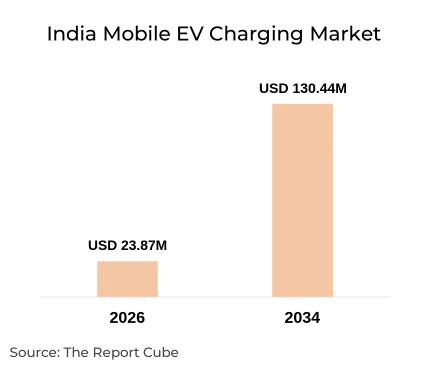
- India Mobile EV Charging Market was valued at USD 23.87 million in 2026.
- Market is projected to reach USD 130.44 million by 2034, reflecting rapid growth.
- Industry is anticipated to expand at a robust 23.65% CAGR during 2026–2034.
- Grid-Powered charging dominates the power source segment across urban deployments.
- Fleet operators represent a high-value end-user segment driving bulk charging demand.
- North India leads regional revenue contribution through concentrated EV adoption.
- South India emerges as the fastest-growing region backed by government EV policy.
- AI-powered smart charging networks and renewable-integrated solutions are reshaping market dynamics.
- Key players include Mahindra Last Mile Mobility, Sun Mobility, ChargeZone, and Statiq.
India Mobile EV Charging Market Insights & Analysis
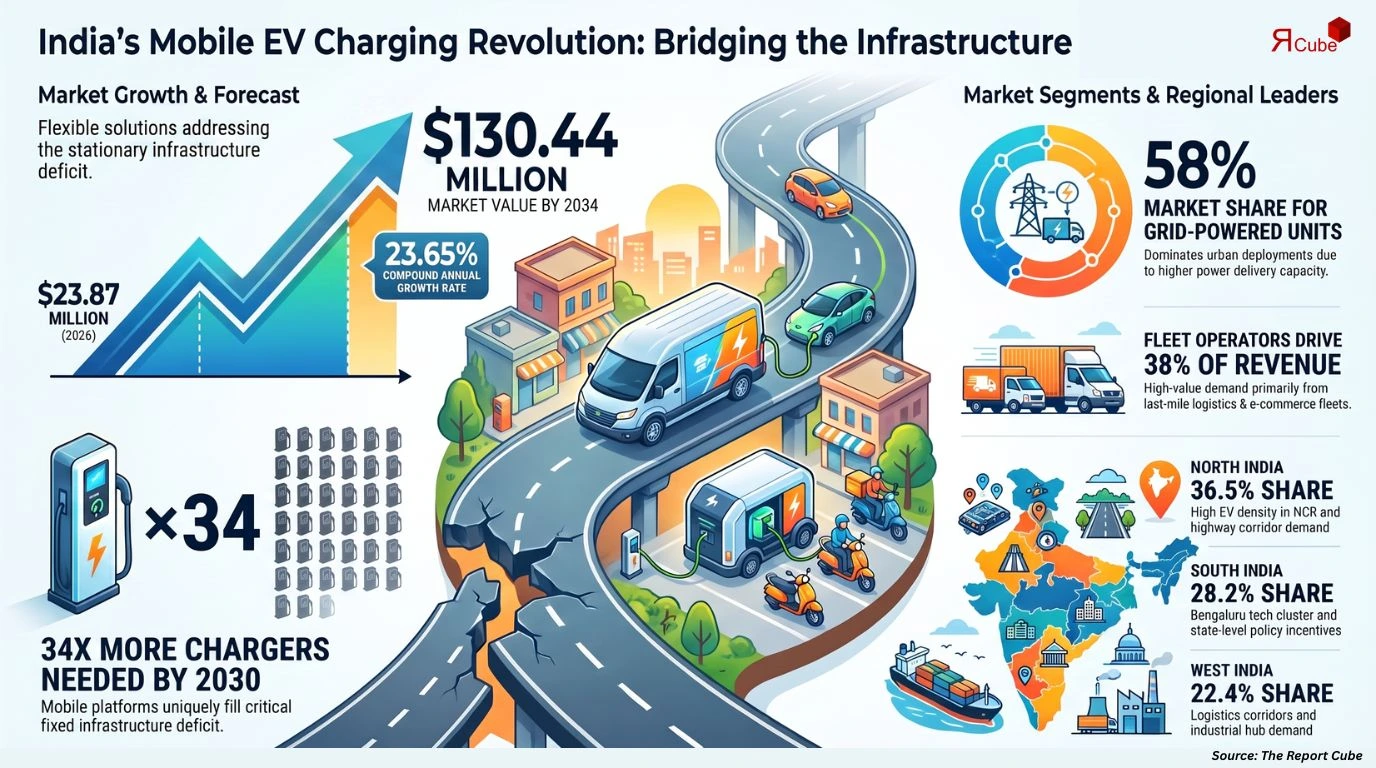
The India Mobile EV Charging Market is anticipated to register a 23.65% CAGR during 2026–2034. The market size was valued at USD 23.87 million in 2026 and is projected to reach USD 130.44 million by 2034. The sector is benefiting from a structural convergence of accelerating EV adoption, chronic fixed-infrastructure deficits, and evolving last-mile mobility demand patterns that make mobile and on-demand charging solutions commercially viable across urban, semi-urban, and highway corridors. India's public EV charging network grew from approximately 5,151 stations in December 2022 to over 29,000 by August 2025, yet analysts estimate the country requires 34 times more chargers by 2030, creating a critical infrastructure gap that mobile charging platforms are uniquely positioned to address.
Government investment continues reinforcing the market's long-term trajectory. The PM E-DRIVE scheme, notified in September 2024 with a ₹10,900 crore outlay, allocates ₹2,000 crore exclusively to public charging infrastructure across 88,500 sites, directly incentivizing operators and fleet-service providers to expand deployments. The India EV charging infrastructure expansion programs are also catalyzing private-sector participation, with leading operators like ChargeZone, Statiq, and ChargeMOD scaling interoperable networks. India recorded approximately 7.98 million EV units sold in 2025, its strongest annual performance, underpinning durable demand across all charging modalities including mobile solutions.
India Mobile EV Charging Market Dynamics
The India Mobile EV Charging Market continues gaining strategic significance as electric vehicle penetration accelerates across passenger, commercial, and three-wheeler segments. Persistent gaps in fixed charging infrastructure, growing fleet electrification mandates, and expanding app-based mobility ecosystems are prompting operators and municipalities to deploy flexible, mobile-first charging solutions that complement stationary networks. India's policy environment further reinforces commercial momentum through structured incentive frameworks and interoperability mandates.
|
Factor |
Type |
Specific Impact on Market |
Magnitude |
|---|---|---|---|
|
Fixed infrastructure deficit |
Driver |
Accelerates mobile charging deployments in underserved zones |
Very High |
|
Fleet electrification mandates |
Driver |
Increases bulk demand from last-mile logistics operators |
High |
|
PM E-DRIVE infrastructure funding |
Opportunity |
Enables CPO expansion and mobile fleet integration |
High |
|
Renewable energy integration |
Trend |
Supports solar-powered mobile charging unit deployment |
High |
|
Interoperability and UPI-style payment platforms |
Trend |
Improves end-user access and increases utilization rates |
Very High |
Key Market Driver: Fixed Infrastructure Gaps Accelerating Mobile Deployment
India's ratio of one public charger per 235 EVs on the road as of 2025 underlines a severe structural deficit that stationary infrastructure alone cannot resolve within the EV30@30 timeline. Mobile EV charging platforms - including on-demand truck-based charging units, battery-swapping networks, and portable charger dispatch services - fill this gap by serving underserved apartment complexes, corporate campuses, tier-2 cities, and highway segments where fixed installation is commercially unviable. Operators including Charzer and PlugNgo are scaling these use cases through asset-light deployment models and real-time app-based user routing integrated with fleet electrification solutions for last-mile logistics.
Major Industry Challenge: Grid Reliability and Power Quality Constraints
Mobile EV charging operations in tier-2 and tier-3 cities frequently encounter voltage fluctuation, inconsistent grid connectivity, and load-balancing challenges that impair charger performance and reduce session completion rates. Unlike fixed charging stations with dedicated grid interconnections, mobile units must operate across variable power environments, requiring robust onboard energy management systems. The absence of standardized grid-interface protocols for mobile charging equipment creates compliance complexity, while distribution companies in several states maintain inconsistent EV-specific tariff structures, increasing operational uncertainty for mobile charging service providers attempting to build commercially sustainable networks.
Emerging Trend Shaping Outlook: Renewable-Integrated Mobile Charging Networks
Solar-powered and battery-buffered mobile charging units are gaining traction across India as operators pursue energy cost optimization and sustainability compliance. Companies are deploying hybrid units combining onboard lithium battery storage with portable solar panels, enabling off-grid charging in rural districts, construction sites, and logistics hubs. The Ministry of New and Renewable Energy's expanded rooftop solar incentives under PM Surya Ghar are reducing the capital cost of solar integration in mobile charging units. This convergence of solar-integrated EV charging infrastructure market is expected to reshape the cost structure of mobile charging operations through 2034.
Need Specific Data, Let’s Customize the Report for You
Request CustomizationIndia Mobile EV Charging Market Segment-wise Analysis
The India Mobile EV Charging Market encompasses a diverse range of power delivery mechanisms and end-user categories, each reflecting distinct infrastructure maturity levels, commercial models, and adoption drivers. Segmentation by power source and end user reveals critical revenue concentration patterns and emerging white-space opportunities that incumbents and new entrants are actively targeting through differentiated deployment strategies.
By Power Source
- Grid-Powered
- Battery-Powered
- Renewable Energy-Powered
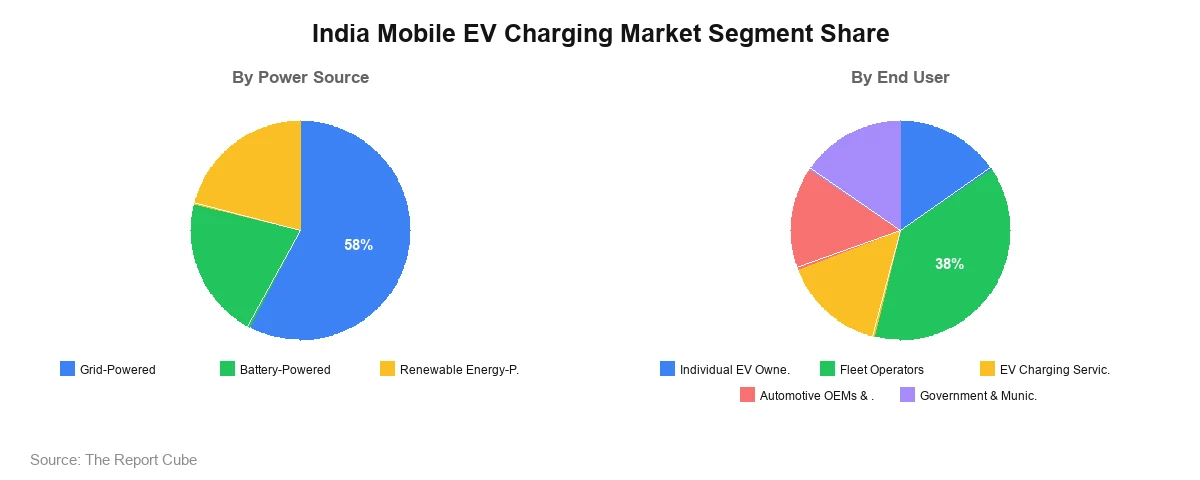
Grid-Powered mobile EV charging commands the dominant position in the power source segment, accounting for an estimated 58% market share in 2026. This dominance reflects the practical advantages of grid-connected mobile units in urban agglomerations - specifically, higher power delivery capacity, lower capital expenditure compared to onboard battery systems, and compatibility with India's expanding AC charging standards including Bharat AC-001 and Type-2 formats. Operators deploying grid-tethered mobile units at temporary events, construction sites, and residential complexes leverage existing distribution infrastructure, reducing per-session energy costs. ChargeZone and ChargeMOD have both incorporated grid-powered mobile deployments into their asset-light expansion strategies across metropolitan corridors.
Battery-Powered mobile charging solutions currently represent approximately 28% of the segment and are expanding rapidly, particularly in semi-urban and peri-urban zones where grid access remains unreliable. Sun Mobility's battery-swapping infrastructure, which enables commercial three-wheeler operators to exchange depleted packs in under five minutes, exemplifies the commercial viability of battery-centric mobile models. Renewable Energy-Powered units - integrating solar panels and wind-assist technologies - account for the remaining share but are projected to grow at the fastest rate through 2034, driven by falling photovoltaic module costs and MNRE incentives. These units are gaining traction with government and municipal operators seeking emission-free charging solutions for public transport fleets.
By End User
- Individual EV Owners
- Fleet Operators
- EV Charging Service Providers
- Automotive OEMs & Dealerships
- Government & Municipalities
Fleet Operators represent the highest-value end-user segment, contributing an estimated 38% of the market's 2026 revenue. India's rapid expansion of electric three-wheeler logistics fleets - driven by e-commerce fulfillment operators, ride-hailing platforms, and urban last-mile delivery companies - creates intensive, predictable charging demand that mobile and on-demand solutions can service more efficiently than fixed infrastructure. Mahindra Last Mile Mobility, which surpassed 3 lakh cumulative EV sales and recorded over 10,000 units sold in August 2025 alone, serves as both a fleet vehicle supplier and a demand anchor for fleet-oriented mobile charging operators. The company's Battery-as-a-Service program with Vidyut further illustrates how OEM-aligned service models are expanding fleet operator engagement with mobile charging ecosystems.
Individual EV Owners represent approximately 25% of end-user revenue, accessing mobile charging primarily through app-based on-demand dispatch services that deliver portable chargers to home or workplace locations. EV Charging Service Providers, including platform aggregators and white-label CPOs, contribute around 18% and serve as critical infrastructure intermediaries linking mobile charger assets to end users through unified platforms. Automotive OEMs and Dealerships - including Mahindra and emerging EV brands - are incorporating mobile charging as a value-added after-sales service, while Government and Municipalities are expanding procurement of mobile charging units for public bus fleets and municipal EV pools under PM E-DRIVE allocations, representing the segment with the highest projected growth rate through 2034.
Regional Projection of India Mobile EV Charging Market
The India Mobile EV Charging Market exhibits pronounced regional variation shaped by EV penetration rates, state-level policy incentives, grid reliability, urban density, and fleet electrification maturity. Each geographic zone presents distinct demand drivers and market entry dynamics for mobile charging operators and infrastructure investors.
|
Region |
Estimated Market Share |
Key Growth Factors |
Consumer Trends |
|---|---|---|---|
|
North India |
36.5% |
High EV density in NCR, state EV policies, highway corridor demand |
Strong app-based charging adoption |
|
South India |
28.2% |
Bengaluru tech cluster, TN and AP state incentives, OEM presence |
Rising solar-integrated mobile unit demand |
|
West India |
22.4% |
Mumbai logistics corridors, Maharashtra EV policy, industrial hubs |
Fleet-driven bulk charging subscriptions |
|
East India |
12.9% |
Expanding e-rickshaw fleets, government municipal EVs, low fixed infra |
Entry-level battery-powered mobile units |
- North India: North India leads the market with approximately 36.5% revenue share, driven by Delhi-NCR's dense EV registrations, Uttar Pradesh's aggressive EV deployment, and Statiq's 4,000 km Jammu-to-Madurai high-speed charging corridor launched with BMW India in October 2025. Cities including Delhi, Noida, and Chandigarh have witnessed significant EV fleet expansion tied to air quality mandates, creating concentrated mobile charging demand at apartment complexes and commercial parking zones.
- South India: South India is the fastest-growing region, with Bengaluru serving as a technology and logistics hub for EV charging innovation. ChargeZone's interoperable network expansion - surpassing 13,500 charging points through OCPI-based roaming partnerships - has disproportionately benefited the South India corridor. Tamil Nadu and Andhra Pradesh state EV policies incentivize fleet electrification, while electric two-wheeler charging demand in South India is accelerating the need for mobile solutions compatible with scooter-format connectors.
- West India: West India contributes approximately 22.4% of market revenue, with Maharashtra's logistics and industrial corridors generating strong fleet operator demand. The TATA.ev MegaCharger network deployed in Pune via ChargeZone and Statiq underlines the region's commercial attractiveness. Gujarat's manufacturing ecosystem and Maharashtra's electric bus procurement programs are additional demand catalysts for mobile and semi-mobile charging deployment.
- East India: East India currently holds approximately 12.9% market share, characterized by high e-rickshaw and electric cargo three-wheeler density in West Bengal, Bihar, and Odisha. Fixed charging infrastructure remains sparse in the region, making battery-powered mobile units and swapping solutions particularly relevant for commercial operators serving hyperlocal delivery and passenger transport segments.
India Mobile EV Charging Market: Recent Development (2025)
- Statiq and BMW India launched a 4,000 km high-speed EV charging corridor spanning Jammu to Madurai.
- ChargeZone crossed 13,500 charging points through OCPI-based interoperable roaming partnerships across India.
- ChargeMOD expanded mobile-friendly charging deployments targeting residential and corporate campus operators nationwide.
- Mahindra Last Mile Mobility surpassed three lakh cumulative EV sales, reinforcing fleet mobile charging demand.
India Mobile EV Charging Market Future Outlook (2034)
The India Mobile EV Charging Market is projected to expand at a 23.65% CAGR, reaching approximately USD 130.44 million by 2034. The market's long-term trajectory is anchored in India's EV30@30 target - 30% EV penetration in new vehicle sales by 2030 - which demands approximately 1.3 million public charging points, a 34x multiplication from current levels that mobile and semi-mobile solutions are structurally positioned to bridge. Investments in grid-edge energy storage, bidirectional charging (V2G), and AI-driven demand forecasting will progressively reduce the operational cost of mobile charging units, making commercial deployment viable beyond metros into tier-3 cities and rural highways.
Technological convergence will be the defining force through 2034, as mobile charging platforms integrate with the government's Unified Bharat e-Charge system - modeled on UPI's impact on digital payments - to offer single-interface discovery, authentication, and payment across all charging networks. The battery energy storage systems market in India will further enable mobile charging units with larger onboard capacities, reducing grid-tethering dependency. Renewable-powered mobile units equipped with AI-based energy dispatch algorithms will serve as distributed grid assets, unlocking revenue streams from demand-response programs and carbon credit markets. Automotive OEM partnerships, municipal procurement, and private equity inflows will collectively drive market maturation.
India Mobile EV Charging Market Report Coverage
|
Report Attribute |
Details |
|---|---|
|
Market Name |
India Mobile EV Charging Market |
|
Market Size (2026) |
USD 23.87 Million |
|
Market Size (2034) |
USD 130.44 Million |
|
Forecast Period |
2026–2034 |
|
CAGR |
23.65% |
|
Base Year |
2026 |
|
Historical Years |
2021–2025 |
|
Forecast Years |
2026–2034 |
|
Segments Covered |
By Power Source, By End User, By Application, By Vehicle Type |
|
Regions Covered |
North India, South India, West India, East India |
|
Key Companies |
Mahindra Last Mile Mobility, Sun Mobility, ChargeZone, Statiq, Earth, Battery Smart, ChargeMOD, PlugNgo, Charzer, Others |
|
Report Format |
PDF, Excel, PPT |
|
Customization |
Available as per client requirements |
Why Choose This Report?
- Comprehensive segmentation covering power source and end-user revenue splits.
- Granular regional analysis across North, South, West, and East India zones.
- Accurate market sizing validated against PM E-DRIVE policy investment frameworks.
- Detailed 2025 developments grounded in real company announcements and launches.
- Competitive profiling covering CPOs, OEM-aligned players, and battery-swap operators.
- Analysis of renewable-integrated and AI-driven mobile charging technology trends.
- Strategic insights supporting CPO investment, fleet electrification, and policy alignment.
- Forward-looking 2034 outlook covering V2G, Unified Bharat e-Charge, and grid-edge storage.
Table of Contents
- Introduction
- Objective of the Study
- Product Definition
- Market Segmentation
- Study Variables
- Research Methodology
- Secondary Data Points
- Companies Interviewed
- Primary Data Points
- Breakdown of Primary Interviews
- Secondary Data Points
- Executive Summary
- Market Dynamics
- Drivers
- Challenges
- Opportunity Assessment
- Recent Trends and Developments
- Policy and Regulatory Landscape
- India Mobile EV Charging Market Overview and Forecast Analysis (2021-2034)
- Market Size, By Value, By Growth Rate (CAGR/USD Millions)
- Demand – Supply Trends
- Market Share, By Charging Type
- AC Charging
- DC Fast Charging
- Market Share, By Vehicle Type
- Passenger Cars
- Commercial Vehicles
- Two-Wheelers
- Market Share, By Application
- Emergency Roadside Charging
- Fleet Charging
- Event & Temporary Charging
- Residential & Workplace Charging
- Remote & Off-Grid Charging
- Market Share, By Power Source
- Grid-Powered
- Battery-Powered
- Renewable Energy-Powered
- Market Share, By End User
- Individual EV Owners
- Fleet Operators
- EV Charging Service Providers
- Automotive OEMs & Dealerships
- Government & Municipalities
- Market Share, By Region
- North India
- South India
- East India
- West India
- Market Share, By Competitors
- Competition Characteristics
- Revenue Shares
- AC Charging India Mobile EV Charging Market Overview, 2021-2034F
- By Value (USD Million)
- By Vehicle Type – Market Size & Forecast 2021-2034, USD Million
- Passenger Cars
- Commercial Vehicles
- Two-Wheelers
- DC Fast Charging India Mobile EV Charging Market Overview, 2021-2034F
- By Value (USD Million)
- By Vehicle Type – Market Size & Forecast 2021-2034, USD Million
- Passenger Cars
- Commercial Vehicles
- Two-Wheelers
- Competitive Outlook (Company Profile – Partial List)
- Mahindra Last Mile Mobility
- Company Overview
- Business Segments
- Strategic Alliances/Partnerships
- Recent Developments
- Sun Mobility
- Company Overview
- Business Segments
- Strategic Alliances/Partnerships
- Recent Developments
- ChargeZone
- Company Overview
- Business Segments
- Strategic Alliances/Partnerships
- Recent Developments
- Statiq
- Company Overview
- Business Segments
- Strategic Alliances/Partnerships
- Recent Developments
- Earth
- Company Overview
- Business Segments
- Strategic Alliances/Partnerships
- Recent Developments
- Battery Smart
- Company Overview
- Business Segments
- Strategic Alliances/Partnerships
- Recent Developments
- ChargeMOD
- Company Overview
- Business Segments
- Strategic Alliances/Partnerships
- Recent Developments
- PlugNgo
- Company Overview
- Business Segments
- Strategic Alliances/Partnerships
- Recent Developments
- Charzer
- Company Overview
- Business Segments
- Strategic Alliances/Partnerships
- Recent Developments
- Others
- Mahindra Last Mile Mobility
- Contact Us & Disclaimer
Top Key Players & Market Share Outlook
- Mahindra Last Mile Mobility
- Sun Mobility
- ChargeZone
- Statiq
- Earth
- Battery Smart
- ChargeMOD
- PlugNgo
- Charzer
- Others
Frequently Asked Questions






