




Build Your Custom Market Intelligence Report
Customize Your ReportSouth Korea Ready-to-Eat Foods Market Key Highlights
By Product Type:
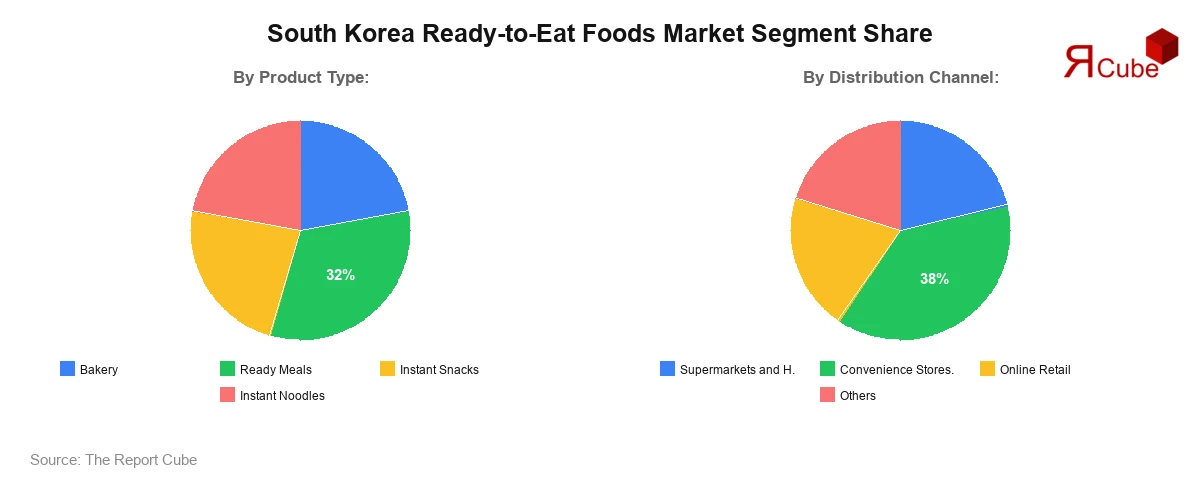
Ready meals represent the leading product segment in the South Korea Ready-to-Eat Foods Market, accounting for approximately 32% market share in 2025.
By Distribution Channel:
Convenience stores dominate distribution, contributing nearly 38% of total market revenue.
Regional Outlook:
The Capital Region leads the South Korea Ready-to-Eat Foods Market, accounting for approximately 44% of total market share.
South Korea Ready-to-Eat Foods Market Insights & Analysis
The South Korea Ready-to-Eat Foods Market is anticipated to register a CAGR of 7.50% during 2026-2034. The market size was valued at USD 7.5 billion in 2025 and is projected to reach USD 14.38 billion by 2034. This robust growth trajectory reflects structural changes in South Korea’s food consumption behavior, driven by urban lifestyles, time constraints, and a strong preference for convenience-oriented meal solutions.
South Korea’s high internet penetration, tech-savvy population, and dense urban living environment have accelerated demand for ready-to-eat foods across all age groups. Single-person households now account for over one-third of total households, significantly boosting demand for portion-controlled, shelf-stable, and easy-to-prepare food options. As a result, ready meals, instant noodles, and packaged snacks have transitioned from occasional consumption to daily dietary staples.
Moreover, the strong presence of domestic food conglomerates and continuous product innovation has enhanced product quality, nutritional value, and variety. Companies are increasingly integrating Korean flavors with global cuisines, strengthening consumer appeal. Combined with advanced cold-chain logistics and efficient retail distribution, these factors position the South Korea Ready-to-Eat Foods Market for sustained expansion throughout the forecast period.
South Korea Ready-to-Eat Foods Market Dynamics
Key Driver: Rising Single-Person Households and Time-Constrained Lifestyles
The rapid increase in single-person households is a central driver of the South Korea Ready-to-Eat Foods Market. With busy work schedules and long commuting hours, consumers increasingly prioritize meal convenience over traditional home cooking. Ready-to-eat foods offer a practical solution, providing balanced meals with minimal preparation time. This trend is particularly evident among working adults and students in metropolitan areas, where demand for instant noodles, chilled meals, and on-the-go snacks continues to rise. As these demographic shifts intensify, they directly reinforce sustained market demand.
Book your FREE 30-minute expert consultation today
Contact UsIndustry Trends: Premiumization and Health-Focused Product Innovation
Building on convenience-driven demand, manufacturers are now focusing on premiumization and health-oriented innovation. The South Korea Ready-to-Eat Foods Market is witnessing growing demand for low-sodium, high-protein, plant-based, and functional food options. Consumers are becoming more label-conscious, prompting companies to enhance ingredient transparency and nutritional value. This shift aligns with broader wellness trends, enabling ready-to-eat products to maintain relevance while addressing health concerns traditionally associated with processed foods.
Major Challenge: Nutritional Perception and Regulatory Scrutiny
Despite strong demand, nutritional concerns remain a challenge for the South Korea Ready-to-Eat Foods Market. High sodium content and preservatives in certain product categories have drawn regulatory attention and consumer scrutiny. While manufacturers are actively reformulating products, compliance with evolving food safety and labeling regulations can increase production costs. These challenges require continuous innovation and transparent communication to maintain consumer trust while sustaining growth.
Opportunity: Expansion of Online Retail and Smart Distribution Channels
The rapid growth of online grocery platforms presents a significant opportunity for the South Korea Ready-to-Eat Foods Market. Digital retail channels enable wider product reach, personalized promotions, and faster delivery, aligning well with consumer expectations. As smart logistics and AI-driven demand forecasting improve supply chain efficiency, manufacturers can better manage inventory and reduce food waste. This digital transformation is expected to unlock new growth avenues across both urban and secondary cities.
South Korea Ready-to-Eat Foods Market Recent Developments
- 2025: CJ CheilJedang launched premium plant-based ready meals targeting health-conscious urban consumers.
- 2025: Nongshim expanded frozen meal production capacity to meet rising domestic and export demand.
Government Initiatives & Policies
- Korean Food Industry Promotion Act: Supports innovation, food safety, and export competitiveness.
- Smart Food Logistics Initiative: Enhances cold-chain efficiency and digital food distribution systems.
South Korea Ready-to-Eat Foods Market Segment-wise Analysis
By Product Type:
- Bakery
- Ready Meals
- Instant Snacks
- Instant Noodles
Ready meals represent the leading product segment in the South Korea Ready-to-Eat Foods Market, accounting for approximately 32% market share in 2025. Strong demand for chilled and frozen meals reflects consumer preference for complete, nutritionally balanced dishes with minimal preparation. This dominance is further supported by continuous flavor innovation and premium offerings tailored to local tastes.
By Distribution Channel:
- Supermarkets and Hypermarkets
- Convenience Stores
- Online Retail
- Others
Convenience stores dominate distribution, contributing nearly 38% of total market revenue. Their dense presence across urban areas and 24/7 accessibility make them ideal for on-the-go consumption. However, online retail is the fastest-growing channel, driven by digital adoption and rapid delivery services, reinforcing the market’s long-term growth outlook.
Regional Projection of South Korea Ready-to-Eat Foods Industry
- Capital Region
- Central Region
- Honam Region
- Yeongnam Region
- Others
The Capital Region leads the South Korea Ready-to-Eat Foods Market, accounting for approximately 44% of total market share. High population density, greater purchasing power, and a strong presence of working professionals drive consistent demand for convenient food solutions. The region’s advanced retail infrastructure and rapid adoption of online grocery platforms further strengthen its leadership position, supporting continued dominance through 2034.
Need insights for a specific region within this market?
Request Regional DataWhy Choose This Report?
- Provides a comprehensive overview of the overall market analysis, encompassing key trends, consumer behavior analysis, and risk assessment to support strategic decision-making.
- Provides accurate, up-to-date insights into market size, segmentation, and emerging opportunities, helping to minimize risk & capitalizing on growth.
- Gives deep understanding of target audience preferences, investment habits, and communication channels for enhanced product development & marketing effectiveness.
- Delivers competitive analysis & benchmarking, uncovering the strengths & weaknesses of market competitors to guide strategies.
- Consolidate comprehensive market intelligence, reducing reasoning & streamlining research efforts.
- Facilitates customized market segmentation & risk mitigation strategies, fine-tuned to the business objectives.
- Aids in identifying both market challenges & untapped opportunities within the industry to drive long-term business growth.
- Provides valuable information based on actual customer data & search trends.
Table of Contents
- Introduction
- Objective of the Study
- Product and Category Definition
- Market Segmentation
- Study Variables
- Research Methodology
- Secondary Data Points
- Breakdown of Secondary Sources
- Primary Data Points
- Breakdown of Primary Interviews
- Secondary Data Points
- Executive Summary
- Market Dynamics
- Drivers
- Challenges
- Opportunity Assessment
- Recent Trends and Developments
- Regulatory and Policy Landscape
- South Korea Ready-to-Eat Foods Market Overview (2021-2034)
- Market Size, By Value (USD Billion)
- Market Share, By Product Type
- Bakery
- Bread
- Cakes & Pastries
- Others
- Ready Meals
- Chilled Meals
- Frozen Meals
- Canned Meals
- Breakfast Cereals
- Instant Snacks
- Savory Snacks
- Sweet Snacks
- Meat Product
- Instant Noodles
- Others
- Bakery
- Market Share, By Packaging Type
- Canned
- Frozen/Chilled
- Retort
- Market Share, By Meal Occasion
- Breakfast
- Lunch
- Dinner
- On-the-Go
- Market Share, By Distribution Channel
- Supermarkets and Hypermarkets
- Convenience Stores
- Online Retail
- Others
- Market Share, By Consumer Group
- Students
- Working Adults
- Families
- Seniors
- Market Share, By Region
- Capital
- Central
- Honam
- Yeongnam
- Others
- Market Share, By Company
- Revenue Shares
- Competitive Landscape
- Capital Region Ready-to-Eat Foods Market
- Market Size, By Value (USD Billion)
- Market Share, By Product Type
- Market Share, By Packaging Type
- Market Share, By Meal Occasion
- Market Share, By Distribution Channel
- Market Share, By Consumer Group
- Central Region Ready-to-Eat Foods Market
- Market Size, By Value (USD Billion)
- Market Share, By Product Type
- Market Share, By Packaging Type
- Market Share, By Meal Occasion
- Market Share, By Distribution Channel
- Market Share, By Consumer Group
- Honam Region Ready-to-Eat Foods Market
- Market Size, By Value (USD Billion)
- Market Share, By Product Type
- Market Share, By Packaging Type
- Market Share, By Meal Occasion
- Market Share, By Distribution Channel
- Market Share, By Consumer Group
- Yeongnam Region Ready-to-Eat Foods Market
- Market Size, By Value (USD Billion)
- Market Share, By Product Type
- Market Share, By Packaging Type
- Market Share, By Meal Occasion
- Market Share, By Distribution Channel
- Market Share, By Consumer Group
- Competitive Outlook and Company Profiles
- CJ CheilJedang
- Company Overview
- Product Portfolio
- Strategic Alliances/Partnerships
- Recent Developments
- Ottogi
- Company Overview
- Product Portfolio
- Strategic Alliances/Partnerships
- Recent Developments
- Nongshim
- Company Overview
- Product Portfolio
- Strategic Alliances/Partnerships
- Recent Developments
- Samyang Foods
- Company Overview
- Product Portfolio
- Strategic Alliances/Partnerships
- Recent Developments
- Dongwon F&B
- Company Overview
- Product Portfolio
- Strategic Alliances/Partnerships
- Recent Developments
- Daesang
- Company Overview
- Product Portfolio
- Strategic Alliances/Partnerships
- Recent Developments
- Pulmuone
- Company Overview
- Product Portfolio
- Strategic Alliances/Partnerships
- Recent Developments
- Hyundai Green Food
- Company Overview
- Product Portfolio
- Strategic Alliances/Partnerships
- Recent Developments
- Lotte Wellfood
- Company Overview
- Product Portfolio
- Strategic Alliances/Partnerships
- Recent Developments
- GS Retail
- Company Overview
- Product Portfolio
- Strategic Alliances/Partnerships
- Recent Developments
- Others
- CJ CheilJedang
- Contact Us and Disclaimer
Top Key Players & Market Share Outlook
- CJ CheilJedang
- Ottogi
- Nongshim
- Samyang Foods
- Dongwon F&B
- Daesang
- Pulmuone
- Hyundai Green Food
- Lotte Wellfood
- GS Retail
- Others
Frequently Asked Questions






