




Build Your Custom Market Intelligence Report
Customize Your ReportJapan Ready-to-Eat Meal Market Key Highlights
By Product Type:
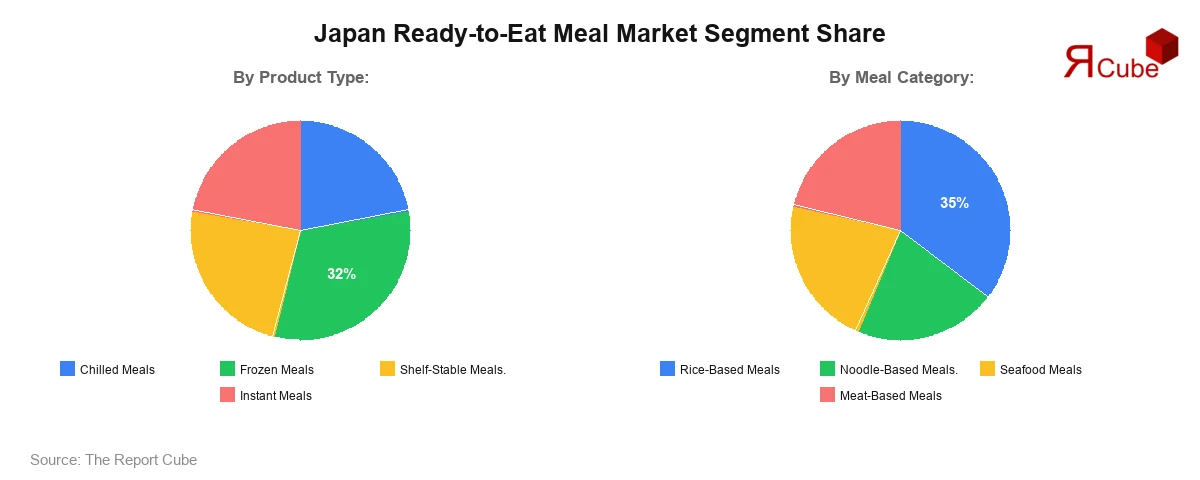
Frozen meals dominate the Japan Ready-to-Eat Meal Market, accounting for approximately 32% of total revenue in 2025.
By Meal Category:
Rice-based meals lead the Japan Ready-to-Eat Meal Market with an estimated 35% market share.
Regional Outlook:
The Kanto region leads the Japan Ready-to-Eat Meal Market, contributing nearly 41% of total revenue.
Japan Ready-to-Eat Meal Market Insights & Analysis
The Japan Ready-to-Eat Meal Market is anticipated to register a CAGR of 6.50% during 2026-2034. The market size was valued at USD 6.5 billion in 2025 and is projected to reach USD 11.46 billion by 2034. This strong growth outlook reflects Japan’s rapidly evolving food consumption landscape, where demographic shifts, urban lifestyles, and changing work patterns continue to redefine meal preparation habits.
Japan’s aging population, rising number of single-person households, and long working hours have significantly increased reliance on ready-to-eat meals. Consumers increasingly prioritize convenience, portion control, and consistent taste, making chilled, frozen, and instant meals an integral part of daily diets. At the same time, product innovation focusing on nutrition balance, reduced sodium, and authentic Japanese flavors is helping manufacturers align with health-conscious preferences.
Moreover, the widespread presence of convenience stores and advanced cold-chain infrastructure has enabled efficient nationwide distribution. Leading food manufacturers and retailers are leveraging data-driven product planning and premium meal concepts to capture evolving demand. As a result, the Japan Ready-to-Eat Meal Market is positioned for sustained expansion throughout the forecast period.
Japan Ready-to-Eat Meal Market Dynamics
Key Driver: Changing Household Structures and Busy Urban Lifestyles
The primary driver of the Japan Ready-to-Eat Meal Market is the structural change in household composition combined with increasingly busy lifestyles. Over 38% of Japanese households now consist of single occupants, significantly increasing demand for portion-controlled, ready-made meals. Working professionals and elderly consumers prefer meals that reduce cooking time while maintaining traditional flavors and nutritional balance. This demand aligns closely with the expansion of chilled and frozen meal segments, creating a strong foundation for market growth.
Book your FREE 30-minute expert consultation today
Contact UsIndustry Trends: Premiumization and Health-Focused Meal Innovation
A notable trend shaping the Japan Ready-to-Eat Meal Market is premiumization supported by health-oriented innovation. Consumers are willing to pay higher prices for meals featuring restaurant-quality taste, regional recipes, and functional health benefits. Manufacturers are responding by introducing low-sodium, high-protein, and plant-forward meal options. This trend directly complements the driver of convenience, as consumers increasingly expect ready-to-eat meals to deliver both quality and nutrition.
Major Challenge: Rising Raw Material and Packaging Costs
Despite strong demand, the Japan Ready-to-Eat Meal Market faces challenges from rising raw material and packaging costs. Fluctuating prices of seafood, meat, and rice, combined with sustainability-driven packaging upgrades, have increased production expenses. These cost pressures impact profit margins and require manufacturers to balance affordability with quality, especially in price-sensitive consumer segments.
Opportunity: Growth of Elderly-Focused and Functional Meals
The aging population presents a significant opportunity within the Japan Ready-to-Eat Meal Market. Demand for soft-textured, easy-to-digest, and nutritionally optimized meals is rising steadily among elderly consumers. Companies that integrate functional nutrition with convenient formats are well-positioned to capitalize on this expanding consumer base, reinforcing long-term market growth.
Japan Ready-to-Eat Meal Market Recent Developments
- 2025: Ajinomoto Co., Inc. expanded its frozen ready-meal portfolio with nutritionally balanced offerings for elderly consumers.
- 2025: Seven & i Holdings Co., Ltd. launched premium chilled meal ranges across urban convenience stores.
Government Initiatives & Policies
- Smart Food System Initiative: Supports innovation in food manufacturing and sustainable supply chains.
- Healthy Life Expectancy Extension Program: Promotes balanced nutrition for aging populations.
Japan Ready-to-Eat Meal Market Segment-wise Analysis
By Product Type:
- Chilled Meals
- Frozen Meals
- Shelf-Stable Meals
- Instant Meals
Frozen meals dominate the Japan Ready-to-Eat Meal Market, accounting for approximately 32% of total revenue in 2025. Their extended shelf life, consistent quality, and suitability for bulk purchasing make them popular among both working professionals and elderly consumers. This segment benefits directly from advanced cold-chain infrastructure and complements the broader convenience-driven market dynamics.
By Meal Category:
- Rice-Based Meals
- Noodle-Based Meals
- Seafood Meals
- Meat-Based Meals
Rice-based meals lead the Japan Ready-to-Eat Meal Market with an estimated 35% market share, reflecting strong cultural preferences. This dominance reinforces the interconnected role of traditional cuisine adaptation in ready-to-eat formats, supporting consumer trust and repeat purchases across distribution channels.
Regional Projection of Japan Ready-to-Eat Meal Industry
- Kanto
- Kinki
- Chubu
- Kyushu and Okinawa
The Kanto region leads the Japan Ready-to-Eat Meal Market, contributing nearly 41% of total revenue. High population density, strong purchasing power, and the concentration of convenience stores in Tokyo and surrounding prefectures drive this dominance. The region’s fast-paced lifestyle directly aligns with demand for ready-to-eat solutions, reinforcing its leadership position throughout the forecast period.
Need insights for a specific region within this market?
Request Regional DataWhy Choose This Report?
- Provides a comprehensive overview of the overall market analysis, encompassing key trends, consumer behavior analysis, and risk assessment to support strategic decision-making.
- Provides accurate, up-to-date insights into market size, segmentation, and emerging opportunities, helping to minimize risk & capitalizing on growth.
- Gives deep understanding of target audience preferences, investment habits, and communication channels for enhanced product development & marketing effectiveness.
- Delivers competitive analysis & benchmarking, uncovering the strengths & weaknesses of market competitors to guide strategies.
- Consolidate comprehensive market intelligence, reducing reasoning & streamlining research efforts.
- Facilitates customized market segmentation & risk mitigation strategies, fine-tuned to the business objectives.
- Aids in identifying both market challenges & untapped opportunities within the industry to drive long-term business growth.
- Provides valuable information based on actual customer data & search trends.
Table of Contents
- Introduction
- Objective of the Study
- Product and Category Definition
- Market Segmentation
- Study Variables
- Research Methodology
- Secondary Data Points
- Breakdown of Secondary Sources
- Primary Data Points
- Breakdown of Primary Interviews
- Secondary Data Points
- Executive Summary
- Market Dynamics
- Drivers
- Challenges
- Opportunity Assessment
- Recent Trends and Developments
- Regulatory and Policy Landscape
- Japan Ready-to-Eat Meal Market Overview (2021-2034)
- Market Size, By Value (USD Billion)
- Market Share, By Product Type
- Chilled Meals
- Frozen Meals
- Shelf-Stable Meals
- Instant Meals
- Meal Kits
- Others
- Market Share, By Meal Category
- Rice-Based Meals
- Noodle-Based Meals
- Seafood Meals
- Meat-Based Meals
- Vegetarian Meals
- Others
- Market Share, By Packaging Type
- Trays
- Bags and Pouches
- Cans
- Cups and Bowls
- Others
- Market Share, By Distribution Channel
- Convenience Stores
- Supermarkets and Hypermarkets
- Online Retail
- Others
- Market Share, By Consumer Group
- Single-Person Households
- Multi-Person Households
- Working Professionals
- Elderly Consumers
- Market Share, By Region
- Hokkaido
- Tohoku
- Kanto
- Chubu
- Kinki
- Chugoku
- Shikoku
- Kyushu and Okinawa
- Market Share, By Company
- Revenue Shares
- Competitive Landscape
- Hokkaido Ready-to-Eat Meal Market
- Market Size, By Value (USD Billion)
- Market Share, By Product Type
- Market Share, By Meal Category
- Market Share, By Packaging Type
- Market Share, By Distribution Channel
- Market Share, By Consumer Group
- Tohoku Ready-to-Eat Meal Market
- Market Size, By Value (USD Billion)
- Market Share, By Product Type
- Market Share, By Meal Category
- Market Share, By Packaging Type
- Market Share, By Distribution Channel
- Market Share, By Consumer Group
- Kanto Ready-to-Eat Meal Market
- Market Size, By Value (USD Billion)
- Market Share, By Product Type
- Market Share, By Meal Category
- Market Share, By Packaging Type
- Market Share, By Distribution Channel
- Market Share, By Consumer Group
- Chubu Ready-to-Eat Meal Market
- Market Size, By Value (USD Billion)
- Market Share, By Product Type
- Market Share, By Meal Category
- Market Share, By Packaging Type
- Market Share, By Distribution Channel
- Market Share, By Consumer Group
- Kinki Ready-to-Eat Meal Market
- Market Size, By Value (USD Billion)
- Market Share, By Product Type
- Market Share, By Meal Category
- Market Share, By Packaging Type
- Market Share, By Distribution Channel
- Market Share, By Consumer Group
- Chugoku Ready-to-Eat Meal Market
- Market Size, By Value (USD Billion)
- Market Share, By Product Type
- Market Share, By Meal Category
- Market Share, By Packaging Type
- Market Share, By Distribution Channel
- Market Share, By Consumer Group
- Shikoku Ready-to-Eat Meal Market
- Market Size, By Value (USD Billion)
- Market Share, By Product Type
- Market Share, By Meal Category
- Market Share, By Packaging Type
- Market Share, By Distribution Channel
- Market Share, By Consumer Group
- Kyushu and Okinawa Ready-to-Eat Meal Market
- Market Size, By Value (USD Billion)
- Market Share, By Product Type
- Market Share, By Meal Category
- Market Share, By Packaging Type
- Market Share, By Distribution Channel
- Market Share, By Consumer Group
- Competitive Outlook and Company Profiles
- Ajinomoto Co., Inc.
- Company Overview
- Product Portfolio
- Strategic Alliances/Partnerships
- Recent Developments
- Nippon Ham Co., Ltd.
- Company Overview
- Product Portfolio
- Strategic Alliances/Partnerships
- Recent Developments
- TableMark Co., Ltd.
- Company Overview
- Product Portfolio
- Strategic Alliances/Partnerships
- Recent Developments
- Nissin Foods Holdings Co., Ltd.
- Company Overview
- Product Portfolio
- Strategic Alliances/Partnerships
- Recent Developments
- Maruha Nichiro Corporation
- Company Overview
- Product Portfolio
- Strategic Alliances/Partnerships
- Recent Developments
- Nichirei Corporation
- Company Overview
- Product Portfolio
- Strategic Alliances/Partnerships
- Recent Developments
- Kewpie Corporation
- Company Overview
- Product Portfolio
- Strategic Alliances/Partnerships
- Recent Developments
- House Foods Group Inc.
- Company Overview
- Product Portfolio
- Strategic Alliances/Partnerships
- Recent Developments
- Meiji Co., Ltd.
- Company Overview
- Product Portfolio
- Strategic Alliances/Partnerships
- Recent Developments
- Seven & i Holdings Co., Ltd.
- Company Overview
- Product Portfolio
- Strategic Alliances/Partnerships
- Recent Developments
- Others
- Ajinomoto Co., Inc.
- Contact Us and Disclaimer
Top Key Players & Market Share Outlook
- Ajinomoto Co., Inc.
- Nippon Ham Co., Ltd.
- TableMark Co., Ltd.
- Nissin Foods Holdings Co., Ltd.
- Maruha Nichiro Corporation
- Nichirei Corporation
- Kewpie Corporation
- House Foods Group Inc.
- Meiji Co., Ltd.
- Seven & i Holdings Co., Ltd.
- Others
Frequently Asked Questions






