



Build Your Custom Market Intelligence Report
Customize Your ReportJapan Online Grocery Market Insights & Analysis
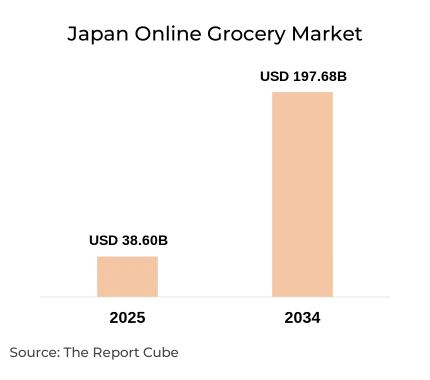
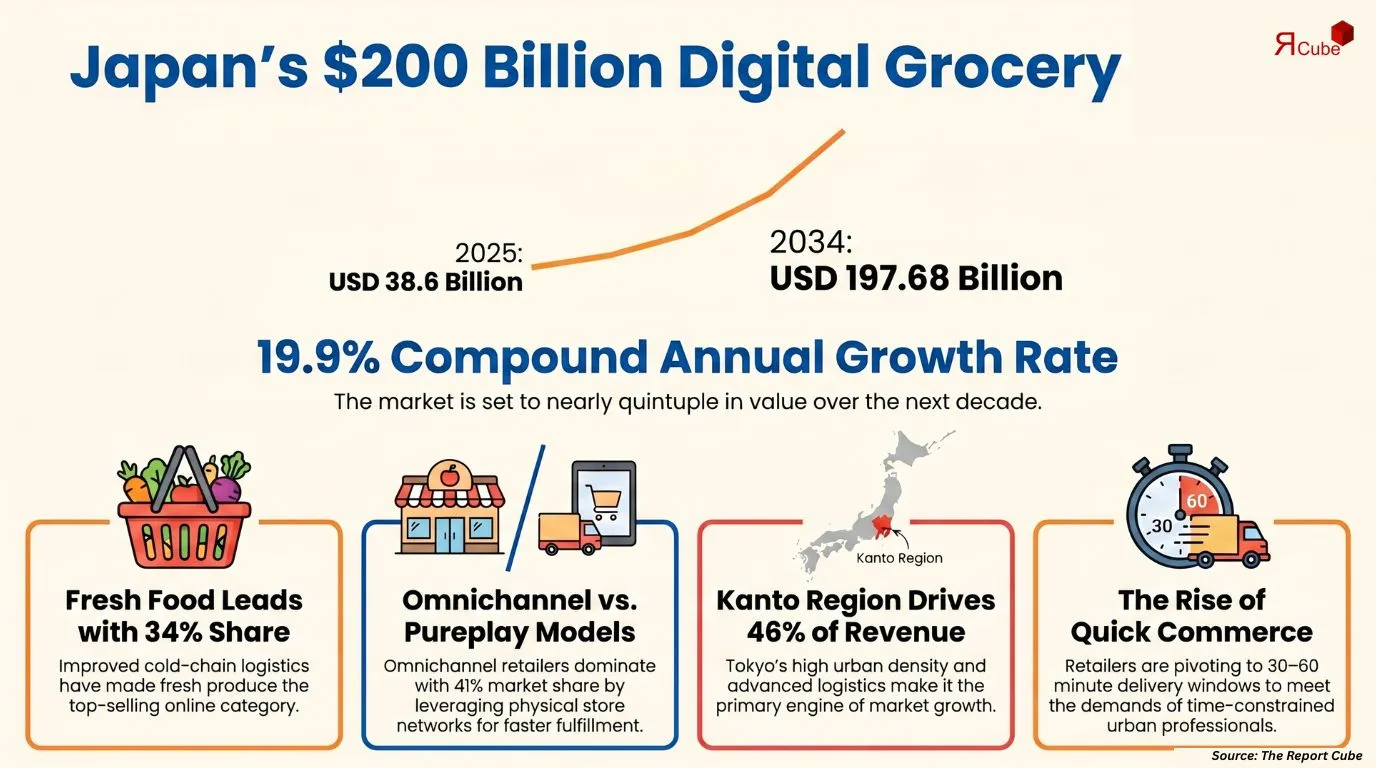
The Japan Online Grocery Market is anticipated to register a CAGR of 19.90% during 2026-2034. The market size was valued at USD 38.6 billion in 2025 and is projected to reach USD 197.68 billion by 2034. This exceptional growth reflects a structural shift in Japanese consumer behavior, where convenience, speed, and reliability are increasingly prioritized. Urban density, high internet penetration exceeding 92%, and widespread smartphone usage have created a fertile environment for online grocery adoption across age groups.
Traditionally cautious consumers have embraced digital grocery platforms due to improved cold-chain logistics, precise delivery scheduling, and trusted brand participation. The COVID-era behavioral shift accelerated adoption, but sustained growth is now driven by lifestyle changes, rising dual-income households, and time-constrained urban professionals. Online platforms are also gaining traction among elderly consumers, supported by simplified interfaces and subscription-based replenishment services.
Furthermore, retailers are investing heavily in automation, dark stores, and AI-driven demand forecasting to meet growing order volumes while maintaining Japan’s high service expectations. As competition intensifies, differentiation through product freshness, private labels, and localized assortments is becoming critical. These interconnected factors position the Japan Online Grocery Market as one of the fastest-growing digital retail segments globally through 2034.
Japan Online Grocery Market Recent Developments
- 2025: Amazon Japan expanded same-day fresh grocery delivery coverage across the Greater Tokyo metropolitan area.
- 2025: AEON Online introduced AI-based demand forecasting to reduce food waste and improve delivery accuracy.
Government Initiatives & Policies
- Digital Garden City Nation Initiative: Promotes digital infrastructure and e-commerce adoption nationwide.
- Green Food System Strategy: Supports sustainable food distribution and smart logistics.
Japan Online Grocery Market Dynamics
Key Driver: Rapid Urbanization and Time-Constrained Lifestyles
Rapid urbanization and increasingly time-constrained lifestyles are central drivers of the Japan Online Grocery Market. Over 91% of Japan’s population now lives in urban areas, where long working hours and commuting times reduce opportunities for frequent in-store shopping. Online grocery platforms address this challenge by offering scheduled, reliable deliveries that fit seamlessly into daily routines. Subscription models for staples such as rice, beverages, and household essentials are gaining popularity, particularly among families and elderly consumers. Additionally, precise delivery windows and high fulfillment accuracy align with Japanese expectations for punctuality and quality, reinforcing trust and repeat usage.
Book your FREE 30-minute expert consultation today
Contact UsIndustry Trends: Expansion of Omnichannel and Quick Commerce Models
The market is witnessing a strong shift toward omnichannel and quick commerce business models. Established retailers are integrating physical stores with digital platforms, enabling click-and-collect and rapid last-mile delivery. Quick commerce services, promising delivery within 30-60 minutes, are expanding in dense urban zones, particularly in Tokyo and Osaka. Approximately 28% of online grocery orders in 2025 were fulfilled within two hours, highlighting rising consumer demand for immediacy. This trend is pushing retailers to invest in micro-fulfillment centers and advanced inventory systems, reshaping competitive dynamics across the sector.
Major Challenge: High Logistics and Fulfillment Costs
Despite robust demand, high logistics and fulfillment costs remain a significant challenge. Maintaining product freshness, especially for seafood and produce, requires advanced cold-chain infrastructure and specialized packaging. Labor shortages in delivery services further increase operational expenses. Profitability pressures are intensified by consumer expectations for low or free delivery fees. Smaller players often struggle to achieve scale efficiencies, making consolidation and partnerships increasingly common as companies seek to optimize cost structures.
Opportunity: Rising Demand for Premium and Organic Products
An emerging opportunity lies in the growing demand for premium, organic, and specialty food products. Health-conscious consumers are increasingly seeking traceable, sustainably sourced items, and online platforms are well-positioned to showcase product origin and certifications. Premium segments are growing at over 22% annually, outpacing mass-market categories. By leveraging data analytics to personalize recommendations and curate premium assortments, online grocers can enhance margins while meeting evolving consumer preferences.
Japan Online Grocery Market Segment-wise Analysis
By Product:
- Fresh Food
- Packaged Food
- Beverages
- Household Essentials
Fresh Food represents the leading product segment, accounting for approximately 34% of total market revenue in 2025. Consumer trust in online fresh food quality has improved significantly due to better sourcing transparency and cold-chain reliability. Urban households increasingly rely on online platforms for fruits, vegetables, seafood, and meat, supported by same-day delivery options. Packaged food and beverages follow closely, benefiting from bulk purchasing and subscription-based replenishment models.
By Business Model:
- Pureplay
- Omnichannel
- Marketplace
- Quick Commerce
Omnichannel models dominate the market with an estimated 41% share in 2025. Retailers leveraging existing store networks achieve faster fulfillment and higher consumer trust. Pureplay platforms remain competitive through wider assortments and advanced personalization, while quick commerce is rapidly expanding in metropolitan areas. Marketplaces enable smaller vendors to reach broader audiences, enhancing product diversity across platforms.
Regional Projection of Japan Online Grocery Industry
- Kanto
- Kansai/Kinki
- Chubu
- Kyushu-Okinawa
The Kanto region leads the Japan Online Grocery Market, contributing nearly 46% of total revenue in 2025. Tokyo’s dense population, high income levels, and advanced logistics infrastructure support rapid adoption of online grocery services. Consumers in Kanto exhibit high order frequency and strong acceptance of premium delivery services. Kansai/Kinki follows as a key growth region, driven by Osaka’s urban concentration and expanding quick commerce networks.
Need insights for a specific region within this market?
Request Regional DataWhy Choose This Report?
- Provides a comprehensive overview of the overall market analysis, encompassing key trends, consumer behavior analysis, and risk assessment to support strategic decision-making.
- Provides accurate, up-to-date insights into market size, segmentation, and emerging opportunities, helping to minimize risk & capitalizing on growth.
- Gives deep understanding of target audience preferences, investment habits, and communication channels for enhanced product development & marketing effectiveness.
- Delivers competitive analysis & benchmarking, uncovering the strengths & weaknesses of market competitors to guide strategies.
- Consolidate comprehensive market intelligence, reducing reasoning & streamlining research efforts.
- Facilitates customized market segmentation & risk mitigation strategies, fine-tuned to the business objectives.
- Aids in identifying both market challenges & untapped opportunities within the industry to drive long-term business growth.
- Provides valuable information based on actual customer data & search trends.
Table of Contents
- Introduction
- Objective of the Study
- Product and Category Definition
- Market Segmentation
- Study Variables
- Research Methodology
- Secondary Data Points
- Breakdown of Secondary Sources
- Primary Data Points
- Breakdown of Primary Interviews
- Secondary Data Points
- Executive Summary
- Market Dynamics
- Drivers
- Challenges
- Opportunity Assessment
- Recent Trends and Developments
- Regulatory and Policy Landscape
- Japan Online Grocery Market Overview (2020-2034)
- Market Size, By Value (USD Billion)
- Market Share, By Product
- Fresh Food
- Packaged Food
- Beverages
- Frozen Food
- Household Essentials
- Personal Care
- Others
- Market Share, By Business Model
- Pureplay
- Omnichannel
- Marketplace
- Quick Commerce
- Others
- Market Share, By Delivery
- Home Delivery
- Store Pickup
- Locker Pickup
- Market Share, By Platform
- Web-Based
- App-Based
- Market Share, By Payment Mode
- Online
- Offline (COD)
- Market Share, By Purchase Type
- One-Time
- Subscription
- Market Share, By Customer Type
- Single Households
- Family Households
- Senior Shoppers
- Corporate Buyers
- Market Share, By Region
- Hokkaido
- Tohoku
- Kanto
- Chubu
- Kansai/Kinki
- Chugoku
- Shikoku
- Kyushu-Okinawa
- Market Share, By Company
- Competition Characteristics
- Revenue Shares & Analysis
- Hokkaido Region Online Grocery Market
- Market Size, By Value (USD Billion)
- Market Share, By Product
- Market Share, By Business Model
- Market Share, By Delivery
- Market Share, By Platform
- Market Share, By Payment Mode
- Market Share, By Purchase Type
- Market Share, By Customer Type
- Tohoku Region Online Grocery Market
- Market Size, By Value (USD Billion)
- Market Share, By Product
- Market Share, By Business Model
- Market Share, By Delivery
- Market Share, By Platform
- Market Share, By Payment Mode
- Market Share, By Purchase Type
- Market Share, By Customer Type
- Kanto Region Online Grocery Market
- Market Size, By Value (USD Billion)
- Market Share, By Product
- Market Share, By Business Model
- Market Share, By Delivery
- Market Share, By Platform
- Market Share, By Purchase Type
- Market Share, By Customer Type
- Chubu Region Online Grocery Market
- Market Size, By Value (USD Billion)
- Market Share, By Product
- Market Share, By Business Model
- Market Share, By Delivery
- Market Share, By Platform
- Market Share, By Payment Mode
- Market Share, By Purchase Type
- Market Share, By Customer Type
- Kansai/Kinki Region Online Grocery Market
- Market Size, By Value (USD Billion)
- Market Share, By Product
- Market Share, By Business Model
- Market Share, By Delivery
- Market Share, By Platform
- Market Share, By Payment Mode
- Market Share, By Purchase Type
- Market Share, By Customer Type
- Chugoku Region Online Grocery Market
- Market Size, By Value (USD Billion)
- Market Share, By Product
- Market Share, By Business Model
- Market Share, By Delivery
- Market Share, By Platform
- Market Share, By Purchase Type
- Market Share, By Customer Type
- Shikoku Region Online Grocery Market
- Market Size, By Value (USD Billion)
- Market Share, By Product
- Market Share, By Business Model
- Market Share, By Delivery
- Market Share, By Platform
- Market Share, By Payment Mode
- Market Share, By Purchase Type
- Market Share, By Customer Type
- Kyushu-Okinawa Region Online Grocery Market
- Market Size, By Value (USD Billion)
- Market Share, By Product
- Market Share, By Business Model
- Market Share, By Delivery
- Market Share, By Platform
- Market Share, By Payment Mode
- Market Share, By Purchase Type
- Market Share, By Customer Type
- Competitive Outlook and Company Profiles
- Rakuten Seiyu Netsuper
- Company Overview
- Service Portfolio
- Strategic Alliances/Partnerships
- Recent Developments
- AEON Online
- Company Overview
- Service Portfolio
- Strategic Alliances/Partnerships
- Recent Developments
- Amazon Japan
- Company Overview
- Service Portfolio
- Strategic Alliances/Partnerships
- Recent Developments
- Ito-Yokado Net Super
- Company Overview
- Service Portfolio
- Strategic Alliances/Partnerships
- Recent Developments
- Life Corporation Online
- Company Overview
- Service Portfolio
- Strategic Alliances/Partnerships
- Recent Developments
- Co-op Online
- Company Overview
- Service Portfolio
- Strategic Alliances/Partnerships
- Recent Developments
- Oisix ra daichi
- Company Overview
- Service Portfolio
- Strategic Alliances/Partnerships
- Recent Developments
- Yodobashi Online
- Company Overview
- Service Portfolio
- Strategic Alliances/Partnerships
- Recent Developments
- Rakuten Ichiba Grocery
- Company Overview
- Service Portfolio
- Strategic Alliances/Partnerships
- Recent Developments
- Costco Online Japan
- Company Overview
- Service Portfolio
- Strategic Alliances/Partnerships
- Recent Developments
- Others
- Rakuten Seiyu Netsuper
- Contact Us and Disclaimer
Top Key Players & Market Share Outlook
- Rakuten Seiyu Netsuper
- AEON Online
- Amazon Japan
- Ito-Yokado Net Super
- Life Corporation Online
- Co-op Online
- Oisix ra daichi
- Yodobashi Online
- Rakuten Ichiba Grocery
- Costco Online Japan
- Others
Frequently Asked Questions






