




Build Your Custom Market Intelligence Report
Customize Your ReportEurope Basmati Rice Market Insights & Analysis
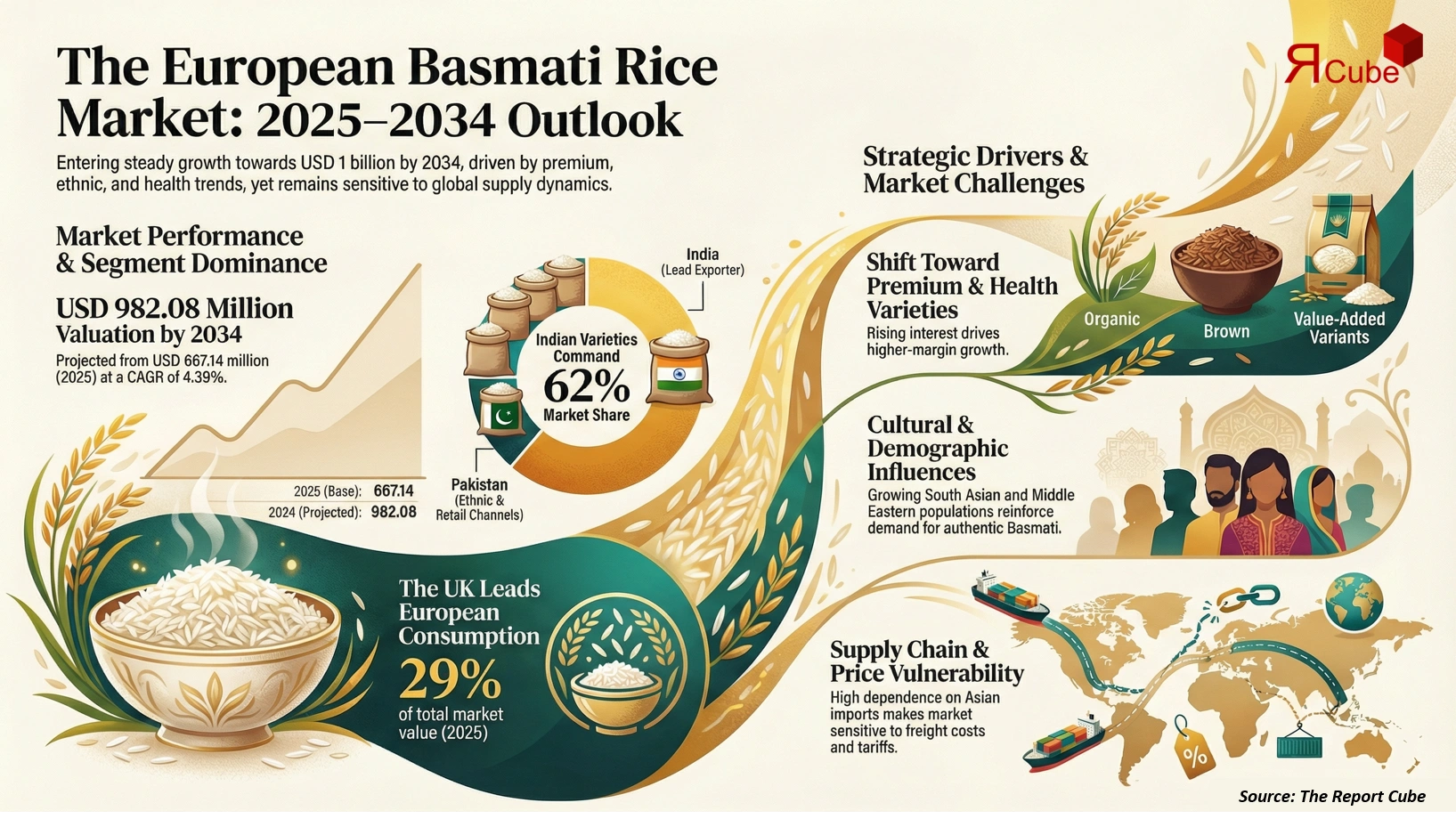
The Europe Basmati Rice Market is anticipated to register a CAGR of 4.39% during the forecast period 2026-2034. The market size was valued at USD 667.14 Million in 2025 and is projected to reach USD 982.08 Million by 2034. This growth reflects steady expansion in basmati rice consumption across Europe, driven by changing dietary preferences, rising ethnic populations, and growing demand for premium and specialty rice varieties. Basmati rice is increasingly perceived as a healthier and higher-quality alternative to standard long-grain rice, supported by its aromatic profile, lower glycemic index, and versatility across global cuisines. European consumers are gradually incorporating basmati rice into everyday meals beyond traditional ethnic cooking, supporting sustained market demand.
Market development is further supported by increasing interest in international cuisines, plant-based diets, and premium food products. Retail expansion, private-label offerings, and strong distribution through ethnic grocery stores and mainstream supermarkets are improving accessibility. Additionally, rising awareness of organic and sustainably sourced food products is boosting demand for organic and brown basmati rice variants. Leading Indian and Pakistani exporters, along with established European brands, are strengthening supply chains, branding strategies, and compliance with European food safety standards, ensuring long-term market stability.
Europe Basmati Rice Market Recent Developments
- 2025: LT Foods expanded premium basmati rice distribution across Western European retail chains.
- 2025: Tilda introduced new value-added basmati rice variants targeting health-conscious consumers.
Government Initiatives & Policies
- EU Food Safety and Quality Regulations: Regulatory framework ensuring quality, traceability, and safety of imported rice products.
- EU Organic Farming Regulation: Policy supporting certified organic food imports and labeling standards.
Europe Basmati Rice Market Dynamics
Key Driver: Growing demand for premium and ethnic food products
The primary driver of the Europe basmati rice market is rising consumer preference for premium, aromatic, and culturally diverse food products. Basmati rice is increasingly favored for its taste, texture, and perceived health benefits, aligning with Europe’s growing interest in global cuisines and home cooking. Expanding South Asian, Middle Eastern, and multicultural populations further reinforce demand, particularly in urban centers. Additionally, rising disposable incomes and willingness to pay for higher-quality staple foods support market growth. These factors collectively strengthen basmati rice positioning as a premium staple across European households.
Major Challenge: Price sensitivity and supply chain dependence
A key challenge facing the Europe basmati rice market is price sensitivity among consumers and strong dependence on imports from India and Pakistan. Currency fluctuations, freight costs, and agricultural output variability directly influence pricing and availability. Compliance with stringent European food safety, pesticide residue, and sustainability standards can also increase costs for exporters. Private-label competition and alternative long-grain rice varieties exert pricing pressure, particularly in cost-conscious markets. Managing supply stability while maintaining competitive pricing remains a critical challenge for market participants.
Industry Trends: Shift toward organic and value-added basmati rice
A defining trend in the Europe basmati rice market is the growing demand for organic, brown, and value-added basmati rice products. Health-conscious consumers are increasingly seeking whole-grain, low-processed, and sustainably sourced foods. Flavoured, ready-to-cook, and convenience-oriented basmati rice variants are gaining popularity, particularly among younger consumers and working households. Retailers are expanding shelf space for premium and specialty rice categories, reflecting evolving consumer preferences. These trends signal a gradual move from commodity-focused consumption toward differentiated, higher-margin basmati offerings.
Opportunity Ahead: Retail expansion and private-label growth
Significant opportunities exist in expanding basmati rice penetration through mainstream retail channels and private-label offerings. Supermarkets are increasingly partnering with established suppliers to launch affordable premium basmati rice under store brands, broadening consumer reach. E-commerce and direct-to-consumer platforms also offer new growth avenues, particularly for niche and organic products. Companies that invest in branding, traceability, and sustainability certifications can enhance consumer trust and capture long-term market share across Europe.
Europe Basmati Rice Market Segment-wise Analysis
By Origin:
- Indian Basmati Variety
- Pakistani Basmati Variety
Indian basmati varieties dominate the European market, accounting for approximately 62% of total demand in 2025. Strong brand recognition, consistent quality, and established trade relationships support this dominance. Pakistani basmati rice holds a meaningful share, particularly in ethnic retail channels, offering competitive pricing and distinctive grain characteristics.
By Rice Type:
- White Basmati Rice
- Brown Basmati Rice
- Organic Basmati Rice
- Flavoured / Value-added Basmati Rice
White basmati rice remains the leading category, representing approximately 54% of total market consumption. However, brown and organic basmati rice segments are expanding rapidly due to health and sustainability trends. Value-added basmati rice products are gaining traction in convenience-focused urban markets.
Regional Projection of Europe Basmati Rice Industry
- United Kingdom
- Germany
- France
- Italy
- Spain
- Netherlands
- Belgium
- Poland
- Rest of Europe
The United Kingdom leads the Europe basmati rice market, accounting for approximately 29% of total market value in 2025. High ethnic population concentration, strong retail penetration, and established basmati consumption patterns support market leadership. Germany and France follow, driven by growing multicultural demographics and premium food demand, while Southern and Eastern European countries represent emerging growth markets.
Why Choose This Report?
- Provides a comprehensive overview of the overall market analysis, encompassing key trends, consumer behavior analysis, and risk assessment to support strategic decision-making.
- Provides accurate, up-to-date insights into market size, segmentation, and emerging opportunities, helping to minimize risk & capitalizing on growth.
- Gives deep understanding of target audience preferences, investment habits, and communication channels for enhanced product development & marketing effectiveness.
- Delivers competitive analysis & benchmarking, uncovering the strengths & weaknesses of market competitors to guide strategies.
- Consolidate comprehensive market intelligence, reducing reasoning & streamlining research efforts.
- Facilitates customized market segmentation & risk mitigation strategies, fine-tuned to the business objectives.
- Aids in identifying both market challenges & untapped opportunities within the industry to drive long-term business growth.
- Provides valuable information based on actual customer data & search trends.
Table of Contents
- Introduction
- Objective of the Study
- Product/Category Definition
- Market Segmentation
- Study Variables
- Research Methodology
- Secondary Data Points
- Breakdown of Secondary Sources
- Primary Data Points
- Breakdown of Primary Interviews
- Secondary Data Points
- Executive Summary
- Market Dynamics
- Drivers
- Challenges
- Opportunity Assessment
- Recent Trends and Developments
- Policy and Regulatory Landscape
- Europe Basmati Rice Market Overview (2020-2034)
- Market Size, By Volume & Value (Kilotons / USD Million)
- Market Share, By Origin
- Indian Basmati Variety
- Pakistani Basmati Variety
- Market Share, By Rice Type
- White Basmati Rice
- Brown Basmati Rice
- Organic Basmati Rice
- Flavoured / Value-added Basmati Rice
- Market Share, By Application
- Household / Retail Consumption
- HoReCa (Hotels, Restaurants & Catering)
- Food Processing & Industrial Use
- Market Share, By Distribution Channel
- Hypermarkets & Supermarkets
- Grocery & Convenience Stores
- Specialty & Ethnic Stores
- Online Channels
- Others
- Market Share, By Pack Size
- Up to 1 Kg
- 1-5 Kg
- Above 5 Kg
- Market Share, By Country
- United Kingdom
- Germany
- France
- Italy
- Spain
- Netherlands
- Belgium
- Poland
- Rest of Europe
- Market Share, By Company
- Revenue Shares
- Competitive Landscape
- United Kingdom Basmati Rice Market
- Market Size, By Volume & Value (USD Million)
- Market Share, By Origin
- Market Share, By Rice Type
- Market Share, By Application
- Market Share, By Distribution Channel
- Market Share, By Pack Size
- Germany Basmati Rice Market
- Market Size, By Volume & Value (USD Million)
- Market Share, By Origin
- Market Share, By Rice Type
- Market Share, By Application
- Market Share, By Distribution Channel
- Market Share, By Pack Size
- France Basmati Rice Market
- Market Size, By Volume & Value (USD Million)
- Market Share, By Origin
- Market Share, By Rice Type
- Market Share, By Application
- Market Share, By Distribution Channel
- Market Share, By Pack Size
- Italy Basmati Rice Market
- Market Size, By Volume & Value (USD Million)
- Market Share, By Origin
- Market Share, By Rice Type
- Market Share, By Application
- Market Share, By Distribution Channel
- Market Share, By Pack Size
- Spain Basmati Rice Market
- Market Size, By Volume & Value (USD Million)
- Market Share, By Origin
- Market Share, By Rice Type
- Market Share, By Application
- Market Share, By Distribution Channel
- Market Share, By Pack Size
- Netherlands Basmati Rice Market
- Market Size, By Volume & Value (USD Million)
- Market Share, By Origin
- Market Share, By Rice Type
- Market Share, By Application
- Market Share, By Distribution Channel
- Market Share, By Pack Size
- Belgium Basmati Rice Market
- Market Size, By Volume & Value (USD Million)
- Market Share, By Origin
- Market Share, By Rice Type
- Market Share, By Application
- Market Share, By Distribution Channel
- Market Share, By Pack Size
- Poland Basmati Rice Market
- Market Size, By Volume & Value (USD Million)
- Market Share, By Origin
- Market Share, By Rice Type
- Market Share, By Application
- Market Share, By Distribution Channel
- Market Share, By Pack Size
- Rest of Europe Basmati Rice Market
- Market Size, By Volume & Value (USD Million)
- Market Share, By Origin
- Market Share, By Rice Type
- Market Share, By Application
- Market Share, By Distribution Channel
- Market Share, By Pack Size
- Competitive Outlook & Company Profiles
- KRBL Limited (India Gate)
- Company Overview
- Product Portfolio
- Strategic Alliances/Partnerships
- Recent Developments
- LT Foods Ltd. (Daawat)
- Company Overview
- Product Portfolio
- Strategic Alliances/Partnerships
- Recent Developments
- Kohinoor Foods
- Company Overview
- Product Portfolio
- Strategic Alliances/Partnerships
- Recent Developments
- Amira Nature Foods
- Company Overview
- Product Portfolio
- Strategic Alliances/Partnerships
- Recent Developments
- Shri Lal Mahal Group
- Company Overview
- Product Portfolio
- Strategic Alliances/Partnerships
- Recent Developments
- Veetee Rice
- Company Overview
- Product Portfolio
- Strategic Alliances/Partnerships
- Recent Developments
- East End Foods
- Company Overview
- Product Portfolio
- Strategic Alliances/Partnerships
- Recent Developments
- Tilda (Hain Celestial)
- Company Overview
- Product Portfolio
- Strategic Alliances/Partnerships
- Recent Developments
- Waqar Rice Mills
- Company Overview
- Product Portfolio
- Strategic Alliances/Partnerships
- Recent Developments
- Others
- KRBL Limited (India Gate)
- Contact Us / Disclaimer
Top Key Players & Market Share Outlook
- KRBL Limited (India Gate)
- LT Foods Ltd. (Daawat)
- Kohinoor Foods
- Amira Nature Foods
- Shri Lal Mahal Group
- Veetee Rice
- East End Foods
- Tilda (Hain Celestial)
- Waqar Rice Mills
- Others
Frequently Asked Questions






