




Build Your Custom Market Intelligence Report
Customize Your ReportGlobal Second-Generation Biofuels Market Insights & Analysis
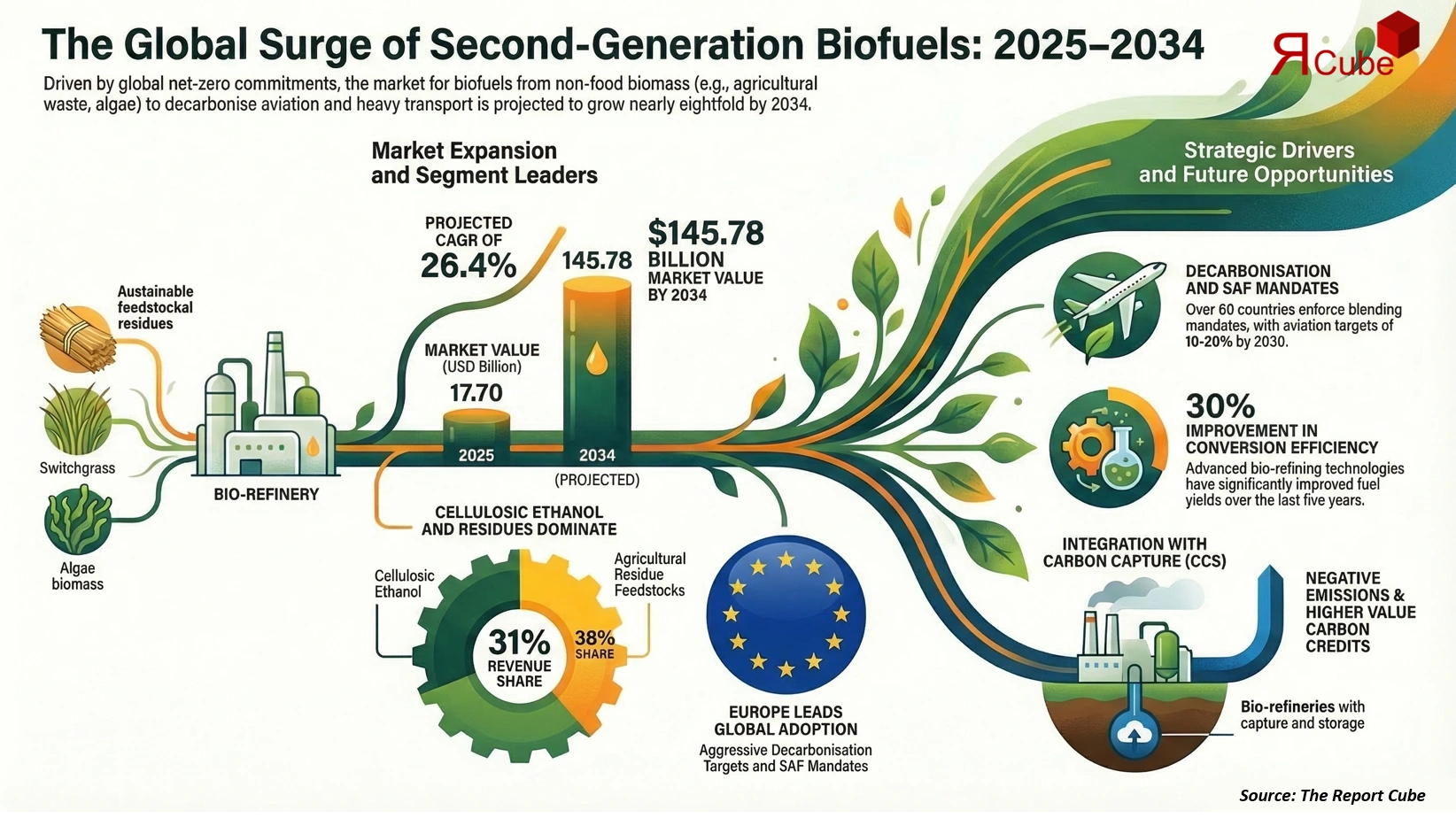
The Global Second-Generation Biofuels Market is anticipated to register a CAGR of 26.40% during 2026-2034. The market size was valued at USD 17.7 billion in 2025 and is projected to reach USD 145.78 billion by 2034. This exceptional growth trajectory highlights the accelerating global shift toward low-carbon energy systems and the urgent need to decarbonize transport, aviation, and industrial fuel consumption. Second-generation biofuels, derived from non-food biomass such as agricultural residues, municipal solid waste, and algae, address key sustainability limitations associated with first-generation biofuels. Governments and energy companies increasingly view these fuels as critical enablers of net-zero commitments, especially in hard-to-abate sectors.
Beyond environmental benefits, the market is gaining traction due to improvements in conversion efficiency, enzyme performance, and thermochemical processing technologies. Advanced bio-refining processes have improved fuel yields by nearly 30% over the past five years, making commercial-scale deployment more viable. The market also benefits from rising mandates for renewable fuel blending, sustainable aviation fuel adoption, and circular economy initiatives that convert waste into value-added energy products. As policy support aligns with technological maturity, second-generation biofuels are emerging as a strategic pillar within the broader renewable energy and alternative fuels landscape.
Global Second-Generation Biofuels Market Recent Developments
- 2025: POET expanded its cellulosic ethanol production capacity using corn stover feedstock in North America.
- 2025: Enerkem commissioned a waste-to-biofuels facility converting municipal solid waste into advanced biofuels.
Government Initiatives & Policies
- U.S. Renewable Fuel Standard (RFS): Mandates increasing volumes of advanced and cellulosic biofuels.
- EU Renewable Energy Directive (RED III): Promotes advanced biofuels and sustainable aviation fuel adoption.
Global Second-Generation Biofuels Market Dynamics
Key Driver: Decarbonization Mandates and Sustainable Fuel Policies
The primary driver of the global second-generation biofuels market is the tightening regulatory framework aimed at reducing greenhouse gas emissions. More than 60 countries now enforce renewable fuel blending mandates, with advanced biofuels receiving preferential credits due to their lower lifecycle emissions. In aviation, sustainable aviation fuel blending targets of 10-20% by 2030 across Europe and North America are accelerating demand. These policies directly favor second-generation biofuels because they deliver up to 85% lower carbon intensity compared to fossil fuels, while avoiding competition with food supply chains.
Major Challenge: High Capital Intensity and Scale-Up Complexity
Despite strong growth prospects, the market faces challenges related to high capital expenditure and operational complexity. Advanced bio-refineries typically require 25-40% higher upfront investment than conventional biofuel plants due to sophisticated pretreatment, enzymatic hydrolysis, and gasification systems. Feedstock variability, logistics costs, and process optimization further complicate scale-up. These challenges can delay commercialization timelines, particularly in developing regions. However, continuous process innovation and public-private funding models are gradually reducing financial barriers.
Industry Trends: Rapid Adoption of Sustainable Aviation Fuel and Waste-Based Biofuels
A major industry trend is the rapid expansion of sustainable aviation fuel production and waste-based biofuels. Airlines increasingly enter long-term offtake agreements to secure SAF supply, driving investment in advanced biofuel pathways such as Fischer-Tropsch diesel and bio-synthetic paraffinic kerosene. Waste-derived biofuels, including those from municipal solid waste and used cooking oil, now represent nearly 22% of total second-generation biofuel feedstock usage. This trend aligns with circular economy principles and improves public acceptance.
Opportunity Ahead: Integration with Hydrogen and Carbon Capture Technologies
The integration of second-generation biofuels with hydrogen production and carbon capture presents a significant opportunity. Bio-refineries adopting carbon capture can achieve negative emissions, attracting premium credits under emerging carbon markets. Additionally, combining biofuels with green hydrogen enables production of advanced e-fuels suitable for long-haul aviation and maritime transport. These hybrid energy systems could unlock new revenue streams and enhance long-term competitiveness.
Global Second-Generation Biofuels Market Segment-wise Analysis
By Fuel Type:
- Cellulosic Ethanol
- Biodiesel from Non-food Feedstocks
- Biobutanol
- Bio-synthetic Paraffinic Kerosene
- Sustainable Aviation Fuel (SAF)
- Fischer-Tropsch (FT) Diesel
- Others
Cellulosic ethanol dominates the fuel type segment, accounting for approximately 31% of total market revenue in 2025. Its leadership is supported by established pilot-to-commercial facilities, abundant agricultural residue availability, and strong policy incentives in North America and Europe. While SAF and FT diesel are growing faster, cellulosic ethanol remains the most commercially mature and widely deployed advanced biofuel.
By Feedstock:
- Lignocellulosic Residues (Agricultural & Forestry Residues)
- Energy Crop
- Municipal Solid Waste
- Used Cooking Oil
- Algae
Lignocellulosic residues lead the feedstock segment with nearly 38% market share in 2025. Their dominance stems from wide availability, low cost, and strong alignment with sustainability regulations. Agricultural residues such as corn stover and wheat straw are increasingly utilized due to improved pretreatment technologies that enhance conversion efficiency.
Regional Projection of Global Second-Generation Biofuels Industry
- North America
- Europe
- Asia Pacific
- Middle East and Africa
- South America
Europe leads the global second-generation biofuels market, holding approximately 36% share in 2025. Strong regulatory backing, aggressive decarbonization targets, and early adoption of sustainable aviation fuel underpin regional leadership. North America follows closely, supported by federal incentives and abundant biomass resources, while Asia Pacific represents the fastest-growing region due to rising energy demand and waste-to-energy initiatives.
Why Choose This Report?
- Provides a comprehensive overview of the overall market analysis, encompassing key trends, consumer behavior analysis, and risk assessment.
- Delivers accurate insights into market size, segmentation, and high-growth opportunities.
- Offers deep understanding of policy impacts and sustainability-driven demand patterns.
- Includes competitive benchmarking of leading and emerging biofuel producers.
- Reduces research complexity by consolidating multi-source market intelligence.
- Supports customized strategic planning and investment decision-making.
- Identifies key risks and untapped opportunities across regions and segments.
- Backed by data-driven insights aligned with current energy transition trends.
Table of Contents
- Introduction
- Objective of the Study
- Product and Category Definition
- Market Segmentation
- Study Variables
- Research Methodology
- Secondary Data Points
- Breakdown of Secondary Sources
- Primary Data Points
- Breakdown of Primary Interviews
- Secondary Data Points
- Executive Summary
- Market Dynamics
- Drivers
- Challenges
- Opportunity Assessment
- Recent Trends and Developments
- Regulatory and Policy Landscape
- Global Second-Generation Biofuels Market Overview (2020-2034)
- Market Size, By Value (USD Billion)
- Market Share, By Fuel Type
- Cellulosic Ethanol
- Biodiesel from Non-food Feedstocks
- Biobutanol
- Bio-synthetic Paraffinic Kerosene
- Sustainable Aviation Fuel (SAF)
- Fischer-Tropsch (FT) Diesel
- Others
- Market Share, By Feedstock
- Lignocellulosic Residues
- Agricultural Residues
- Forestry Residues
- Energy Crop
- Municipal Solid Waste
- Used Cooking Oil
- Algae
- Lignocellulosic Residues
- Market Share, By Conversion Pathway
- Biochemical Route
- Enzymatic Hydrolysis
- Fermentation
- Thermochemical Route
- Gasification
- Pyrolysis
- Fischer-Tropsch Synthesis
- Hybrid Routes
- Biochemical Route
- Market Share, By Application
- Road Transport
- Aviation
- Marine
- Power Generation
- Others
- Market Share, By End User
- Oil and Gas
- Fuel Blenders
- Aviation and Airlines
- Logistics and Fleet Operators
- Utilities and Independent Power Producers
- Other
- Market Share, By Region
- North America
- Europe
- Asia Pacific
- Middle East and Africa
- South America
- Market Share, By Company
- Revenue Shares
- Competitive Landscape
- North America Second-Generation Biofuels Market
- Market Size, By Value (USD Billion)
- Market Share, By Fuel Type
- Market Share, By Feedstock
- Market Share, By Conversion Pathway
- Market Share, By Application
- Market Share, By End User
- Market Share, By Region/Country Group
- Market Share, By Country
- United States
- Canada
- Mexico
- Europe Second-Generation Biofuels Market
- Market Size, By Value (USD Billion)
- Market Share, By Fuel Type
- Market Share, By Feedstock
- Market Share, By Conversion Pathway
- Market Share, By Application
- Market Share, By End User
- Market Share, By Region/Country Group
- Market Share, By Country
- Germany
- France
- United Kingdom
- Italy
- Spain
- Northern and Nordic Countries
- Rest of Europe
- Asia Pacific Second-Generation Biofuels Market
- Market Size, By Value (USD Billion)
- Market Share, By Fuel Type
- Market Share, By Feedstock
- Market Share, By Conversion Pathway
- Market Share, By Application
- Market Share, By End User
- Market Share, By Region/Country Group
- Market Share, By Country
- China
- India
- Japan
- South Korea
- Australia
- Rest of Asia Pacific
- Middle East and Africa Second-Generation Biofuels Market
- Market Size, By Value (USD Billion)
- Market Share, By Fuel Type
- Market Share, By Feedstock
- Market Share, By Conversion Pathway
- Market Share, By Application
- Market Share, By End User
- Market Share, By Region/Country Group
- Market Share, By Country
- Saudi Arabia
- United Arab Emirates
- South Africa
- Rest of Middle East and Africa
- South America Second-Generation Biofuels Market
- Market Size, By Value (USD Billion)
- Market Share, By Fuel Type
- Market Share, By Feedstock
- Market Share, By Conversion Pathway
- Market Share, By Application
- Market Share, By End User
- Market Share, By Region/Country Group
- Market Share, By Country
- Brazil
- Argentina
- Chile
- Rest of South America
- Competitive Outlook and Company Profiles
- Abengoa
- Company Overview
- Product Portfolio
- Strategic Alliances/Partnerships
- Recent Developments
- DuPont de Nemours
- Company Overview
- Product Portfolio
- Strategic Alliances/Partnerships
- Recent Developments
- Novozymes
- Company Overview
- Product Portfolio
- Strategic Alliances/Partnerships
- Recent Developments
- BP
- Company Overview
- Product Portfolio
- Strategic Alliances/Partnerships
- Recent Developments
- POET
- Company Overview
- Product Portfolio
- Strategic Alliances/Partnerships
- Recent Developments
- Renewable Energy Group
- Company Overview
- Product Portfolio
- Strategic Alliances/Partnerships
- Recent Developments
- Gevo
- Company Overview
- Product Portfolio
- Strategic Alliances/Partnerships
- Recent Developments
- Enerkem
- Company Overview
- Product Portfolio
- Strategic Alliances/Partnerships
- Recent Developments
- Amyris
- Company Overview
- Product Portfolio
- Strategic Alliances/Partnerships
- Recent Developments
- Solazyme
- Company Overview
- Product Portfolio
- Strategic Alliances/Partnerships
- Recent Developments
- Others
- Abengoa
- Contact Us and Disclaimer
Top Key Players & Market Share Outlook
- Abengoa
- DuPont de Nemours
- Novozymes
- BP
- POET
- Renewable Energy Group
- Gevo
- Enerkem
- Amyris
- Solazyme
- Others
Frequently Asked Questions






