



Build Your Custom Market Intelligence Report
Customize Your ReportUAE 3D Printed Construction Market Insights & Analysis
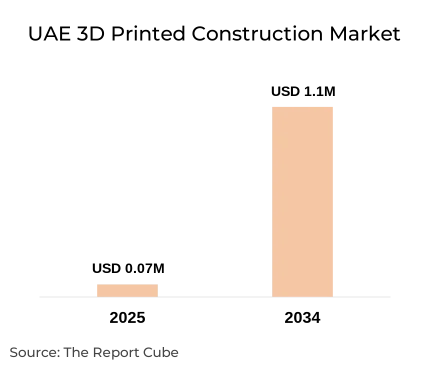
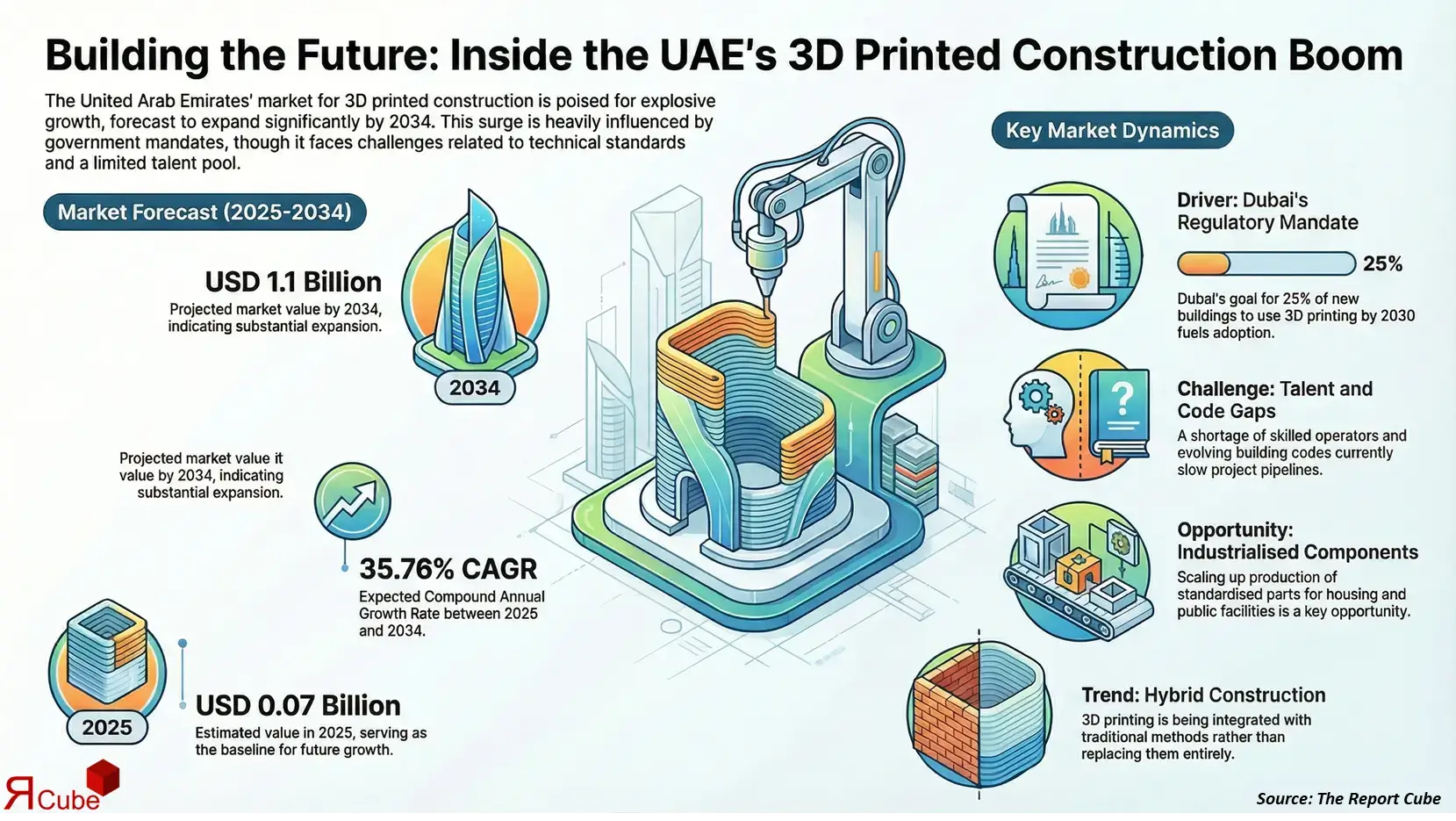
The UAE 3D Printed Construction Market is anticipated to register a CAGR of 35.76% during 2026-2034. The market size was valued at USD 0.07 million in 2025 and is projected to reach USD 1.1 million by 2034. The market is still at a nascent stage but is expanding rapidly as the UAE positions itself as a global leader in advanced construction technologies. Strong government backing, combined with the need for faster, cost-efficient, and sustainable construction methods, is accelerating the adoption of 3D printing across residential, commercial, and infrastructure projects.
The UAE’s construction ecosystem is uniquely suited for 3D printed construction due to high urbanization, ambitious real estate developments, and labor optimization goals. 3D printing significantly reduces material waste, construction timelines, and dependency on manual labor, aligning well with national sustainability and productivity objectives. As pilot projects transition into scalable deployments, developers are increasingly confident in the structural integrity and economic feasibility of 3D printed buildings.
Furthermore, collaboration between technology providers, construction firms, and government authorities is creating a supportive innovation environment. With continuous advancements in printing equipment, material science, and design software, the UAE 3D Printed Construction Market is expected to evolve from experimental applications to mainstream construction practices by the end of the forecast period.
UAE 3D Printed Construction Market Recent Developments
- 2025: Dubai Municipality approved additional permits for large-scale residential projects using 3D printed concrete structures.
- 2025: COBOD International partnered with a UAE contractor to deploy next-generation gantry-based printers for housing projects.
Government Initiatives & Policies
- Dubai 3D Printing Strategy: Mandates 25% of new buildings to use 3D printing technologies by 2030.
- UAE Net Zero 2050 Initiative: Promotes sustainable construction technologies, including additive manufacturing.
UAE 3D Printed Construction Market Dynamics
Key Driver: Strong Government Support for Advanced Construction Technologies
Government-led initiatives are the primary driver of the UAE 3D Printed Construction Market. Authorities view 3D printing as a strategic tool to enhance construction efficiency, reduce costs, and meet sustainability targets. Regulatory frameworks are being adapted to accommodate additive construction methods, encouraging private sector participation. Public-sector pilot projects, including offices, villas, and service buildings, have validated the technology’s feasibility. These initiatives reduce adoption risk for developers and accelerate market penetration. Additionally, government-backed funding and innovation zones are enabling technology providers to localize operations, further strengthening the ecosystem.
Book your FREE 30-minute expert consultation today
Contact UsIndustry Trends: Shift Toward Gantry-Based and Robotic Printing Systems
The market is witnessing a clear trend toward gantry system and robotic arm-based 3D printers capable of handling large-scale structures. Gantry systems dominate current deployments due to their stability and suitability for mass construction projects. Meanwhile, robotic arm systems are gaining traction for complex architectural designs and customized components. Continuous improvements in automation, software integration, and real-time monitoring are enhancing print accuracy and structural reliability. As a result, developers are increasingly incorporating 3D printing at the design stage rather than treating it as an experimental add-on.
Major Challenge: High Initial Capital Investment and Skill Gaps
Despite strong growth potential, high upfront investment remains a key challenge for market expansion. 3D printing equipment, specialized materials, and skilled operators require significant capital commitment. Smaller contractors often struggle to justify these costs without long-term project visibility. In addition, limited availability of trained professionals in additive construction slows deployment timelines. Although training programs are emerging, bridging the skills gap will be essential for scaling adoption across all emirates.
Opportunity: Sustainable Construction and Rapid Urban Development
The UAE’s emphasis on sustainability and rapid urban expansion presents a major opportunity for the 3D Printed Construction Market. 3D printing reduces material waste by up to 60% and lowers carbon emissions compared to conventional methods. These benefits align directly with national environmental goals. Moreover, the technology enables rapid construction of affordable housing, disaster-relief structures, and temporary facilities. As material innovation improves durability and cost efficiency, 3D printed construction is poised to become a preferred solution for future urban development projects.
UAE 3D Printed Construction Market Segment-wise Analysis
By Technology:
- Gantry System
- Robotic Arm
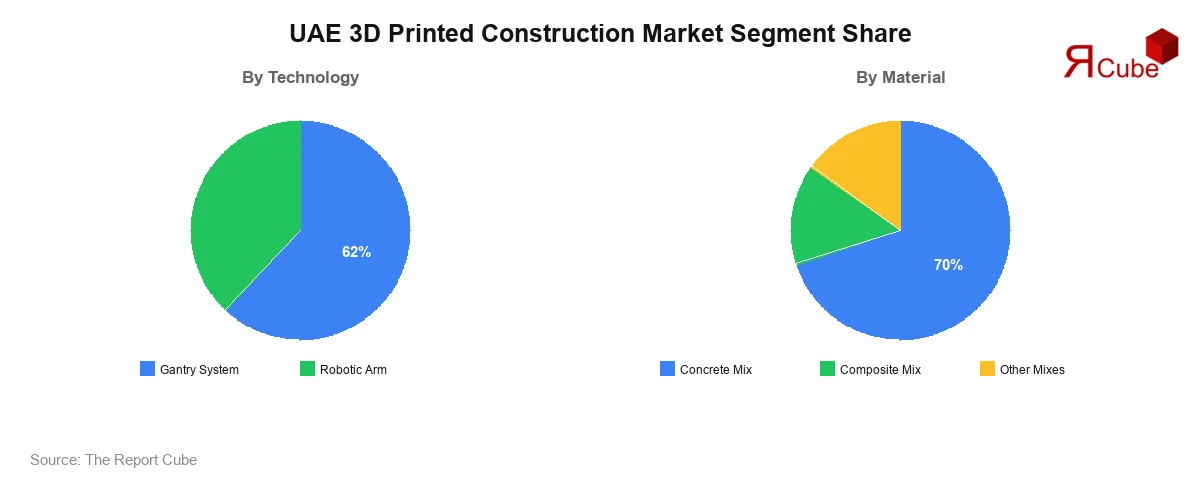
The gantry system segment leads the market, accounting for approximately 62% of total market share in 2025. Its dominance is driven by suitability for large-scale, repetitive construction projects such as housing units and low-rise buildings. Gantry systems offer higher stability, faster printing speeds, and lower operational complexity compared to robotic arms. However, robotic arm systems are expected to grow at a faster rate due to their flexibility in architectural design and adaptability to constrained construction sites.
By Material:
- Concrete Mix
- Composite Mix
- Other Mixes
Concrete mix materials dominate the UAE 3D Printed Construction Market, holding nearly 70% market share in 2025. Their widespread use is supported by proven structural performance, availability of raw materials, and regulatory acceptance. Composite mixes are gaining attention for enhanced strength and thermal properties, particularly in specialized applications. Ongoing research into alternative mixes is expected to further diversify material adoption over the forecast period.
Regional Projection of UAE 3D Printed Construction Industry
- Abu Dhabi
- Dubai
- Sharjah
- Ras Al Khaimah
- Other Emirates
Dubai leads the UAE 3D Printed Construction Market, contributing approximately 48% of total market revenue in 2025. The emirate’s leadership is driven by proactive government mandates, strong private sector participation, and a robust innovation ecosystem. Abu Dhabi follows closely, focusing on sustainable infrastructure and government-backed pilot projects. Other emirates are gradually adopting the technology, supported by shared knowledge transfer and decreasing equipment costs.
Need insights for a specific region within this market?
Request Regional DataWhy Choose This Report?
- Provides a comprehensive overview of the overall market analysis, encompassing key trends, consumer behavior analysis, and risk assessment to support strategic decision-making.
- Provides accurate, up-to-date insights into market size, segmentation, and emerging opportunities, helping to minimize risk & capitalizing on growth.
- Gives deep understanding of target audience preferences, investment habits, and communication channels for enhanced product development & marketing effectiveness.
- Delivers competitive analysis & benchmarking, uncovering the strengths & weaknesses of market competitors to guide strategies.
- Consolidate comprehensive market intelligence, reducing reasoning & streamlining research efforts.
- Facilitates customized market segmentation & risk mitigation strategies, fine-tuned to the business objectives.
- Aids in identifying both market challenges & untapped opportunities within the industry to drive long-term business growth.
- Provides valuable information based on actual customer data & search trends.
Table of Contents
- Introduction
- Objective of the Study
- Product and Category Definition
- Market Segmentation
- Study Variables
- Research Methodology
- Secondary Data Points
- Breakdown of Secondary Sources
- Primary Data Points
- Breakdown of Primary Interviews
- Secondary Data Points
- Executive Summary
- Market Dynamics
- Drivers
- Challenges
- Opportunity Assessment
- Recent Trends and Developments
- Regulatory and Policy Landscape
- UAE 3D Printed Construction Market Overview (2020-2034)
- Market Size, By Value (USD Million)
- Market Share, By Technology
- Gantry System
- Robotic Arm
- Market Share, By Material
- Concrete Mix
- Composite Mix
- Other Mixes
- Market Share, By Construction Type
- Residential
- Commercial
- Industrial
- Infrastructure
- Market Share, By End-User
- Developers
- Government
- Contractors
- Others
- Market Share, By Region
- Abu Dhabi
- Dubai
- Sharjah
- Ras Al Khaimah
- Other Emirates
- Market Share, By Company
- Revenue Shares
- Competition Characteristics
- Revenue Shares & Analysis
- Abu Dhabi 3D Printed Construction Market
- Market Size, By Value (USD Million)
- Market Share, By Technology
- Market Share, By Material
- Market Share, By Construction Type
- Market Share, By End-User
- Dubai 3D Printed Construction Market
- Market Size, By Value (USD Million)
- Market Share, By Technology
- Market Share, By Material
- Market Share, By Construction Type
- Market Share, By End-User
- Sharjah 3D Printed Construction Market
- Market Size, By Value (USD Million)
- Market Share, By Technology
- Market Share, By Material
- Market Share, By Construction Type
- Market Share, By End-User
- Ras Al Khaimah 3D Printed Construction Market
- Market Size, By Value (USD Million)
- Market Share, By Technology
- Market Share, By Material
- Market Share, By Construction Type
- Market Share, By End-User
- Competitive Outlook and Company Profiles
- Printstone3D
- Company Overview
- Technology & Services
- Strategic Alliances/Partnerships
- Recent Developments
- 3DXB Group
- Company Overview
- Technology & Services
- Strategic Alliances/Partnerships
- Recent Developments
- CyBe Construction
- Company Overview
- Technology & Services
- Strategic Alliances/Partnerships
- Recent Developments
- 3DVinci Creations
- Company Overview
- Technology & Services
- Strategic Alliances/Partnerships
- Recent Developments
- Concreative
- Company Overview
- Technology & Services
- Strategic Alliances/Partnerships
- Recent Developments
- e.construct
- Company Overview
- Technology & Services
- Strategic Alliances/Partnerships
- Recent Developments
- Apis Cor
- Company Overview
- Technology & Services
- Strategic Alliances/Partnerships
- Recent Developments
- COBOD International
- Company Overview
- Technology & Services
- Strategic Alliances/Partnerships
- Recent Developments
- Inoventive 3D
- Company Overview
- Technology & Services
- Strategic Alliances/Partnerships
- Recent Developments
- Avenco Robotics
- Company Overview
- Technology & Services
- Strategic Alliances/Partnerships
- Recent Developments
- Others
- Printstone3D
- Contact Us and Disclaimer
Top Key Players & Market Share Outlook
- Printstone3D Technology & Services
- 3DXB Group Technology & Services
- CyBe Construction Technology & Services
- 3DVinci Creations Technology & Services
- Concreative Technology & Services
- e.construct Technology & Services
- Apis Cor Technology & Services
- COBOD International Technology & Services
- Inoventive 3D Technology & Services
- Avenco Robotics Technology & Services
- Others
Frequently Asked Questions