



Build Your Custom Market Intelligence Report
Customize Your ReportUAE 3D Printing Market Insights & Analysis
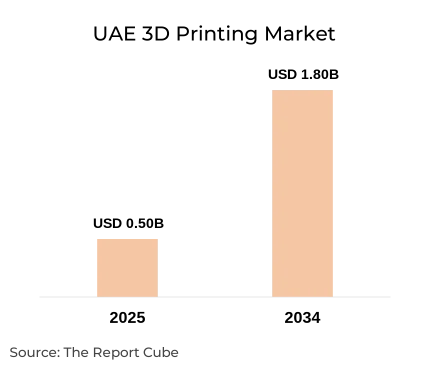
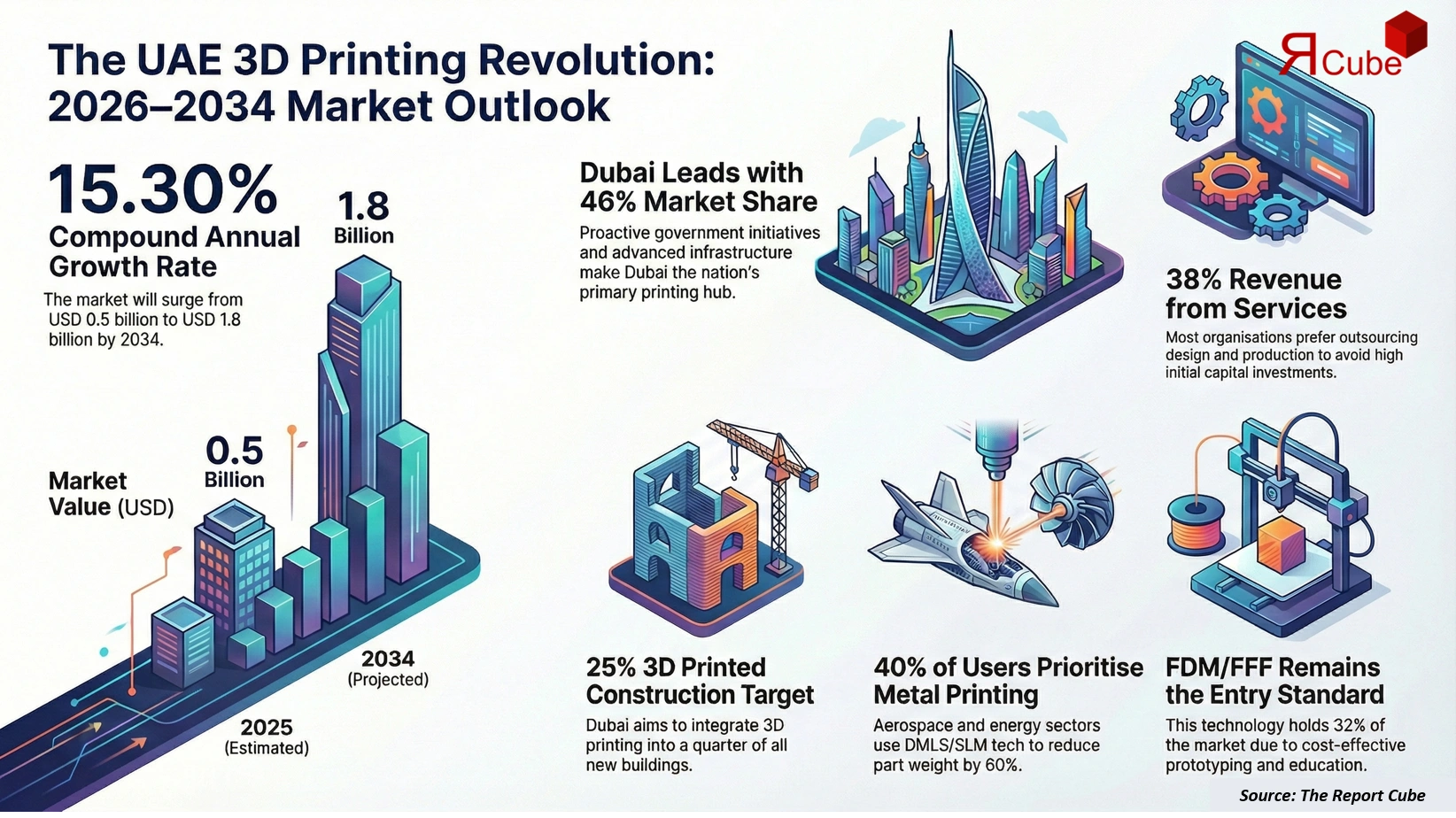
The UAE 3D Printing Market is anticipated to register a CAGR of 15.30% during 2026-2034. The market size was valued at USD 0.5 billion in 2025 and is projected to reach USD 1.8 billion by 2034. The UAE market is experiencing rapid acceleration due to strong government backing, advanced infrastructure development, and increasing adoption of additive manufacturing across construction, aerospace, healthcare, automotive, and industrial manufacturing sectors.
The country’s ambition to position itself as a global hub for advanced manufacturing has significantly boosted investments in 3D printing technologies. Public and private sector collaboration has enabled faster commercialization of prototypes, reduced material waste, and shorter production cycles. As a result, companies are increasingly adopting 3D printing to improve cost efficiency, customization capabilities, and supply chain resilience, particularly in high-value applications.
Moreover, rising demand for localized production and rapid prototyping is reshaping traditional manufacturing models across the UAE. The integration of 3D printing with smart factory initiatives and digital design platforms further strengthens the market outlook. These combined factors are expected to sustain strong growth momentum for the UAE 3D Printing Market through 2034.
UAE 3D Printing Market Recent Developments
- 2025: Immensa Technology Labs expanded its industrial-scale additive manufacturing facility to support aerospace and energy projects.
- 2025: Inoventive 3D launched advanced metal printing services targeting construction and heavy engineering applications.
Government Initiatives & Policies
- Dubai 3D Printing Strategy: Promotes large-scale adoption of additive manufacturing across construction and manufacturing sectors.
- UAE Industry 4.0 Program: Encourages advanced manufacturing technologies, including 3D printing, to enhance industrial competitiveness.
UAE 3D Printing Market Dynamics
Key Driver: Strong Government Support for Advanced Manufacturing
Government-led initiatives remain the most influential driver of the UAE 3D Printing Market. National strategies actively encourage the adoption of additive manufacturing to reduce reliance on imports, accelerate infrastructure delivery, and support sustainable construction practices. The Dubai 3D Printing Strategy alone targets integrating 3D printing into at least 25% of new buildings, creating substantial demand for large-format printers and construction-grade materials. In addition, public-sector procurement policies increasingly favor locally manufactured components, motivating industries to adopt 3D printing for rapid, on-demand production. This policy-driven demand creates a stable foundation for long-term market growth.
Book your FREE 30-minute expert consultation today
Contact UsIndustry Trends: Rising Adoption of Metal and Industrial-Grade Printing
A notable trend shaping the market is the growing shift toward metal and industrial-grade 3D printing technologies. Sectors such as aerospace, defense, and oil and gas are increasingly using DMLS and SLM technologies to produce complex, lightweight, and high-strength components. Nearly 40% of industrial users in the UAE now prioritize metal additive manufacturing due to its ability to reduce part weight by up to 60% while maintaining structural integrity. This trend is also encouraging service providers to expand advanced material portfolios and post-processing capabilities, strengthening the overall value chain.
Major Challenge: High Initial Investment and Skill Gap
Despite strong growth prospects, high initial capital investment remains a key challenge for the UAE 3D Printing Market. Advanced industrial printers, specialized materials, and skilled workforce requirements significantly increase entry barriers, particularly for small and mid-sized enterprises. Additionally, limited availability of experienced design engineers and additive manufacturing specialists slows adoption across certain industries. While training programs are expanding, the skill gap continues to restrain faster penetration of advanced 3D printing solutions, especially outside major urban centers.
Opportunity: Customization and On-Demand Manufacturing
The growing demand for customization and on-demand manufacturing presents a major opportunity for market participants. 3D printing enables companies to deliver highly customized components without the need for expensive tooling or long lead times. This capability is particularly valuable in healthcare, where patient-specific implants and prosthetics are gaining popularity, and in construction, where customized architectural elements improve design flexibility. As businesses increasingly prioritize agility and personalization, additive manufacturing is expected to unlock new revenue streams across multiple industries.
UAE 3D Printing Market Segment-wise Analysis
By Technology:
- FDM/FFF
- SLA/DLP
- SLS
- DMLS/SLM
Among technologies, FDM/FFF holds the largest market share at approximately 32% in 2025, driven by its cost-effectiveness and widespread use in prototyping and educational applications. However, DMLS/SLM is the fastest-growing segment, supported by rising demand from aerospace and industrial manufacturing. Metal printing technologies offer superior strength, durability, and precision, making them increasingly attractive for mission-critical components and high-value applications.
By Component:
- Printers
- Materials
- Software
- Services
Services dominate the component segment, accounting for nearly 38% of market revenue. Many end users prefer outsourcing design, printing, and post-processing to specialized service providers to avoid high upfront investment. This trend is particularly strong in construction and healthcare, where complex regulatory and quality requirements favor experienced service partners. Meanwhile, materials demand continues to grow steadily, supported by increasing use of advanced polymers and metal powders.
Regional Projection of UAE 3D Printing Industry
- Dubai
- Abu Dhabi
- Sharjah & North
Dubai leads the UAE 3D Printing Market with an estimated 46% market share in 2025. The emirate benefits from proactive government initiatives, strong private-sector participation, and advanced infrastructure. Dubai hosts the majority of large-scale 3D printing projects, particularly in construction and industrial manufacturing. Abu Dhabi follows as a key growth region, supported by investments in aerospace, defense, and energy sectors, while Sharjah and the northern emirates are gradually expanding adoption through industrial parks and academic partnerships.
Need insights for a specific region within this market?
Request Regional DataWhy Choose This Report?
- Provides a comprehensive overview of the overall market analysis, encompassing key trends, consumer behavior analysis, and risk assessment to support strategic decision-making.
- Provides accurate, up-to-date insights into market size, segmentation, and emerging opportunities, helping to minimize risk & capitalizing on growth.
- Gives deep understanding of target audience preferences, investment habits, and communication channels for enhanced product development & marketing effectiveness.
- Delivers competitive analysis & benchmarking, uncovering the strengths & weaknesses of market competitors to guide strategies.
- Consolidate comprehensive market intelligence, reducing reasoning & streamlining research efforts.
- Facilitates customized market segmentation & risk mitigation strategies, fine-tuned to the business objectives.
- Aids in identifying both market challenges & untapped opportunities within the industry to drive long-term business growth.
- Provides valuable information based on actual customer data & search trends.
Table of Contents
- Introduction
- Objective of the Study
- Product and Category Definition
- Market Segmentation
- Study Variables
- Research Methodology
- Secondary Data Points
- Breakdown of Secondary Sources
- Primary Data Points
- Breakdown of Primary Interviews
- Secondary Data Points
- Executive Summary
- Market Dynamics
- Drivers
- Challenges
- Opportunity Assessment
- Recent Trends and Developments
- Regulatory and Policy Landscape
- UAE 3D Printing Market Overview (2020-2034)
- Market Size, By Value (USD Billion)
- Market Share, By Technology
- FDM/FFF
- SLA/DLP
- SLS
- DMLS/SLM
- Binder Jetting
- Material Jetting
- Market Share, By Component
- Printers
- Materials
- Software
- Services
- Market Share, By Material
- Plastics
- Metals
- Ceramics
- Composites
- Concrete
- Market Share, By Application
- Prototyping
- Tooling
- Functional Parts
- Market Share, By End User
- Construction
- Healthcare
- Automotive
- Aerospace
- Consumer Goods
- Education
- Oil & Gas
- Market Share, By Region
- Dubai
- Abu Dhabi
- Sharjah & North
- Market Share, By Company
- Revenue Shares
- Competitive Landscape
- Dubai 3D Printing Market
- Market Size, By Value (USD Billion)
- Market Share, By Technology
- Market Share, By Component
- Market Share, By Material
- Market Share, By Application
- Market Share, By End User
- Abu Dhabi 3D Printing Market
- Market Size, By Value (USD Billion)
- Market Share, By Technology
- Market Share, By Component
- Market Share, By Material
- Market Share, By Application
- Market Share, By End User
- Sharjah & Northerns 3D Printing Market
- Market Size, By Value (USD Billion)
- Market Share, By Technology
- Market Share, By Component
- Market Share, By Material
- Market Share, By Application
- Market Share, By End User
- Competitive Outlook and Company Profiles
- Ultratec 3D
- Company Overview
- Product & Service Portfolio
- Strategic Alliances/Partnerships
- Recent Developments
- Immensa Technology Labs
- Company Overview
- Product & Service Portfolio
- Strategic Alliances/Partnerships
- Recent Developments
- Generation 3D
- Company Overview
- Product & Service Portfolio
- Strategic Alliances/Partnerships
- Recent Developments
- 3DVinci Creations
- Company Overview
- Product & Service Portfolio
- Strategic Alliances/Partnerships
- Recent Developments
- Sinterex
- Company Overview
- Product & Service Portfolio
- Strategic Alliances/Partnerships
- Recent Developments
- Proto21
- Company Overview
- Product & Service Portfolio
- Strategic Alliances/Partnerships
- Recent Developments
- 3D Creations
- Company Overview
- Product & Service Portfolio
- Strategic Alliances/Partnerships
- Recent Developments
- Inoventive 3D
- Company Overview
- Product & Service Portfolio
- Strategic Alliances/Partnerships
- Recent Developments
- 3D HUB Dubai
- Company Overview
- Product & Service Portfolio
- Strategic Alliances/Partnerships
- Recent Developments
- Print Big LLC
- Company Overview
- Product & Service Portfolio
- Strategic Alliances/Partnerships
- Recent Developments
- Others
- Ultratec 3D
- Contact Us and Disclaimer
Top Key Players & Market Share Outlook
- Ultratec 3D
- Immensa Technology Labs
- Generation 3D
- 3DVinci Creations
- Sinterex
- Proto21
- 3D Creations
- Inoventive 3D
- 3D HUB Dubai
- Print Big LLC
- Others
Frequently Asked Questions






