




Build Your Custom Market Intelligence Report
Customize Your ReportUnited States (US) Steel Tubes Market Insights & Analysis
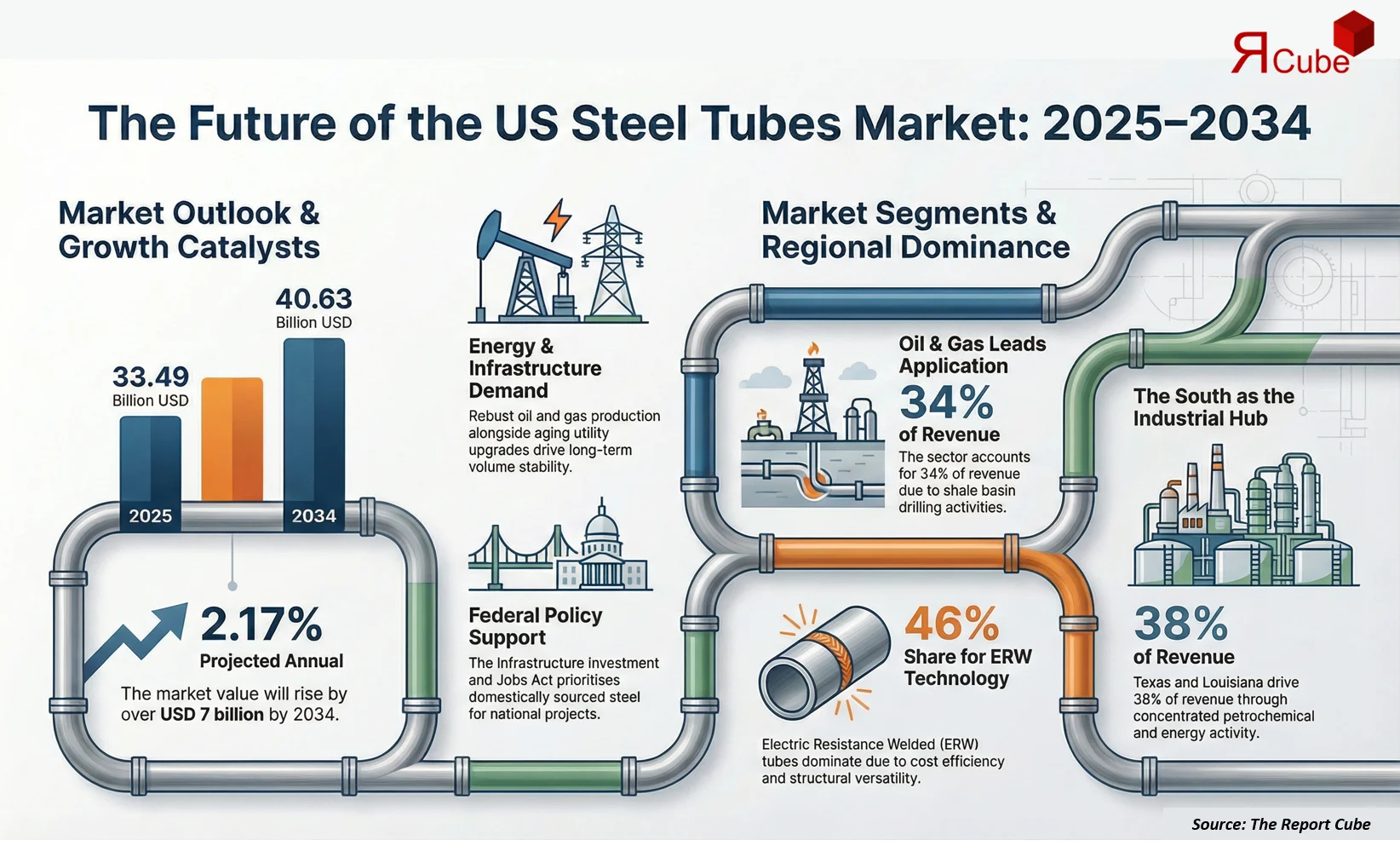
The United States (US) Steel Tubes Market is anticipated to register a CAGR of 2.17% during 2026-2034. The market size was valued at USD 33.49 billion in 2025 and is projected to reach USD 40.63 billion by 2034. The market remains a critical backbone of the US industrial ecosystem, supported by consistent demand from energy, construction, automotive, and infrastructure sectors. Steel tubes continue to be indispensable due to their strength, durability, and versatility across high-pressure and structural applications.
Growth in the market is closely linked to rising investments in domestic energy production, particularly shale oil and gas, alongside ongoing upgrades to aging water, sewage, and power infrastructure. Federal infrastructure funding and reshoring initiatives are encouraging domestic steel consumption, benefiting local tube manufacturers. At the same time, advancements in manufacturing technologies are improving product consistency and cost efficiency, helping producers remain competitive against imports.
Additionally, sustainability considerations are shaping procurement decisions, with end users increasingly favoring domestically produced steel tubes due to lower supply chain risk and improved environmental compliance. As downstream industries stabilize and gradually expand, the US Steel Tubes Market is expected to maintain steady, long-term growth through 2034.
United States (US) Steel Tubes Market Recent Developments
- 2025: : Hi‑Tech Pipes Limited expanded ERW tube capacity to support rising domestic energy infrastructure demand.
- 2025: :Vallourec strengthened its US manufacturing footprint to improve OCTG supply reliability.
Government Initiatives & Policies
- Infrastructure Investment and Jobs Act: Supports large-scale upgrades of water, energy, and transportation infrastructure using domestically sourced steel.
- Buy America Provisions: Encourages the use of US-made steel products in federally funded projects.
United States (US) Steel Tubes Market Dynamics
Key Driver: Strong Demand from Energy and Infrastructure Sectors
Robust demand from oil & gas and infrastructure development is a primary driver of the US Steel Tubes Market. Steel tubes are essential for drilling, transmission, and structural support across upstream and midstream energy operations. With US crude oil production remaining above 12 million barrels per day, the need for OCTG and line pipes continues to support stable tube consumption. Simultaneously, large-scale investments in water pipelines, sewage systems, and power generation facilities are driving steady orders for structural and pressure tubes. These combined demand streams provide long-term volume stability for domestic manufacturers.
Book your FREE 30-minute expert consultation today
Contact UsIndustry Trends: Shift Toward High-Performance and Specialized Tubes
A notable trend in the market is the growing preference for high-performance and application-specific steel tubes. End users increasingly demand products with improved corrosion resistance, higher strength-to-weight ratios, and tighter dimensional tolerances. This trend is especially evident in petrochemical and automotive applications, where performance and safety standards are rising. Manufacturers are responding by investing in advanced metallurgy, automated inspection systems, and process optimization. As a result, value-added steel tubes are gaining traction, allowing producers to improve margins despite moderate overall market growth.
Major Challenge: Volatility in Raw Material Prices
Fluctuating steel scrap and iron ore prices pose a significant challenge to market participants. Raw material cost volatility directly impacts production economics, making pricing strategies difficult, particularly for long-term supply contracts. Smaller and mid-sized manufacturers are more exposed to margin pressure when unable to pass cost increases to customers. Additionally, competition from low-cost imports during periods of relaxed trade enforcement can further strain domestic pricing, challenging profitability across the value chain.
Opportunity: Infrastructure Modernization and Reshoring Initiatives
Ongoing infrastructure modernization and reshoring of manufacturing activities present a strong opportunity for the US Steel Tubes Market. Federal and state-funded projects prioritize domestically produced steel, directly benefiting US-based tube manufacturers. Furthermore, reshoring trends in automotive and industrial manufacturing are increasing local demand for precision steel tubes. Companies that align capacity expansion with infrastructure timelines and invest in product differentiation are well-positioned to capture incremental growth over the forecast period.
United States (US) Steel Tubes Market Segment-wise Analysis
By Application:
- Oil & Gas
- Petrochemicals
- Construction
- Automotive
The Oil & Gas segment leads the market by application, accounting for approximately 34% of total revenue in 2025. This dominance is driven by sustained drilling activity, pipeline maintenance, and replacement projects across major shale basins. Steel tubes used in this segment require high durability and pressure resistance, supporting higher average selling prices. Construction follows closely, supported by non-residential building and infrastructure projects, while automotive demand remains stable due to consistent vehicle production and aftermarket needs.
By Technology:
- Seamless Tubes
- ERW Tubes
- SAW Tubes
- Other Technologies
ERW tubes dominate the technology segment, holding nearly 46% market share in 2025. Their cost efficiency, dimensional accuracy, and suitability for structural and automotive applications drive widespread adoption. Seamless tubes command strong demand in high-pressure oil & gas and power generation uses, while SAW tubes are preferred for large-diameter pipeline projects. Technological advancements are improving quality consistency across all categories.
Regional Projection of United States (US) Steel Tubes Industry
- Northeast
- Midwest
- South
- West
The South region leads the US Steel Tubes Market, contributing approximately 38% of total revenue in 2025. This leadership is supported by high concentration of oil & gas activity, expanding petrochemical hubs, and favorable industrial policies. States such as Texas and Louisiana drive substantial demand for OCTG and line pipes. The Midwest follows closely due to its strong automotive and manufacturing base, while infrastructure upgrades support steady growth across all regions.
Need insights for a specific region within this market?
Request Regional DataWhy Choose This Report?
- Provides a comprehensive overview of the overall market analysis, encompassing key trends, consumer behavior analysis, and risk assessment to support strategic decision-making.
- Provides accurate, up-to-date insights into market size, segmentation, and emerging opportunities, helping to minimize risk & capitalizing on growth.
- Gives deep understanding of target audience preferences, investment habits, and communication channels for enhanced product development & marketing effectiveness.
- Delivers competitive analysis & benchmarking, uncovering the strengths & weaknesses of market competitors to guide strategies.
- Consolidate comprehensive market intelligence, reducing reasoning & streamlining research efforts.
- Facilitates customized market segmentation & risk mitigation strategies, fine-tuned to the business objectives.
- Aids in identifying both market challenges & untapped opportunities within the industry to drive long-term business growth.
- Provides valuable information based on actual customer data & search trends.
Table of Contents
- Introduction
- Objective of the Study
- Product and Category Definition
- Market Segmentation
- Study Variables
- Research Methodology
- Secondary Data Points
- Breakdown of Secondary Sources
- Primary Data Points
- Breakdown of Primary Interviews
- Secondary Data Points
- Executive Summary
- Market Dynamics
- Drivers
- Challenges
- Opportunity Assessment
- Recent Trends and Developments
- Regulatory and Policy Landscape
- US Steel Tubes Market Overview (2021-2034)
- Market Size, By Value (USD Billion)
- Market Share, By Application
- Oil & Gas
- Petrochemicals
- Construction
- Automotive
- Water & Sewage
- Power Generation
- Other Industries
- Market Share, By Technology
- Seamless Tubes
- ERW Tubes
- SAW Tubes
- Market Share, By End User
- Commercial
- Residential
- Industrial
- Market Share, By Region
- Northeast
- Midwest
- South
- West
- Market Share, By Company
- Competition Characteristics
- Revenue Shares & Analysis
- Northeast US Steel Tubes Market
- Market Size, By Value (USD Billion)
- Market Share, By Application
- Market Share, By Technology
- Market Share, By End User
- Midwest US Steel Tubes Market
- Market Size, By Value (USD Billion)
- Market Share, By Application
- Market Share, By Technology
- Market Share, By End User
- South US Steel Tubes Market
- Market Size, By Value (USD Billion)
- Market Share, By Application
- Market Share, By Technology
- Market Share, By End User
- West US Steel Tubes Market
- Market Size, By Value (USD Billion)
- Market Share, By Application
- Market Share, By Technology
- Market Share, By End User
- Competitive Outlook and Company Profiles
- United States Steel Corporation
- Company Overview
- Product Portfolio
- Strategic Alliances/Partnerships
- Recent Developments
- Nucor Tubular Products
- Company Overview
- Product Portfolio
- Strategic Alliances/Partnerships
- Recent Developments
- Zekelman Industries
- Company Overview
- Product Portfolio
- Strategic Alliances/Partnerships
- Recent Developments
- US Steel Tubular Products
- Company Overview
- Product Portfolio
- Strategic Alliances/Partnerships
- Recent Developments
- Tenaris
- Company Overview
- Product Portfolio
- Strategic Alliances/Partnerships
- Recent Developments
- Vallourec Star
- Company Overview
- Product Portfolio
- Strategic Alliances/Partnerships
- Recent Developments
- TMK IPSCO
- Company Overview
- Product Portfolio
- Strategic Alliances/Partnerships
- Recent Developments
- American Cast Iron Pipe Company
- Company Overview
- Product Portfolio
- Strategic Alliances/Partnerships
- Recent Developments
- Allied Tube & Conduit
- Company Overview
- Product Portfolio
- Strategic Alliances/Partnerships
- Recent Developments
- Benteler Steel Tube Manufacturing
- Company Overview
- Product Portfolio
- Strategic Alliances/Partnerships
- Recent Developments
- Others
- United States Steel Corporation
- Contact Us and Disclaimer
Top Key Players & Market Share Outlook
- United States Steel Corporation
- Nucor Tubular Products
- Zekelman Industries
- US Steel Tubular Products
- Tenaris
- Vallourec Star
- TMK IPSCO
- American Cast Iron Pipe Company
- Allied Tube & Conduit
- Benteler Steel Tube Manufacturing
- Others
Frequently Asked Questions






