



Build Your Custom Market Intelligence Report
Customize Your ReportUAE Welding Equipment Market Insights & Analysis
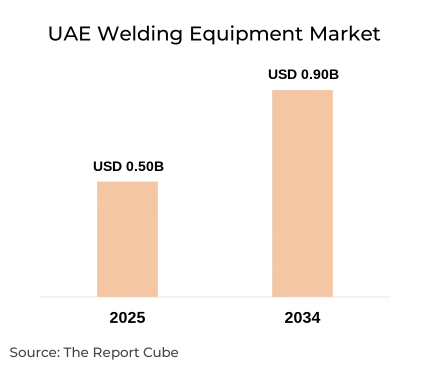
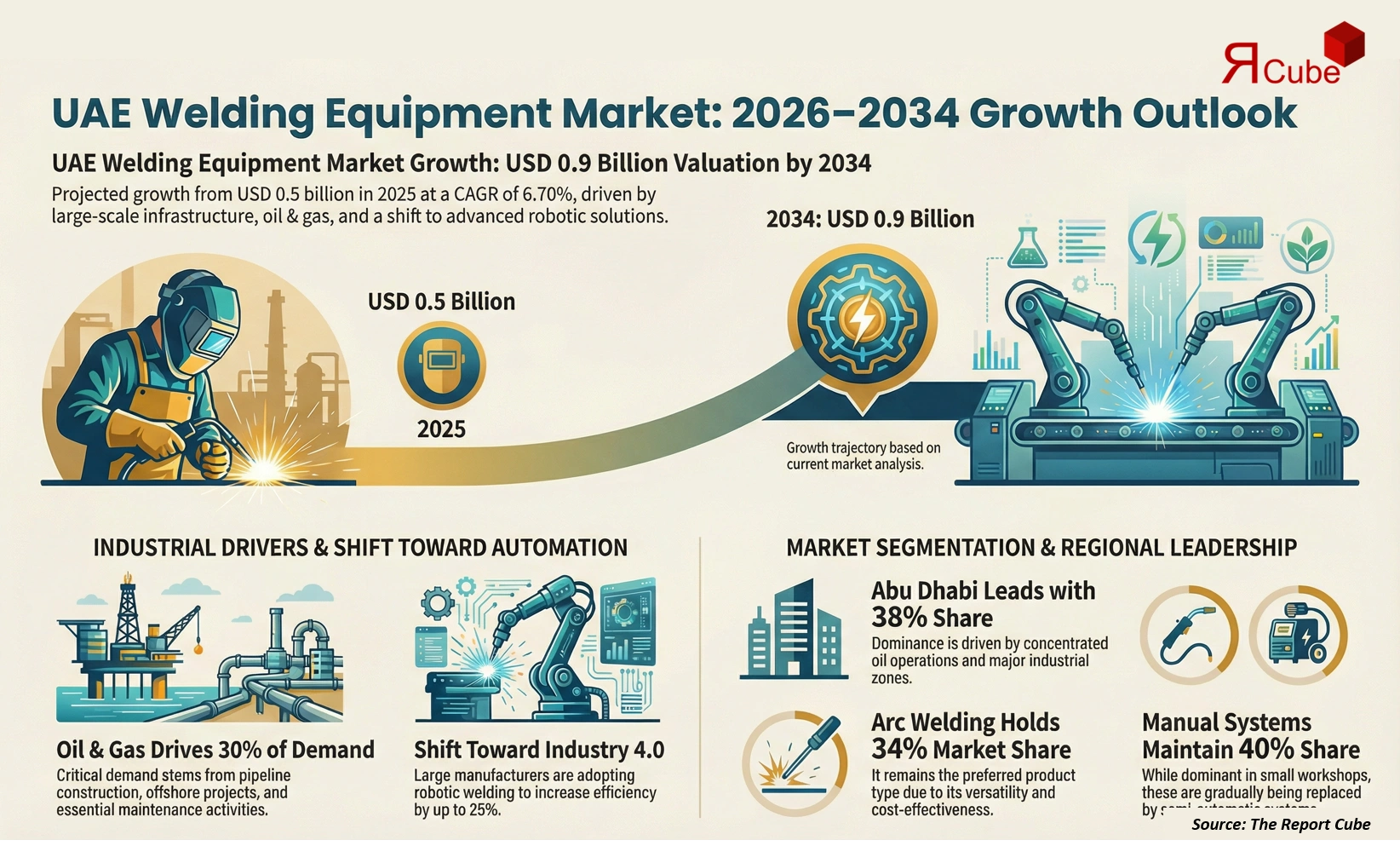
The UAE Welding Equipment Market is anticipated to register a CAGR of 6.70% during 2026-2034. The market size was valued at USD 0.5 billion in 2025 and is projected to reach USD 0.9 billion by 2034. The market is gaining consistent momentum, supported by large-scale infrastructure development, rising investments in oil & gas projects, and continuous expansion of industrial manufacturing facilities across the UAE. Welding equipment remains a critical component in construction, shipbuilding, energy, and automotive sectors, ensuring structural integrity and operational efficiency.
The UAE’s long-term economic diversification strategy is accelerating demand for advanced welding technologies. Industrial zones, logistics hubs, and renewable energy projects are increasing the need for precision welding solutions. Furthermore, the government’s focus on local manufacturing and smart factories is encouraging the adoption of automated and robotic welding systems. These shifts are gradually transforming the welding equipment landscape from conventional manual systems to more efficient and digitally enabled solutions.
In addition, the presence of global welding equipment manufacturers and distributors in the UAE strengthens supply availability and technical support. Training programs, equipment leasing models, and after-sales services are also improving adoption rates among small and medium-sized enterprises. Together, these factors position the UAE Welding Equipment Market for sustainable growth through 2034.
UAE Welding Equipment Market Recent Developments
- 2025: Lincoln Electric expanded its welding automation portfolio in the UAE to support large infrastructure projects.
- 2025: ESAB Corporation introduced energy-efficient inverter-based welding machines for industrial users.
Government Initiatives & Policies
- Operation 300bn: UAE industrial strategy supporting advanced manufacturing and fabrication technologies.
- UAE Net Zero 2050 Initiative: Encourages efficient industrial processes and advanced equipment adoption.
UAE Welding Equipment Market Dynamics
Key Driver: Rapid Infrastructure and Industrial Development
Rapid infrastructure expansion across the UAE is a primary driver of the welding equipment market. Mega construction projects, including commercial complexes, transportation networks, and energy facilities, require extensive welding activities. The oil & gas sector alone accounts for nearly 30% of total welding equipment demand, driven by pipeline construction, maintenance, and offshore projects. Additionally, growing investments in metal fabrication and industrial manufacturing are increasing the need for reliable welding systems. As the UAE continues to position itself as a regional industrial hub, demand for both conventional and advanced welding equipment is expected to rise steadily.
Book your FREE 30-minute expert consultation today
Contact UsIndustry Trends: Shift Toward Automation and Robotic Welding
A key trend shaping the market is the gradual shift toward automated and robotic welding systems. Large manufacturers and fabrication units are adopting robotic welding to improve precision, reduce material waste, and enhance productivity. Automated systems can increase welding efficiency by up to 25% while ensuring consistent quality. This trend aligns with the UAE’s broader push toward Industry 4.0 and smart manufacturing. Although manual systems remain dominant among smaller workshops, increasing labor costs and the need for skilled welders are accelerating interest in semi-automatic and robotic solutions.
Major Challenge: High Initial Investment and Skilled Labor Shortage
High upfront costs associated with advanced welding equipment pose a major challenge to market growth. Automated and robotic systems require significant capital investment, making them less accessible to small and medium enterprises. Additionally, operating sophisticated welding equipment demands skilled technicians, and the shortage of certified welders and automation specialists can slow adoption. Maintenance costs and the need for regular training further add to operational expenses, creating barriers for broader market penetration.
Opportunity: Growing Demand for Energy-Efficient and Sustainable Welding Solutions
The increasing emphasis on sustainability and energy efficiency presents a strong opportunity for the UAE Welding Equipment Market. Industries are seeking inverter-based and low-energy welding machines to reduce power consumption and operational costs. Energy-efficient welding equipment can lower electricity usage by up to 20%, making them attractive for large-scale projects. Furthermore, renewable energy installations, including solar and wind projects, require specialized welding solutions, opening new application areas for advanced equipment suppliers.
UAE Welding Equipment Market Segment-wise Analysis
By Product Type:
- Arc Welding
- MIG/MAG Welding
- TIG Welding
- Spot Welding
- Plasma Welding
Arc welding leads the UAE Welding Equipment Market by product type, accounting for approximately 34% market share in 2025. Its dominance is attributed to versatility, cost-effectiveness, and widespread use in construction and heavy fabrication. MIG/MAG welding follows closely, driven by its efficiency and suitability for high-volume industrial applications. TIG welding remains essential for precision tasks in aerospace and specialized manufacturing, while plasma welding is gradually gaining traction for high-quality, automated applications.
By Equipment Type:
- Manual Systems
- Semi-Automatic
- Automatic
- Robotic Systems
Manual welding systems currently dominate the market with nearly 40% share, supported by their affordability and extensive use in small workshops and maintenance activities. However, semi-automatic systems are witnessing faster growth due to improved productivity and reduced skill dependency. Robotic systems, though holding a smaller share, represent the fastest-growing segment as large manufacturers increasingly prioritize automation and consistent quality.
Regional Projection of UAE Welding Equipment Industry
- Abu Dhabi
- Dubai
- Sharjah
- Northern Emirates
Abu Dhabi leads the UAE Welding Equipment Market, contributing nearly 38% of total revenue in 2025. The region’s dominance is driven by large oil & gas operations, industrial zones, and infrastructure investments. Dubai follows closely, supported by construction, real estate, and manufacturing activities. Sharjah and the Northern Emirates are emerging as growth regions due to expanding industrial clusters and logistics facilities, gradually increasing regional demand for welding equipment.
Need insights for a specific region within this market?
Request Regional DataWhy Choose This Report?
- Provides a comprehensive overview of the overall market analysis, encompassing key trends, consumer behavior analysis, and risk assessment to support strategic decision-making.
- Provides accurate, up-to-date insights into market size, segmentation, and emerging opportunities, helping to minimize risk & capitalizing on growth.
- Gives deep understanding of target audience preferences, investment habits, and communication channels for enhanced product development & marketing effectiveness.
- Delivers competitive analysis & benchmarking, uncovering the strengths & weaknesses of market competitors to guide strategies.
- Consolidate comprehensive market intelligence, reducing reasoning & streamlining research efforts.
- Facilitates customized market segmentation & risk mitigation strategies, fine-tuned to the business objectives.
- Aids in identifying both market challenges & untapped opportunities within the industry to drive long-term business growth.
- Provides valuable information based on actual customer data & search trends.
Table of Contents
- Introduction
- Objective of the Study
- Product and Category Definition
- Market Segmentation
- Study Variables
- Research Methodology
- Secondary Data Points
- Breakdown of Secondary Sources
- Primary Data Points
- Breakdown of Primary Interviews
- Secondary Data Points
- Executive Summary
- Market Dynamics
- Drivers
- Challenges
- Opportunity Assessment
- Recent Trends and Developments
- Regulatory and Policy Landscape
- UAE Welding Equipment Market Overview (2020-2034)
- Market Size, By Value (USD Billion)
- Market Share, By Product Type
- Arc Welding
- MIG/MAG Welding
- TIG Welding
- Spot Welding
- Plasma Welding
- Market Share, By Equipment Type
- Manual Systems
- Semi‑Automatic
- Automatic
- Robotic Systems
- Market Share, By End‑Use Sector
- Oil and Gas
- Construction
- Manufacturing
- Shipbuilding
- Power and Energy
- Market Share, By Consumable
- Stick Electrodes
- Solid Wires
- Flux‑Cored Wires
- SAW Wires
- Shielding Gases
- Market Share, By Sales Channel
- Direct Sales
- Distributors
- Online Channels
- Market Share, By Region
- Abu Dhabi
- Dubai
- Sharjah
- Northern Emirates
- Market Share, By Company
- Competition Characteristics
- Revenue Shares & Analysis
- Abu Dhabi Welding Equipment Market
- Market Size, By Value (USD Billion)
- Market Share, By Product Type
- Market Share, By Equipment Type
- Market Share, By End‑Use Sector
- Market Share, By Consumable
- Market Share, By Sales Channel
- Dubai Welding Equipment Market
- Market Size, By Value (USD Billion)
- Market Share, By Product Type
- Market Share, By Equipment Type
- Market Share, By End‑Use Sector
- Market Share, By Consumable
- Market Share, By Sales Channel
- Sharjah Welding Equipment Market
- Market Size, By Value (USD Billion)
- Market Share, By Product Type
- Market Share, By Equipment Type
- Market Share, By End‑Use Sector
- Market Share, By Consumable
- Market Share, By Sales Channel
- Northern Emirates Welding Equipment Market
- Market Size, By Value (USD Billion)
- Market Share, By Product Type
- Market Share, By Equipment Type
- Market Share, By End‑Use Sector
- Market Share, By Consumable
- Market Share, By Sales Channel
- Competitive Outlook and Company Profiles
- The Lincoln Electric Company
- Company Overview
- Product Portfolio
- Strategic Alliances/Partnerships
- Recent Developments
- ESAB Corporation
- Company Overview
- Product Portfolio
- Strategic Alliances/Partnerships
- Recent Developments
- Miller Electric Mfg. LLC
- Company Overview
- Product Portfolio
- Strategic Alliances/Partnerships
- Recent Developments
- Kemppi Oy
- Company Overview
- Product Portfolio
- Strategic Alliances/Partnerships
- Recent Developments
- Panasonic Connect Co., Ltd.
- Company Overview
- Product Portfolio
- Strategic Alliances/Partnerships
- Recent Developments
- Fronius International GmbH
- Company Overview
- Product Portfolio
- Strategic Alliances/Partnerships
- Recent Developments
- Illinois Tool Works Inc.
- Company Overview
- Product Portfolio
- Strategic Alliances/Partnerships
- Recent Developments
- voestalpine Böhler Welding
- Company Overview
- Product Portfolio
- Strategic Alliances/Partnerships
- Recent Developments
- Ador Welding Ltd.
- Company Overview
- Product Portfolio
- Strategic Alliances/Partnerships
- Recent Developments
- Carl Cloos Schweißtechnik GmbH
- Company Overview
- Product Portfolio
- Strategic Alliances/Partnerships
- Recent Developments
- Others
- The Lincoln Electric Company
- Contact Us and Disclaimer
Top Key Players & Market Share Outlook
- The Lincoln Electric Company
- ESAB Corporation
- Miller Electric Mfg. LLC
- Kemppi Oy
- Panasonic Connect Co., Ltd.
- Fronius International GmbH
- Illinois Tool Works Inc.
- voestalpine Böhler Welding
- Ador Welding Ltd.
- Carl Cloos Schweißtechnik GmbH
- Others
Frequently Asked Questions






