



Build Your Custom Market Intelligence Report
Customize Your ReportUnited States Access Control Market Insights & Analysis
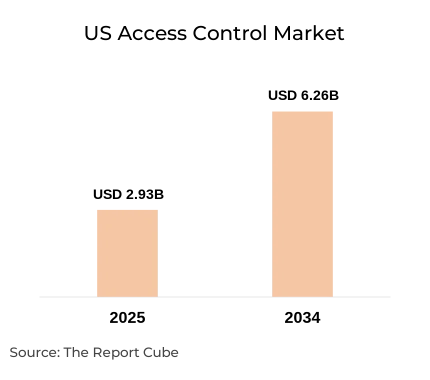
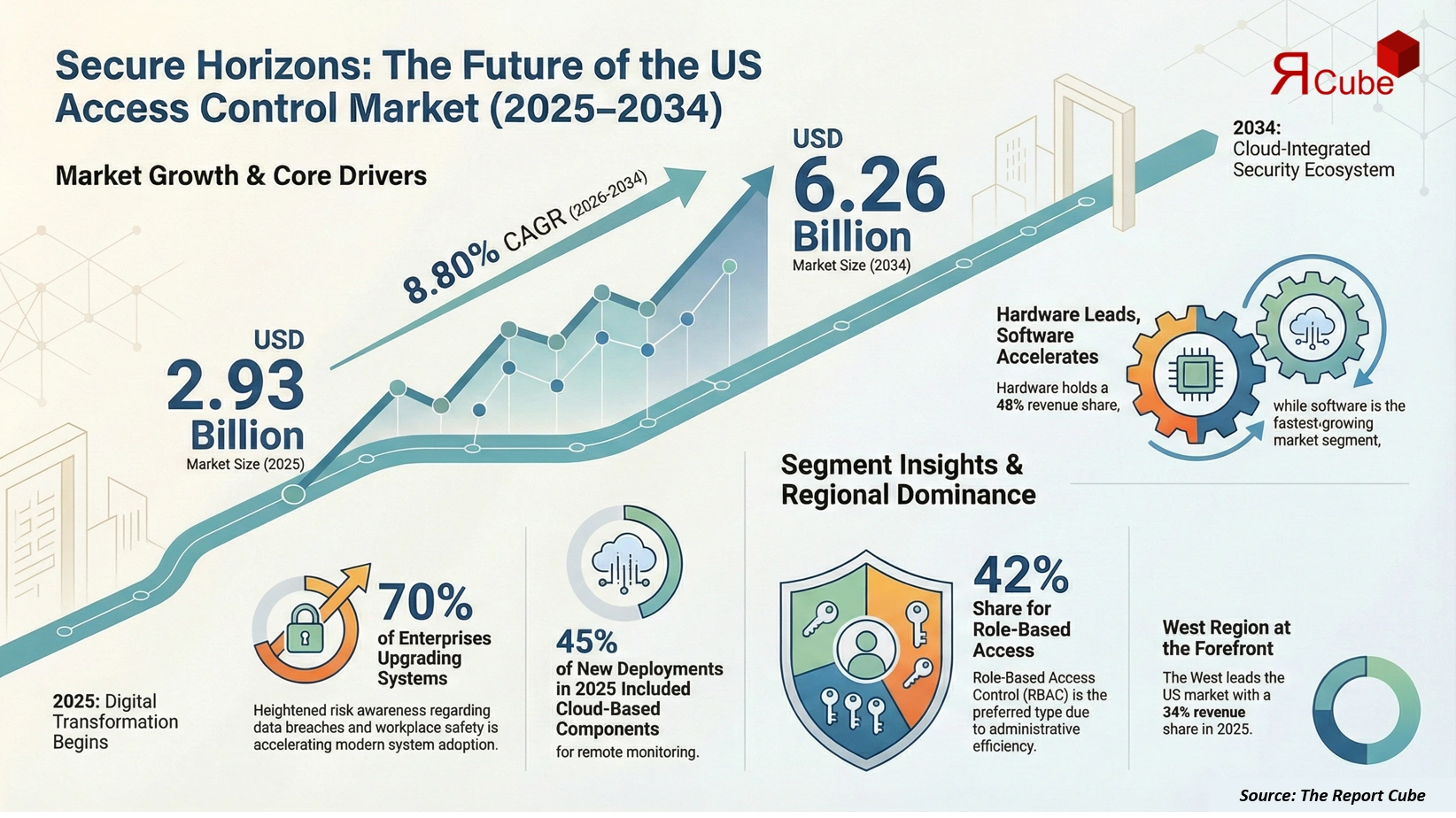
The United States Access Control Market is anticipated to register a CAGR of 8.80% during 2026-2034. The market size was valued at USD 2.93 billion in 2025 and is projected to reach USD 6.26 billion by 2034. The market is expanding rapidly as organizations across commercial, residential, industrial, and government sectors prioritize security, compliance, and identity management. Rising concerns over unauthorized access, data breaches, and workplace safety are encouraging the adoption of advanced access control systems across public and private infrastructure.
This growth is further reinforced by increasing investments in smart buildings and critical infrastructure modernization. Enterprises are shifting from traditional lock-and-key mechanisms toward integrated access control platforms combining hardware, software, and analytics. The widespread deployment of cloud-based access management solutions is also enhancing scalability and remote monitoring capabilities, particularly for multi-site organizations. As security threats become more sophisticated, demand for intelligent and adaptive access control solutions continues to rise steadily across the United States.
Moreover, regulatory requirements related to data protection, employee safety, and facility security are compelling organizations to upgrade legacy systems. The convergence of access control with video surveillance, biometrics, and IoT-enabled security ecosystems is strengthening the market outlook. These interconnected developments collectively position the U.S. Access Control Market for sustained, high-value growth through 2034.
United States Access Control Market Recent Developments
- 2025: Honeywell International expanded its cloud-based access control portfolio to support multi-site enterprise security management.
- 2025: ASSA ABLOY introduced next-generation biometric readers focused on high-security commercial applications.
Government Initiatives & Policies
- U.S. Cybersecurity Strategy: Strengthens physical and digital access protection across critical infrastructure.
- Federal Building Security Standards Program: Enhances access control requirements for government facilities.
United States Access Control Market Dynamics
Key Driver: Rising Security Threats and Infrastructure Protection Needs
The increasing frequency of security breaches, workplace violence incidents, and unauthorized facility access is a primary driver of the United States Access Control Market. Organizations are under mounting pressure to protect employees, assets, and sensitive data, particularly in sectors such as healthcare, finance, education, and government. Over 70% of U.S. enterprises upgraded or planned to upgrade access control systems by 2025, reflecting heightened risk awareness. Modern access control solutions provide real-time monitoring, identity verification, and audit trails, enabling proactive threat mitigation. This growing emphasis on comprehensive security frameworks continues to accelerate market adoption nationwide.
Book your FREE 30-minute expert consultation today
Contact UsIndustry Trends: Shift Toward Cloud-Based and Integrated Access Systems
A major trend reshaping the market is the transition toward cloud-based access control platforms integrated with broader security ecosystems. Organizations increasingly prefer centralized management dashboards that allow remote access provisioning, monitoring, and compliance reporting. Cloud adoption reduces upfront infrastructure costs while enabling scalability and rapid deployment across distributed locations. Additionally, integration with video surveillance, visitor management, and analytics tools enhances situational awareness. Approximately 45% of new access control deployments in 2025 included cloud-native components, highlighting the strong momentum behind this trend.
Major Challenge: High Implementation Costs and System Complexity
Despite strong demand, high implementation and integration costs remain a significant challenge, particularly for small and mid-sized enterprises. Advanced access control systems require substantial investment in hardware, software licensing, network infrastructure, and skilled personnel. Compatibility issues between legacy systems and modern platforms further complicate deployment. Additionally, ongoing maintenance and cybersecurity considerations increase total cost of ownership. These factors can delay adoption decisions and limit market penetration among cost-sensitive users.
Opportunity: Expanding Adoption of Smart Buildings and IoT Security
The rapid growth of smart buildings and IoT-enabled infrastructure presents a substantial opportunity for the U.S. Access Control Market. Smart offices, residential complexes, and industrial facilities increasingly rely on connected security solutions that automate access permissions and respond dynamically to occupancy patterns. Access control systems integrated with sensors and building management platforms enhance energy efficiency and operational control. As smart building investments grow at over 10% annually, access control vendors are well-positioned to capture long-term value through innovative, interoperable solutions.
United States Access Control Market Segment-wise Analysis
By Component:
- Hardware
- Software
- Services
- Integrated Solutions
Hardware remains the leading component segment, accounting for nearly 48% of market revenue in 2025. This dominance is driven by sustained demand for card readers, biometric scanners, controllers, and electronic locks across commercial and government facilities. Among hardware categories, biometric access devices hold a significant share due to enhanced security accuracy. However, software is the fastest-growing segment, supported by increasing adoption of cloud-based access management platforms and analytics-driven security solutions.
By Type:
- Discretionary Access
- Mandatory Access
- Role-Based Access
- Attribute-Based Access
Role-Based Access Control (RBAC) leads the market by type, representing approximately 42% of total deployments in 2025. RBAC is widely adopted across enterprises due to its efficiency in managing user permissions based on job roles, reducing administrative complexity and security risks. Mandatory access control remains prominent in government and defense sectors, while discretionary models are commonly used in smaller organizations. The growing need for scalable identity governance continues to strengthen RBAC adoption.
Regional Projection of United States Access Control Industry
- Northeast
- Midwest
- South
- West
The West region leads the United States Access Control Market, accounting for approximately 34% of total market revenue in 2025. Strong technology adoption, high concentration of commercial infrastructure, and significant investments in smart buildings drive regional dominance. States such as California and Washington are early adopters of cloud-based and biometric access solutions. The South follows closely, supported by expanding commercial construction and industrial security requirements, while the Midwest shows steady growth driven by manufacturing and logistics sector demand.
Need insights for a specific region within this market?
Request Regional DataWhy Choose This Report?
- Provides a comprehensive overview of the overall market analysis, encompassing key trends, consumer behavior analysis, and risk assessment to support strategic decision-making.
- Provides accurate, up-to-date insights into market size, segmentation, and emerging opportunities, helping to minimize risk & capitalizing on growth.
- Gives deep understanding of target audience preferences, investment habits, and communication channels for enhanced product development & marketing effectiveness.
- Delivers competitive analysis & benchmarking, uncovering the strengths & weaknesses of market competitors to guide strategies.
- Consolidate comprehensive market intelligence, reducing reasoning & streamlining research efforts.
- Facilitates customized market segmentation & risk mitigation strategies, fine-tuned to the business objectives.
- Aids in identifying both market challenges & untapped opportunities within the industry to drive long-term business growth.
- Provides valuable information based on actual customer data & search trends.
Table of Contents
- Introduction
- Objective of the Study
- Product and Category Definition
- Market Segmentation
- Study Variables
- Research Methodology
- Secondary Data Points
- Breakdown of Secondary Sources
- Primary Data Points
- Breakdown of Primary Interviews
- Secondary Data Points
- Executive Summary
- Market Dynamics
- Drivers
- Challenges
- Opportunity Assessment
- Recent Trends and Developments
- Regulatory and Policy Landscape
- US Access Control Market Overview (2021-2034)
- Market Size, By Value (USD Billion)
- Market Share, By Component
- Hardware
- Software
- Services
- Market Share, By Type
- Discretionary Access
- Mandatory Access
- Role-Based Access
- Market Share, By Authentication
- Biometric Systems
- Smart Card
- Electronic Locks
- Other Methods
- Market Share, By End User
- Commercial
- Government
- Residential
- Healthcare
- Industrial
- Transport
- Others
- Market Share, By Region
- Northeast
- Midwest
- South
- West
- Market Share, By Company
- Competition Characteristics
- Revenue Shares & Analysis
- Northeast US Access Control Market
- Market Size, By Value (USD Billion)
- Market Share, By Component
- Market Share, By Type
- Market Share, By Authentication
- Market Share, By End User
- Midwest US Access Control Market
- Market Size, By Value (USD Billion)
- Market Share, By Component
- Market Share, By Type
- Market Share, By Authentication
- Market Share, By End User
- South US Access Control Market
- Market Size, By Value (USD Billion)
- Market Share, By Component
- Market Share, By Type
- Market Share, By Authentication
- Market Share, By End User
- West US Access Control Market
- Market Size, By Value (USD Billion)
- Market Share, By Component
- Market Share, By Type
- Market Share, By Authentication
- Market Share, By End User
- Competitive Outlook and Company Profiles
- ASSA ABLOY
- Company Overview
- Product Portfolio
- Strategic Alliances/Partnerships
- Recent Developments
- dormakaba Group
- Company Overview
- Product Portfolio
- Strategic Alliances/Partnerships
- Recent Developments
- Johnson Controls
- Company Overview
- Product Portfolio
- Strategic Alliances/Partnerships
- Recent Developments
- Allegion PLC
- Company Overview
- Product Portfolio
- Strategic Alliances/Partnerships
- Recent Developments
- Honeywell International
- Company Overview
- Product Portfolio
- Strategic Alliances/Partnerships
- Recent Developments
- Axis Communications
- Company Overview
- Product Portfolio
- Strategic Alliances/Partnerships
- Recent Developments
- Bosch Security
- Company Overview
- Product Portfolio
- Strategic Alliances/Partnerships
- Recent Developments
- Identiv Inc.
- Company Overview
- Product Portfolio
- Strategic Alliances/Partnerships
- Recent Developments
- Nedap N.V.
- Company Overview
- Product Portfolio
- Strategic Alliances/Partnerships
- Recent Developments
- Siemens AG
- Company Overview
- Product Portfolio
- Strategic Alliances/Partnerships
- Recent Developments
- Others
- ASSA ABLOY
- Contact Us and Disclaimer
Top Key Players & Market Share Outlook
- ASSA ABLOY
- dormakaba Group
- Johnson Controls
- Allegion PLC
- Honeywell International
- Axis Communications
- Bosch Security
- Identiv Inc.
- Nedap N.V.
- Siemens AG
- Others
Frequently Asked Questions






