



Build Your Custom Market Intelligence Report
Customize Your ReportJapan Acetic Anhydride Market Key Takeaways
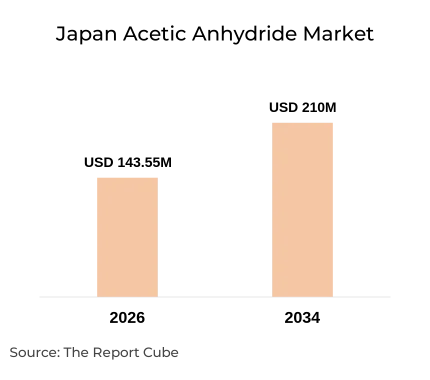
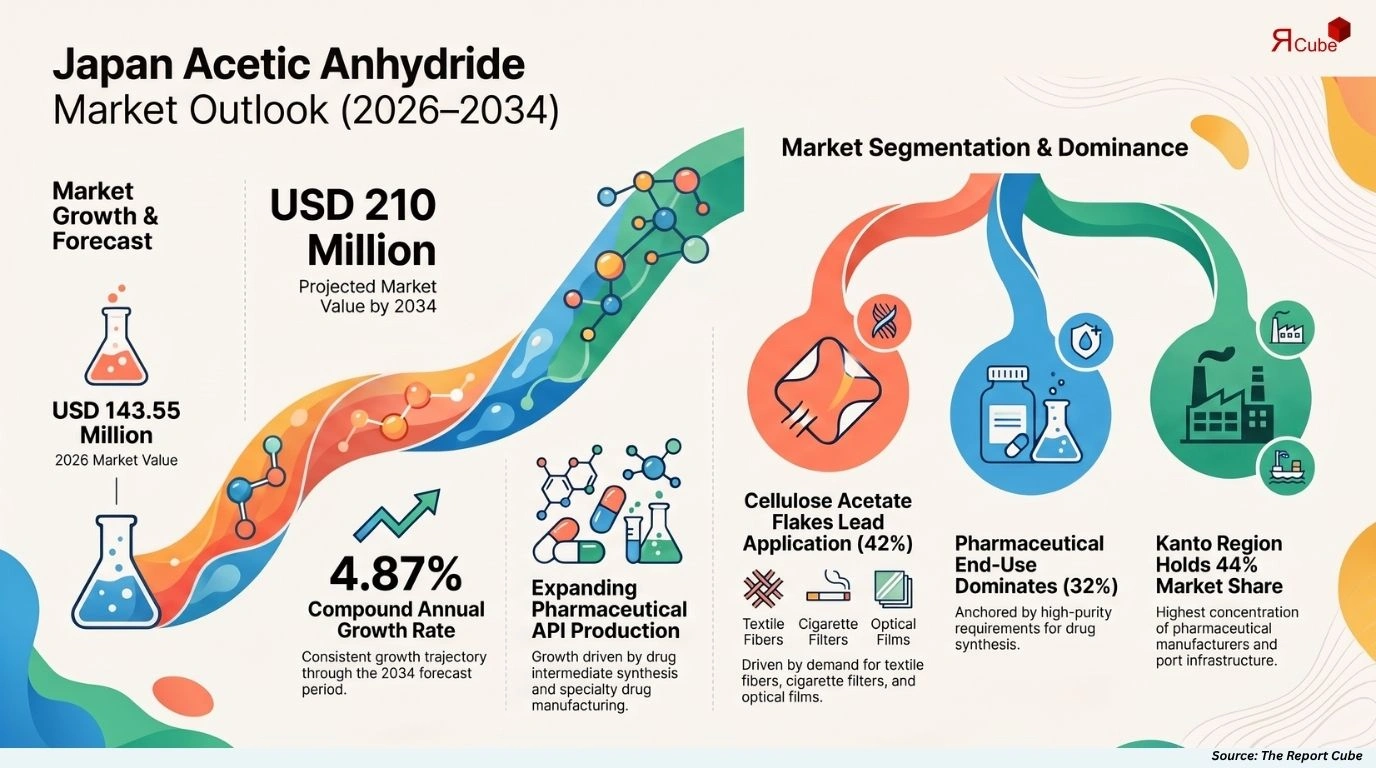
- Japan acetic anhydride market valued at USD 143.55 million in 2026, reflecting stable industrial chemical demand.
- Industry projected to reach USD 210.00 million by 2034 at a 4.87% CAGR.
- Market expanding at a consistent 4.87% CAGR through the 2034 forecast period.
- Cellulose acetate flakes leads the application segment driven by textile and film manufacturing demand.
- Pharmaceutical end-use dominates Japan's acetic anhydride consumption across commercial production channels.
- Agrochemical sector remains among the fastest-growing end-use segments as crop protection formulation expands.
- Celanese Corporation, Eastman Chemical Company, and Kanto Chemical Co. Inc. lead acetic anhydride supply in Japan.
- Sustainability-driven reformulation and pharmaceutical API expansion are reshaping acetic anhydride procurement demand.
Japan Acetic Anhydride Market Overview
The Japan Acetic Anhydride Market is anticipated to register a 4.87% CAGR during 2026–2034. The market size was valued at USD 143.55 million in 2026 and is projected to reach USD 210.00 million by 2034. Japan's well-established pharmaceutical manufacturing base, advanced textile and cellulose acetate processing industry, and mature agrochemical production sector are collectively sustaining demand for acetic anhydride as a core industrial intermediate. Government initiatives supporting domestic chemical manufacturing competitiveness, including METI-backed industrial upgrading programs, are reinforcing supply chain development across chemical processing zones.
A thorough Japan Acetic Anhydride Market analysis reveals that expanding pharmaceutical API synthesis requirements and growing TAED-based detergent formulation activity are generating consistent volume demand across the country's chemical processing sector. Celanese Corporation and Eastman Chemical Company have strengthened their Japan distribution logistics, ensuring reliable supply to domestic manufacturers. Kokusan Chemical Co. Ltd. and Junsei Chemical Co. Ltd. serve mid-scale pharmaceutical and research-grade procurement needs, while Sahara International Petrochemical Company supports competitive commodity-grade supply across laundry, textile, and agrochemical industrial applications.
Japan Acetic Anhydride Market Size & Forecast
|
Metric |
Details |
|---|---|
|
Market Size (2026) |
USD 143.55 Million |
|
Market Size (2034) |
USD 210.00 Million |
|
CAGR (2026–2034) |
4.87% |
|
Base Year |
2026 |
|
Historical Years |
2021–2025 |
|
Forecast Years |
2026–2034 |
The Japan Acetic Anhydride Market size was valued at USD 143.55 million in 2026 and is projected to reach USD 210.00 million by 2034, expanding at a 4.87% CAGR across the forecast period. This sustained growth trajectory is primarily differentiated by Japan's expanding pharmaceutical manufacturing activity and the continued adoption of cellulose acetate-based materials across specialty film, textile, and filtration applications requiring high-purity acetic anhydride input.
Japan Acetic Anhydride Market Dynamics
Japan's acetic anhydride sector is shaped by intersecting demand from pharmaceutical synthesis, cellulose acetate processing, agrochemical production, and laundry formulation manufacturing. Japan Acetic Anhydride Market growth is supported by established chemical processing infrastructure, strong domestic pharmaceutical output, and growing demand for TAED-based cleaning agents across commercial and industrial laundry segments through 2034.
|
Factor |
Type |
Specific Impact on Market |
Magnitude |
|---|---|---|---|
|
Expanding pharmaceutical API production |
Driver |
Increases acetic anhydride consumption in drug intermediate synthesis processes |
High |
|
Cellulose acetate film and textile demand |
Driver |
Sustains high-volume acetic anhydride procurement from fiber and specialty film producers |
High |
|
Agrochemical sector formulation growth |
Opportunity |
Supports new procurement contracts from herbicide and pesticide active ingredient manufacturers |
Medium |
|
Volatile acetic acid feedstock pricing |
Challenge |
Disrupts input cost stability and compresses margins for downstream acetic anhydride processors |
Medium |
|
Green chemistry and process efficiency adoption |
Trend |
Encourages catalytic acetic anhydride production methods with lower energy and emission intensity |
Medium |
- Growth Drivers - Japan's pharmaceutical sector, anchored by major producers and active in both API synthesis and specialty drug manufacturing, drives consistent acetic anhydride demand. The cellulose acetate processing industry, supplying cigarette filters, optical films, and textile acetate fibers, further sustains large-volume industrial procurement from integrated chemical suppliers including Celanese Corporation and Eastman Chemical Company.
- Market Opportunities - Japan's agrochemical industry is expanding herbicide and insecticide formulation capacity, generating incremental demand for acetic anhydride as an acetylating agent in active ingredient synthesis. E-commerce and digitized B2B chemical procurement platforms are also improving specialty-grade sourcing access for mid-scale pharmaceutical and food-grade ingredient manufacturers across regional production clusters.
- Industry Challenges - Stringent chemical handling regulations under Japan's Industrial Safety and Health Act and the Chemical Substances Control Law impose compliance requirements on acetic anhydride storage, transportation, and end-use reporting. Meeting evolving GHS labeling, occupational exposure threshold standards, and environmental discharge controls collectively increases compliance costs for smaller chemical distributors and downstream industrial processors.
Japan Acetic Anhydride Market Trends
- Emerging Trends - Japan Acetic Anhydride Market trends reflect growing interest in bio-based acetic anhydride production routes as chemical manufacturers respond to decarbonization mandates. Pharmaceutical-grade ultra-high-purity acetic anhydride demand is expanding as advanced API synthesis processes require tighter impurity control specifications from supplier partners.
- Technology Trends - Continuous flow chemistry reactors and advanced catalytic carbonylation technologies are improving production efficiency and yield consistency across Japan's acetic anhydride manufacturing facilities. Digital process monitoring platforms and automated quality control systems are enabling real-time batch parameter adjustment, reducing waste and improving output purity for high-specification pharmaceutical and specialty chemical applications.
- Regulatory Trends - Japan's Chemical Substances Control Law continues to evolve with updated risk assessment requirements for industrial chemicals, including acetic anhydride handling and downstream use reporting. REACH-equivalent assessment frameworks and GHS-aligned hazard communication standards are increasingly referenced in procurement specifications by multinational buyers sourcing acetic anhydride for pharmaceutical and food-contact material applications in Japan.
Need Specific Data, Let’s Customize the Report for You
Request CustomizationJapan Acetic Anhydride Market Segment Analysis
Japan's acetic anhydride market serves distinct application categories and end-use industries, each driven by unique production-scale requirements, purity specifications, and procurement volume structures. The Japan Acetic Anhydride Market share distribution across application and end-use segments reflects the chemical's critical role in pharmaceutical synthesis, cellulose acetate manufacturing, and performance detergent formulation across Japan's diversified industrial base.
By Application
|
Application |
Estimated Share (2026) |
Key Characteristics |
|---|---|---|
|
Cellulose Acetate Flakes |
42% |
Large-volume industrial use; textile fiber, cigarette filter, and optical film manufacturing |
|
Pharmaceuticals |
30% |
High-purity grade requirement; API intermediate and drug synthesis applications |
|
TAED |
16% |
Tetraacetylethylenediamine production; laundry bleach activator formulation demand |
|
Others |
12% |
Food-grade vinegar production, dye intermediates, specialty chemical synthesis |
Cellulose acetate flakes manufacturing dominates the By Application segment at an estimated 42% share in 2026, driven by sustained demand from Japan's textile fiber producers and specialty film manufacturers. Celanese Corporation and Eastman Chemical Company are primary acetic anhydride suppliers for this segment's high-volume processing requirements. Pharmaceuticals, accounting for approximately 30%, rely on Kanto Chemical Co. Inc. and Junsei Chemical Co. Ltd. for research-grade and industrial-purity supply. TAED production and other specialty applications collectively serve Japan's growing laundry formulation and fine chemical manufacturing sub-sectors.
By End-use
|
End-use |
Estimated Share (2026) |
Growth Outlook |
|---|---|---|
|
Pharmaceutical |
32% |
Steady; anchored by API manufacturing expansion and drug intermediate synthesis volumes |
|
Agrochemical |
20% |
Fast-growing; herbicide and pesticide active ingredient acetylation demand increasing |
|
Laundry & Cleaning |
18% |
Stable; TAED-driven bleach activator demand from commercial detergent manufacturers |
|
Food & Beverages |
12% |
Moderate; food-grade acetic anhydride for vinegar production and permitted additives |
|
Textile |
11% |
Stable; cellulose acetate fiber and acetate fabric manufacturing in regional clusters |
|
Others |
7% |
Niche; dye synthesis, photography chemicals, and specialty intermediate applications |
The pharmaceutical end-use segment leads at an estimated 32% share in 2026, supplied by Celanese Corporation, Eastman Chemical Company, and Kokusan Chemical Co. Ltd. The agrochemical segment demonstrates the fastest growth trajectory as Japan's crop protection industry scales herbicide formulation capacity. Sahara International Petrochemical Company contributes competitive pricing for commodity-grade acetic anhydride serving agrochemical, laundry, and textile downstream manufacturing requirements across Japan's regional chemical processing zones.
Japan Acetic Anhydride Market Regional Analysis
|
Region |
Estimated Market Share |
Key Growth Factors |
Consumer Trends |
|---|---|---|---|
|
Kanto |
44% |
Dense pharmaceutical and chemical manufacturing concentration; major port import infrastructure |
High pharmaceutical-grade procurement, specialty API synthesis demand |
|
Kansai |
28% |
Established chemical processing clusters; textile and cellulose acetate fiber manufacturing |
Mid-to-high purity acetic anhydride sourcing, textile and pharma segment demand |
|
Chubu |
18% |
Automotive and industrial chemical manufacturing; agrochemical formulation activity |
Agrochemical and industrial-grade acetic anhydride procurement growth |
|
Others |
10% |
Regional food processing, agricultural input production, and smaller chemical distributors |
Food-grade and commodity-grade acetic anhydride sourcing from local distributors |
- Kanto - Accounting for approximately 44% of total market demand, Kanto houses Japan's highest concentration of pharmaceutical manufacturers, specialty chemical producers, and major import terminals across Tokyo Bay industrial zones. The region's integrated logistics infrastructure supports reliable high-volume acetic anhydride supply from international sources including Celanese Corporation and Eastman Chemical Company to downstream industrial buyers.
- Kansai - Japan's second-largest chemical processing hub, Kansai hosts established textile acetate fiber operations and pharmaceutical API manufacturing clusters in Osaka and Hyogo prefectures. Regional demand is characterized by mid-to-high purity acetic anhydride procurement driven by specialty fiber producers and contract pharmaceutical manufacturers requiring consistent-grade chemical input supplies.
- Chubu - Anchored by Nagoya's industrial manufacturing base, Chubu generates acetic anhydride demand primarily from agrochemical formulation facilities, industrial chemical intermediates producers, and automotive-adjacent specialty coating manufacturers. The region's growing herbicide and pesticide ingredient synthesis activity is positioning it as an emerging acetic anhydride consumption center through 2034.
- Others - Remaining prefectures and regional clusters account for approximately 10% of national demand, drawing acetic anhydride supply through domestic distributor networks for food-grade vinegar production, small-scale agricultural input manufacturing, and specialty chemical processing operations outside the major industrial corridor zones.
Japan Acetic Anhydride Market Share & Competitive Landscape
The Japan Acetic Anhydride Market's competitive structure features a blend of global integrated chemical manufacturers and domestic specialty chemical distributors, competing across purity grades, supply reliability, and technical customer service capability. Key players differentiate through vertical integration depth, logistics network strength, and regulatory compliance documentation support for pharmaceutical and food-grade procurement channels.
|
Company |
Competitive Strength |
Primary Segment Served |
|---|---|---|
|
Kanto Chemical Co. Inc. |
Domestic distribution depth, research-grade chemical supply |
Pharmaceutical, laboratory, specialty chemical |
|
Junsei Chemical Co. Ltd. |
High-purity reagent supply, established research chemical network |
Pharmaceutical, research and analytical |
|
Kokusan Chemical Co. Ltd. |
Domestic production capability, cost-competitive industrial-grade supply |
Pharmaceutical, industrial intermediate |
|
Celanese Corporation |
Global vertical integration, cellulose acetate feedstock expertise |
Cellulose acetate flakes, pharmaceutical |
|
Sahara International Petrochemical Company |
Competitive commodity-grade pricing, Middle East production scale |
Agrochemical, laundry, textile |
|
Eastman Chemical Company |
Broad acetic anhydride portfolio, advanced process technology |
Cellulose acetate, pharmaceutical, TAED |
|
Others |
Regional distribution, niche specialty grade supply |
Various end-use categories |
Key Companies in the Japan Acetic Anhydride Market
Celanese Corporation
Celanese Corporation, headquartered in Irving, Texas, USA, is a global specialty chemicals company and one of the world's largest producers of acetic acid and acetic anhydride through its integrated acetyls platform. In 2024, Celanese strengthened its Asia-Pacific supply chain logistics to ensure consistent acetic anhydride delivery to Japan's pharmaceutical and cellulose acetate manufacturing customers amid global feedstock price volatility. Its vertically integrated production from methanol through acetyls positions it as a structurally critical supplier in Japan's industrial chemical market.
Eastman Chemical Company
Eastman Chemical Company, headquartered in Kingsport, Tennessee, USA, operates across specialty chemicals, advanced materials, and additives, with acetic anhydride forming part of its integrated acetyls and cellulose platform. In 2025, Eastman continued advancing process optimization initiatives across its acetyls production assets to improve cost competitiveness and delivery reliability for Japan-based pharmaceutical and cellulose acetate film customers. Its broad application expertise spanning pharmaceutical, textile, and TAED formulation positions it as a versatile acetic anhydride partner for Japan's diversified industrial chemical buyers.
Japan Acetic Anhydride Market Recent Developments
|
Year |
Company |
Development |
|---|---|---|
|
2025 |
Eastman Chemical Company |
Advanced acetyls production process optimization to improve cost and delivery reliability for Asia-Pacific pharmaceutical and cellulose customers |
Japan Acetic Anhydride Market Future Outlook
The Japan Acetic Anhydride Market forecast projects market expansion from USD 143.55 million in 2026 to USD 210.00 million by 2034 at a 4.87% CAGR. Pharmaceutical API synthesis growth, cellulose acetate fiber and film manufacturing investment, and expanding agrochemical formulation activity will collectively sustain demand. Celanese Corporation, Eastman Chemical Company, and Kokusan Chemical Co. Ltd. are expected to deepen Japan market presence through application-specific technical support programs and supply reliability commitments.
Technological advancement in acetic anhydride production, including catalytic process optimization, continuous flow manufacturing adoption, and digital quality monitoring integration, will progressively improve cost efficiency and output purity consistency for Japan's mid-scale chemical processors through 2034. Sustainable production standards, regulatory compliance documentation requirements, and growing buyer preference for traceable chemical supply chains will collectively drive procurement specification upgrades across pharmaceutical, food-grade, and specialty chemical end-use applications in Japan.
Japan Acetic Anhydride Market Report Coverage
The following Japan Acetic Anhydride Market report provides comprehensive coverage across application segments, end-use industries, regional demand zones, and competitive intelligence for strategic planning and investment decision-making.
|
Report Attribute |
Details |
|---|---|
|
Market Name |
Japan Acetic Anhydride Market |
|
Market Size (2026) |
USD 143.55 Million |
|
Market Size (2034) |
USD 210.00 Million |
|
Forecast Period |
2026–2034 |
|
CAGR |
4.87% |
|
Base Year |
2026 |
|
Historical Years |
2021–2025 |
|
Forecast Years |
2026–2034 |
|
Segments Covered |
By Application (Cellulose Acetate Flakes, Pharmaceuticals, TAED, Others); By End-use (Pharmaceutical, Agrochemical, Laundry & Cleaning, Food & Beverages, Textile, Others) |
|
Regions Covered |
Kanto, Kansai, Chubu, Others |
|
Key Companies |
Kanto Chemical Co. Inc., Junsei Chemical Co. Ltd., Kokusan Chemical Co. Ltd., Celanese Corporation, Sahara International Petrochemical Company, Eastman Chemical Company, Others |
|
Report Format |
PDF, Excel, PPT |
|
Customization |
Available as per client requirements |
Why Choose This Japan Acetic Anhydride Market Report?
- Comprehensive coverage of Japan's industrial acetic anhydride demand across application and end-use segments.
- Accurate market sizing from USD 143.55 million in 2026 through USD 210.00 million in 2034 forecast.
- Detailed segmentation by application type and end-use industry with estimated 2026 share distributions.
- Regional insights covering Kanto, Kansai, Chubu, and other prefectural demand zones with share estimates.
- Competitive profiling of six key global and domestic acetic anhydride suppliers with segment positioning.
- In-depth analysis of pharmaceutical, cellulose acetate, and agrochemical demand trends reshaping procurement.
- Forecast data supporting supplier partnership planning, investment decisions, and market entry strategy.
- Research aligned with Japan's industrial chemical sector development and pharmaceutical manufacturing growth objectives.
Table of Contents
- Introduction
- Objective of the Study
- Product Definition
- Market Segmentation
- Study Variables
- Research Methodology
- Secondary Data Points
- Companies Interviewed
- Primary Data Points
- Breakdown of Primary Interviews
- Secondary Data Points
- Executive Summary
- Market Dynamics
- Drivers
- Challenges
- Opportunity Assessment
- Recent Trends and Developments
- Policy and Regulatory Landscape
- Japan Acetic Anhydride Market Overview and Forecast Analysis (2021-2034)
- Market Size, By Value, By Growth Rate (CAGR/USD Millions)
- Demand – Supply Trends
- Market Share, By Application
- Cellulose Acetate Flakes
- Pharmaceuticals
- TAED
- Others
- Market Share, By End-use
- Pharmaceutical
- Agrochemical
- Laundry & Cleaning
- Food & Beverages
- Textile
- Others
- Market Share, By Region
- Kanto
- Kansai
- Chubu
- Others
- Market Share, By Competitors
- Competition Characteristics
- Revenue Shares
- Cellulose Acetate Flakes Japan Acetic Anhydride Market Overview, 2021-2034F
- By Value (USD Million)
- By End-use – Market Size & Forecast 2021-2034, USD Million
- Pharmaceutical
- Agrochemical
- Laundry & Cleaning
- Food & Beverages
- Textile
- Others
- Pharmaceuticals Japan Acetic Anhydride Market Overview, 2021-2034F
- By Value (USD Million)
- By End-use – Market Size & Forecast 2021-2034, USD Million
- Pharmaceutical
- Agrochemical
- Laundry & Cleaning
- Food & Beverages
- Textile
- Others
- TAED Japan Acetic Anhydride Market Overview, 2021-2034F
- By Value (USD Million)
- By End-use – Market Size & Forecast 2021-2034, USD Million
- Pharmaceutical
- Agrochemical
- Laundry & Cleaning
- Food & Beverages
- Textile
- Others
- Others Japan Acetic Anhydride Market Overview, 2021-2034F
- By Value (USD Million)
- By End-use – Market Size & Forecast 2021-2034, USD Million
- Pharmaceutical
- Agrochemical
- Laundry & Cleaning
- Food & Beverages
- Textile
- Others
- Competitive Outlook (Company Profile - Partial List)
- Kanto Chemical Co. Inc.
- Company Overview
- Business Segments
- Strategic Alliances/Partnerships
- Recent Developments
- Junsei Chemical Co.Ltd.
- Company Overview
- Business Segments
- Strategic Alliances/Partnerships
- Recent Developments
- Kokusan Chemical Co. Ltd.
- Company Overview
- Business Segments
- Strategic Alliances/Partnerships
- Recent Developments
- Celanese Corporation
- Company Overview
- Business Segments
- Strategic Alliances/Partnerships
- Recent Developments
- Sahara International Petrochemical Company
- Company Overview
- Business Segments
- Strategic Alliances/Partnerships
- Recent Developments
- Eastman Chemical Company
- Company Overview
- Business Segments
- Strategic Alliances/Partnerships
- Recent Developments
- Others
- Kanto Chemical Co. Inc.
- Contact Us & Disclaimer
Top Key Players & Market Share Outlook
- Kanto Chemical Co. Inc.
- Junsei Chemical Co.Ltd.
- Kokusan Chemical Co., Ltd.
- Celanese Corporation
- Sahara International Petrochemical Company
- Eastman Chemical Company
- Others
Frequently Asked Questions






