



Build Your Custom Market Intelligence Report
Customize Your ReportKey Highlights
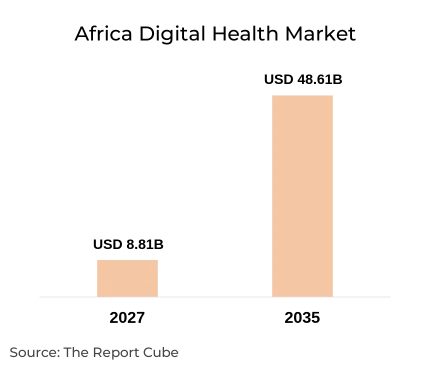
- Africa Digital Health Market size is valued at USD 8.81 billion in 2027 and is forecast to reach USD 48.61 billion by 2035.
- The supplied forecast implies a CAGR of 23.80% during 2027–2035.
- The base year is 2026, with the supplied historical period 2022–2026 and forecast period 2027–2035.
- The input identifies 4 segmentation dimensions; all supplied subsegments are retained in the segment analysis.
- The supplied leading-segment shares are analyst estimates, not independently verified public market statistics.
- The market's demand profile is shaped by: Digital health includes telehealth, mobile health, healthcare analytics and digital health systems. Addressable spending depends on provider digitisation, payer integration, public procureme
- Regional revenue shares, competitor rankings and company market shares are not assigned without comparable primary evidence.
Market Outlook
Digital health includes telehealth, mobile health, healthcare analytics and digital health systems. Addressable spending depends on provider digitisation, payer integration, public procurement, connectivity, data governance, clinical workflow fit and the ability to operate across fragmented health systems. The market value.
The commercial structure of the Africa Digital Health Market varies across national markets and end-user groups. Buyers assess availability, quality assurance, operating cost, delivery reliability and suitability for local conditions. Suppliers compete through product performance, service networks, technical support, regulatory.
Forecast interpretation should therefore separate three evidence layers: supplied market estimates, official sector indicators and qualitative market analysis. Official sources can validate the operating environment, but they do not independently validate the supplied market valuation. The report does not treat.
Government Regulations
Digital health providers face national health-profession rules, medical-device requirements where software performs a regulated medical function, patient confidentiality obligations, data protection laws, cybersecurity rules and telemedicine practice standards. Health records may be subject to sensitive-data controls and cross-border transfer restrictions..
Africa Digital Health Market Dynamics
Market dynamics reflect the interaction of end-user demand, procurement cycles, infrastructure readiness, affordability and regulatory requirements. The strongest growth signals are not necessarily the same as the largest current revenue pools: a fast-growing application may start from a small base.
| Factor | Type | Specific Impact on Market | Magnitude |
|---|---|---|---|
| Structural demand | Driver | Recurring or project-linked need supports baseline demand, depending on the market's operating cycle. | High relevance |
| Technology and service improvement | Driver | Better performance, reliability, convenience or digital workflow integration can improve adoption. | Medium–High relevance |
| Local capability and distribution | Opportunity | Local service, assembly, partnerships and channel reach can reduce delivery friction. | Medium–High relevance |
| Regulatory alignment | Opportunity | Clearer standards and predictable approvals can improve procurement confidence. | Medium relevance |
| Affordability and financing | Challenge | Budget constraints, foreign exchange and payment delays can defer purchases or restrict coverage. | High relevance |
| Infrastructure and skills gaps | Challenge | Power, logistics, connectivity, trained staff and maintenance capacity can limit deployment. | High relevance |
The driver entries identify the demand foundations: Structural demand (Recurring or project-linked need supports baseline demand, depending on the market's operating cycle.); Technology and service improvement (Better performance, reliability, convenience or digital workflow integration can improve adoption.). The opportunity entries point to areas where suppliers may improve adoption or access: Local capability and distribution (Local service, assembly, partnerships and channel reach can reduce delivery friction.); Regulatory alignment (Clearer standards and predictable approvals can improve procurement confidence.). The challenge entries show constraints that may delay purchasing or deployment: Affordability and financing (Budget constraints, foreign exchange and payment delays can defer purchases or restrict coverage.); Infrastructure and skills gaps (Power, logistics, connectivity, trained staff and maintenance capacity can limit deployment.). The magnitude labels are qualitative assessments from this report framework, not measured market shares or independently quantified impact values.
Growth Drivers
Demand growth is supported by the underlying activity that creates the need for africa digital health market. This may be corporate outsourcing demand, healthcare delivery, industrial and mining projects, transport electrification, trade flows or offshore development, depending on the market..
Need Specific Data, Let’s Customize the Report for You
Request CustomizationMarket Opportunities
Opportunities span telehealth, mobile health, digital health records, health analytics, remote monitoring and workflow systems for providers and payers. Scalable solutions that work with low-bandwidth environments, local languages, interoperable systems and practical payment models can address access and operational gaps.
Opportunity Assessment
Commercial potential should be assessed by customer economics, procurement access, distribution reach, product performance and local service capability. The supplied market forecast indicates the expected direction and scale of the market under the provided assumptions; it does not by itself establish the addressable opportunity for every supplier. Companies should validate country-level demand, purchasing power, import requirements and channel economics before committing capacity.
Industry Challenges
Adoption is constrained by uneven connectivity, device affordability, fragmented health information systems, limited digital skills, data-protection requirements, reimbursement uncertainty and trust concerns. Integration with clinical workflows and the ability to demonstrate safety and improved outcomes are essential for sustained use.
Market-wide data availability is another constraint. Public sources often describe policy, sector activity, disease burden, industrial output or infrastructure rather than the exact revenue pool defined by this market. Accordingly, segment and regional shares supplied in the input are treated as analyst estimates, not independently verified published statistics. They should not be interpreted as audited market measurements.
Market Trends
The market is moving toward interoperable digital records, mobile-first access, remote consultations, analytics and hybrid models that connect digital tools with in-person care. Governments and health systems are increasingly considering digital health as part of service delivery, while governance and evidence requirements remain central.
Across the forecast period, supplier performance is likely to depend on the ability to combine product or service quality with reliable delivery, technical support, compliance and transparent total-cost economics. The pace of adoption will differ by country and customer group; the forecast should therefore be read as a market-level projection rather than a guarantee of uniform growth.
Africa Digital Health Market Segment Analysis
The segmentation below reproduces the two segmentation dimensions and all subsegments supplied for this market. Each category includes focused commentary on the leading segment and the second analyzed segment. Share figures are labelled as analyst estimates where supplied and are not represented as independently verified market statistics.
By Technology
- Tele Healthcare
- mHealth
- Healthcare Analytics
- Digital Health Systems
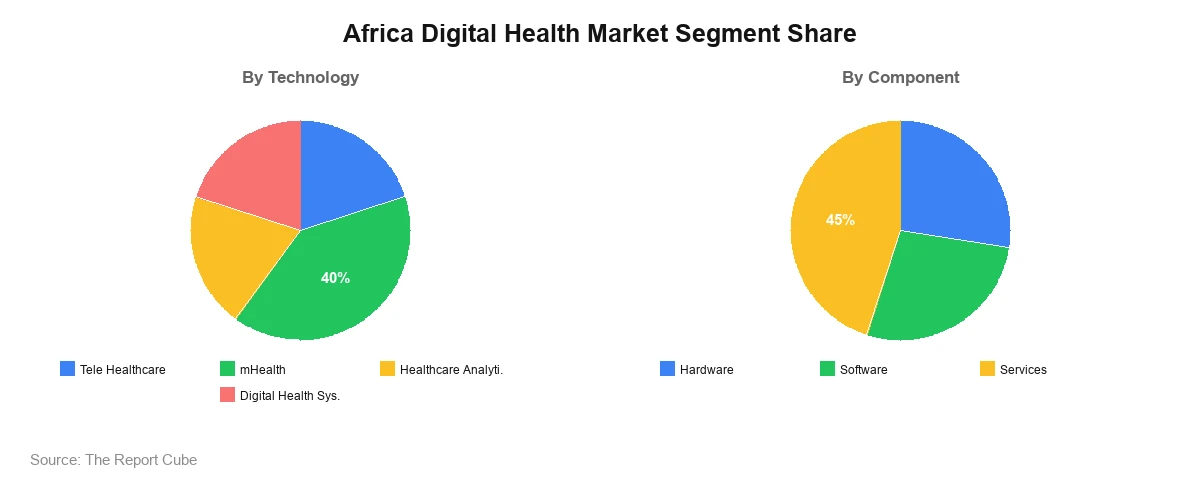
mHealth leads this category with an approximate 40% share in 2026. Tele Healthcare is the second analyzed segment. Its commercial role is linked to a distinct product, customer, technology or use-case requirement within the category. The remaining subsegments Healthcare Analytics, Digital Health Systems are retained in the scope, but their individual shares are not reliably quantifiable from the available sources.
By Component
- Hardware
- Software
- Services
Services leads this category with an approximate 45% share in 2026 . Hardware is the second analyzed segment. Its commercial role is linked to a distinct product, customer, technology or use-case requirement within the category. The remaining subsegments Software are retained in the scope, but their individual shares are not reliably quantifiable from the available sources.
Africa Digital Health Market Regional Analysis
Regional performance varies by market, geography and the supplied country or regional scope. The table summarizes the available regional assessment. Region-specific industry trends are shown only where supported; otherwise, they are identified as not reliably established from available sources.
| Region | Key Growth Factors | Industry Trends |
|---|---|---|
| West Africa | Large populations and uneven access to health facilities create use cases for provider digitization, telehealth and mobile health tools. | Mobile-enabled patient engagement, digital records and health-financing tools are expanding, but connectivity and affordability gaps persist. |
| East Africa | Mobile-money and mobile connectivity ecosystems provide a foundation for digital health delivery and health-service coordination. | Telehealth, mobile health and digitized provider workflows can help address distance and service-access barriers. |
| Southern Africa | More developed private and public health-service infrastructure in some markets supports adoption of electronic records and provider platforms. | Interoperability, data governance and integration with existing health systems are central implementation issues. |
| North Africa | Digital infrastructure and urban health networks offer potential for health analytics and provider digitization. | Adoption depends on national digital-health policy, integration standards and workforce capability. |
The table covers Regional split. The key-growth-factor column retains the available regional assessments. Comparable region-specific industry-trend evidence and consistently measured regional shares were not supplied, so these are not presented as quantified findings.
These groupings are not necessarily exhaustive or mutually exclusive at the level of all possible market activity. The input estimate for the leading group is retained as an estimate and is not used to calculate the shares of other regions. A comparable regional revenue-share series was not established from the reviewed source set.
Company Profiles
- HeliumHealth: HeliumHealth is included among the companies identified for this market in the supplied input. The available project source set does not establish a verified market-specific revenue figure, share, ranking, contract award or country-level footprint for this company. Its position should therefore be evaluated through official product information, regulatory or certification records, disclosed regional operations and customer announcements before assigning a competitive rank.
- mPharma: mPharma is included among the companies identified for this market in the supplied input. The available project source set does not establish a verified market-specific revenue figure, share, ranking, contract award or country-level footprint for this company. Its position should therefore be evaluated through official product information, regulatory or certification records, disclosed regional operations and customer announcements before assigning a competitive rank.
Africa Digital Health Market Future Outlook
The supplied forecast places the Africa Digital Health Market at USD 8.81 billion in 2027 and USD 48.61 billion by 2035, at the supplied CAGR of 23.8% over 2027–2035. These are input values retained for CMS publication and are not independently re-estimated in this narrative. The forecast trajectory will depend on market-specific adoption, capital availability, policy execution, customer affordability, supply-chain resilience and the ability of providers to deliver consistent quality.
In the near term, suppliers are likely to prioritise operational reliability, channel access and compliance. Over the medium term, investment in technology, local capability, partnerships and service infrastructure may influence competitive outcomes. Forecast uncertainty remains material where public datasets do not directly measure the defined market; readers should interpret the projection alongside the disclosed evidence limitations.
Africa Digital Health Market Report Coverage
The Africa Digital Health Market report coverage table summarizes the supplied market values, forecast assumptions, geographic scope, segmentation and named companies. No base-year market value was supplied, so it is identified as unavailable; the 2027 and forecast-year values are reproduced from the input.
| Parameter | Details |
|---|---|
| Market Name | Africa Digital Health Market |
| Market Size (2027) | 8.81 billion |
| Market Size (Forecast Year) | 48.61 billion |
| CAGR | 23.80% |
| Base Year | 2026 |
| Historical Period | 2022-2026 |
| Forecast Period | 2027-2035 |
| Segmentation | By Technology, By Component, By Application, By End Use |
| Regions Covered | Regional split |
| Key Companies | HeliumHealth, mPharma, Yodawy, WellaHealth, Healthtracka, TIBU Health, DrugStoc, DabaDoc, MediBuddy, Others |
| Customization | Yes |
The table consolidates the report scope and supplied assumptions for the Africa Digital Health Market. The supplied market value moves from 8.81 billion in 2027 to 48.61 billion in 2035. The supplied CAGR is 23.8%; it is reproduced as provided and should be read alongside the stated forecast period. The historical reference period is 2021–2025. The forecast reference period is 2027–2035. These are the report inputs and scope descriptors; the table does not independently validate the underlying market estimates.
Why Choose This Africa Digital Health Market Report
- Presents the supplied 2027 market value, 2035 forecast value and CAGR without altering the input assumptions.
- Organises all supplied segmentation categories and retains every listed subsegment.
- Explains the leading and second analyzed segment within each category while distinguishing estimates from verified statistics.
- Provides a regional or country-group assessment without inventing unsupported revenue shares.
- Identifies the companies supplied for the competitive landscape without assigning unsupported rankings or market shares.
- Uses institutional and official sources for relevant policy, regulatory and sector context, with source limitations disclosed.
- Highlights market opportunities, operating constraints, trends and forecast uncertainties to support further commercial assessment.
Table of Contents
- Introduction
- Objective of the Study
- Product Definition
- Market Segmentation
- Study Variables
- Research Methodology
- Secondary Data Points
- Companies Interviewed
- Primary Data Points
- Breakdown of Primary Interviews
- Secondary Data Points
- Executive Summary
- Market Dynamics
- Drivers
- Challenges
- Opportunity Assessment
- Recent Trends and Developments
- Policy and Regulatory Landscape
- Africa Digital Health Market Overview and Forecast Analysis (2022-2035)
- Market Size, By Value, By Growth Rate (CAGR/USD Billions)
- Demand – Supply Trends
- Market Share, By Technology
- Tele Healthcare
- mHealth
- Healthcare Analytics
- Digital Health Systems
- Market Share, By Component
- Hardware
- Software
- Services
- Market Share, By Application
- Obesity
- Diabetes
- Cardiovascular
- Respiratory Diseases
- Others
- Market Share, By End Use
- Patients
- Providers
- Payers
- Others
- Market Share, By Competitors
- Competition Characteristics
- Revenue Shares
- Tele Healthcare Africa Digital Health Market Overview, 2022-2035F
- By Value (USD Million)
- By Component – Market Size & Forecast 2022-2035, USD Million
- Hardware
- Software
- Services
- mHealth Africa Digital Health Market Overview, 2022-2035F
- By Value (USD Million)
- By Component – Market Size & Forecast 2022-2035, USD Million
- Hardware
- Software
- Services
- Healthcare Analytics Africa Digital Health Market Overview, 2022-2035F
- By Value (USD Million)
- By Component – Market Size & Forecast 2022-2035, USD Million
- Hardware
- Software
- Services
- Digital Health Systems Africa Digital Health Market Overview, 2022-2035F
- By Value (USD Million)
- By Component – Market Size & Forecast 2022-2035, USD Million
- Hardware
- Software
- Services
- Competitive Outlook (Company Profile – Partial List)
- HeliumHealth
- Company Overview
- Business Segments
- Strategic Alliances/Partnerships
- Recent Developments
- mPharma
- Company Overview
- Business Segments
- Strategic Alliances/Partnerships
- Recent Developments
- Yodawy
- Company Overview
- Business Segments
- Strategic Alliances/Partnerships
- Recent Developments
- WellaHealth
- Company Overview
- Business Segments
- Strategic Alliances/Partnerships
- Recent Developments
- Healthtracka
- Company Overview
- Business Segments
- Strategic Alliances/Partnerships
- Recent Developments
- TIBU Health
- Company Overview
- Business Segments
- Strategic Alliances/Partnerships
- Recent Developments
- DrugStoc
- Company Overview
- Business Segments
- Strategic Alliances/Partnerships
- Recent Developments
- DabaDoc
- Company Overview
- Business Segments
- Strategic Alliances/Partnerships
- Recent Developments
- MediBuddy
- Company Overview
- Business Segments
- Strategic Alliances/Partnerships
- Recent Developments
- Others
- HeliumHealth
- Contact Us & Disclaimer
Top Key Players & Market Share Outlook
- HeliumHealth
- mPharma
- Yodawy
- WellaHealth
- Healthtracka
- TIBU Health
- DrugStoc
- DabaDoc
- MediBuddy
- Others
Frequently Asked Questions