


Build Your Custom Market Intelligence Report
Customize Your ReportKey Highlights
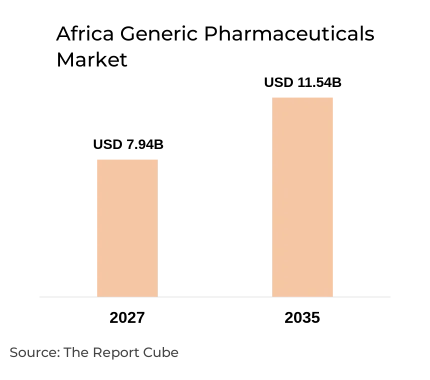
- The Africa Generic Pharmaceuticals Market was valued at USD 7.94 billion in 2027.
- The market is forecast to reach USD 11.54 billion by 2035.
- The market is expanding at a CAGR of 4.78% during 2027–2035.
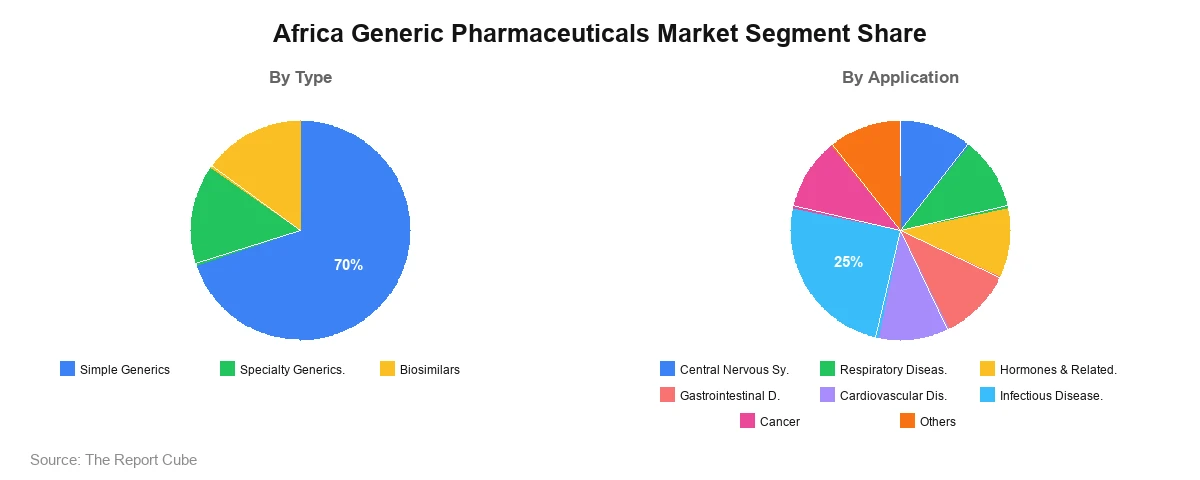
- By type, Simple Generics lead with an approximate 70% share in 2026.
- By application, Infectious Diseases account for an estimated 25% share in 2026.
- Small Molecule products dominate the product category with an approximate 85% share in 2026.
- Retail Pharmacies represent the leading distribution channel, accounting for an estimated 55% share in 2026.
Market Outlook
Generic pharmaceuticals are medicines developed to provide alternatives to branded originator products after the relevant patent or exclusivity protections expire. They generally contain the same active pharmaceutical ingredients as their reference medicines and must meet applicable quality, safety and efficacy requirements. Across Africa, generic medicines play an important role in improving access to affordable treatments through public healthcare programmes, private pharmacies, hospitals and other medicine distribution channels.
Demand is generated across several therapeutic categories, including infectious diseases, cardiovascular conditions, respiratory diseases, cancer and central nervous system disorders. Simple generics represent the largest type category, while small molecule medicines account for the dominant product segment. Retail pharmacies are an important distribution channel because they provide access to medicines for patients receiving outpatient treatment. Hospital pharmacies and institutional procurement also contribute to pharmaceutical demand.
The Africa Generic Pharmaceuticals Market is projected to grow from USD 7.94 billion in 2027 to USD 11.54 billion by 2035, registering a CAGR of 4.78%. Growth is supported by the need for affordable medicines, increasing healthcare requirements, established generic medicine consumption and initiatives aimed at strengthening local pharmaceutical manufacturing. However, the market remains influenced by import dependence, regulatory differences and supply-chain limitations across African countries.
The competitive environment includes multinational pharmaceutical companies and regional manufacturers such as Abbott Laboratories, F. Hoffmann-La Roche Ltd, Novartis AG, Cipla South Africa, Aspen Holdings, Teva Pharmaceutical Industries Ltd., Viatris Inc. and Sun Pharmaceutical Industries Ltd. Opportunities are emerging through local production investment, regional regulatory cooperation and broader access to generic medicines. Manufacturers must also address quality assurance, pricing pressures and differences in national medicine registration requirements.
Government Regulations
Generic pharmaceuticals in Africa are regulated through national medicine registration, manufacturing, importation, distribution and quality-control requirements. Regulatory authorities assess medicines for applicable safety, quality and efficacy standards before they are authorized for commercial distribution. In South Africa, the South African Health Products Regulatory Authority (SAHPRA) oversees the regulation of health products, including medicines, and is responsible for relevant registration, licensing, inspection and post-market surveillance activities. Pharmaceutical manufacturers and distributors must comply with applicable national requirements and maintain appropriate quality-management systems.
At the continental level, the African Medicines Agency (AMA) is intended to strengthen regulatory coordination and improve access to quality-assured medical products. Regulatory harmonization initiatives supported by the World Health Organization and African regional institutions focus on improving regulatory capacity, cooperation and reliance mechanisms. These developments are relevant to pharmaceutical companies seeking to commercialize generic medicines across multiple African countries, where differences in registration procedures and regulatory implementation can influence market-entry timelines and operating costs.
Africa Generic Pharmaceuticals Market Dynamics
Demand is shaped by the need for affordable medicines, disease-treatment requirements, pharmaceutical import dependence, local manufacturing development and national healthcare policies. Regulatory capacity, procurement systems and distribution infrastructure also influence product availability and competition. These factors determine the adoption of generic medicines and the ability of manufacturers to expand their presence across African pharmaceutical markets.
|
Factor |
Type |
Specific Impact on Market |
Magnitude |
|---|---|---|---|
|
Growing demand for affordable medicines |
Driver |
Generic alternatives support access to lower-cost treatments across healthcare systems |
High |
|
Expansion of healthcare and pharmaceutical manufacturing capacity |
Driver |
Healthcare development and local production initiatives support medicine availability |
Medium-High |
|
Investment in local generic pharmaceutical production |
Opportunity |
Domestic manufacturing and contract production can reduce reliance on imported finished medicines |
High |
|
Regional regulatory harmonization |
Opportunity |
Regulatory cooperation can improve market access and reduce duplicated registration processes |
Medium-High |
|
Dependence on imported pharmaceutical products |
Challenge |
International supply disruptions and currency movements can affect medicine availability and costs |
High |
|
Fragmented regulatory and distribution systems |
Challenge |
Differences in national approvals and distribution infrastructure complicate regional operations |
Medium-High |
Growth Drivers: Demand for Affordable Generic Medicines
The need for affordable pharmaceutical treatments is a major driver of generic medicine demand across Africa. Generic medicines provide alternatives to originator products and can support the affordability of treatment for patients, public healthcare programmes and private healthcare providers. The World Health Organization has highlighted the importance of improving access to essential medicines across the African Region. As healthcare systems address communicable and non-communicable diseases, the requirement for cost-effective medicines is expected to support demand across several therapeutic categories.
Need Specific Data, Let’s Customize the Report for You
Request CustomizationMarket Opportunities: Expansion of Local Pharmaceutical Manufacturing
Investment in domestic and regional pharmaceutical manufacturing presents an opportunity for generic medicine producers. According to the World Health Organization's framework for strengthening local production of medicines, vaccines and other health technologies in the African Region for 2025–2035, improving manufacturing capacity and strengthening pharmaceutical supply systems are important regional priorities. Investment in production facilities, technology transfer, workforce development and quality systems could help manufacturers expand their regional presence and improve the availability of generic medicines.
Industry Challenges: Import Dependence and Regulatory Fragmentation
Africa's dependence on imported finished pharmaceutical products creates exposure to international supply-chain disruptions, exchange-rate fluctuations, freight costs and external pricing pressures. The WHO has reported that countries in its African Region import between 70% and 100% of finished pharmaceutical products. This dependence can affect medicine availability, particularly in markets with limited domestic manufacturing capacity. Differences in national registration procedures, regulatory requirements and approval timelines further complicate the distribution of generic medicines across multiple countries.
Market Trends: Growing Focus on Regulatory Harmonization
Regulatory cooperation is becoming increasingly important as pharmaceutical manufacturers seek to expand their presence across African countries. The African Medicines Agency is intended to strengthen regulatory convergence, improve coordination and support access to quality-assured medical products. Greater regulatory cooperation could help reduce duplicated procedures and improve the predictability of medicine registration processes. Manufacturers with established compliance systems and regional distribution capabilities may be better positioned to benefit from these developments.
Africa Generic Pharmaceuticals Market Segment Analysis
The Africa Generic Pharmaceuticals Market is segmented by type, application, product, route of administration, distribution channel and country. Each segment reflects different dimensions of pharmaceutical demand, including medicine categories, therapeutic requirements, formulation characteristics, administration methods and distribution channels.
By Type
- Simple Generics
- Specialty Generics
- Biosimilars
Simple Generics lead the category with an approximate 70% share in 2026, based on the supplied analyst estimate. Their leading position reflects the established use of conventional generic medicines across primary healthcare, outpatient treatment and essential medicine programmes. Specialty Generics address more complex therapeutic and formulation requirements, while Biosimilars represent a specialized category associated with biologic medicines and their alternatives. Adoption across these categories depends on affordability, regulatory approval, manufacturing capabilities and clinical acceptance.
By Application
- Central Nervous System Disorders
- Respiratory Diseases
- Hormones & Related Diseases
- Gastrointestinal Diseases
- Cardiovascular Diseases
- Infectious Diseases
- Cancer
- Others
Infectious Diseases lead the category with an approximate 25% share in 2026, based on the supplied analyst estimate. Demand for generic medicines in this category is influenced by the continuing need to manage communicable diseases and maintain access to essential treatments. Cardiovascular Diseases, Respiratory Diseases, Cancer and other therapeutic categories also contribute to market demand as healthcare systems address a wider range of treatment requirements. The Central Nervous System Disorders, Hormones & Related Diseases and Gastrointestinal Diseases categories further support the use of generic pharmaceutical products.
Africa Generic Pharmaceuticals Market Regional Analysis
The Africa Generic Pharmaceuticals Market is analyzed across the countries included in the supplied segmentation. Market conditions vary according to healthcare infrastructure, pharmaceutical manufacturing capabilities, medicine procurement systems, regulatory development and access to healthcare. South Africa is identified as the leading country in the supplied analyst estimate, although it is missing from the provided country list. Comparable country-level revenue shares are not available from the supplied data, so no additional shares are assigned.
|
Country |
Key Market Factors |
Industry Trends |
|---|---|---|
|
Botswana |
Demand for affordable medicines and access through public and private healthcare channels |
Continued importance of generic medicines in healthcare procurement |
|
Namibia |
Pharmaceutical importation and medicine distribution requirements |
Focus on medicine availability and supply-chain management |
|
Zimbabwe |
Need for affordable treatments and reliable pharmaceutical supplies |
Importance of generic medicines in public and private healthcare |
|
Zambia |
Demand from healthcare facilities and essential medicine procurement |
Continued focus on medicine access and pharmaceutical supply systems |
|
Tanzania |
Healthcare expansion and demand for essential pharmaceutical products |
Development of local pharmaceutical manufacturing and distribution |
|
Others |
Different healthcare requirements and pharmaceutical regulatory environments |
Gradual development of generic medicine access and supply networks |
South Africa is identified in the supplied analyst estimate as the leading country, accounting for approximately 25% of the market in 2026. Its pharmaceutical industry includes established manufacturing capabilities, multinational pharmaceutical operations and a national regulatory framework overseen by SAHPRA. South Africa's pharmaceutical manufacturing and distribution ecosystem supports its importance in the regional market. It should be added as a separate country in the segmentation to maintain consistency with the supplied market-share estimate.
Competitive Landscape
The Africa Generic Pharmaceuticals Market includes multinational pharmaceutical companies, regional manufacturers and suppliers of generic and specialty medicines across several therapeutic categories. Competition is influenced by product portfolios, manufacturing capabilities, regulatory approvals, pricing, procurement relationships and distribution reach. Companies with established quality systems and regional distribution networks are positioned to participate in demand across African markets. The table summarizes selected companies and their general competitive strengths rather than representing a market-share ranking.
|
Company |
Competitive Strength |
Primary Segment Served |
|---|---|---|
|
Abbott Laboratories |
Established pharmaceutical and healthcare product portfolio with international operations |
Generic and branded medicines, diagnostics and healthcare products |
|
F. Hoffmann-La Roche Ltd |
Strong pharmaceutical research and specialized treatment portfolio |
Specialty medicines and selected therapeutic categories |
|
Novartis AG |
Global pharmaceutical operations and established medicine development capabilities |
Pharmaceutical products across multiple therapeutic areas |
|
Cipla South Africa |
Generic medicine portfolio and established presence in the South African pharmaceutical market |
Generic and respiratory medicines |
|
Aspen Holdings |
Regional pharmaceutical manufacturing capabilities and established African presence |
Generic medicines, sterile products and pharmaceutical manufacturing |
|
Teva Pharmaceutical Industries Ltd. |
International generic medicine portfolio and pharmaceutical manufacturing experience |
Generic and specialty medicines |
|
Endo International plc |
Historical pharmaceutical portfolio and experience in specialty pharmaceutical products |
Specialty and generic pharmaceutical products |
|
Viatris Inc. |
Broad global portfolio and established generic medicine operations |
Generic and established branded medicines |
|
Sun Pharmaceutical Industries Ltd. |
Large generic pharmaceutical portfolio and international manufacturing network |
Generic and specialty medicines |
- Aspen Holdings: Aspen Pharmacare is a South African pharmaceutical company with manufacturing operations covering finished-dose medicines, active pharmaceutical ingredients, sterile products, oral solid doses, liquids, semi-solids and biological products. Its manufacturing capabilities and regional presence make it an important participant in the African pharmaceutical industry. The company serves multiple therapeutic categories and participates in both local and international pharmaceutical supply chains.
- Cipla South Africa: Cipla South Africa is associated with the wider Cipla pharmaceutical group, which operates across multiple therapeutic areas and supplies generic and branded medicines. The company's portfolio includes products serving respiratory and other treatment requirements. Its South African presence and broader international operations support its participation in the regional generic medicine landscape.
Recent Developments and Updates
- 2025: The World Health Organization's African Region introduced its 2025–2035 framework for strengthening local production of medicines, vaccines and other health technologies. The framework identifies manufacturing capacity, regulatory development, workforce capabilities and regional supply-chain strengthening as important priorities.
- May 2026: The World Health Organization and the African Medicines Agency announced a collaboration framework focused on regulatory harmonization, convergence, reliance mechanisms and stronger surveillance systems to improve access to quality-assured medical products across Africa.
- Ongoing: The African Medicines Agency continues to advance continental regulatory cooperation and support the development of more coordinated medicine regulatory systems. Its progress is relevant to pharmaceutical manufacturers seeking to improve access to multiple African markets.
Africa Generic Pharmaceuticals Market Future Outlook
The Africa Generic Pharmaceuticals Market is expected to grow steadily through 2035, supported by demand for affordable medicines, healthcare-system development and continuing treatment requirements across infectious and non-communicable disease categories. Simple Generics and Small Molecule products are likely to remain important components of pharmaceutical supply because of their established use across therapeutic areas. Retail pharmacies are also expected to remain an important distribution channel for outpatient medicines, while hospital pharmacies and institutional procurement will continue to support demand across healthcare facilities.
Competition is likely to be influenced by local pharmaceutical manufacturing initiatives, regulatory harmonization, quality assurance and regional distribution capabilities. Manufacturers investing in production infrastructure, technology transfer and regulatory compliance may be better positioned to address regional demand. However, dependence on imported finished medicines, fragmented national regulatory systems, financing limitations and distribution challenges are expected to remain important considerations for market participants.
Africa Generic Pharmaceuticals Market Report Coverage
This Africa Generic Pharmaceuticals Market report summarizes market valuation, forecast, segmentation, country framework and competitive ecosystem for 2027–2035.
|
Parameter |
Details |
|---|---|
|
Market Name |
Africa Generic Pharmaceuticals Market |
|
Market Size (Base Year) |
USD 7.94 billion (2027) |
|
Market Size (Forecast Year) |
USD 11.54 billion (2035) |
|
CAGR |
4.78% |
|
Base Year |
2026 |
|
Historical Period |
2022–2026 |
|
Forecast Period |
2027–2035 |
|
Geographic Scope |
Africa |
|
Segmentation |
By Type, By Application, By Product, By Route of Administration, By Distribution Channel, By Country |
|
Countries Covered |
Botswana, Namibia, Zimbabwe, Zambia, Tanzania, Others |
|
Key Companies |
Abbott Laboratories, F. Hoffmann-La Roche Ltd, Novartis AG, Cipla South Africa, Aspen Holdings, Teva Pharmaceutical Industries Ltd., Endo International plc, Viatris Inc., Sun Pharmaceutical Industries Ltd. |
|
Customization |
Available as per requirement |
Why Choose This Africa Generic Pharmaceuticals Market Report?
- Presents the 2027 market value, 2035 forecast and 4.78% CAGR for the Africa Generic Pharmaceuticals Market.
- Segments the market by type, application, product, route of administration, distribution channel and country.
- Reviews key drivers, opportunities, challenges and trends shaping generic pharmaceutical demand.
- Examines the role of local pharmaceutical manufacturing and regional regulatory harmonization.
- Profiles key pharmaceutical companies by their portfolios and general competitive capabilities.
- Highlights the importance of affordable medicines, generic product availability and pharmaceutical distribution networks.
- Supports market-entry assessment, competitive analysis, investment evaluation and strategic business planning.
Table of Contents
- Introduction
- Objective of the Study
- Product Definition
- Market Segmentation
- Study Variables
- Research Methodology
- Secondary Data Points
- Companies Interviewed
- Primary Data Points
- Breakdown of Primary Interviews
- Secondary Data Points
- Executive Summary
- Market Dynamics
- Drivers
- Challenges
- Opportunity Assessment
- Recent Trends and Developments
- Policy and Regulatory Landscape
- Africa Generic Pharmaceuticals Market Overview and Forecast Analysis (2022-2035)
- Market Size, By Value, By Growth Rate (CAGR/USD Billions)
- Demand – Supply Trends
- Market Share, By Type
- Simple Generics
- Specialty Generics
- Biosimilars
- Market Share, By Application
- Central Nervous System Disorders
- Respiratory Diseases
- Hormones & Related Diseases
- Gastrointestinal Diseases
- Cardiovascular Diseases
- Infectious Diseases
- Cancer
- Others
- Market Share, By Product
- Small Molecule
- Large Molecule
- Market Share, By Route of Administration
- Oral
- Injectable
- Inhalable
- Others
- Market Share, By Distribution Channel
- Retail Pharmacies
- Hospital Pharmacies
- Others
- Market Share, By Country
- Botswana
- Namibia
- Zimbabwe
- Zambia
- Tanzania
- Others
- Market Share, By Competitors
- Competition Characteristics
- Revenue Shares
- Simple Generics Africa Generic Pharmaceuticals Market Overview, 2022-2035F
- By Value (USD Million)
- By Application – Market Size & Forecast 2022-2035, USD Million
- Central Nervous System Disorders
- Respiratory Diseases
- Hormones & Related Diseases
- Gastrointestinal Diseases
- Cardiovascular Diseases
- Infectious Diseases
- Cancer
- Others
- Specialty Generics Africa Generic Pharmaceuticals Market Overview, 2022-2035F
- By Value (USD Million)
- By Application – Market Size & Forecast 2022-2035, USD Million
- Central Nervous System Disorders
- Respiratory Diseases
- Hormones & Related Diseases
- Gastrointestinal Diseases
- Cardiovascular Diseases
- Infectious Diseases
- Cancer
- Others
- Biosimilars Africa Generic Pharmaceuticals Market Overview, 2022-2035F
- By Value (USD Million)
- By Application – Market Size & Forecast 2022-2035, USD Million
- Central Nervous System Disorders
- Respiratory Diseases
- Hormones & Related Diseases
- Gastrointestinal Diseases
- Cardiovascular Diseases
- Infectious Diseases
- Cancer
- Others
- Competitive Outlook (Company Profile – Partial List)
- Abbott Laboratories
- Company Overview
- Business Segments
- Strategic Alliances/Partnerships
- Recent Developments
- F. Hoffmann-La Roche Ltd
- Company Overview
- Business Segments
- Strategic Alliances/Partnerships
- Recent Developments
- Novartis AG
- Company Overview
- Business Segments
- Strategic Alliances/Partnerships
- Recent Developments
- Cipla South Africa
- Company Overview
- Business Segments
- Strategic Alliances/Partnerships
- Recent Developments
- Aspen Holdings
- Company Overview
- Business Segments
- Strategic Alliances/Partnerships
- Recent Developments
- Teva Pharmaceutical Industries Ltd.
- Company Overview
- Business Segments
- Strategic Alliances/Partnerships
- Recent Developments
- Endo International plc
- Company Overview
- Business Segments
- Strategic Alliances/Partnerships
- Recent Developments
- Viatris Inc.
- Company Overview
- Business Segments
- Strategic Alliances/Partnerships
- Recent Developments
- Sun Pharmaceutical Industries Ltd.
- Company Overview
- Business Segments
- Strategic Alliances/Partnerships
- Recent Developments
- Others
- Abbott Laboratories
- Contact Us & Disclaimer
Top Key Players & Market Share Outlook
- Abbott Laboratories
- F. Hoffmann-La Roche Ltd
- Novartis AG
- Cipla South Africa
- Aspen Holdings
- Teva Pharmaceutical Industries Ltd.
- Endo International plc
- Viatris Inc.
- Sun Pharmaceutical Industries Ltd.
- Others
Frequently Asked Questions