


Build Your Custom Market Intelligence Report
Customize Your ReportKey Highlights
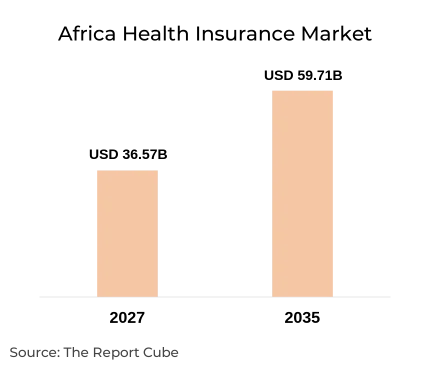
- The Africa Health Insurance Market is projected to reach USD 36.57 billion in 2027, based on the supplied market estimate.
- The market is forecast to reach USD 59.71 billion by 2035.
- The market is expected to expand at a CAGR of 6.32% during 2027-2035.
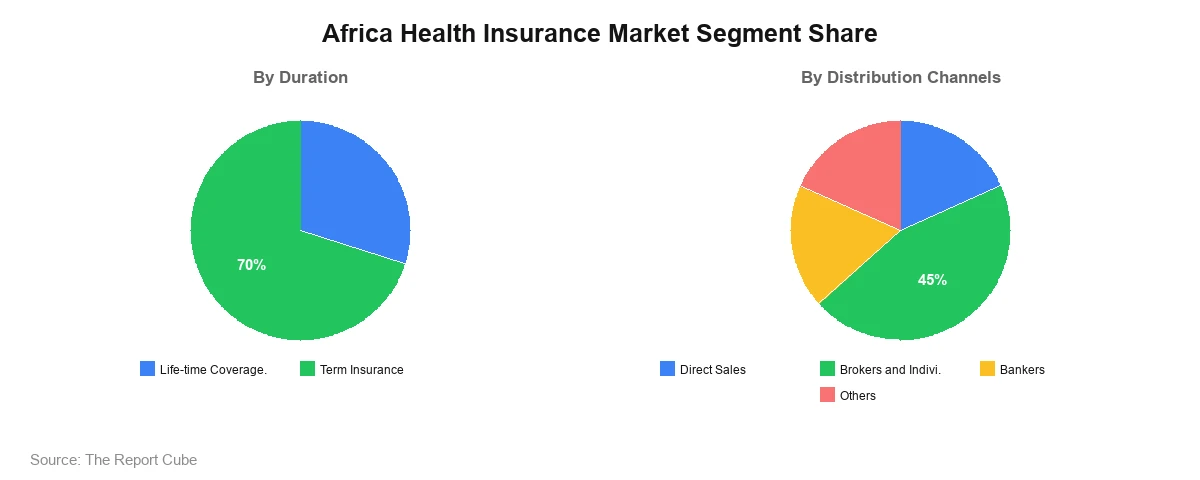
- By duration, Term Insurance leads with an estimated 70% share in 2026, based on the supplied analyst estimate.
- By distribution channel, Brokers and Individual Agents lead with an estimated 45% share in 2026, based on the supplied analyst estimate.
- Southern Africa is identified as the leading regional category, with an estimated 40% share in 2026, based on the supplied analyst estimate.
- Growing demand for financial protection against healthcare costs, national health coverage reforms and international private medical insurance partnerships are shaping the competitive environment.
Market Outlook
Health insurance provides financial protection against eligible medical expenses, including hospitalization, consultations, diagnostic procedures, medicines and other covered healthcare services. Across Africa, the market includes public and social health insurance arrangements, private medical insurance, employer-sponsored healthcare benefits and international private medical insurance. The market's development is closely connected to healthcare affordability, formal employment, household purchasing power and the ability of insurers to establish reliable provider networks.
Demand varies significantly across African countries because healthcare financing structures, income levels, insurance penetration and public healthcare capacity differ. Private health insurance is relevant to formal-sector employees, businesses, higher-income households, expatriates and internationally mobile professionals. Brokers and individual agents remain important distribution intermediaries, while direct sales, bank-led distribution and other channels provide additional access to insurance products. Group medical benefits and international coverage also support demand among employers and multinational organizations.
The Africa Health Insurance Market is projected to grow from USD 36.57 billion in 2027 to USD 59.71 billion by 2035, registering a CAGR of 6.32%. The supplied market estimates indicate an expanding market for healthcare risk protection. Growth opportunities are associated with rising demand for affordable medical coverage, healthcare financing reforms, employer-sponsored insurance, digital distribution and products designed for different income groups.
The competitive environment includes regional insurance groups, international health insurers, medical assistance providers and specialist international private medical insurance companies. Competition is influenced by coverage flexibility, provider networks, claims administration, underwriting capabilities, distribution partnerships and premium affordability. Strategic partnerships between international insurers and African financial services groups are also helping providers expand their regional reach and develop employee health benefit solutions.
Government Regulations
Health insurance regulation in Africa is country-specific and involves insurance supervisors, health ministries and statutory health insurance authorities. In South Africa, the National Health Insurance Act 20 of 2023 establishes a framework for a National Health Insurance Fund and strategic purchasing of healthcare services, although its commencement is subject to proclamation. Kenya's Social Health Insurance Act 2023 establishes the Social Health Authority framework, while Ghana's National Health Insurance Authority operates under the National Health Insurance Act 2012 (Act 852). Nigeria's National Insurance Commission supervises and licenses insurance companies, brokers and agents. These frameworks influence insurer authorization, product administration, provider accreditation, policyholder protection and financial reporting. Companies operating across multiple African markets must therefore comply with local licensing, solvency, consumer-protection and healthcare financing requirements.
Africa Health Insurance Market Dynamics
Market performance is influenced by healthcare affordability, public health financing policies, formal employment, household income and access to private healthcare facilities. National reforms aimed at expanding financial protection can change the balance between public and private coverage, while insurers must manage medical inflation, claims costs, provider networks and affordability. These factors influence product design, distribution strategies and the development of insurance coverage across different African markets.
|
Factor |
Type |
Specific Impact on Market |
Magnitude |
|---|---|---|---|
|
High out-of-pocket healthcare expenditure |
Driver |
Creates demand for financial protection against hospitalization and other medical expenses. |
High |
|
Expansion of national health financing programmes |
Driver |
Encourages broader participation in health coverage and strengthens the role of organized healthcare financing. |
High |
|
Digital insurance distribution and administration |
Opportunity |
Can improve customer acquisition, policy servicing, premium collection and claims communication. |
Medium-High |
|
Employer-sponsored medical benefits |
Opportunity |
Creates opportunities for group policies and integrated employee health benefit programmes. |
Medium-High |
|
Medical inflation and affordability constraints |
Challenge |
Raises claims costs and premiums, potentially limiting policy renewals and coverage expansion. |
High |
|
Fragmented regulatory and healthcare systems |
Challenge |
Increases operational complexity for insurers managing products and provider networks across multiple countries. |
Medium-High |
Growth Drivers: Rising Demand for Financial Protection Against Healthcare Costs
High out-of-pocket healthcare spending creates a substantial need for financial risk protection across African countries. According to the WHO Regional Office for Africa, out-of-pocket expenditure represented approximately 34% of current health expenditure in 2022, while healthcare costs continued to create financial hardship for households. This situation supports demand for insurance products that reduce the financial impact of medical treatment. Private health insurers, social insurance programmes and employer-sponsored schemes can contribute to broader financial protection, subject to affordability and coverage availability.
Need Specific Data, Let’s Customize the Report for You
Request CustomizationMarket Opportunities: Expansion of Employer-Sponsored and Digital Health Insurance
Digital distribution and employer-sponsored health benefits offer opportunities to expand access to medical insurance. Mobile-enabled customer acquisition, digital policy administration and online claims communication can reduce servicing friction and improve access to insurance information. Employers also represent an important customer group because group medical benefits can cover employees and eligible dependants through structured arrangements. International insurer partnerships with local providers and brokers can further support distribution and healthcare access. However, affordability, local licensing and provider-network capacity remain important conditions for successful expansion.
Industry Challenges: Medical Inflation and Limited Insurance Affordability
Medical inflation, uneven household income and the cost of private healthcare can make comprehensive health insurance difficult to afford for a large section of the population. Insurers must balance premium competitiveness with adequate coverage, claims management and financial sustainability. High treatment costs and limited availability of healthcare providers in some locations can also affect claims expenses and service quality. These constraints may encourage customers to select limited-benefit products or remain outside formal insurance arrangements, restricting the expansion of comprehensive coverage.
Market Trends: Growth of Integrated and Cross-Border Health Benefits
Insurers and healthcare benefit providers are increasingly using partnerships to combine international coverage capabilities with local distribution and healthcare networks. This approach is particularly relevant for multinational employers, expatriates and businesses operating across several African markets. Regional employee benefit networks, digital administration and flexible geographic coverage are becoming important product features. The expansion of integrated health benefit partnerships also reflects demand for consistent employee coverage across borders, although the availability of products remains subject to local regulatory approvals and underwriting arrangements.
Africa Health Insurance Market Segment Analysis
The Africa Health Insurance Market is segmented by duration, distribution channel and regional category. These segments reflect differences in policy coverage periods, customer acquisition methods and the geographic markets in which health insurance products are distributed.
By Duration
- Life-time Coverage
- Term Insurance
Term Insurance leads this category with an approx. 70% share in 2026, based on the supplied analyst estimate rather than a published market statistic. Term-based products provide coverage for a defined policy period and are generally structured around renewal conditions, premium payments and specified medical benefits. Their defined coverage periods can make them suitable for individual customers, families and employer-sponsored groups seeking medical protection for a particular period. Life-time Coverage represents the other supplied category and may appeal to customers seeking longer-duration protection, subject to product availability, underwriting terms and local insurance regulations. Policy structures and terminology differ across African markets, so these categories should be interpreted as the report's segmentation framework.
By Distribution Channels
- Direct Sales
- Brokers and Individual Agents
- Bankers
- Others
Brokers and Individual Agents lead this category with an approx. 45% share in 2026, based on the supplied analyst estimate rather than a published market statistic. Intermediaries play an important role in explaining policy benefits, comparing coverage options, assisting with applications and connecting customers with insurers. Their role can be particularly relevant in markets where health insurance products have complex exclusions, provider networks and claims procedures. Direct Sales provides insurers with opportunities to manage customer relationships and policy servicing, while Bankers can support distribution through financial services relationships. Others includes alternative distribution arrangements, subject to local market practices.
Africa Health Insurance Market Regional Analysis
The Africa Health Insurance Market is assessed across Francophone Africa, Anglophone West Africa, Southern Africa, North Africa and other markets. Regional demand is influenced by healthcare financing systems, income levels, private healthcare infrastructure, insurance regulation and the development of employer-sponsored and individual medical coverage.
|
Region |
Estimated Market Share |
Key Growth Factors |
Industry Trends |
|---|---|---|---|
|
Francophone Africa |
Not independently verified |
Development of national health financing arrangements, employer-sponsored coverage and private healthcare services. |
Partnership-led distribution and expansion of regional employee health benefits. |
|
Anglophone West Africa |
Not independently verified |
Demand for private medical coverage, formal-sector employee benefits and improved access to healthcare financing. |
Growth of broker-led distribution, digital policy servicing and group medical plans. |
|
Southern Africa |
Approx. 40% in 2026 (analyst estimate supplied by user) |
Established private health financing structures, insurance distribution networks and employer-sponsored healthcare benefits. |
Competition between medical schemes, commercial insurers and international health benefit providers. |
|
North Africa |
Not independently verified |
Healthcare system development, private hospital capacity and demand for supplementary medical coverage. |
Development of private insurance offerings alongside public healthcare financing arrangements. |
|
Others |
Not independently verified |
Expansion of healthcare access, insurance awareness and formal health financing programmes. |
Country-specific insurance products and partnerships with local healthcare providers. |
Southern Africa is identified as the leading regional category in the supplied research, with an estimated 40% share in 2026. South Africa is an important market within this grouping, supported by established private medical scheme arrangements and commercial health insurance activity. The region also attracts international insurers and employee benefit providers seeking partnerships with local financial services groups. However, the 40% figure is an analyst estimate supplied for this report and has not been independently verified through comparable regional premium or revenue data.
Competitive Landscape
The Africa Health Insurance Market includes regional insurers, international private medical insurance providers, global health benefit companies and specialist intermediaries. Competition is shaped by geographic coverage, policy design, provider networks, claims administration, broker relationships and the ability to serve individuals and multinational employers. The following companies are the participants supplied for this report; the table does not represent a verified market-share ranking or confirm identical operating roles across all African countries.
|
Company |
Competitive Strength |
Primary Segment Served |
|---|---|---|
|
Santam |
Pan-African specialist insurance presence and accident and health insurance capabilities. |
Specialist accident and health, group personal accident and related insurance solutions. |
|
Allianz Care |
International health insurance expertise and geographic coverage options, including Africa-area cover. |
International private medical insurance and expatriate health benefits. |
|
Cigna Global |
International medical insurance products and access to a broad global healthcare network. |
Individual, family and international employee health plans. |
|
Aetna International |
Historically recognized international health benefits brand and multinational healthcare capabilities. |
International medical coverage; current product and underwriting availability should be checked by market. |
|
Globality Health |
International health insurance focus and solutions for globally mobile customers. |
International private medical insurance. |
|
Bupa Global |
International private medical insurance with global healthcare access and premium coverage options. |
International individual and family medical insurance. |
|
Clements Worldwide |
International insurance specialization for expatriates, globally mobile professionals and organizations. |
International health and related expatriate insurance solutions. |
|
Global Underwriters |
Specialist international insurance and travel-related medical coverage capabilities. |
International medical and travel medical insurance products. |
|
IMG |
International medical insurance and travel medical coverage capabilities. |
International health, expatriate and travel medical insurance. |
|
Insured Nomads |
Digital-first international insurance proposition for globally mobile customers. |
Nomad, expatriate and international travel-related health coverage. |
- Allianz Care: Allianz Care is the international health business of Allianz Partners and provides international health insurance solutions for individuals, families and businesses. Its product offering includes geographic coverage options that can include Africa, depending on the selected plan. The company's international healthcare capabilities and partnerships with regional financial services providers support its position in the expatriate and multinational employee benefits segments. Its 2025 partnership with SanlamAllianz further expanded its employee health benefits network across several African markets.
- Cigna Global: Cigna Global provides international health insurance products for globally mobile professionals, families and retirees. Its proposition includes international medical coverage, multilingual customer support and access to a broad network of healthcare professionals and facilities. Its international positioning is relevant to expatriates, multinational employers and customers seeking medical coverage across more than one country. Product eligibility, geographic coverage and benefits depend on the policy selected and the customer's country of residence.
Recent Developments and Updates
- December 2025: Allianz Partners announced a partnership with SanlamAllianz to expand its Allianz Health & Benefits Network across Africa. The initial programme covered Morocco, Ivory Coast, Senegal, Cameroon, Gabon, Mauritius, Burkina Faso, Mali, Madagascar, Togo and Benin, subject to relevant regulatory approvals. The partnership is intended to provide multinational employers with integrated employee health and benefits solutions across participating markets.
- 2025: AXA Global Healthcare announced strategic collaborations with Old Mutual General Insurance Kenya and Executive Healthcare Solutions. Under the arrangement, new AXA Global Healthcare policies in Kenya were to be locally underwritten by Old Mutual from 1 October 2025. The partnership supports international private medical insurance distribution and local underwriting capabilities in East Africa.
Africa Health Insurance Market Future Outlook
The Africa Health Insurance Market is expected to expand during 2027-2035 as demand for healthcare financial protection, employer-sponsored medical benefits and international coverage develops. Public health financing reforms and private insurance partnerships may create opportunities for insurers to reach additional customer groups. Digital distribution, flexible coverage structures and stronger provider networks are also likely to influence product development, although affordability will remain an important determinant of market adoption.
Competition is expected to focus on premium affordability, claims efficiency, healthcare provider access, product flexibility and local distribution partnerships. International insurers may continue collaborating with African financial services groups and brokers to strengthen their regional presence. However, medical inflation, differences in country-level regulation, limited household purchasing power and uneven healthcare infrastructure will remain important challenges. Insurers that align coverage with local customer requirements and regulatory frameworks may be better positioned to expand sustainably.
Africa Health Insurance Market Report Coverage
This report covers the Africa Health Insurance Market outlook, supplied market estimates, segmentation, regional assessment, industry dynamics and competitive landscape for 2027-2035.
|
Parameter |
Details |
|---|---|
|
Market Name |
Africa Health Insurance Market |
|
Market Size (2027) |
USD 36.57 billion |
|
Market Size (2035) |
USD 59.71 billion |
|
CAGR |
6.32% |
|
Base Year |
2026 |
|
Historical Period |
2022-2026 |
|
Forecast Period |
2027-2035 |
|
Geographic Scope |
Africa |
|
Segmentation |
By Duration, By Distribution Channels and By Regional |
|
Regions Covered |
Francophone Africa, Anglophone West Africa, Southern Africa, North Africa and Others |
|
Key Companies |
Santam, Allianz Care, Cigna Global, Aetna International, Globality Health, Bupa Global, Clements Worldwide, Global Underwriters, IMG and Insured Nomads |
|
Customization |
Available as per requirement |
Why Choose This Africa Health Insurance Market Report?
- Provides the supplied 2027 market estimate, 2035 forecast and expected CAGR for the Africa Health Insurance Market.
- Examines the market by duration, distribution channels and regional categories.
- Evaluates key growth drivers, market opportunities, industry challenges and emerging trends.
- Assesses regional market conditions across Francophone Africa, Anglophone West Africa, Southern Africa, North Africa and Others.
- Reviews the competitive positioning and capabilities of regional and international health insurance participants.
- Highlights developments in international employee health benefits, private medical insurance partnerships and digital distribution.
- Provides market context to support strategic planning, market-entry assessment, product development and competitive analysis.
Table of Contents
- Introduction
- Objective of the Study
- Product Definition
- Market Segmentation
- Study Variables
- Research Methodology
- Secondary Data Points
- Companies Interviewed
- Primary Data Points
- Breakdown of Primary Interviews
- Secondary Data Points
- Executive Summary
- Market Dynamics
- Drivers
- Challenges
- Opportunity Assessment
- Recent Trends and Developments
- Policy and Regulatory Landscape
- Africa Health Insurance Market Overview and Forecast Analysis (2022-2035)
- Market Size, By Value, By Growth Rate (CAGR/USD Billions)
- Demand – Supply Trends
- Market Share, By Duration
- Life-time Coverage
- Term Insurance
- Market Share, By Distribution Channels
- Direct Sales
- Brokers and Individual Agents
- Bankers
- Others
- Market Share, By Regional
- Francophone Africa
- Anglophone West Africa
- Southern Africa
- North Africa
- Others
- Market Share, By Competitors
- Competition Characteristics
- Revenue Shares
- Life-time Coverage Africa Health Insurance Market Overview, 2022-2035F
- By Value (USD Million)
- By Distribution Channels – Market Size & Forecast 2022-2035, USD Million
- Direct Sales
- Brokers and Individual Agents
- Bankers
- Others
- Term Insurance Africa Health Insurance Market Overview, 2022-2035F
- By Value (USD Million)
- By Distribution Channels – Market Size & Forecast 2022-2035, USD Million
- Direct Sales
- Brokers and Individual Agents
- Bankers
- Others
- Competitive Outlook (Company Profile – Partial List)
- Santam
- Company Overview
- Business Segments
- Strategic Alliances/Partnerships
- Recent Developments
- Allianz Care
- Company Overview
- Business Segments
- Strategic Alliances/Partnerships
- Recent Developments
- Cigna Global
- Company Overview
- Business Segments
- Strategic Alliances/Partnerships
- Recent Developments
- Aetna International
- Company Overview
- Business Segments
- Strategic Alliances/Partnerships
- Recent Developments
- Globality Health
- Company Overview
- Business Segments
- Strategic Alliances/Partnerships
- Recent Developments
- Bupa Global
- Company Overview
- Business Segments
- Strategic Alliances/Partnerships
- Recent Developments
- Clements Worldwide
- Company Overview
- Business Segments
- Strategic Alliances/Partnerships
- Recent Developments
- Global Underwriters
- Company Overview
- Business Segments
- Strategic Alliances/Partnerships
- Recent Developments
- IMG
- Company Overview
- Business Segments
- Strategic Alliances/Partnerships
- Recent Developments
- Insured Nomads
- Company Overview
- Business Segments
- Strategic Alliances/Partnerships
- Recent Developments
- Santam
- Contact Us & Disclaimer
Top Key Players & Market Share Outlook
- Santam
- Allianz Care
- Cigna Global
- Aetna International
- Globality Health
- Bupa Global
- Clements Worldwide
- Global Underwriters
- IMG
- Insured Nomads
Frequently Asked Questions