


Build Your Custom Market Intelligence Report
Customize Your ReportKey Highlights
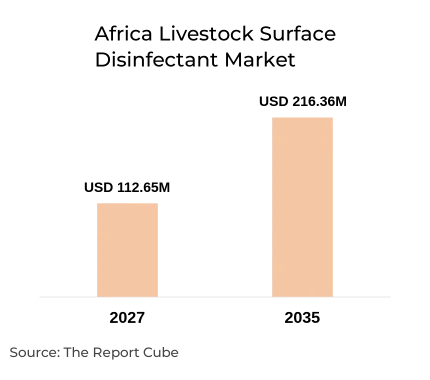
- The Africa Livestock Surface Disinfectant Market is estimated at USD 112.65 million in 2027, based on the supplied market data.
- The market is projected to reach USD 216.36 million by 2035.
- The market is expected to expand at a CAGR of 8.50% during 2027-2035.
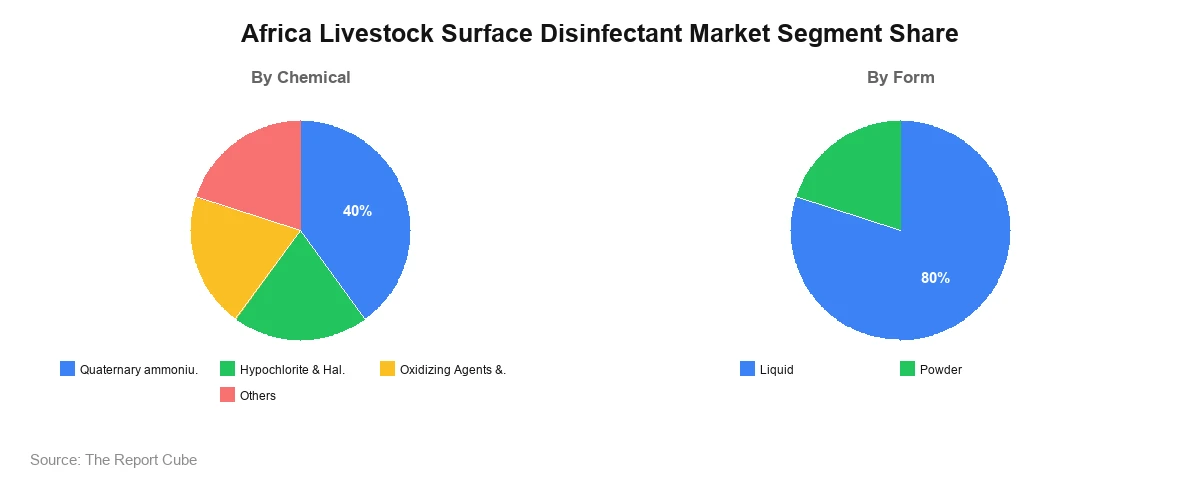
- By chemical, Quaternary Ammonium Compounds & Phenols lead with an estimated 40% share in 2026, based on the supplied analyst estimate.
- By form, Liquid products lead with an estimated 80% share in 2026, based on the supplied analyst estimate.
- By livestock, Poultry leads with an estimated 45% share in 2026, while South Africa leads the supplied country grouping with an estimated 30% share in 2026. Both are analyst estimates.
- Growing emphasis on farm biosecurity, disease prevention, poultry production hygiene and livestock disease outbreak management is supporting demand for surface disinfectants.
Market Outlook
Livestock surface disinfectants are chemical formulations used to reduce or eliminate disease-causing microorganisms on farm floors, walls, animal housing, equipment, transport vehicles, feeding systems and other environmental surfaces. These products are an important component of livestock biosecurity because contaminated surfaces and equipment can contribute to pathogen transmission between animals and production facilities. The market includes disinfectants based on quaternary ammonium compounds, phenols, hypochlorite, halogens, oxidizing agents and other chemical formulations.
Demand is associated with poultry farms, cattle operations, pig farms, veterinary facilities, hatcheries, livestock transportation and commercial animal production facilities. Farm operators use disinfectants as part of routine cleaning programmes, between production cycles and during disease-control activities. Product selection depends on the pathogens being targeted, surface compatibility, organic matter, application method, contact time and cost. Liquid formulations are used across several spraying and washing applications, while powder products offer alternative storage, handling and preparation characteristics.
The Africa Livestock Surface Disinfectant Market is projected to increase from USD 112.65 million in 2027 to USD 216.36 million by 2035, registering a CAGR of 8.50%. The supplied forecast reflects expected demand expansion across livestock production and farm hygiene applications. Disease prevention, poultry biosecurity, livestock commercialization and improved awareness of cleaning and disinfection protocols are relevant factors influencing the market's development.
The competitive landscape includes international animal health and biosecurity companies, chemical manufacturers and specialist disinfectant suppliers. Competition is influenced by antimicrobial efficacy, formulation stability, application flexibility, material compatibility, regulatory acceptance and distribution networks. Companies offering products for poultry houses, cattle facilities, pig housing, equipment and transport disinfection can address multiple livestock production environments. Market opportunities also depend on product affordability and the ability to provide technical guidance to commercial and small-scale farms.
Government Regulations
Livestock surface disinfectants are subject to country-specific chemical, veterinary, agricultural input, environmental and workplace safety requirements. The World Organisation for Animal Health (WOAH) provides international guidance recommending that disinfectant selection consider the pathogen, premises and objects being treated, with authorization supported by appropriate efficacy testing. In South Africa, the Department of Agriculture issued a clarification dated 2 December 2025 stating that general-purpose surface and equipment disinfectants not applied to animals for medicinal purposes do not fall under the Stock Remedies Act 36 of 1947, although other legislation may still apply. Products specifically applied to animals for medicinal purposes remain within that Act's scope. Across African markets, manufacturers and distributors must assess applicable chemical registration, product labelling, safety data, environmental disposal and local import requirements.
Africa Livestock Surface Disinfectant Market Dynamics
Market demand is influenced by livestock disease prevention, commercial farm hygiene practices, animal production intensity and the adoption of structured biosecurity programmes. Disinfectant performance depends on chemical composition, pathogen susceptibility, surface conditions and correct application. Poultry and pig production facilities require regular environmental hygiene measures, while cattle operations use disinfectants across animal housing, equipment and transport environments. Product affordability, regulatory compliance and availability of technical guidance also influence purchasing decisions.
|
Factor |
Type |
Specific Impact on Market |
Magnitude |
|---|---|---|---|
|
Growing emphasis on livestock biosecurity |
Driver |
Encourages regular disinfection of animal housing, equipment, vehicles and other farm surfaces. |
High |
|
Disease prevention in poultry and pig production |
Driver |
Supports demand for disinfectants used in routine farm hygiene and outbreak response. |
High |
|
Development of broad-spectrum and specialized formulations |
Opportunity |
Creates opportunities for products targeting specific pathogens, surfaces and farm applications. |
Medium-High |
|
Expansion of commercial livestock production |
Opportunity |
Increases the potential customer base for structured farm sanitation and disinfection programmes. |
Medium-High |
|
Price sensitivity and inconsistent farm hygiene infrastructure |
Challenge |
Can restrict adoption of specialized disinfectants and consistent application protocols among smaller farms. |
High |
|
Incorrect product selection and application |
Challenge |
Organic matter, unsuitable concentrations and inadequate contact time can reduce disinfection effectiveness. |
Medium-High |
Growth Drivers: Increasing Focus on Livestock Farm Biosecurity
Livestock disease prevention requires consistent sanitation practices across animal housing, equipment, transport vehicles and farm environments. According to WOAH's Terrestrial Animal Health Code, disinfection procedures should be selected according to the pathogen and the surfaces being treated, while cleaning should precede the application of disinfectants. Its African Swine Fever guidance also identifies thorough cleansing and disinfection as part of outbreak control. These recommendations support the use of surface disinfectants in routine farm biosecurity and disease-management programmes.
Need Specific Data, Let’s Customize the Report for You
Request CustomizationMarket Opportunities: Specialized Formulations for Poultry and Pig Farm Hygiene
Specialized formulations designed for poultry houses, hatcheries, pig housing, cattle facilities and livestock transport equipment offer opportunities for product differentiation. WOAH's poultry biosecurity guidance emphasizes preventing the introduction and spread of infectious agents in intensive production systems. Manufacturers can address this requirement through products with validated pathogen-specific efficacy, suitable material compatibility and practical application methods. Opportunities also exist for technical support, farm hygiene protocols and distributor-led education, particularly where operators need assistance selecting appropriate products and applying them correctly.
Industry Challenges: Price Sensitivity and Inconsistent Disinfection Practices
Adoption can be constrained by the cost of specialized formulations, limited access to trained personnel and inconsistent farm sanitation infrastructure. Effective disinfection requires more than product application: surfaces must be cleaned to remove organic material, the correct concentration must be prepared and adequate contact time must be maintained. WOAH guidance highlights that organic matter can interfere with disinfection effectiveness and that product selection must consider the pathogen and treated surface. These requirements create practical challenges for farms with limited technical resources.
Market Trends: Shift Toward Broad-Spectrum and Application-Specific Disinfectants
Product development is increasingly focused on formulations that address multiple pathogen groups and support different farm applications. Commercial product portfolios include quaternary ammonium compound combinations, phenolic formulations, oxidizing agents and other disinfectant chemistries. LANXESS, for example, markets products for livestock surface, equipment and vehicle disinfection, while its product range includes both liquid and powder formulations. These developments reflect the importance of matching product chemistry and application requirements to the biosecurity needs of individual livestock operations.
Africa Livestock Surface Disinfectant Market Segment Analysis
The Africa Livestock Surface Disinfectant Market is segmented by chemical, form, livestock category and regional market. These segments represent differences in disinfectant formulation, product delivery, livestock production requirements and country-level demand conditions.
By Chemical
- Quaternary ammonium compounds & Phenols
- Hypochlorite & Halogens
- Oxidizing Agents & Aldehydes
- Others
Quaternary ammonium compounds & Phenols lead this category with an approx. 40% share in 2026, based on the supplied analyst estimate rather than a published market statistic. Quaternary ammonium compounds are used in disinfectant formulations designed for farm surfaces and equipment, while phenolic formulations provide another established chemistry option for environmental disinfection. Hypochlorite & Halogens represent another important chemical group, with hypochlorite widely referenced in international disinfection guidance. Oxidizing Agents & Aldehydes offer additional options for pathogen-control applications, while Others includes alternative formulations. Product performance depends on pathogen susceptibility, organic matter, concentration and contact time.
By Form
- Liquid
- Powder
Liquid products lead this category with an approx. 80% share in 2026, based on the supplied analyst estimate rather than a published market statistic. Liquid disinfectants are used in spraying, washing, surface treatment and equipment sanitation programmes across different livestock facilities. They can be supplied as ready-to-use products or concentrates requiring dilution before application. Powder products represent the other supplied category and can provide practical advantages in storage, transportation and preparation of working solutions. The selection between liquid and powder formats depends on farm infrastructure, water availability, application equipment, product stability and the operating requirements of livestock facilities.
Africa Livestock Surface Disinfectant Market Regional Analysis
The Africa Livestock Surface Disinfectant Market is analyzed across South Africa, Nigeria, Ethiopia, Tanzania and Kenya. Regional demand is shaped by livestock production systems, commercial poultry and cattle operations, veterinary services, disease-control priorities, agricultural input distribution and the adoption of farm biosecurity practices.
|
Region |
Estimated Market Share |
Key Growth Factors |
Industry Trends |
|---|---|---|---|
|
South Africa |
Approx. 30% in 2026 (analyst estimate supplied by user) |
Commercial livestock production, established agricultural input distribution and veterinary services. |
Greater attention to structured farm biosecurity, product compliance and specialized animal health solutions. |
|
Nigeria |
Not independently verified |
Poultry and cattle production, demand for farm hygiene and animal disease prevention. |
Opportunities for affordable disinfectant products and stronger distribution to commercial farms. |
|
Ethiopia |
Not independently verified |
Large livestock production base and demand for veterinary and animal health services. |
Potential for wider adoption of livestock hygiene and disease-prevention programmes. |
|
Tanzania |
Not independently verified |
Cattle, poultry and other livestock production, with demand for farm sanitation and disease control. |
Development of commercial livestock operations and farm-level biosecurity practices. |
|
Kenya |
Not independently verified |
Commercial poultry and dairy production, veterinary service availability and livestock health programmes. |
Growing relevance of farm hygiene products and organized animal health distribution. |
South Africa is identified as the leading country in the supplied segmentation, with an estimated 30% share in 2026. The country has an established agricultural and animal health industry, with demand for livestock hygiene products across poultry, cattle and other commercial farming activities. Regulatory oversight of agricultural and veterinary products also influences the product registration and distribution environment. The supplied share remains an analyst estimate and should not be interpreted as an independently verified national revenue statistic.
Competitive Landscape
The Africa Livestock Surface Disinfectant Market includes international chemical manufacturers and animal health companies offering products for farm hygiene, surface sanitation and livestock biosecurity. Competitive positioning is influenced by disinfectant efficacy, chemical formulation, product availability, technical support and distribution reach. The following companies were supplied for this report. Their inclusion reflects relevant product or chemical capabilities, not a verified ranking of African livestock surface disinfectant revenue or market share.
|
Company |
Competitive Strength |
Primary Segment Served |
|---|---|---|
|
LANXESS AG |
Dedicated biosecurity portfolio with livestock disinfectants, surface sanitation and animal hygiene solutions. |
Livestock, poultry and pig farm surface and equipment disinfection. |
|
Solvay S.A. |
Peracetic acid and oxidizing chemistry capabilities for disinfection and hygiene applications. |
Oxidizing-agent-based disinfection and animal biosecurity-related applications. |
|
Neogen Corporation |
Animal safety and biosecurity product portfolio, including disinfectants for animal production environments. |
Livestock and poultry facility disinfection and animal care hygiene. |
|
DuPont de Nemours, Inc. |
Specialty chemical and material science capabilities; current direct participation in African livestock surface disinfectants requires product-level verification. |
Relevant chemical and industrial hygiene applications; direct livestock disinfectant activity not independently established. |
- LANXESS AG: LANXESS is a specialty chemicals company with a dedicated Biosecurity Solutions business serving livestock, poultry and aquaculture production. Its portfolio includes Virkon, TH4+, Mefisto, Aldekol and other products for surface, equipment and farm disinfection. The company's products address different chemical formulations and application requirements, including liquid and powder formats. Its livestock biosecurity portfolio and international distribution capabilities position it as a relevant participant in the animal hygiene and surface disinfectant category.
- Neogen Corporation: Neogen provides animal safety and biosecurity products, including disinfectants for livestock production facilities and animal care environments. Its product catalogue describes formulations designed for poultry houses, swine facilities, livestock premises, equipment and veterinary settings. The company's portfolio includes products intended to address bacterial, viral and fungal contamination on farm surfaces. Its presence in animal health and food safety provides a relevant competitive platform, although country-level product availability and regulatory approvals should be verified separately.
Recent Developments and Updates
- September 2026: WOAH's Terrestrial Animal Health Standards Commission meeting report included an updated chapter on cleaning and disinfection, emphasizing biosecurity planning, removal of organic material before disinfection, appropriate contact time and correct product use. The document is a Commission meeting report and should not be treated as a final adopted standard without checking the subsequent official status.
Africa Livestock Surface Disinfectant Market Future Outlook
The Africa Livestock Surface Disinfectant Market is expected to expand during 2027-2035, supported by greater attention to animal health, livestock farm hygiene and biosecurity management. Poultry, cattle and pig production facilities are expected to remain important demand areas. Manufacturers may benefit from developing formulations that address specific pathogens, offer reliable surface compatibility and support practical application across different livestock environments. Liquid and powder products are likely to remain relevant across varied farm operating conditions.
Competition is expected to focus on formulation performance, product affordability, regulatory compliance, distribution reach and technical support. International manufacturers may strengthen their positions through local distributors, veterinary partnerships and broader animal health portfolios. However, price sensitivity, inconsistent farm sanitation practices, limited technical knowledge and differences in national product registration requirements may constrain adoption. Suppliers that combine validated efficacy with accessible pricing and practical farm-level guidance may be better positioned to develop sustainable demand.
Africa Livestock Surface Disinfectant Market Report Coverage
This report covers the Africa Livestock Surface Disinfectant Market size, forecast, chemical segmentation, product forms, livestock applications, regional markets and competitive landscape for 2027-2035.
|
Parameter |
Details |
|---|---|
|
Market Name |
Africa Livestock Surface Disinfectant Market |
|
Market Size (2027) |
USD 112.65 million |
|
Market Size (2035) |
USD 216.36 million |
|
CAGR |
8.50% |
|
Base Year |
2026 |
|
Historical Period |
2022-2026 |
|
Forecast Period |
2027-2035 |
|
Geographic Scope |
Africa |
|
Segmentation |
By Chemical, By Form, By Livestock and By Regional |
|
Regions Covered |
South Africa, Nigeria, Ethiopia, Tanzania and Kenya |
|
Key Companies |
LANXESS AG, Solvay S.A., Neogen Corporation and DuPont de Nemours, Inc. |
|
Customization |
Available as per requirement |
Why Choose This Africa Livestock Surface Disinfectant Market Report?
- Provides the supplied 2027 market estimate, 2035 forecast and 8.50% CAGR for the Africa Livestock Surface Disinfectant Market.
- Examines market segmentation by chemical composition, product form, livestock category and country.
- Evaluates the role of livestock biosecurity, disease prevention, farm sanitation and product application practices.
- Assesses demand conditions across South Africa, Nigeria, Ethiopia, Tanzania and Kenya.
- Reviews the product portfolios and competitive capabilities of key chemical and animal health companies.
- Highlights opportunities in broad-spectrum formulations, poultry hygiene, livestock equipment sanitation and farm biosecurity programmes.
- Provides market context to support product development, distribution planning, market-entry assessment and competitive strategy.
Table of Contents
- Introduction
- Objective of the Study
- Product Definition
- Market Segmentation
- Study Variables
- Research Methodology
- Secondary Data Points
- Companies Interviewed
- Primary Data Points
- Breakdown of Primary Interviews
- Secondary Data Points
- Executive Summary
- Market Dynamics
- Drivers
- Challenges
- Opportunity Assessment
- Recent Trends and Developments
- Policy and Regulatory Landscape
- Africa Livestock Surface Disinfectant Market Overview and Forecast Analysis (2022-2035)
- Market Size, By Value, By Growth Rate (CAGR/USD Billions)
- Demand – Supply Trends
- Market Share, By Chemical
- Quaternary ammonium compounds & Phenols
- Hypochlorite & Halogens
- Oxidizing Agents & Aldehydes
- Others
- Market Share, By Form
- Liquid
- Powder
- Market Share, By Livestock
- Cattle
- Pig
- Poultry
- Others
- Market Share, By Regional
- South Africa
- Nigeria
- Ethiopia
- Tanzania
- Kenya
- Market Share, By Competitors
- Competition Characteristics
- Revenue Shares
- Quaternary ammonium compounds & Phenols Africa Livestock Surface Disinfectant Market Overview, 2022-2035F
- By Value (USD Million)
- By Form – Market Size & Forecast 2022-2035, USD Million
- Liquid
- Powder
- Hypochlorite & Halogens Africa Livestock Surface Disinfectant Market Overview, 2022-2035F
- By Value (USD Million)
- By Form – Market Size & Forecast 2022-2035, USD Million
- Liquid
- Powder
- Oxidizing Agents & Aldehydes Africa Livestock Surface Disinfectant Market Overview, 2022-2035F
- By Value (USD Million)
- By Form – Market Size & Forecast 2022-2035, USD Million
- Liquid
- Powder
- Others Africa Livestock Surface Disinfectant Market Overview, 2022-2035F
- By Value (USD Million)
- By Form – Market Size & Forecast 2022-2035, USD Million
- Liquid
- Powder
- Competitive Outlook (Company Profile – Partial List)
- Lanxess AG
- Company Overview
- Business Segments
- Strategic Alliances/Partnerships
- Recent Developments
- Solvay S.A.
- Company Overview
- Business Segments
- Strategic Alliances/Partnerships
- Recent Developments
- Neogen Corporation
- Company Overview
- Business Segments
- Strategic Alliances/Partnerships
- Recent Developments
- DuPont de Nemours
- Company Overview
- Business Segments
- Strategic Alliances/Partnerships
- Recent Developments
- Lanxess AG
- Contact Us & Disclaimer
Top Key Players & Market Share Outlook
- Lanxess AG
- Solvay S.A.
- Neogen Corporation
- and DuPont de Nemours
- Inc.
Frequently Asked Questions