



Build Your Custom Market Intelligence Report
Customize Your ReportAustralia Polypropylene Market Key Takeaways
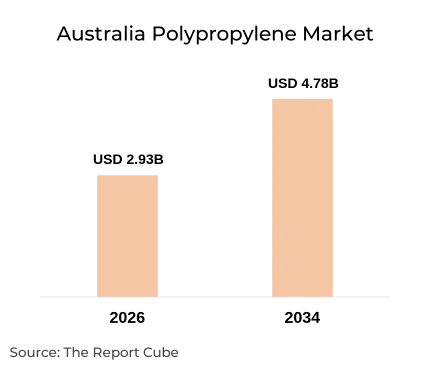
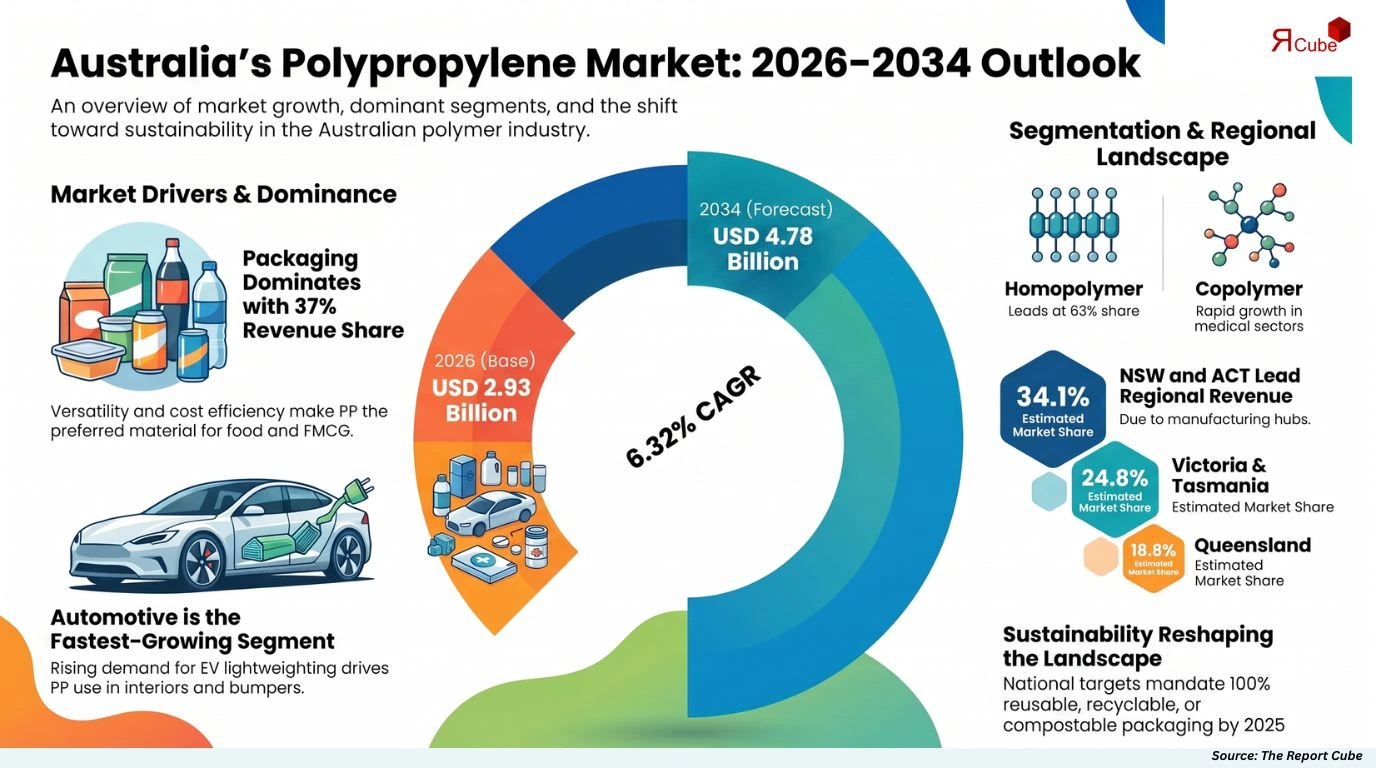
- Market was valued at USD 2.93 billion in 2026, reflecting sustained domestic polymer demand.
- Industry projected to reach USD 4.78 billion by 2034, expanding at a 6.32% CAGR.
- Packaging dominates end-user segments due to polypropylene's versatility and cost efficiency.
- Homopolymer type leads the market owing to widespread industrial and consumer applications.
- New South Wales and Australian Capital Territory account for the highest regional revenue share.
- Automotive end-use is the fastest-growing segment driven by lightweighting material demand.
- ExxonMobil, LyondellBasell, SABIC, INEOS, and Borealis lead competitive market positioning.
- Circular economy mandates and recycled polypropylene adoption are reshaping Australia's polymer landscape.
Australia Polypropylene Market Insights & Analysis
The Australia Polypropylene Market is anticipated to register a 6.32% CAGR during 2026–2034. The market size was valued at USD 2.93 billion in 2026 and is projected to reach USD 4.78 billion by 2034. Sustained demand from packaging, automotive, building and construction, medical, and electrical and electronics industries continues to fuel market expansion across Australia's diverse geographic and industrial landscape. The country's near self-sufficient production profile, with domestic consumption reaching approximately 957,000 tons in 2024, reinforces the market's structural resilience and positions it for consistent long-term volume growth.
Government-backed infrastructure investment programs, including Australia's National Housing Accord targeting 1.2 million new homes over five years, are generating substantial downstream PP demand across construction fittings, pipes, and insulation systems. Additionally, Australia's National Packaging Targets, which mandate 100% reusable, recyclable, or compostable packaging by 2025, are accelerating investment in food-grade and certified recycled polypropylene solutions. These regulatory and policy frameworks are encouraging leading global producers operating in the region to scale up advanced recycled polypropylene supply chains while expanding their domestic distribution networks to meet the evolving material specifications of Australian manufacturers.
Australia Polypropylene Market Dynamics
The Australia Polypropylene Market is experiencing a well-defined growth trajectory shaped by expanding manufacturing activities, infrastructure development, and shifting consumer preferences toward lightweight, chemically resistant polymer solutions. Increasing downstream sector diversification, rising adoption of sustainable PP grades, and growing industrial conversion from traditional materials collectively underpin the market's robust demand momentum across every major application vertical.
|
Factor |
Type |
Specific Impact on Market |
Magnitude |
|---|---|---|---|
|
Packaging industry expansion |
Driver |
Accelerates flexible and rigid PP consumption in food and FMCG |
Very High |
|
Automotive lightweighting mandates |
Driver |
Increases PP use in bumpers, dashboards, and interior components |
High |
|
National Packaging Targets |
Opportunity |
Drives adoption of food-grade recycled and circular PP grades |
High |
|
Housing and infrastructure investment |
Driver |
Boosts PP demand in pipes, fittings, and construction materials |
High |
|
Circular economy and rPP adoption |
Trend |
Reshapes procurement toward certified sustainable polymer grades |
Very High |
Key Market Driver: Packaging Sector Consumption Expanding Rapidly
Australia's packaging industry remains the single most influential demand driver for polypropylene, accounting for an estimated 36% of total end-user revenue in 2026. Rising domestic consumption of packaged food and beverages, pharmaceutical blister packs, and FMCG rigid containers continues to drive high-volume PP procurement from converters and brand owners. Australia's well-developed retail infrastructure and export-oriented food processing sector further reinforce consistent packaging-grade PP demand. Growing adoption of polypropylene film and flexible packaging solutions is intensifying procurement volumes for both homopolymer and random copolymer grades suitable for high-clarity, heat-sealable film applications.
Major Industry Challenge: Feedstock Price Volatility and Import Dependency
Despite near self-sufficient domestic production, Australia's polypropylene market remains partially exposed to global propylene feedstock price fluctuations linked to crude oil and naphtha pricing cycles. Refinery rationalization - including the closure of ExxonMobil's Altona refinery in 2021 and LyondellBasell's Geelong facility acquisition by Viva Energy - has shifted the domestic supply equation, creating periodic import dependency for specialty and high-performance PP grades. This structural feedstock sensitivity can compress converter margins during global energy price spikes, limiting the rate at which downstream processors invest in new capacity and product development across specialty polypropylene compound applications.
Emerging Trend Shaping Outlook: Recycled and Bio-Based PP Mainstreaming
Circular economy imperatives are materially reshaping Australia's polypropylene procurement landscape. SABIC's TRUCIRCLE certified circular PP program and LyondellBasell's Circulen portfolio are enabling Australian converters to access independently certified recycled-content grades that meet both regulatory and brand sustainability commitments. Advanced recycling technologies - including pyrolysis-oil-based PP production - are gaining commercial traction as Extended Producer Responsibility (EPR) frameworks across Australian states mandate minimum recycled content in packaging. This structural shift toward sustainable polymer sourcing represents a multiyear revenue growth catalyst that will differentiate market leaders from commodity-grade PP distributors throughout the forecast period.
Need Specific Data, Let’s Customize the Report for You
Request CustomizationAustralia Polypropylene Market Segment-wise Analysis
The Australia Polypropylene Market is segmented across two primary analytical dimensions: polymer type and end-user industry. Each segmentation layer reveals distinct demand drivers, adoption patterns, and growth trajectories that collectively shape the market's competitive and investment landscape through 2034.
By Type
- Homopolymer
- Copolymer and Others
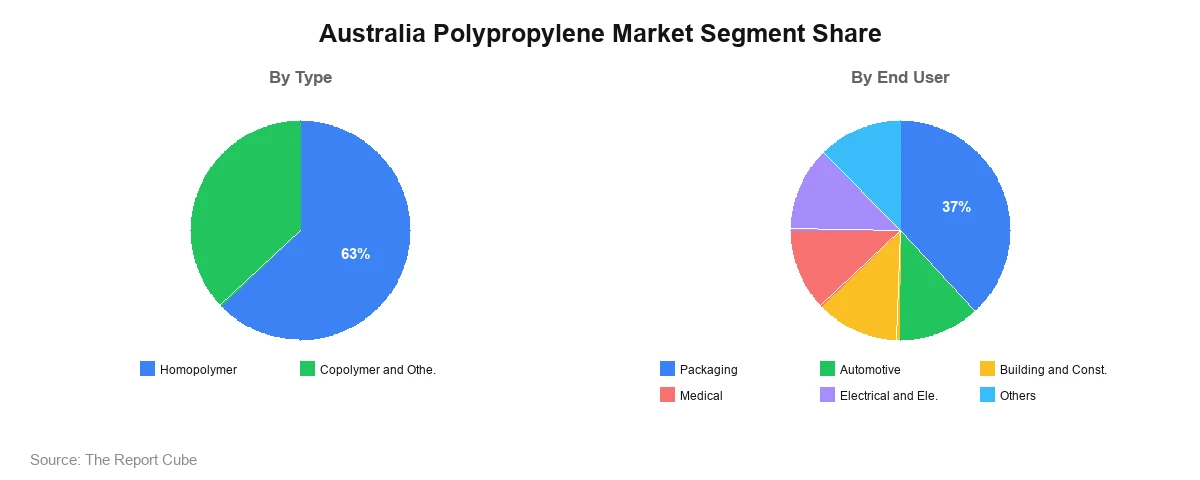
Homopolymer polypropylene dominates the Australian market with an estimated 63% revenue share in 2026, driven by its superior stiffness, cost efficiency, and broad compatibility across packaging films, rigid containers, textiles, and industrial injection-molded components. Its price-performance ratio remains unmatched among PP grades for high-volume applications, making it the preferred choice for food packaging converters, FMCG manufacturers, and construction material producers operating across Australia's eastern seaboard industrial corridors. Consistent propylene monomer availability and established processing infrastructure further reinforce homopolymer's entrenched market leadership.
Copolymer and others account for the remaining approximately 37% of the by-type segment, with copolymer grades registering the fastest growth trajectory through 2034. Random copolymers are gaining significant traction in medical device manufacturing, pharmaceutical packaging, and food-grade container applications owing to their optical clarity, flexibility at low temperatures, and superior chemical resistance. Impact copolymers are increasingly specified in automotive interior components, electrical enclosures, and battery casing applications as Australia's EV infrastructure expands. Growing downstream sector diversification is progressively widening the copolymer addressable market across the country's industrial manufacturing base.
By End User
- Packaging
- Automotive
- Building and Construction
- Medical
- Electrical and Electronics
- Others
Packaging commands the leading end-user position with an estimated 37% revenue share in the Australia Polypropylene Market in 2026, supported by sustained demand from food and beverage, pharmaceutical, and consumer goods sectors. Australia's robust retail and export food supply chains require consistent volumes of packaging-grade PP for rigid containers, flexible films, closures, and thermoformed trays. National packaging sustainability targets are simultaneously accelerating the shift toward mono-material and recyclable PP structures, creating a dual demand dynamic where both virgin and certified recycled grades see rising procurement volumes from major brand owners and contract packagers.
Automotive stands out as the fastest-growing end-user segment, propelled by Australia's expanding EV assembly activity and growing original equipment manufacturer demand for lightweight polymer components. PP's use in bumpers, dashboards, instrument panels, door trims, and underbody shields continues displacing heavier conventional materials. Building and construction PP demand is reinforced by the National Housing Accord infrastructure pipeline, driving pipe fitting, geomembrane, and insulation material consumption. The medical segment is gaining momentum through growing local manufacturing of diagnostic equipment housings, surgical instrument trays, and pharmaceutical packaging, while electrical and electronics adoption is rising in tandem with Australia's data center construction boom and smart grid infrastructure rollout.
Regional Projection of Australia Polypropylene Market
The Australia Polypropylene Market exhibits notable regional variation shaped by industrial concentration, infrastructure investment levels, population density, and proximity to ports facilitating resin imports. Eastern states dominate revenue generation while Western Australia and Queensland present distinct demand profiles driven by their resource extraction and agri-food sectors.
|
Region |
Estimated Market Share |
Key Growth Factors |
Consumer Trends |
|---|---|---|---|
|
Australian Capital Territory and New South Wales |
34.1% |
Manufacturing hubs, food processing, construction |
Packaging and medical PP demand |
|
Victoria and Tasmania |
24.8% |
Automotive, FMCG, pharmaceutical manufacturing |
Copolymer and specialty PP grades |
|
Queensland |
18.6% |
Agri-food packaging, mining equipment, housing |
Homopolymer PP for rigid applications |
|
Western Australia |
13.7% |
Mining and resources supply chain, construction |
Industrial and pipe-grade PP |
|
Northern Territory and Southern Australia |
8.8% |
Infrastructure investment, gas processing |
Construction and utility PP |
- Australian Capital Territory and New South Wales: This combined region leads with approximately 34.1% market share, anchored by Sydney's large-scale food and beverage manufacturing, pharmaceutical packaging converters, and significant building and construction activity aligned with major urban housing development programs.
- Victoria and Tasmania: Victoria retains Australia's most diversified manufacturing base, driving copolymer PP demand across automotive components, household appliance parts, and pharmaceutical container production supported by established supply chain logistics corridors.
- Queensland: Queensland's strength in agri-food processing, tropical packaging requirements, and rapidly expanding residential construction activity sustains robust homopolymer PP volumes, with the state's growth in renewable energy infrastructure adding new electrical enclosure demand.
- Western Australia: Western Australia's mining and resources sector generates consistent demand for industrial-grade PP in piping, protective covers, and equipment housings, while Perth's residential construction expansion drives building-segment polypropylene consumption across the forecast period.
- Northern Territory and Southern Australia: This region represents the smallest combined share, with demand primarily driven by utility infrastructure, gas processing plant components, and government-funded remote community construction programs requiring durable, weather-resistant polymer materials.
Australia Polypropylene Market: Recent Development (2025)
- ExxonMobil enhanced Exxtend recycled PP technology, enabling higher-quality circular grades for Australian packaging converters.
- SABIC scaled its TRUCIRCLE circular polypropylene program, supplying certified sustainable PP to Australian food and FMCG brands.
- LyondellBasell expanded its Circulen bio-based and recycled PP portfolio, supporting Australian automotive and packaging sector demand.
- Borealis commissioned its Borcycle compounding line, delivering high-performance recycled polyolefin materials for Australian industrial applications.
Australia Polypropylene Market Future Outlook (2034)
The Australia Polypropylene Market is projected to expand at a 6.32% CAGR, reaching approximately USD 4.78 billion by 2034. Continued diversification of downstream end-use sectors - spanning advanced packaging formats, EV component manufacturing, medical device production, and smart infrastructure construction - will sustain above-average demand growth relative to the broader Asia-Pacific plastics industry. Structural catalysts including Australia's growing domestic EV assembly base, expanding pharmaceutical manufacturing capabilities, and national housing pipeline will consistently generate incremental PP demand volumes through the full forecast horizon.
Technology advancement will materially reshape the market's competitive architecture over the coming decade. AI-driven polymer formulation optimization, advanced catalyst system development enabling high-performance specialty grades, and industrial-scale chemical recycling will progressively elevate the sophistication of PP grades available to Australian converters. The expanding polypropylene fiber and nonwoven materials market will create new application opportunities in hygiene products, agricultural textiles, and filtration media. Leading global producers including ExxonMobil, SABIC, LyondellBasell, and Borealis will continue investing in circular PP supply infrastructure to meet Australia's evolving packaging sustainability mandates and EPR compliance requirements, reinforcing long-term market premium over commodity-grade resin alternatives.
Australia Polypropylene Market Report Coverage
|
Report Attribute |
Details |
|---|---|
|
Market Name |
Australia Polypropylene Market |
|
Market Size (2026) |
USD 2.93 Billion |
|
Market Size (2034) |
USD 4.78 Billion |
|
Forecast Period |
2026–2034 |
|
CAGR |
6.32% |
|
Base Year |
2026 |
|
Historical Years |
2021–2025 |
|
Forecast Years |
2026–2034 |
|
Segments Covered |
By Type (Homopolymer, Copolymer and Others), By End User (Packaging, Automotive, Building and Construction, Medical, Electrical and Electronics, Others) |
|
Regions Covered |
Australian Capital Territory and New South Wales, Northern Territory and Southern Australia, Western Australia, Queensland, Victoria and Tasmania |
|
Key Companies |
ExxonMobil Corporation, LyondellBasell Industries N.V., SABIC, INEOS Group Holdings S.A., Borealis AG, Braskem S.A., Reliance Industries Limited, Formosa Plastics Corporation, TotalEnergies SE, Others |
|
Report Format |
PDF, Excel, PPT |
|
Customization |
Available as per client requirements |
Why Choose This Report?
- Comprehensive analysis grounded in Australia-specific market data and regional intelligence.
- Accurate market sizing with a reliable 6.32% CAGR forecast through 2034.
- Detailed segmentation across polymer type and six end-user industry verticals.
- Regional insights covering all five Australian state-level market zones in depth.
- Competitive profiling of nine global polypropylene producers active in Australia.
- Analysis of circular economy, recycled PP adoption, and EPR compliance impact.
- Coverage of 2025 corporate developments across key market participants.
- Strategic investment and supply chain insights supporting informed business decisions.
Table of Contents
- Introduction
- Objective of the Study
- Product Definition
- Market Segmentation
- Study Variables
- Research Methodology
- Secondary Data Points
- Companies Interviewed
- Primary Data Points
- Breakdown of Primary Interviews
- Secondary Data Points
- Executive Summary
- Market Dynamics
- Drivers
- Challenges
- Opportunity Assessment
- Recent Trends and Developments
- Policy and Regulatory Landscape
- Australia Polypropylene Market Overview and Forecast Analysis (2021-2034)
- Market Size, By Value, By Growth Rate (CAGR/USD Billions)
- Demand – Supply Trends
- Market Share, By Type
- Homopolymer
- Copolymer and Others
- Market Share, By End User
- Packaging
- Automotive
- Building & Construction
- Medical
- Electrical & Electronics
- Others
- Market Share, By Region
- Australia Capital Territory & New South Wales
- Northern Territory & Southern Australia
- Western Australia
- Queensland
- Victoria & Tasmania
- Market Share, By Competitors
- Competition Characteristics
- Revenue Shares
- Homopolymer Australia Polypropylene Market Overview, 2021-2034F
- By Value (USD Million)
- By End User – Market Size & Forecast 2021-2034, USD Million
- Packaging
- Automotive
- Building & Construction
- Medical
- Electrical & Electronics
- Others
- Copolymer and Others Australia Polypropylene Market Overview, 2021-2034F
- By Value (USD Million)
- By End User – Market Size & Forecast 2021-2034, USD Million
- Packaging
- Automotive
- Building & Construction
- Medical
- Electrical & Electronics
- Others
- Competitive Outlook (Company Profile – Partial List)
- ExxonMobil Corporation
- Company Overview
- Business Segments
- Strategic Alliances/Partnerships
- Recent Developments
- LyondellBasell Industries N.V.
- Company Overview
- Business Segments
- Strategic Alliances/Partnerships
- Recent Developments
- SABIC
- Company Overview
- Business Segments
- Strategic Alliances/Partnerships
- Recent Developments
- INEOS Group Holdings S.A.
- Company Overview
- Business Segments
- Strategic Alliances/Partnerships
- Recent Developments
- Borealis AG
- Company Overview
- Business Segments
- Strategic Alliances/Partnerships
- Recent Developments
- Braskem S.A.
- Company Overview
- Business Segments
- Strategic Alliances/Partnerships
- Recent Developments
- Reliance Industries Limited
- Company Overview
- Business Segments
- Strategic Alliances/Partnerships
- Recent Developments
- Formosa Plastics Corporation
- Company Overview
- Business Segments
- Strategic Alliances/Partnerships
- Recent Developments
- TotalEnergies SE
- Company Overview
- Business Segments
- Strategic Alliances/Partnerships
- Recent Developments
- Others
- ExxonMobil Corporation
- Contact Us & Disclaimer
Top Key Players & Market Share Outlook
- ExxonMobil Corporation
- LyondellBasell Industries N.V.
- SABIC
- INEOS Group Holdings S.A.
- Borealis AG
- Braskem S.A.
- Reliance Industries Limited
- Formosa Plastics Corporation
- TotalEnergies SE
- Others
Frequently Asked Questions






