


Build Your Custom Market Intelligence Report
Customize Your ReportKey Highlights
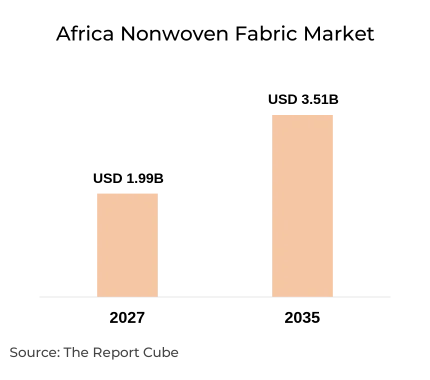
- The Africa Nonwoven Fabric Market is estimated at USD 1.99 billion in 2027.
- The market is projected to reach USD 3.51 billion by 2035, registering a stated CAGR of 7.34% during 2027-2035.
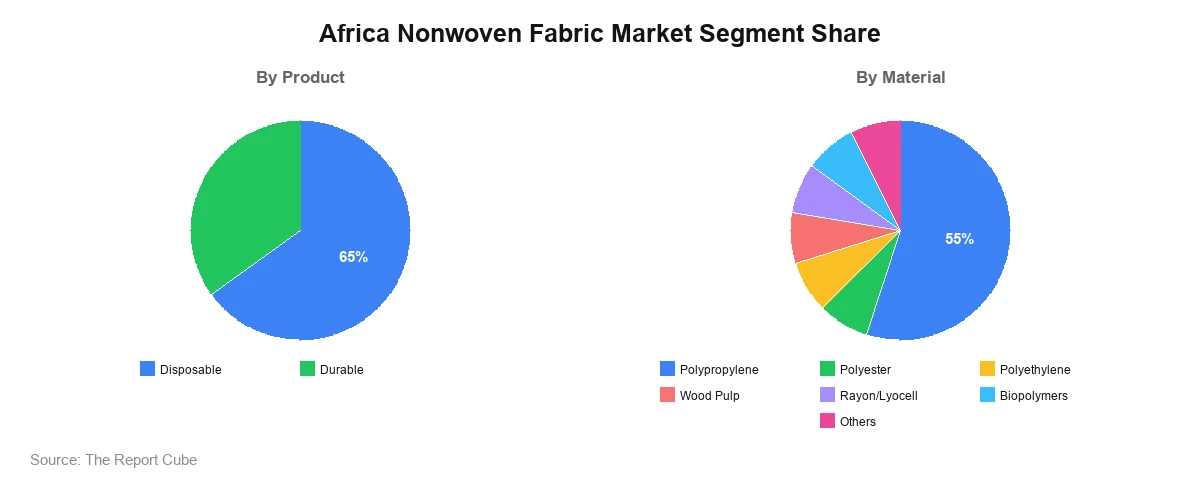
- By product, Disposable nonwoven fabrics lead with an approx. 65% share in 2026, based on the supplied analyst estimate.
- By material, Polypropylene leads with an approx. 55% share in 2026, supported by its widespread use in spunbond and spunmelt nonwoven production.
- By application, Hygiene leads with an approx. 40% share in 2026, reflecting demand for diapers, feminine hygiene products, wipes and other disposable products.
- By technology, Spunbond leads with an approx. 45% share in 2026, based on the supplied analyst estimate.
- By regional category, South Africa leads with an approx. 40% share in 2026, based on the supplied analyst estimate.
- Key market participants include Fibertex Nonwovens, PFNonwovens, Spunchem International, Freudenberg Group, Kimberly-Clark and other regional and international manufacturers.
Market Outlook
Nonwoven fabrics are engineered textile materials produced by bonding or interlocking fibres and filaments through mechanical, chemical, thermal or other manufacturing processes rather than conventional weaving or knitting. These materials are used in a wide range of applications, including personal hygiene products, medical and healthcare supplies, filtration, automotive interiors, construction materials, industrial products and consumer goods. Their characteristics, such as absorbency, softness, strength, filtration efficiency, barrier performance and lightweight construction, make them suitable for both disposable and durable applications.
The Africa Nonwoven Fabric Market is supported by demand from hygiene product manufacturers, healthcare facilities, industrial users, construction companies, automotive suppliers and filtration businesses. Disposable nonwovens are used in baby diapers, feminine hygiene products, adult incontinence products, medical gowns, masks and wipes. Durable nonwovens are used in geotextiles, automotive components, furniture, filtration media, insulation and other technical applications. Polypropylene remains an important raw material because of its suitability for spunbond, meltblown and spunmelt manufacturing processes.
The market is estimated to reach USD 1.99 billion in 2027 and USD 3.51 billion by 2035, reflecting a stated CAGR of 7.34%. Demand growth is associated with hygiene product consumption, healthcare requirements, urbanisation, industrial applications and infrastructure development. South Africa has an established nonwoven manufacturing base, including producers of spunbond fabrics, needlepunch materials and technical textiles. North Africa also represents an important manufacturing and consumption region, with nonwoven production facilities and hygiene-related applications in countries such as Egypt.
Competition is shaped by manufacturing capacity, polymer sourcing, production technology, fabric quality, product customisation, cost efficiency and customer relationships with converters and finished-product manufacturers. Producers are focusing on lightweight materials, multilayer structures, improved filtration and barrier performance, and specialised nonwovens for hygiene, healthcare and industrial applications. Opportunities also exist in local manufacturing, technical textiles, geotextiles, filtration products and the development of lower-impact materials.
Government Regulations
Nonwoven fabric manufacturers and finished-product suppliers must comply with applicable requirements covering product safety, chemical substances, occupational health, environmental management, manufacturing quality and end-use performance. Regulatory requirements depend on whether the material is sold as an industrial textile, hygiene-product component, medical textile or finished medical device. In South Africa, the South African Health Products Regulatory Authority (SAHPRA) regulates medical device establishments and applicable medical devices, including relevant manufacturer, importer and distributor activities.
Medical and surgical masks and other products making medical claims may fall under specific medical-device and product-standard requirements; ordinary nonwoven fabric is not automatically classified as a medical device simply because it can be used in healthcare products. The National Regulator for Compulsory Specifications (NRCS) also provides regulatory guidance for masks, with requirements depending on intended use and product claims. In addition, South Africa's Clothing and Textile Competitiveness Programme supports manufacturing competitiveness and local production capabilities in the textile value chain. Manufacturers operating in other African countries must assess national product standards, environmental permits, chemical controls, import requirements and healthcare product regulations separately.
Africa Nonwoven Fabric Market Dynamics
Market development is influenced by demand for disposable hygiene products, healthcare-related materials, industrial textiles, filtration products and construction applications. Raw material availability, polypropylene pricing, manufacturing capacity and production technology affect manufacturers' cost structures and competitive positioning. At the same time, product performance requirements, environmental considerations and the availability of local converting capabilities influence the adoption of different nonwoven materials and manufacturing processes across African markets.
|
Factor |
Type |
Specific Impact on Market |
Magnitude |
|---|---|---|---|
|
Growing demand for disposable hygiene products |
Driver |
Consumption of diapers, feminine hygiene products, adult incontinence products and wipes supports demand for lightweight nonwoven fabrics. |
High |
|
Healthcare and infection prevention requirements |
Driver |
Healthcare applications require nonwoven materials for masks, gowns, drapes, medical wipes and other protective and hygiene products. |
High |
|
Local manufacturing and technical textile investment |
Opportunity |
Investment in spunbond, meltblown, needlepunch and other technologies can strengthen regional supply capabilities and reduce dependence on imported materials. |
High |
|
Specialised filtration and construction applications |
Opportunity |
Demand for filtration media, geotextiles, automotive materials and industrial fabrics creates opportunities beyond disposable hygiene applications. |
Medium-High |
|
Polypropylene and other raw material price volatility |
Challenge |
Changes in polymer, pulp and synthetic fibre prices affect production costs, pricing decisions and profit margins. |
High |
|
Environmental concerns and waste management |
Challenge |
Growing scrutiny of disposable products and plastic-based materials increases pressure to improve material efficiency, recyclability and end-of-life management. |
Medium-High |
Growth Drivers: Increasing Demand for Disposable Hygiene Products
Growing demand for disposable hygiene products is a major driver of nonwoven fabric consumption across Africa. Nonwoven materials are used in baby diapers, feminine hygiene products, adult incontinence products, wet wipes and other personal care applications because of their softness, absorbency, liquid management and barrier properties. Polypropylene spunbond and spunmelt materials are commonly used in topsheets, backsheets, acquisition layers and other product components. Demand is supported by population growth, urbanisation, changing consumer preferences and the expansion of organised retail and personal care product distribution. The United Nations' population and urbanisation research highlights the continued expansion of African urban populations, which can support broader access to packaged consumer and hygiene products. However, urbanisation is a demand-enabling factor rather than a direct measure of nonwoven fabric consumption. Manufacturers supplying hygiene-product converters can benefit from consistent demand for lightweight, high-performance materials and from the development of local converting capacity.
Need Specific Data, Let’s Customize the Report for You
Request CustomizationMarket Opportunities: Expansion of Local Nonwoven Manufacturing and Technical Textiles
Investment in local nonwoven manufacturing presents an opportunity to strengthen supply chains and serve regional demand for hygiene, healthcare, construction and industrial applications. South Africa already has a base of producers operating spunbond, meltblown, needlepunch and other nonwoven technologies. Expanding manufacturing capacity, improving production efficiency and developing specialised material grades can help suppliers serve both domestic converters and regional export customers. North African manufacturing locations also provide opportunities to supply regional hygiene and healthcare markets. In addition to disposable products, manufacturers can diversify into geotextiles, automotive materials, filtration media, insulation and industrial nonwovens. These applications can broaden revenue sources and reduce dependence on a single end-use category.
Industry Challenges: Raw Material Price Volatility and Environmental Pressure
Nonwoven fabric manufacturers face cost pressures associated with polypropylene, polyester, polyethylene, wood pulp, viscose and other fibre inputs. Polypropylene-based products are particularly exposed to changes in petrochemical feedstock and polymer pricing. Manufacturers must manage procurement costs while maintaining fabric quality, weight consistency and competitive selling prices. Imported raw materials, currency fluctuations, freight expenses and supply-chain disruptions can further affect production economics in African markets. Environmental concerns represent another challenge, particularly for disposable nonwovens and products containing synthetic polymers. Growing attention to plastic waste, product disposal and recycling creates pressure on manufacturers to improve material efficiency, explore alternative fibres and develop products with improved end-of-life characteristics. However, the suitability of recycling and biodegradation solutions depends on the fabric composition, product contamination, collection infrastructure and available processing technology.
Market Trends: Growth of Spunbond and Multilayer Nonwoven Technologies
Spunbond and spunmelt technologies remain important in the production of lightweight nonwoven fabrics for hygiene, healthcare and industrial applications. Spunbond materials provide strength and dimensional stability, while combinations of spunbond and meltblown layers can provide improved barrier and filtration properties. Multilayer structures such as SMS are used in applications requiring a balance of strength, softness and protection. Manufacturers are also investing in specialised processes such as needlepunch for geotextiles, automotive materials and filtration products. South African producers demonstrate the diversity of regional capabilities: Spunchem International operates spunbond, SMS and meltblown-related capabilities, while Fibertex Nonwovens South Africa specialises in needlepunch products and technical applications. These developments reflect a broader shift toward application-specific nonwoven materials rather than reliance on a single fabric structure.
Africa Nonwoven Fabric Market Segment Analysis
The Africa Nonwoven Fabric Market is segmented by product, material, application, technology and regional category. Product segmentation distinguishes disposable and durable fabrics, while material segmentation covers polypropylene, polyester, polyethylene, wood pulp, rayon/lyocell, biopolymers and other inputs. Application segmentation includes hygiene, healthcare, construction, industrial and consumer uses. Technology segmentation reflects different fibre-web formation and bonding processes, including spunbond, dry laid, wet laid, spunlace and meltblown manufacturing.
By Product
- Disposable
- Durable
Disposable nonwoven fabrics lead the product category with an approx. 65% share in 2026, based on the supplied analyst estimate. Disposable products are widely used in baby diapers, feminine hygiene products, adult incontinence products, medical gowns, masks, wipes and other personal care applications. Their adoption is supported by convenience, hygiene requirements, absorbency and the need for single-use products in selected healthcare and consumer applications. Durable nonwoven fabrics serve longer-life applications such as geotextiles, automotive components, furniture, filtration, insulation and industrial materials. Demand for durable products is influenced by infrastructure development, manufacturing activity, automotive production and technical textile requirements.
By Material
- Polypropylene
- Polyester
- Polyethylene
- Wood Pulp
- Rayon/Lyocell
- Biopolymers
- Others
Polypropylene leads the material category with an approx. 55% share in 2026, based on the supplied analyst estimate. Polypropylene is widely used in spunbond and meltblown nonwoven manufacturing because it can be processed into lightweight fabrics with suitable strength, softness and barrier characteristics. Its applications include hygiene products, medical textiles, protective materials, packaging-related products and industrial fabrics. Polyester is used in durable nonwovens, automotive materials, filtration media, geotextiles and other technical applications where strength and dimensional stability are important. Polyethylene is used in selected nonwoven structures and composite products requiring flexibility and moisture resistance.
Wood pulp is relevant to absorbent products, wipes and cellulose-based nonwovens. Rayon and lyocell provide cellulosic fibre characteristics such as softness and absorbency, while biopolymers are being explored for selected applications where renewable or alternative polymer inputs are required. Others include additional synthetic, natural and specialty fibres used in application-specific nonwoven products.
Africa Nonwoven Fabric Market Regional Analysis
The regional analysis covers South Africa, North Africa and Central Africa, following the segmentation supplied for this report. South Africa has an established base of nonwoven fabric manufacturers and technical textile producers, including businesses serving hygiene, automotive, construction and industrial applications. North Africa benefits from manufacturing activity and demand for hygiene and healthcare products, with Egypt representing an important nonwoven production location. Central Africa is assessed as an emerging market where nonwoven consumption is linked to healthcare, hygiene, construction and industrial requirements. The supplied regional estimate identifies South Africa as the leading category with an approx. 40% share in 2026. This share is an analyst estimate rather than a published regional market statistic.
|
Region |
Key Growth Factors |
Industry Trends |
|---|---|---|
|
South Africa |
Established nonwoven manufacturing, hygiene product demand, healthcare applications, construction and industrial activity. |
Production of spunbond, meltblown, needlepunch and technical nonwoven fabrics for hygiene, automotive, filtration and geotextile applications. |
|
North Africa |
Hygiene product consumption, healthcare requirements, industrial development and local manufacturing activity. |
Development of spunmelt production capacity and supply of nonwoven materials to hygiene, healthcare and consumer product manufacturers. |
|
Central Africa |
Healthcare requirements, hygiene product distribution, infrastructure development and industrial demand. |
Market development supported by imported nonwoven materials, finished hygiene products and gradual expansion of local converting activities. |
Competitive Landscape
The Africa Nonwoven Fabric Market includes regional manufacturers, international nonwoven material producers and integrated hygiene product companies. Competition is influenced by production capacity, raw material sourcing, manufacturing technology, fabric quality, product specifications, pricing and supply reliability. South Africa has a visible group of local producers, including Spunchem International, Fibertex Nonwovens and Freudenberg Nonwovens. PFNonwovens also operates production facilities in South Africa and Egypt, giving it a relevant regional manufacturing presence. International companies such as Kimberly-Clark, Berry Global and Ahlstrom have capabilities in nonwoven materials and downstream applications, although their direct manufacturing and sales presence can vary by country and product category.
|
Company |
Competitive Strength |
Primary Segment Served |
|---|---|---|
|
Fibertex Nonwovens A/S |
Established South African manufacturing operation specialising in needlepunch nonwovens and polypropylene geotextiles. |
Construction, geotextiles, automotive, filtration and technical textiles. |
|
PFNonwovens Group |
Spunmelt nonwoven production capabilities and manufacturing facilities in South Africa and Egypt. |
Personal hygiene, healthcare and industrial applications. |
|
Spunchem International |
South African nonwoven manufacturer with spunbond, SMS, meltblown and laminating-related capabilities. |
Hygiene, automotive, agriculture, PPE and industrial applications. |
|
Kimberly-Clark |
Strong hygiene product expertise and engineered nonwoven material capabilities for consumer and professional applications. |
Hygiene, wipes, healthcare and consumer products. |
|
Wemy Industries |
Regional Nigerian hygiene and personal care product manufacturing presence; direct nonwoven fabric production requires separate verification. |
Baby care, feminine hygiene and personal care products. |
|
Brits Nonwoven |
South African nonwoven industry participant listed in the National Textile Bargaining Council's nonwoven employer category. |
Nonwoven products and related applications; specific product portfolio requires verification. |
|
Freudenberg Group |
Global technical nonwoven capabilities and an established South African nonwoven subsidiary. |
Industrial, filtration, automotive, medical and technical textiles. |
|
Ahlstrom-Munksjö |
Specialty fibre-based materials and filtration-related nonwoven capabilities; current regional supply arrangements require verification. |
Filtration, healthcare, industrial and specialty materials. |
|
Berry Global Group Inc. |
Global engineered materials and nonwoven product capabilities, including spunbond and meltblown technologies. |
Hygiene, healthcare, filtration and industrial applications. |
|
Others |
Regional nonwoven producers, textile converters, importers and specialised material suppliers. |
Hygiene, healthcare, construction, industrial and consumer applications. |
- Spunchem International: Spunchem International is a South African producer of nonwoven fabrics and laminates serving a broad range of industries. Established in 1995, the company developed one of South Africa's early spunbond manufacturing operations and has expanded its capabilities through investment in specialised production equipment. Its current manufacturing capabilities include spunbond, SMS, meltblown, coating, cast film, breathable film, laminating, printing and slitting. The company's products serve agricultural, automotive, hygiene, domestic, industrial roofing and personal protective equipment applications. Its local manufacturing presence and broad process capabilities position it as a relevant supplier in the African nonwoven fabric market.
- PFNonwovens Group: PFNonwovens is a global producer of lightweight spunmelt nonwoven materials for personal hygiene, healthcare and industrial applications. Its product portfolio includes nonwoven materials for baby care, female care, adult care, healthcare and agricultural applications. The company has an important regional manufacturing presence, with production facilities in South Africa and Egypt. Its manufacturing operations and spunmelt technology provide a direct link to African demand for hygiene and healthcare nonwoven materials. The company's products are used by converters and manufacturers that require material properties such as softness, strength, absorbency and barrier performance.
Recent Developments and Updates
- February 2025 – Fibertex South Africa company name update: Fibertex announced that its South African subsidiary adopted the name Fibertex Nonwovens (Pty) Ltd. The company continues to operate its manufacturing facility in Hammarsdale, KwaZulu-Natal, specialising in needlepunch nonwovens and polypropylene geotextiles.
- 2025 – South African nonwoven industry representation: The National Textile Bargaining Council's nonwoven employer category lists multiple local industry participants, including Fibertex Nonwovens, Freudenberg Nonwovens, Spunchem International and other manufacturers. This reflects the presence of an established nonwoven manufacturing ecosystem in South Africa.
Africa Nonwoven Fabric Market Future Outlook
The Africa Nonwoven Fabric Market is expected to experience continued growth through 2035, supported by demand for disposable hygiene products, healthcare materials, industrial textiles, filtration media and construction-related applications. Based on the supplied estimates, the market is projected to increase from USD 1.99 billion in 2027 to USD 3.51 billion by 2035, at a stated CAGR of 7.34%. Disposable products are expected to remain an important product category, while hygiene applications and polypropylene-based fabrics are likely to continue supporting demand. Spunbond and spunmelt technologies are expected to remain relevant because of their suitability for high-volume hygiene and healthcare manufacturing.
South Africa is expected to retain an important position in regional manufacturing due to its existing nonwoven production base and technical textile capabilities. North Africa also offers opportunities through hygiene product manufacturing, industrial development and local production facilities, particularly in Egypt. Central Africa represents an emerging market where growth is likely to depend on improved distribution, healthcare product availability, consumer demand and the development of local converting and manufacturing capabilities. Opportunities in geotextiles, filtration, automotive materials and industrial applications can support diversification beyond disposable hygiene products.
Future competition will depend on raw material procurement, production efficiency, product innovation, quality consistency and customer relationships with hygiene and industrial converters. Manufacturers may increasingly focus on lighter fabric structures, multilayer spunmelt materials, filtration performance, alternative fibre inputs and more efficient manufacturing processes. However, polymer price volatility, imported input dependence, environmental concerns and uneven regional manufacturing infrastructure may continue to affect market development. Companies that combine cost-efficient production with application-specific products and reliable regional supply capabilities are likely to be better positioned to capture growth.
Africa Nonwoven Fabric Market Report Coverage
This Africa Nonwoven Fabric Market report provides an overview of market size, forecast, key growth factors, segmentation, regional developments and the competitive landscape during 2027-2035. It examines disposable and durable products, major raw material categories, end-use applications and manufacturing technologies. The report also reviews South Africa, North Africa and Central Africa and profiles major nonwoven manufacturers and related industry participants.
|
Parameter |
Details |
|---|---|
|
Market Name |
Africa Nonwoven Fabric Market |
|
Market Size (2027) |
USD 1.99 billion |
|
Market Size (Forecast Year) |
USD 3.51 billion (2035) |
|
CAGR |
7.34% |
|
Base Year |
2026 |
|
Historical Period |
2022-2026 |
|
Forecast Period |
2027-2035 |
|
Geographic Scope |
Africa |
|
Segmentation |
By Product, By Material, By Application, By Technology, By Regional |
|
Regions Covered |
South Africa, North Africa, Central Africa |
|
Key Companies |
Fibertex Nonwovens A/S, PFNonwovens Group, Spunchem International, Kimberly-Clark, Wemy Industries, Brits Nonwoven, Freudenberg Group, Ahlstrom-Munksjö, Berry Global Group Inc. and Others |
|
Customization |
Available as per requirement |
Why Choose This Africa Nonwoven Fabric Market Report?
- Provides the supplied 2027 market valuation and 2035 forecast for the Africa Nonwoven Fabric Market.
- Examines disposable and durable nonwoven product categories and their key applications.
- Analyses polypropylene, polyester, polyethylene, wood pulp, rayon/lyocell, biopolymers and other material categories.
- Reviews hygiene, construction, industrial, consumer, filtration, automotive and medical applications.
- Evaluates spunbond, dry laid, wet laid, spunlace, meltblown and other manufacturing technologies.
- Examines market dynamics, including growth drivers, opportunities, industry challenges and technology trends.
- Provides regional analysis of South Africa, North Africa and Central Africa.
- Profiles key manufacturers and industry participants, including their product capabilities and market positioning.
Table of Contents
- Introduction
- Objective of the Study
- Product Definition
- Market Segmentation
- Study Variables
- Research Methodology
- Secondary Data Points
- Companies Interviewed
- Primary Data Points
- Breakdown of Primary Interviews
- Secondary Data Points
- Executive Summary
- Market Dynamics
- Drivers
- Challenges
- Opportunity Assessment
- Recent Trends and Developments
- Policy and Regulatory Landscape
- Africa Nonwoven Fabric Market Overview and Forecast Analysis (2022-2035)
- Market Size, By Value, By Growth Rate (CAGR/USD Billions)
- Demand – Supply Trends
- Market Share, By Product
- Disposable
- Durable
- Market Share, By Material
- Polypropylene
- Polyester
- Polyethylene
- Wood Pulp
- Rayon/Lyocell
- Biopolymers
- Others
- Market Share, By Application
- Hygiene
- Building & Construction
- Industrial
- Consumer Products
- Filtration
- Automotive
- Medical & Healthcare
- Others
- Market Share, By Technology
- Spunbond
- Dry Laid
- Wet Laid
- Spunlace
- Meltblown
- Others
- Market Share, By Regional
- South Africa
- North Africa
- Central Africa
- Market Share, By Competitors
- Competition Characteristics
- Revenue Shares
- Disposable Africa Nonwoven Fabric Market Overview, 2022-2035F
- By Value (USD Million)
- By Material – Market Size & Forecast 2022-2035, USD Million
- Polypropylene
- Polyester
- Polyethylene
- Wood Pulp
- Rayon/Lyocell
- Biopolymers
- Others
- Durable Africa Nonwoven Fabric Market Overview, 2022-2035F
- By Value (USD Million)
- By Material – Market Size & Forecast 2022-2035, USD Million
- Polypropylene
- Polyester
- Polyethylene
- Wood Pulp
- Rayon/Lyocell
- Biopolymers
- Others
- Competitive Outlook (Company Profile – Partial List)
- Fibertex Nonwovens A/S
- Company Overview
- Business Segments
- Strategic Alliances/Partnerships
- Recent Developments
- PFNonwovens Group
- Company Overview
- Business Segments
- Strategic Alliances/Partnerships
- Recent Developments
- Spunchem
- Company Overview
- Business Segments
- Strategic Alliances/Partnerships
- Recent Developments
- Kimberly-Clark
- Company Overview
- Business Segments
- Strategic Alliances/Partnerships
- Recent Developments
- Wemy industries
- Company Overview
- Business Segments
- Strategic Alliances/Partnerships
- Recent Developments
- Brits Nonwoven
- Company Overview
- Business Segments
- Strategic Alliances/Partnerships
- Recent Developments
- Freudenberg Group
- Company Overview
- Business Segments
- Strategic Alliances/Partnerships
- Recent Developments
- Ahlstorm-Munksjo
- Company Overview
- Business Segments
- Strategic Alliances/Partnerships
- Recent Developments
- Berry Global Group Inc.
- Company Overview
- Business Segments
- Strategic Alliances/Partnerships
- Recent Developments
- Others
- Fibertex Nonwovens A/S
- Contact Us & Disclaimer
Top Key Players & Market Share Outlook
- Fibertex Nonwovens A/S
- PFNonwovens Group
- Spunchem
- Kimberly-Clark
- Wemy industries
- Brits Nonwoven
- Freudenberg Group
- Ahlstorm-Munksjo
- Berry Global Group Inc.
- Others
Frequently Asked Questions