



Build Your Custom Market Intelligence Report
Customize Your ReportUSA Agentic AI Platform Market Key Takeaways
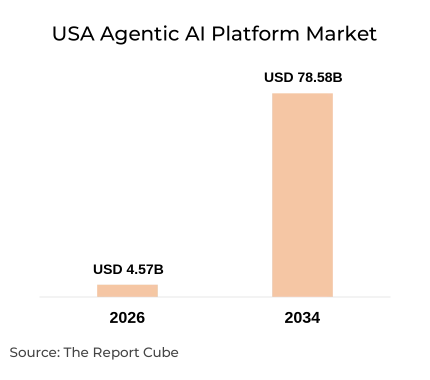
- USA Agentic AI Platform Market valued at USD 4.57 billion in 2026, driven by accelerating enterprise autonomous workflow investments.
- Market projected to reach USD 78.58 billion by 2034, expanding at a remarkable 42.70% CAGR.
- BFSI remains the dominant end-user segment owing to deep compliance infrastructure and governed data ecosystems.
- Cloud deployment continues leading infrastructure adoption due to scalable, cost-efficient agentic AI execution environments.
- The West United States commands regional leadership through concentrated hyperscale cloud infrastructure and AI innovation ecosystems.
- Multi-agent orchestration, memory persistence, and autonomous reasoning are defining the next generation of enterprise platforms.
- Leading companies include Microsoft, Google Cloud, Amazon Web Services, Salesforce, ServiceNow, and UiPath.
- Rising enterprise demand for autonomous workflow automation and real-time decision intelligence continues accelerating platform adoption.
USA Agentic AI Platform Market Insights & Analysis
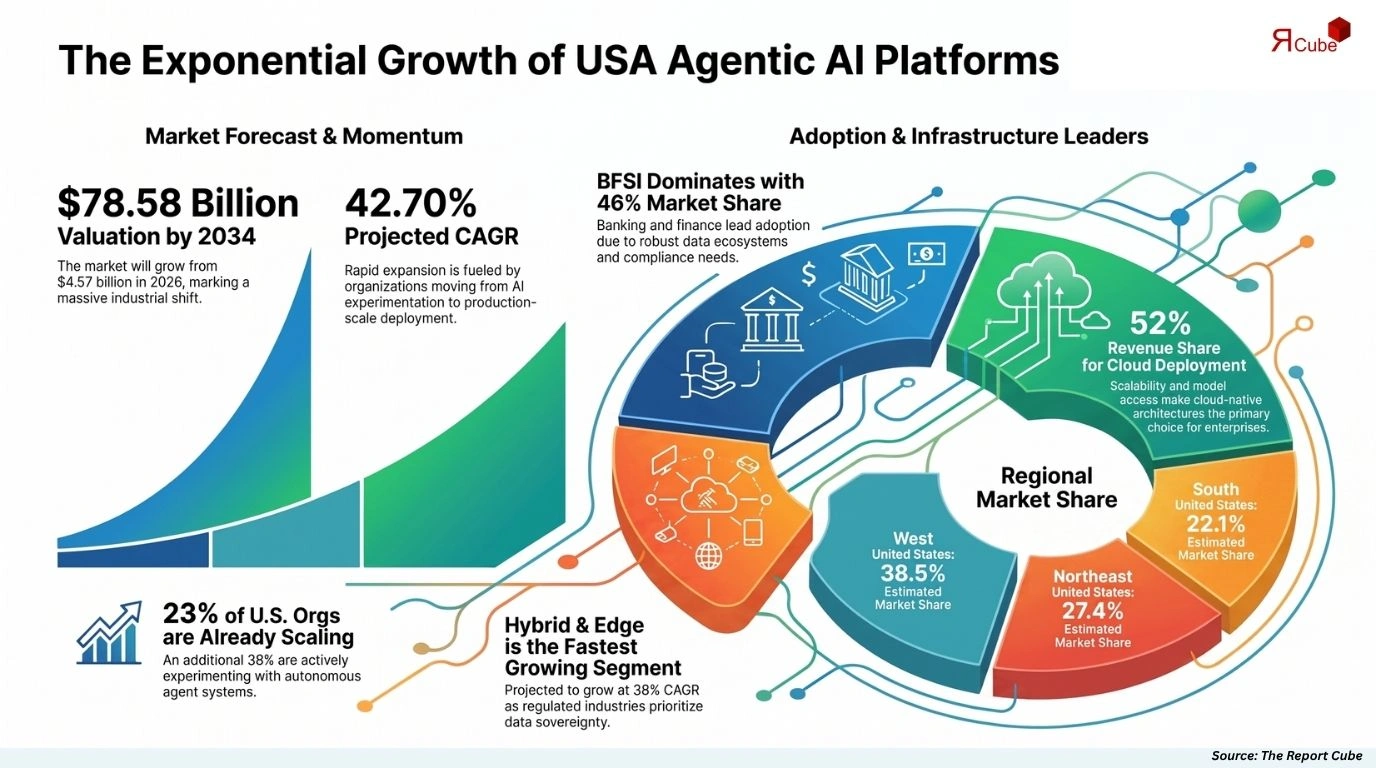
The USA Agentic AI Platform Market is anticipated to register a 42.70% CAGR during 2026–2034. The market size was valued at USD 4.57 billion in 2026 and is projected to reach USD 78.58 billion by 2034. Growth is driven by rising enterprise adoption of autonomous AI systems capable of perceiving context, planning multi-step tasks, and executing decisions without continuous human intervention. Organizations across BFSI, healthcare, and retail are deploying agentic platforms to automate knowledge work, streamline operations, and achieve measurable productivity gains in complex, high-volume workflows.
The United States benefits from concentrated model research capabilities, hyperscale cloud infrastructure, venture-backed AI ecosystems, and strong enterprise software distribution networks that collectively accelerate platform deployment. According to McKinsey's State of AI 2025 report, 23% of US organizations are already scaling agentic AI systems, with an additional 39% actively in experimentation phases. Federal initiatives supporting responsible AI adoption and significant private-sector capital flows into agentic infrastructure are reinforcing long-term demand for enterprise-grade autonomous platforms.
USA Agentic AI Platform Market Dynamics
Enterprise adoption of agentic AI platforms in the United States is accelerating as organizations move beyond narrow generative AI assistants toward coordinated autonomous systems capable of managing full business processes across distributed digital environments. Buying decisions are increasingly shaped by orchestration depth, governance controls, regulatory compliance, and the ability to integrate with existing enterprise software stacks. Both large enterprises and growing mid-market organizations are increasing investments in platforms that deliver production-ready, audit-ready autonomous agent deployments.
|
Factor |
Type |
Specific Impact on Market |
Magnitude |
|---|---|---|---|
|
Enterprise automation demand |
Driver |
Accelerates deployment of multi-agent orchestration platforms |
Very High |
|
Cloud infrastructure expansion |
Opportunity |
Enables scalable, cost-efficient agentic AI rollout across sectors |
High |
|
Regulatory compliance requirements |
Driver |
Boosts demand for governed, auditable autonomous agent frameworks |
High |
|
Hybrid and edge deployment growth |
Trend |
Expands agentic AI adoption in regulated and sovereign environments |
High |
|
Multi-agent system complexity |
Challenge |
Increases integration, governance, and workflow design requirements |
Medium |
Key Market Driver: Enterprise Automation and Workflow Transformation
US organizations are investing heavily in agentic AI platforms to automate document-intensive, judgment-based, and decision-support workflows that previously required large human teams. BFSI organizations deploying agents for fraud detection, compliance monitoring, and claims processing, alongside healthcare providers using clinical documentation agents that reduce physician documentation time by 30% to 42%, demonstrate measurable ROI that is driving broader enterprise adoption. The shift from pilot programs to production-scale deployment is compressing enterprise evaluation cycles and increasing average platform contract values.
Major Industry Challenge: Legacy System Integration and Governance Complexity
Many US enterprises operate on layered technology stacks where legacy ERP systems, on-premise databases, and older API layers make integrating agentic platforms difficult at scale. Without reliable data access and system-of-record proximity, autonomous agents cannot execute reliably, which means workflow integration, legacy data mapping, and policy alignment determine whether deployments reach production. Studies from Accenture and Wipro indicate that 70 to 80 percent of agentic initiatives have not yet achieved enterprise-scale deployment, underscoring that orchestration discipline and governance architecture remain the primary barriers to realized value.
Emerging Trend Shaping Outlook: Hybrid and Sovereign Deployment Architecture
Regulated industries including financial services, healthcare, and government are driving significant adoption of hybrid and on-premise agentic AI deployment models. Hybrid and edge deployments are projected to grow at 36% CAGR through the forecast period, reflecting the compliance-driven need for data sovereignty, full audit trails, and system-of-record proximity. UiPath's May 2026 release of on-premises agentic AI for public sector environments and the broader emergence of air-gapped deployment options signal that sovereign infrastructure is becoming a strategically distinct and fast-growing segment of the US agentic AI platform market.
Need Specific Data, Let’s Customize the Report for You
Request CustomizationUSA Agentic AI Platform Market Segment-wise Analysis
US enterprises are deploying agentic AI platforms across a widening range of end-user industries and infrastructure environments. Increasing adoption of multi-agent orchestration, purpose-built vertical agents, and hybrid cloud architectures is creating differentiated demand patterns across deployment models and industry segments that directly shape market opportunity distribution through 2034.
By End-User
- BFSI
- Healthcare & Life Sciences
- Retail & E-Commerce
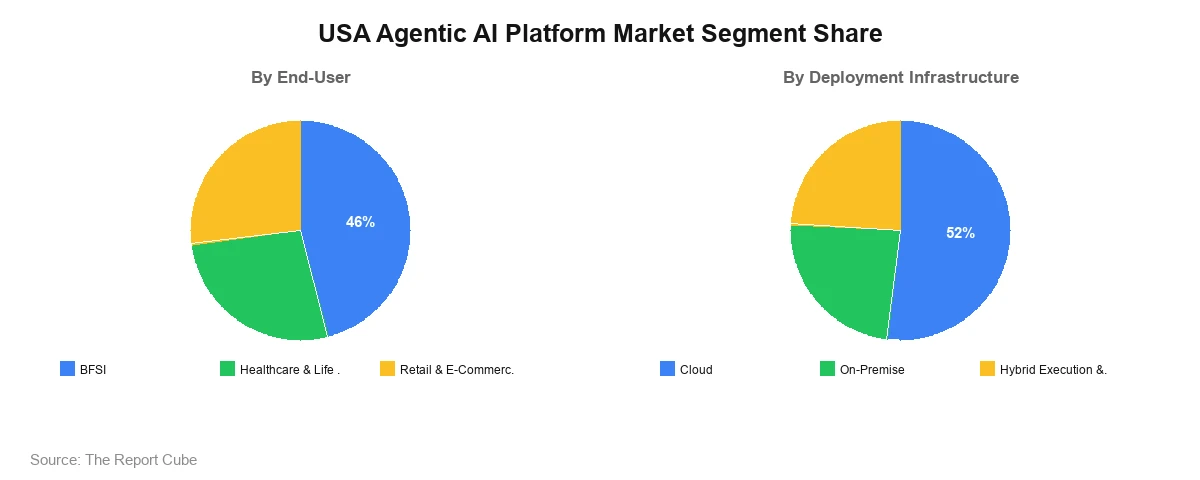
BFSI dominates the end-user segment with an estimated 46% market share, reflecting the sector's early adoption of agentic platforms for fraud detection, compliance automation, personalized financial advisory, algorithmic trading support, and claims processing. The sector entered the agentic AI era with strong data infrastructure, robust API layers, and compliance tooling already in place from prior automation and AI programs, which significantly lowered integration barriers and accelerated production deployment timelines. The same data discipline that historically slowed cloud adoption in banking now amplifies agentic ROI, because governed, structured data is precisely what autonomous agents require to perform reliably at enterprise scale.
Healthcare & Life Sciences is emerging as the fastest-growing end-user vertical, driven by clinical documentation automation, revenue cycle management optimization, and prior authorization workflows. Clinical documentation agents deployed by US healthcare systems are reducing physician documentation time by up to 42% and saving clinicians as many as 66 minutes per day, creating compelling unit-level ROI that is accelerating broader institutional adoption. Retail & E-Commerce organizations are deploying agents for personalization engines, inventory management, and customer service automation, with the segment projected to expand at over 36% CAGR through 2034 as organizations prioritize AI-driven customer experience transformation.
By Deployment Infrastructure
- Cloud
- On-Premise
- Hybrid Execution & Edge
Cloud deployment dominates the infrastructure segment with an estimated 52% revenue share in 2026, driven by the scalability, speed-to-deployment, and model access advantages that hyperscale cloud environments provide for enterprise agentic workloads. Major platforms from Microsoft Azure AI, Google's Gemini Enterprise Agent Platform, and Amazon Bedrock deliver orchestration, reasoning, memory persistence, and tool-use APIs through cloud-native architectures that reduce the upfront infrastructure investment required for enterprise deployment. Subscription-based consumption models further lower entry barriers, particularly for mid-market organizations deploying first-generation autonomous agent workflows across CRM, ERP, and customer engagement systems.
On-Premise deployments maintain a dedicated foothold in financial services and government sectors where data residency, regulatory compliance, and audit trail requirements preclude full cloud migration. Hybrid Execution & Edge represents the fastest-growing infrastructure segment, projected to expand at over 36% CAGR as enterprises design deployment architectures that balance cloud-based model inference with on-premise data access and edge-based execution for latency-sensitive and compliance-critical workflows. The launch of UiPath Automation Suite with on-premises agentic capabilities in May 2026 and ServiceNow's AI Control Tower integration across hybrid environments validate the growing enterprise preference for infrastructure-flexible deployment models.
Regional Projection of USA Agentic AI Platform Market
The USA Agentic AI Platform Market shows distinct regional revenue patterns driven by cloud infrastructure concentration, enterprise software adoption density, regulatory environment, and sector-specific demand. The West United States commands the largest regional share, while the Northeast and South are expanding rapidly across financial services, healthcare, and manufacturing verticals.
|
Region |
Estimated Market Share |
Key Growth Factors |
Consumer Trends |
|---|---|---|---|
|
West United States |
38.5% |
Hyperscale cloud infrastructure, AI-native enterprise adoption, tech sector density |
High adoption of multi-agent orchestration and cloud-native platforms |
|
Northeast United States |
27.4% |
BFSI and healthcare concentration, regulatory compliance demand |
Strong demand for governed, auditable agentic workflows |
|
South United States |
22.1% |
Energy, logistics, and healthcare sector digitization |
Growing enterprise RPA-to-agentic platform migration |
|
Midwest United States |
12.0% |
Manufacturing, insurance, and regional bank automation |
Increasing demand for hybrid and on-premise deployment models |
- West United States: The West dominates with approximately 38.5% regional revenue share, anchored by the technology sector's concentration of AI-native enterprises, hyperscale cloud campuses, and significant venture investment in agentic infrastructure supporting rapid platform adoption.
- Northeast United States: The Northeast benefits from high BFSI and healthcare sector density, driving strong demand for compliance-ready, auditable agentic platforms across financial institutions, hospital networks, and insurance organizations operating under strict federal and state regulatory frameworks.
- South United States: The South is expanding driven by energy, logistics, and healthcare organizations accelerating digital transformation, with growing enterprise demand for cloud-based agentic orchestration tools that automate high-volume, document-intensive operational workflows.
- Midwest United States: The Midwest shows steady growth led by manufacturing, insurance, and regional banking sectors that are migrating from traditional RPA platforms toward hybrid agentic architectures that preserve on-premise data residency while extending autonomous decision capabilities.
USA Agentic AI Platform Market: Recent Development (2025)
- Google Cloud launched Gemini Enterprise Agent Platform at Cloud Next 2026, replacing standalone Vertex AI for enterprise agentic deployments.
- Salesforce expanded Agentforce 360 partnerships with AWS, OpenAI, Anthropic, and Google, accelerating enterprise agentic deployment at scale.
- UiPath launched enterprise-grade agentic automation platform in April 2025, unifying AI agents, robots, and people in a single system.
- ServiceNow unveiled AI Platform with AI Control Tower and Apriel Nemotron 15B reasoning model, partnering with NVIDIA for enterprise agents.
USA Agentic AI Platform Market Future Outlook (2034)
The USA Agentic AI Platform Market is projected to expand at a 42.70% CAGR, reaching USD 78.58 billion by 2034. Sustained growth will be driven by the deepening integration of autonomous agents into enterprise software stacks, the maturation of multi-agent orchestration frameworks, and the expansion of vertical-specific agentic solutions across BFSI, healthcare, retail, and government sectors. As enterprises move from pilot programs to production deployments at scale, the market will benefit from increasing average contract values, expanding platform ecosystems, and growing demand for governance, observability, and policy-enforcement tooling that makes agentic systems enterprise-trustworthy.
Long-term expansion will be reinforced by advances in reasoning model performance, declining inference costs, and the proliferation of agent-to-agent communication protocols that allow complex enterprise workflows to be fully automated across distributed systems. Google Cloud's $750 million partner fund for agentic development and ServiceNow's target of $1 billion in AI-specific revenue signal the scale of vendor investment entering the market. Organizations will increasingly adopt continuous risk assessment, agent identity management, and compliance-embedded orchestration frameworks to ensure that autonomous operations remain auditable, secure, and aligned with evolving federal regulatory expectations for responsible enterprise AI deployment.
USA Agentic AI Platform Market Report Coverage
|
Report Attribute |
Details |
|---|---|
|
Market Name |
USA Agentic AI Platform Market |
|
Market Size (2026) |
USD 4.57 Billion |
|
Market Size (2034) |
USD 78.58 Billion |
|
Forecast Period |
2026–2034 |
|
CAGR |
42.70% |
|
Base Year |
2026 |
|
Historical Years |
2021–2025 |
|
Forecast Years |
2026–2034 |
|
Segments Covered |
By End-User, By Deployment Infrastructure, By Business Function & Application, By Component Mode, By Agent Architecture Type |
|
Regions Covered |
West United States, Northeast United States, South United States, Midwest United States |
|
Key Companies |
Microsoft, Google Cloud, Amazon Web Services (AWS), Salesforce, ServiceNow, UiPath, Others |
|
Report Format |
PDF, Excel, PPT |
|
Customization |
Available as per client requirements |
Why Choose This Report?
- Comprehensive analysis covering enterprise agentic AI adoption trends across US industries.
- Accurate market sizing with a reliable 42.70% CAGR forecast through 2034.
- Detailed segmentation identifying highest-revenue end-user and infrastructure opportunities.
- Regional breakdown highlighting the West, Northeast, South, and Midwest growth dynamics.
- Competitive profiling of leading US agentic AI platform vendors and their strategies.
- Analysis of multi-agent orchestration, hybrid deployment, and governance framework adoption.
- Strategic insights supporting investment, product, and partnership decision-making effectively.
- Data-driven research aligned with current enterprise automation and AI industry best practices.
Table of Contents
- Introduction
- Objective of the Study
- Product Definition
- Market Segmentation
- Study Variables
- Research Methodology
- Secondary Data Points
- Companies Interviewed
- Primary Data Points
- Breakdown of Primary Interviews
- Secondary Data Points
- Executive Summary
- Market Dynamics
- Drivers
- Challenges
- Opportunity Assessment
- Recent Trends and Developments
- Policy and Regulatory Landscape
- USA Agentic AI Platform Market Overview and Forecast Analysis (2021-2034)
- Market Size, By Value, By Growth Rate (CAGR/USD Billions)
- Demand – Supply Trends
- Market Share, By Core Software Technology Stack
- Integrated Enterprise Agent Platforms
- Agent Development & Orchestration Frameworks
- Agentic Process Automation (APA)
- Governance, Security, & Observability Platforms
- Memory & Context Management Platforms
- Market Share, By Agent Architecture Type
- Single-Agent Systems
- Multi-Agent Systems
- Market Share, By Component Mode
- Software Solutions
- Professional Services
- Market Share, By Business Function & Application
- Customer Service & Experience
- IT Operations & Software Engineering
- Sales & Marketing Operations
- Finance & Accounting
- Market Share, By End-User
- BFSI
- Healthcare & Life Sciences
- Retail & E-Commerce
- Market Share, By Deployment Infrastructure
- Cloud
- On-Premise
- Hybrid Execution & Edge
- Market Share, By Region
- West United States
- Midwest United States
- Northeast United States
- South United States
- Market Share, By Competitors
- Competition Characteristics
- Revenue Shares
- Integrated Enterprise Agent Platforms USA Agentic AI Platform Market Overview, 2021-2034F
- By Value (USD Million)
- By Agent Architecture Type – Market Size & Forecast 2021-2034, USD Million
- Single-Agent Systems
- Multi-Agent Systems
- Agent Development & Orchestration Frameworks USA Agentic AI Platform Market Overview, 2021-2034F
- By Value (USD Million)
- By Agent Architecture Type – Market Size & Forecast 2021-2034, USD Million
- Single-Agent Systems
- Multi-Agent Systems
- Agentic Process Automation (APA) USA Agentic AI Platform Market Overview, 2021-2034F
- By Value (USD Million)
- By Agent Architecture Type – Market Size & Forecast 2021-2034, USD Million
- Single-Agent Systems
- Multi-Agent Systems
- Governance, Security, & Observability Platforms USA Agentic AI Platform Market Overview, 2021-2034F
- By Value (USD Million)
- By Agent Architecture Type – Market Size & Forecast 2021-2034, USD Million
- Single-Agent Systems
- Multi-Agent Systems
- Memory & Context Management Platforms USA Agentic AI Platform Market Overview, 2021-2034F
- By Value (USD Million)
- By Agent Architecture Type – Market Size & Forecast 2021-2034, USD Million
- Single-Agent Systems
- Multi-Agent Systems
- Competitive Outlook (Company Profile – Partial List)
- Microsoft
- Company Overview
- Business Segments
- Strategic Alliances/Partnerships
- Recent Developments
- Google Cloud
- Company Overview
- Business Segments
- Strategic Alliances/Partnerships
- Recent Developments
- Amazon Web Services (AWS)
- Company Overview
- Business Segments
- Strategic Alliances/Partnerships
- Recent Developments
- Salesforce
- Company Overview
- Business Segments
- Strategic Alliances/Partnerships
- Recent Developments
- ServiceNow
- Company Overview
- Business Segments
- Strategic Alliances/Partnerships
- Recent Developments
- UiPath
- Company Overview
- Business Segments
- Strategic Alliances/Partnerships
- Recent Developments
- Others
- Microsoft
- Contact Us & Disclaimer
Top Key Players & Market Share Outlook
- Microsoft
- Google Cloud
- Amazon Web Services (AWS)
- Salesforce
- ServiceNow
- UiPath
- Others
Frequently Asked Questions






