



Build Your Custom Market Intelligence Report
Customize Your ReportAustralia Agricultural Packaging Market Key Takeaways
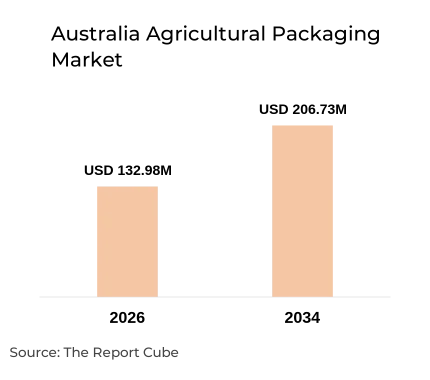
- Market valuation reaches USD 132.98 million during 2026.
- Forecast market valuation reaches USD 206.73 million by 2034.
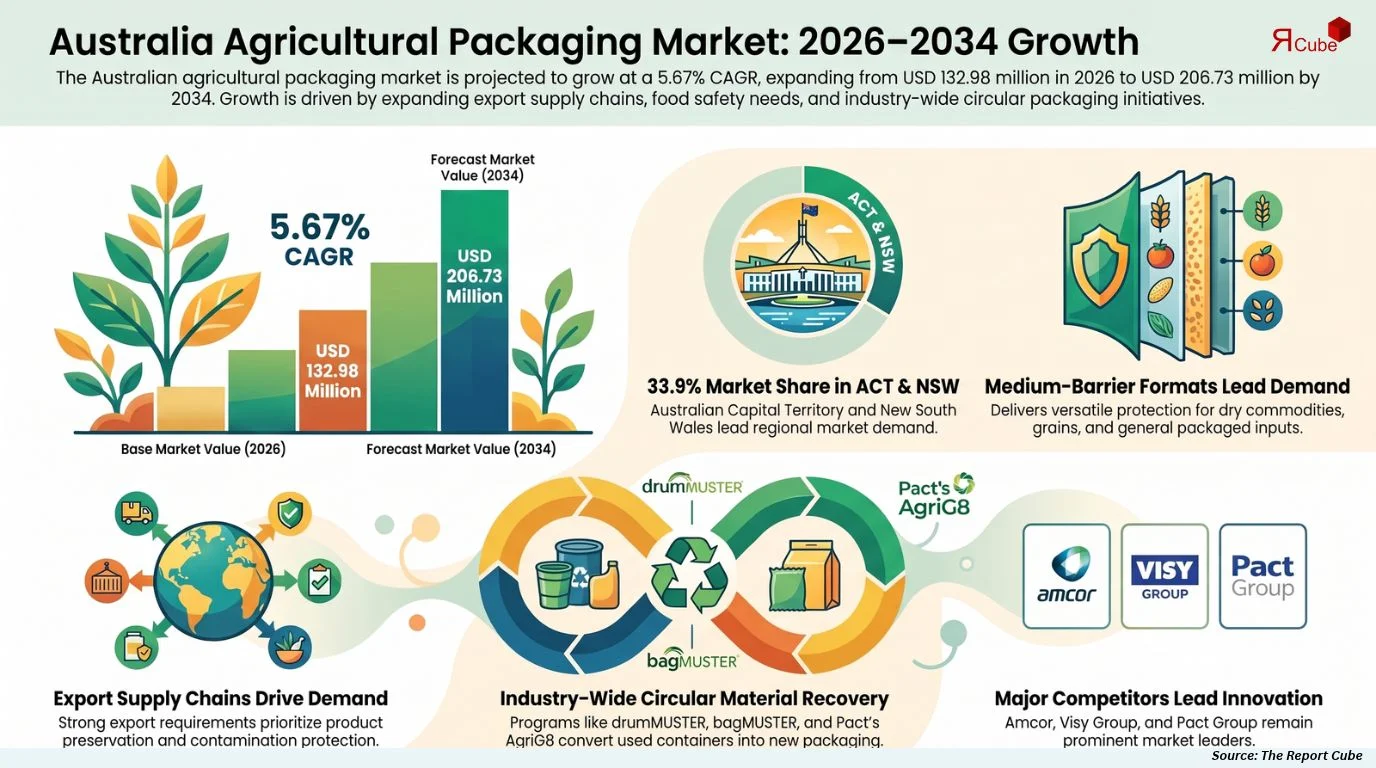
- Market expansion is projected at a 5.67% CAGR.
- Amcor, Visy, and Pact Group remain prominent competitors.
- Medium-barrier packaging represents the leading strength category.
- Australian Capital Territory and New South Wales lead regionally.
- Queensland and Western Australia offer agricultural growth opportunities.
- Recyclable materials increasingly influence agricultural packaging product development.
Australia Agricultural Packaging Market Insights & Analysis
The Australia Agricultural Packaging Market is anticipated to register a 5.67% CAGR during 2026–2034. The market size was valued at USD 132.98 million in 2026 and is projected to reach USD 206.73 million by 2034. Demand is supported by agricultural exports, food processing, horticultural distribution, and the need to protect agricultural products during storage and transportation. Packaging requirements vary across fresh produce, processed foods, fertilizers, pesticides, and biological products. Flexible films, bags, drums, and corrugated containers provide different combinations of moisture resistance, mechanical strength, and transport protection. Medium-barrier formats are positioned to benefit from their practical versatility. However, independently verified 2026 market shares for individual segments are not publicly established in the available information.
Sustainability initiatives are influencing investment priorities across Australia's packaging value chain. Packaging stewardship frameworks and agricultural container recovery programs encourage collection, recycling, and responsible material management. Industry initiatives such as drumMUSTER and bagMUSTER support the recovery of used agricultural packaging. Pact Group's AgriG8 initiative demonstrates how recovered agricultural chemical containers can be converted into new industrial packaging. These developments create opportunities for manufacturers to improve material recovery and develop recyclable packaging formats while maintaining product compatibility, durability, and applicable safety standards.
Australia Agricultural Packaging Market Dynamics
Agricultural packaging demand reflects the interaction of agricultural output, export quality requirements, chemical handling practices, and packaging recovery infrastructure. Australian producers require packaging that protects products during storage and long-distance distribution. Food processors prioritize freshness and handling efficiency, while agricultural input suppliers require compatible containers that support safe transport and storage. Packaging manufacturers compete on barrier performance, structural integrity, material recovery, and supply reliability. Future growth will depend on aligning packaging specifications with end-use requirements and evolving environmental expectations.
|
Factor |
Type |
Specific Impact on Market |
Magnitude |
|
Agricultural exports |
Driver |
Increases demand for protective packaging that preserves product quality during transportation. |
High |
|
Food safety and shelf-life requirements |
Driver |
Supports barrier films, sealed bags, and protective secondary packaging. |
High |
|
Agricultural chemical stewardship |
Driver |
Encourages collection, recycling, and development of recycled-content containers. |
High |
|
Packaging recovery and environmental regulation |
Market influence |
Increases emphasis on recyclable designs and documented material recovery. |
High |
|
Regional agricultural diversity |
Demand influence |
Creates varied requirements for bulk bags, chemical containers, produce cartons, and flexible films. |
Medium to high |
Key Market Driver: Expanding Agricultural Supply Chains
Australia's agricultural supply chains require packaging that maintains product integrity from farms and processing facilities through distribution networks and export channels. Produce, grains, seeds, and processed foods need protection against moisture, contamination, compression, and handling damage. Agricultural input manufacturers have additional requirements for secure, compatible containers that support safe transport and storage. Increasing expectations for traceability, consistent packaging performance, and reliable delivery can strengthen demand for specialized formats. Manufacturers combining appropriate barrier properties with efficient handling and established distribution networks are positioned to capture recurring orders.
Major Industry Challenge: Meeting Diverse Protection Requirements
Agricultural packaging suppliers must accommodate different protection requirements across food products, fertilizers, pesticides, and biological inputs. Materials suitable for dry commodities may not provide adequate protection for moisture-sensitive products or chemical formulations. Packaging intended for regulated agricultural inputs must also meet applicable product compatibility, containment, labeling, and transport requirements. Regional variations in farming practices and distribution conditions complicate specification standardization. Manufacturers need appropriate testing, material selection, and quality-control procedures to maintain product integrity. Application-specific design and consistent performance therefore remain important competitive differentiators.
Need Specific Data, Let’s Customize the Report for You
Request CustomizationEmerging Trend Shaping Outlook: Circular Materials and Recovery
Circular packaging systems are becoming more relevant as agricultural businesses seek practical routes for recovering used packaging. Pact Group's AgriG8 initiative uses recycled agricultural chemical container material to manufacture new industrial-grade containers, demonstrating an application-specific recovery model. Australia's bagMUSTER program also supports the collection of agricultural soft-plastic bags. These initiatives may encourage investment in collection infrastructure, recycled-content validation, and packaging designs suited to recovery. The opportunity is particularly significant where industry partnerships establish dependable material streams without compromising packaging performance or applicable safety requirements.
Australia Agricultural Packaging Market Segment-wise Analysis
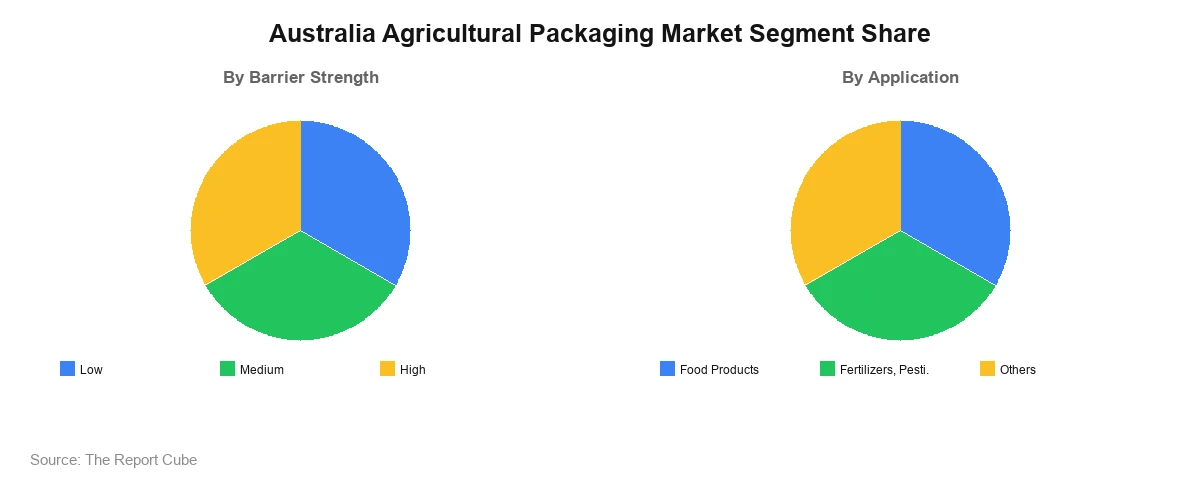
The market is segmented by barrier strength, application, and geographic region. Barrier strength reflects the degree of protection required against moisture, oxygen, contamination, and handling stress. Application segmentation distinguishes food packaging from agricultural input packaging and other uses. Regional segmentation reflects differences in production patterns, processing capacity, agricultural input demand, and logistics infrastructure.
By Barrier Strength
- Low
- Medium
- High
Medium-barrier packaging represents the leading category in the published market benchmark. Its position reflects suitability for products requiring practical protection without the specialized performance demanded by highly sensitive applications. Grain products, dry agricultural commodities, and several packaged inputs can use medium-protection structures depending on composition and storage conditions. Multilayer films, coated materials, and suitable composite structures provide options for balancing moisture resistance, mechanical integrity, and handling requirements. This historical share should not be interpreted as a verified 2026 estimate.
Low-barrier packaging serves applications in which extensive moisture or oxygen protection is unnecessary or where ventilation and routine handling are more important. It can be appropriate for selected agricultural goods and products with comparatively limited preservation requirements. High-barrier packaging targets products needing stronger resistance to oxygen, moisture, external contamination, or other environmental exposure. It can be relevant to sensitive food products and specialized agricultural formulations. Adoption across all three categories depends on product characteristics, required shelf life, packaging compatibility, and distribution conditions. Material engineering improvements may support more precise barrier selection.
By Application
- Food Products
- Fertilizers, Pesticides and Biologicals
- Others
Food products represent the largest application category in the published benchmark. Demand reflects packaging requirements across fresh produce, processed foods, grains, and other agricultural products moving through domestic and export supply chains. Packaging protects products during handling and transportation while supporting hygiene, shelf-life management, and distribution efficiency. Flexible films, produce bags, sealed packs, and corrugated cartons serve different product categories. Australia's established food production and processing industries underpin recurring packaging demand, although the exact 2026 application share has not been independently verified.
Fertilizers, pesticides, and biologicals require packaging designed around chemical compatibility, containment, moisture control, and safe handling. Containers, industrial-grade cubes, sacks, and specialized bags support the movement of agricultural inputs between manufacturers, distributors, and farms. Recycled-content packaging is relevant where recovery programs provide suitable feedstock and meet applicable product requirements. The others category includes additional agricultural packaging uses outside the two principal categories. Growth across these applications depends on agricultural activity, input distribution, packaging specifications, product safety requirements, and the availability of suitable collection and recovery infrastructure.
Regional Projection of Australia Agricultural Packaging Market
Regional demand varies with agricultural specialization, population concentration, processing infrastructure, and access to domestic and export distribution channels. New South Wales and the Australian Capital Territory lead the published regional benchmark, while Queensland and Western Australia offer opportunities linked to agricultural production and logistics. Victoria and Tasmania benefit from food processing and horticulture. The regional outlook remains sensitive to product mix, packaging specifications, transport conditions, and recovery infrastructure.
|
Region |
Estimated Market Share |
Key Growth Factors |
Consumer Trends |
|
Australia Capital Territory & New South Wales |
33.9% in the 2025 benchmark |
Distribution networks, processing facilities, agricultural output, export access |
Preference for reliable supply and packaging suited to food safety and handling |
|
Victoria & Tasmania |
Not independently verified |
Food processing, horticulture, dairy, produce distribution |
Interest in recyclable formats and consistent packaging quality |
|
Queensland |
Not independently verified |
Horticulture, agricultural production, food processing, input distribution |
Demand for durable packaging adapted to handling and transport conditions |
|
Northern Territory & Southern Australia |
Not independently verified |
Regional farming operations, agricultural input distribution, logistics requirements |
Preference for robust packaging suited to regional supply chains |
|
Western Australia |
Not independently verified |
Grain production, horticulture, agricultural exports, extended distribution routes |
Demand for reliable containment and protection during long-distance transport |
- Australia Capital Territory & New South Wales: This leading grouping benefits from established distribution infrastructure, food processing activity, and access to major commercial markets and export logistics. The published 2025 benchmark share is 33.9%.
- Victoria & Tasmania: Food processing, dairy, horticulture, and produce distribution support varied packaging demand. Recyclable fiber-based formats and protective packaging offer opportunities where performance requirements can be met.
- Queensland: Horticulture, crop production, and agricultural input distribution support demand for produce cartons, flexible packaging, sacks, and containers. Climate and transport conditions influence material selection.
- Northern Territory & Southern Australia: Diverse production environments and extended distribution routes create demand for durable packaging suited to agricultural inputs, bulk handling, and regional logistics.
- Western Australia: Grain production, horticulture, and agricultural export activity support demand for protective packaging. Supplier reliability and transport durability remain important for geographically dispersed customers.
Australia Agricultural Packaging Market: Recent Development (2025)
- Visy partnered with Tassal to launch locally recyclable cardboard prawn boxes containing 74% recycled content.
- Visy Specialties consolidated four packaging brands under one banner, commencing operations across Australia and New Zealand in July.
- Amcor reported recycle-ready solutions covering 96% of its flexible packaging portfolio by area at fiscal year-end 2025.
- Pact Group introduced rFresh 100 food-grade recycled HDPE resin for milk and juice bottle packaging applications.
Australia Agricultural Packaging Market Future Outlook (2034)
The market is projected to reach USD 206.73 million by 2034, representing a forecast CAGR of 5.67% from 2026 through 2034. Growth opportunities are expected across food packaging, agricultural input containers, flexible films, and recyclable secondary packaging. Demand for improved moisture protection, stronger transport performance, and dependable packaging supply should support product development. Agricultural chemical recovery programs may also expand opportunities for recycled-content containers where material quality, compatibility, and applicable safety requirements are satisfied. Manufacturers with established distribution networks and application-specific engineering capabilities are positioned to compete for recurring demand.
Technology advancement will influence packaging design through improved barrier materials, material-efficient structures, digital traceability, and increasingly data-driven quality management. AI-enabled inspection, demand forecasting, and production monitoring could improve defect detection and inventory planning, although the scale of adoption across Australian agricultural packaging remains uncertain. Circularity initiatives and packaging stewardship programs are likely to influence investment priorities as producers and suppliers seek better recovery outcomes. Long-term expansion will depend on agricultural output, export activity, food processing requirements, regional logistics, and compliance with packaging obligations. Companies combining protective performance with practical recyclability may strengthen their position through 2034.
Australia Agricultural Packaging Market Report Coverage
|
Report Attribute |
Details |
|
Market Name |
Australia Agricultural Packaging Market |
|
Market Size (2026) |
USD 132.98 million |
|
Market Size (2034) |
USD 206.73 million |
|
Forecast Period |
2026–2034 |
|
CAGR |
5.67% |
|
Base Year |
2025 |
|
Historical Years |
2021–2025 |
|
Forecast Years |
2026–2034 |
|
Segments Covered |
By Material Type, By Product, By Barrier Strength, By Application |
|
Regions Covered |
Australia Capital Territory & New South Wales; Victoria & Tasmania; Queensland; Northern Territory & Southern Australia; Western Australia |
|
Key Companies |
Amcor; Visy Group; Pact Group Holdings Limited; Integrated Packaging Australia; FROMM Packaging Australia Pty Ltd; Others |
Why Choose This Report?
- Evaluates market expansion using clearly specified forecast assumptions.
- Examines barrier strength across three distinct packaging categories.
- Assesses food products and agricultural input applications separately.
- Identifies regional opportunities across Australia's agricultural production centers.
- Reviews sustainability initiatives influencing packaging design and recovery.
- Analyzes competitive developments involving established packaging manufacturers.
- Highlights technology opportunities affecting future operational performance.
- Supports strategic planning through structured market segmentation and forecasting.
Table of Contents
- Introduction
- Objective of the Study
- Product Definition
- Market Segmentation
- Study Variables
- Research Methodology
- Secondary Data Points
- Companies Interviewed
- Primary Data Points
- Breakdown of Primary Interviews
- Secondary Data Points
- Executive Summary
- Market Dynamics
- Drivers
- Challenges
- Opportunity Assessment
- Recent Trends and Developments
- Policy and Regulatory Landscape
- Australia Agricultural Packaging Market Overview and Forecast Analysis (2021-2034)
- Market Size, By Value, By Growth Rate (CAGR/USD Millions)
- Demand – Supply Trends
- Market Share, By Material Type
- Plastic
- Metal
- Paper and Paperboards
- Composite Materials
- Others
- Market Share, By Product
- Pouches and Bags
- Drums
- Bottles and Cans
- Others
- Market Share, By Barrier Strength
- Low
- Medium
- High
- Market Share, By Application
- Food Products
- Fertilizers, Pesticides and Biologicals
- Others
- Market Share, By Regiona
- Australia Capital Territory & New South Wales
- Victoria & Tasmania
- Queensland
- Northern Territory & Southern Australia
- Western Australia
- Market Share, By Competitors
- Competition Characteristics
- Revenue Shares
- Plastic Australia Agricultural Packaging Market Overview, 2021-2034F
- By Value (USD Million)
- By Product – Market Size & Forecast 2021-2034, USD Million
- Pouches and Bags
- Drums
- Bottles and Cans
- Others
- Metal Australia Agricultural Packaging Market Overview, 2021-2034F
- By Value (USD Million)
- By Product – Market Size & Forecast 2021-2034, USD Million
- Pouches and Bags
- Drums
- Bottles and Cans
- Others
- Paper and Paperboards Australia Agricultural Packaging Market Overview, 2021-2034F
- By Value (USD Million)
- By Product – Market Size & Forecast 2021-2034, USD Million
- Pouches and Bags
- Drums
- Bottles and Cans
- Others
- Composite Materials Australia Agricultural Packaging Market Overview, 2021-2034F
- By Value (USD Million)
- By Product – Market Size & Forecast 2021-2034, USD Million
- Pouches and Bags
- Drums
- Bottles and Cans
- Others
- Others Australia Agricultural Packaging Market Overview, 2021-2034F
- By Value (USD Million)
- By Product – Market Size & Forecast 2021-2034, USD Million
- Pouches and Bags
- Drums
- Bottles and Cans
- Others
- Competitive Outlook (Company Profile - Partial List)
- Amcor
- Company Overview
- Business Segments
- Strategic Alliances/Partnerships
- Recent Developments
- Visy Group
- Company Overview
- Business Segments
- Strategic Alliances/Partnerships
- Recent Developments
- Pact Group Holdings Limited
- Company Overview
- Business Segments
- Strategic Alliances/Partnerships
- Recent Developments
- Integrated Packaging Australia
- Company Overview
- Business Segments
- Strategic Alliances/Partnerships
- Recent Developments
- FROMM Packaging Australia Pty Ltd
- Company Overview
- Business Segments
- Strategic Alliances/Partnerships
- Recent Developments
- Others
- Amcor
- Contact Us & Disclaimer
Top Key Players & Market Share Outlook
- Amcor
- Visy Group
- Pact Group Holdings Limited
- Integrated Packaging Australia
- FROMM Packaging Australia Pty Ltd
- Others
Frequently Asked Questions






