



Build Your Custom Market Intelligence Report
Customize Your ReportAustralia Men's Footwear Market Key Takeaways
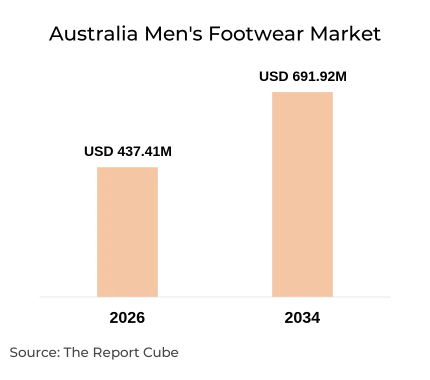
- Market valued at USD 437.41 million in 2026, reflecting steady consumer spending on men's footwear.
- Industry projected to reach USD 691.92 million by 2034, expanding at a 5.90% CAGR.
- Premium segment leads revenue contribution through sustained demand for heritage and performance brands.
- Online distribution channels are recording the fastest adoption growth across all Australian states.
- New South Wales accounts for the largest regional share, driven by urban consumer density.
- Athleisure adoption, sustainability awareness, and lifestyle shifts are shaping male purchasing behavior.
- Leading companies include Nike, Adidas, ASICS, R.M.Williams, Brand Collective, and Bared Footwear.
- Rising disposable incomes, sports participation, and e-commerce expansion continue accelerating market demand.
Australia Men's Footwear Market Insights & Analysis
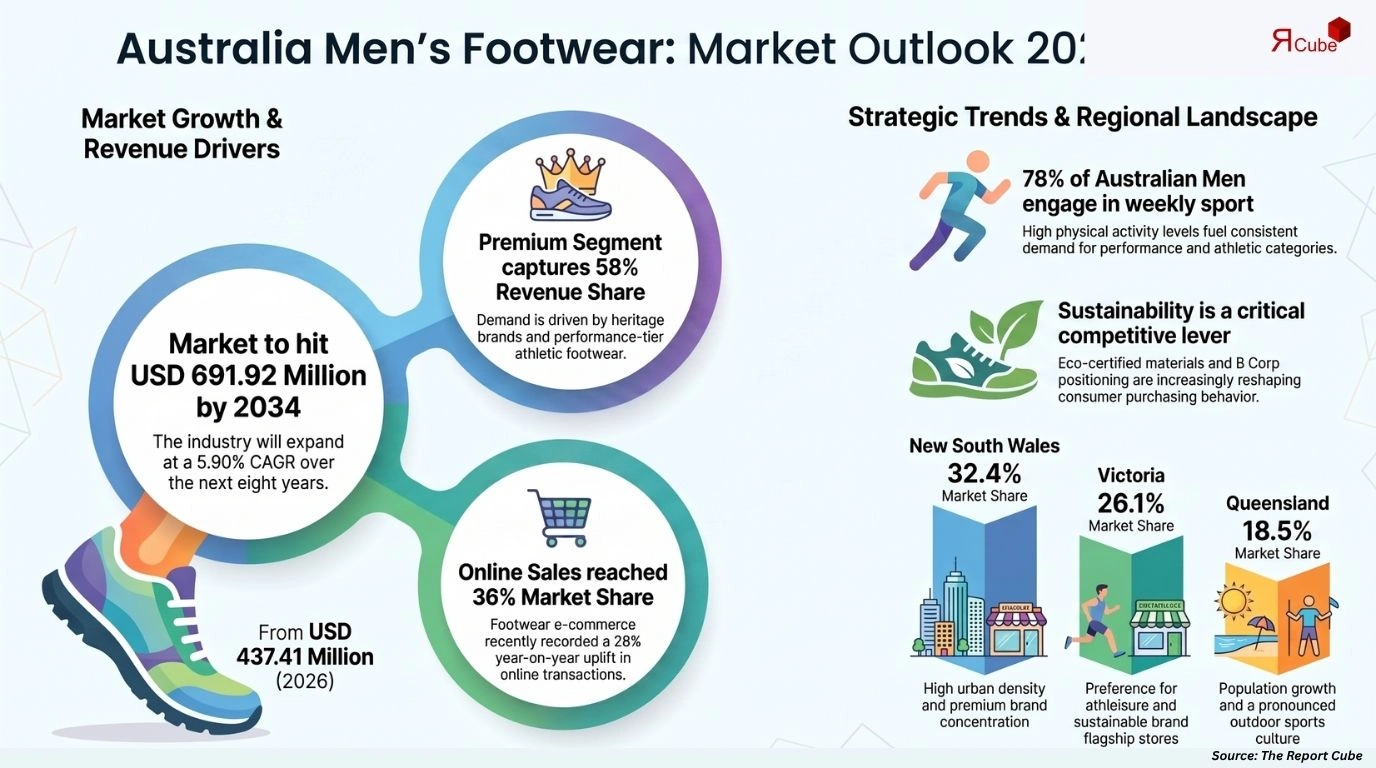
The Australia Men's Footwear Market is anticipated to register a 5.90% CAGR during 2026–2034. The market size was valued at USD 437.41 million in 2026 and is projected to reach USD 691.92 million by 2034. The market benefits from strong sports participation rates - the Australian Sports Commission reports that 78% of males aged 15 and above engage in sports or physical activity weekly - which directly supports demand for performance and athletic footwear across all price tiers. Brands operating across both premium and mass segments are deepening their investments in product innovation, retail presence, and digital commerce to capture this well-established demand base.
Consumer spending patterns in Australia increasingly favor footwear that performs across multiple contexts: the same shoe worn at the gym, the commute, and the weekend gathering. This blurring of functional boundaries has been beneficial for the Australia Men's Footwear Market, particularly within the athletic and casual sub-categories where versatility commands a premium. The footwear e-commerce segment in Australia recorded a 28% year-on-year uplift in online sales in October 2025, driven by improved sizing tools, returns infrastructure, and seasonal promotions - reinforcing that the channel shift is not slowing. Domestic brands such as Bared Footwear (Australia's first B Corp-certified footwear label) and R.M.Williams (manufacturing handcrafted leather boots in Adelaide since 1932) continue to anchor the premium local offer against international competition.
Australia Men's Footwear Market Dynamics
The Australia Men's Footwear Market operates at the intersection of shifting lifestyle preferences, expanding digital retail infrastructure, and the growing commercial weight of sustainability credentials. International athletic brands compete directly with well-positioned domestic labels, while mass-market retailers and online platforms extend reach into regional and suburban consumption centers. Across all distribution tiers, brands are investing in product development and consumer experience to defend and grow their share.
|
Factor |
Type |
Specific Impact on Market |
Magnitude |
|---|---|---|---|
|
Rising sports and fitness participation |
Driver |
Accelerates athletic and performance footwear demand |
Very High |
|
Growth of online retail and e-commerce |
Opportunity |
Expands consumer access and increases specialty brand visibility |
High |
|
Premiumization of everyday footwear |
Trend |
Lifts average selling prices across both athletic and non-athletic segments |
High |
|
Sustainability compliance pressure |
Driver |
Encourages eco-certified material sourcing and B Corp positioning |
High |
|
Low-cost import competition |
Challenge |
Compresses margins for domestic manufacturers and mid-tier brands |
Medium |
Key Market Driver: Sports Participation Fueling Athletic Demand
Australia's high sports participation rate directly translates to sustained footwear demand. With approximately 13 million adults engaging in organized sports annually according to the Department of Health and Aged Care, the consumption of purpose-built athletic footwear remains structurally supported. Gym memberships across the Fitness and Lifestyle Group network reported 5% sales growth in recent years, adding to the base of active consumers who regularly replace performance footwear. Brands with sport-specific product lines - running, court, trail, and cross-training - gain consistent repeat purchase cycles from this active male demographic, which forms the core demand engine for the Australia Athletic Footwear Market and the men's segment within it.
Major Industry Challenge: Low-Cost Import Pressure on Domestic Producers
Domestic footwear manufacturers face persistent margin pressure from low-cost imports, primarily from Southeast Asian production hubs, which department stores and mass-market retailers increasingly prefer for their price competitiveness. This dynamic has reduced shelf allocation for locally produced footwear in volume retail environments, pushing domestic brands toward premium differentiation, direct-to-consumer digital channels, and brand storytelling as competitive levers. Labels that lack the capital or brand equity to execute these strategies face contraction. The challenge is particularly pronounced in the mass segment, where price sensitivity is high and international supply chains operate at a significant cost advantage.
Emerging Trend Shaping Outlook: Sustainable and Ethically Sourced Footwear
Consumer consciousness around material sourcing, supply chain ethics, and end-of-life product management is visibly reshaping purchasing behavior in the Australian men's footwear segment. Major athletic brands including Nike, Adidas, and ASICS have all expanded their eco-friendly product catalogues in response to this trend. Domestically, Bared Footwear earned B Corp certification with a 2025 sustainability audit score of 126.7, and has recycled or donated over 31,200 pairs of shoes through its Save Our Soles program since 2019. Retailers are responding by expanding shelf space and digital prominence for verified sustainable lines, creating tangible commercial advantages for brands that can substantiate their environmental credentials through independent certification.
Need Specific Data, Let’s Customize the Report for You
Request CustomizationAustralia Men's Footwear Market Segment-wise Analysis
The Australia Men's Footwear Market is segmented by pricing tier and distribution channel - two dimensions where purchasing behavior differs most sharply and where competitive positioning is most consequential for both domestic and international brands.
By Pricing
- Premium
- Mass
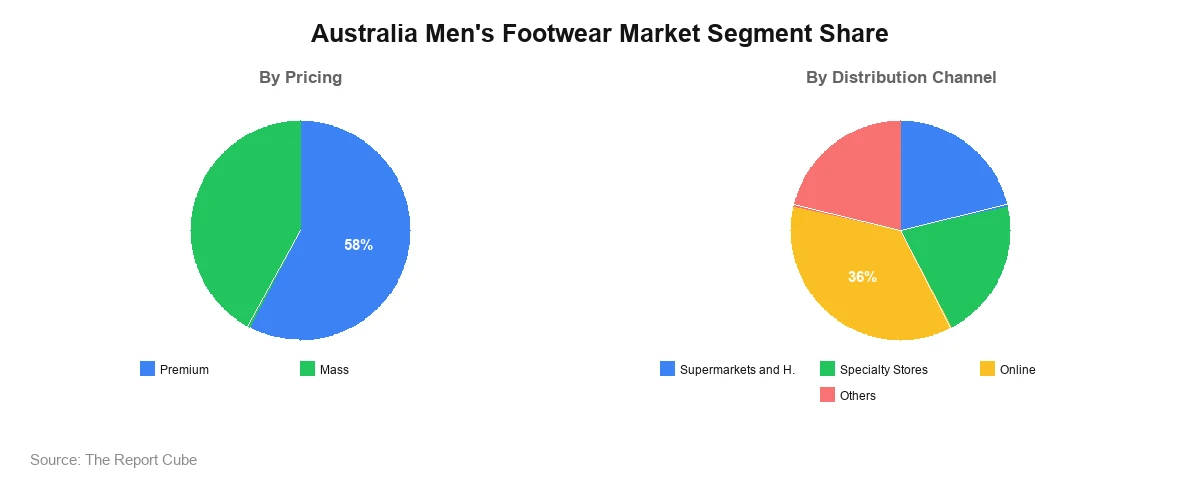
The premium segment accounts for an estimated 58% of the Australia Men's Footwear Market by revenue, driven by sustained consumer preference for quality construction, brand heritage, and performance credentials. R.M.Williams, handcrafting leather boots at its Adelaide workshop since 1932, remains one of the strongest domestic premium performers, with its Chelsea boot acting as a cross-generational purchase among Australian men. FEIT and Wootten serve a narrower but fiercely loyal cohort of buyers who prioritize artisanal production and ethical sourcing above all else. International brands Nike, Adidas, and ASICS capture premium positioning within athletic categories through performance-driven product lines tied to professional sports associations. Across premium, men's premium leather footwear demand in Australia is strengthened by the durability narrative - buyers justify higher price points through cost-per-wear logic rather than aspirational branding alone.
The mass segment, holding an estimated 42% revenue share, serves price-sensitive consumers through specialty chains, supermarkets, and online platforms where promotional pricing, broad size availability, and convenience dominate purchasing decisions. Brand Collective operates a significant portfolio of accessible-tier brands through its Australian retail network, capturing volume demand that premium brands are structurally unable to serve. Growth within the mass segment is increasingly driven by online channels, where platform-level promotions, loyalty programs, and streamlined return policies reduce the friction of purchasing footwear without in-store fitting. Younger demographic cohorts, particularly Millennials and Gen Z males, are frequent mass-segment online buyers who trade up selectively rather than maintaining a single-brand loyalty.
By Distribution Channel
- Supermarkets and Hypermarkets
- Specialty Stores
- Online
- Others
Online distribution commands an estimated 36% of Australia Men's Footwear Market revenue and is the fastest-growing channel by transaction volume. The footwear e-commerce market in Australia was expected to reach USD 3,400.1 million across all categories by 2025, with men's footwear contributing a meaningful portion as improved virtual fitting tools, competitive pricing, and frictionless returns reduce the historic reluctance to purchase shoes online. Brands with strong DTC digital infrastructure - including R.M.Williams, Nike Australia, ASICS Oceania, and Bared Footwear - are capturing online-first male consumers who research heavily before purchase and demonstrate higher basket values than in-store equivalents. The Sydney Swans' partnership with Nike as its official apparel and footwear partner signals the growing importance of sports-led brand visibility in driving online traffic and conversion for performance footwear.
Specialty stores retain an estimated 39% revenue share and remain the dominant physical channel for considered footwear purchases, particularly within the premium and performance categories where expert fitting assistance and tactile product evaluation matter. Supermarkets and hypermarkets contribute approximately 18% of market revenue, predominantly through the mass segment, and serve as the entry point for habitual, low-consideration repeat purchases such as casual sneakers and basic athletic shoes. The Others channel - including factory outlets, brand flagships, and pop-up retail - accounts for the remaining 7%. Frasers Group's partnership with Accent Group to launch and operate the Sports Direct chain across at least 50 Australian and New Zealand locations over six years further strengthens the specialty retail footprint for men's sports footwear distribution in Australia, expanding the physical reach of athletic brands into suburban and regional markets.
Regional Projection of Australia Men's Footwear Market
The Australia Men's Footwear Market demonstrates meaningful variation across states and territories, shaped by population density, income levels, sports culture, and the penetration of both specialty retail and online commerce. New South Wales and Victoria collectively account for the majority of market revenue, while Queensland and Western Australia offer the clearest growth headroom in the near term.
|
Region |
Estimated Market Share |
Key Growth Factors |
Consumer Trends |
|---|---|---|---|
|
New South Wales |
32.4% |
High urban population, premium brand concentration, e-commerce penetration |
Strong premium and online channel adoption |
|
Victoria |
26.1% |
Dense retail footprint, brand flagship concentration in Melbourne CBD |
Athleisure and sustainable brand preference growing |
|
Queensland |
18.5% |
Rising population growth, outdoor and sports culture, suburban retail expansion |
Casual and athletic footwear dominate purchase occasions |
|
Australian Capital Territory |
5.8% |
Higher-than-average household income, public sector employment |
Premium and heritage brand purchases above national average |
|
Western Australia |
11.2% |
Mining-driven income levels, expanding Perth metropolitan market |
Work boot and durable footwear demand alongside lifestyle categories |
|
Others |
6.0% |
Tasmania, South Australia, Northern Territory regional growth |
Value-oriented purchasing with growing online channel use |
- New South Wales: New South Wales commands the largest regional share at approximately 32.4%, anchored by Sydney's high-density urban consumer base, a concentration of premium brand flagship stores, and strong e-commerce infrastructure that facilitates both domestic and international online purchases.
- Victoria: Victoria holds around 26.1% of market revenue, with Melbourne's CBD and inner-suburb retail precincts hosting brand flagships and specialty footwear destinations. Consumer preference for athleisure and sustainability-certified brands is notably higher here than the national average.
- Queensland: Queensland accounts for approximately 18.5% market share and is the fastest-growing state by volume, supported by population inflows, a pronounced outdoor and sports culture, and Accent Group and Sports Direct's planned expansion into suburban retail nodes.
- Australian Capital Territory: The ACT contributes around 5.8% of market revenue but punches above its demographic weight in premium footwear spend, driven by above-average household incomes and a predominantly professional consumer profile that supports heritage and performance-tier purchases.
- Western Australia: Western Australia generates approximately 11.2% of market revenue, with mining-sector incomes supporting both work boot and lifestyle footwear demand in the Perth metropolitan area and regional centers. The Australia Men's Footwear Market in Western Australia is increasingly transitioning from purely functional to fashion-functional purchases as urbanization accelerates.
- Others: The remaining states and territories contribute approximately 6.0% collectively, with Tasmania, South Australia, and the Northern Territory representing niche but stable demand pools where value-oriented purchasing and growing online adoption define the purchasing environment.
Australia Men's Footwear Market: Recent Development (2025)
- ASICS Oceania launched Australia's first work boot range in March 2025, combining running shoe biomechanics with worksite protection.
- Athletics Australia extended its official partnership with PUMA through 2032, reinforcing performance footwear alignment with elite athletic programs.
- Frasers Group increased its Accent Group stake to 19.57% in April 2025, enabling Sports Direct's Australian and New Zealand retail rollout.
- Nike was confirmed as the Sydney Swans' official apparel and footwear partner across all AFL and AFLW teams in 2025.
Australia Men's Footwear Market Future Outlook (2034)
The Australia Men's Footwear Market is projected to reach USD 691.92 million by 2034, expanding at a 5.90% CAGR over the forecast period. Growth will be driven by deepening athletic participation, continued premiumization, and accelerating digital commerce adoption across all Australian states. Brands with robust direct-to-consumer capabilities and credible sustainability narratives will capture disproportionate share as younger male cohorts - who place measurably more value on ethics and experience than prior generations - represent a growing proportion of market spend. End-of-life footwear management, including recycling partnerships and circular material commitments, will transition from differentiator to baseline expectation among premium consumers by 2030.
Technology will play an increasingly functional role in both product development and the retail experience. Virtual fitting tools, AI-driven size recommendation engines, and personalized product suggestions will reduce return rates and improve online conversion across all channels. On the product side, 3D-printed midsoles, bio-based materials, and data-informed performance design will allow brands to deliver precision comfort at scale - capabilities that align well with the Australia Footwear Market trajectory toward performance-lifestyle integration. Domestic brands that combine Australian manufacturing heritage with these technology-forward capabilities - as R.M.Williams and FEIT already demonstrate at the premium tier - are well positioned to sustain pricing power and consumer loyalty through 2034 and beyond.
Australia Men's Footwear Market Report Coverage
|
Report Attribute |
Details |
|---|---|
|
Market Name |
Australia Men's Footwear Market |
|
Market Size (2026) |
USD 437.41 Million |
|
Market Size (2034) |
USD 691.92 Million |
|
Forecast Period |
2026–2034 |
|
CAGR |
5.90% |
|
Base Year |
2026 |
|
Historical Years |
2021–2025 |
|
Forecast Years |
2026–2034 |
|
Segments Covered |
By Pricing (Premium, Mass), By Distribution Channel (Supermarkets and Hypermarkets, Specialty Stores, Online, Others) |
|
Regions Covered |
New South Wales, Victoria, Queensland, Australian Capital Territory, Western Australia, Others |
|
Key Companies |
Nike Inc., Adidas Australia Pty Limited, ASICS Oceania Pty Ltd., R.M.Williams Pty Ltd, FEIT, Milu Boutique, MONOCHROME the Label, Wootten, Bared Pty Ltd, Brand Collective Pty Ltd., Others |
|
Report Format |
PDF, Excel, PPT |
|
Customization |
Available as per client requirements |
Why Choose This Report?
- Comprehensive analysis of both pricing tiers and all active distribution channels in Australia.
- Accurate market sizing at USD 437.41 million in 2026 with a reliable 2034 forecast.
- State-level regional breakdown covering New South Wales, Victoria, Queensland, and beyond.
- Detailed profiling of domestic brands including R.M.Williams, Bared Footwear, and FEIT.
- Insights into sustainability, B Corp certification, and ethical sourcing trends reshaping purchasing behavior.
- Analysis of online channel acceleration, including virtual fitting and e-commerce conversion data.
- Competitive intelligence covering market share dynamics among Nike, Adidas, and ASICS in Australia.
- Strategic data supporting brand investment, retail expansion, and distribution channel decisions.
Table of Contents
- Introduction
- Objective of the Study
- Product Definition
- Market Segmentation
- Study Variables
- Research Methodology
- Secondary Data Points
- Companies Interviewed
- Primary Data Points
- Breakdown of Primary Interviews
- Secondary Data Points
- Executive Summary
- Market Dynamics
- Drivers
- Challenges
- Opportunity Assessment
- Recent Trends and Developments
- Policy and Regulatory Landscape
- Australia Men’s Footwear Market Overview and Forecast Analysis (2021-2034)
- Market Size, By Value, By Growth Rate (CAGR/USD Millions)
- Demand – Supply Trends
- Market Share, By Product
- Non-Athletic Footwear
- Athletic Footwear
- Market Share, By Material
- Rubber
- Fabric
- Leather
- Plastic
- Others
- Market Share, By Pricing
- Premium
- Mass
- Market Share, By Distribution Channel
- Supermarkets and Hypermarkets
- Speciality Stores
- Online
- Others
- Market Share, By Region
- New South Wales
- Victoria
- Queensland
- Australian Capital Territory
- Western Australia
- Others
- Market Share, By Competitors
- Competition Characteristics
- Revenue Shares
- Non-Athletic Footwear Australia Men’s Footwear Market Overview, 2021-2034F
- By Value (USD Million)
- By Material – Market Size & Forecast 2021-2034, USD Million
- Rubber
- Fabric
- Leather
- Plastic
- Others
- Athletic Footwear Australia Men’s Footwear Market Overview, 2021-2034F
- By Value (USD Million)
- By Material – Market Size & Forecast 2021-2034, USD Million
- Rubber
- Fabric
- Leather
- Plastic
- Others
- Competitive Outlook (Company Profile - Partial List)
- Nike Inc.
- Company Overview
- Business Segments
- Strategic Alliances/Partnerships
- Recent Developments
- Adidas Australia Pty Limited
- Company Overview
- Business Segments
- Strategic Alliances/Partnerships
- Recent Developments
- ASICS Oceania Pty Ltd.
- Company Overview
- Business Segments
- Strategic Alliances/Partnerships
- Recent Developments
- R.M.Williams Pty Ltd
- Company Overview
- Business Segments
- Strategic Alliances/Partnerships
- Recent Developments
- FEIT
- Company Overview
- Business Segments
- Strategic Alliances/Partnerships
- Recent Developments
- Milu Boutique
- Company Overview
- Business Segments
- Strategic Alliances/Partnerships
- Recent Developments
- MONOCHROME`the Label
- Company Overview
- Business Segments
- Strategic Alliances/Partnerships
- Recent Developments
- Wootten
- Company Overview
- Business Segments
- Strategic Alliances/Partnerships
- Recent Developments
- Bared Pty Ltd
- Company Overview
- Business Segments
- Strategic Alliances/Partnerships
- Recent Developments
- Brand Collective Pty Ltd.
- Company Overview
- Business Segments
- Strategic Alliances/Partnerships
- Recent Developments
- Others
- Nike Inc.
- Contact Us & Disclaimer
Top Key Players & Market Share Outlook
- Nike Inc.
- Adidas Australia Pty Limited
- ASICS Oceania Pty Ltd.
- R.M.Williams Pty Ltd
- FEIT
- Milu Boutique
- MONOCHROME`the Label
- Wootten
- Bared Pty Ltd
- Brand Collective Pty Ltd.
- Others
Frequently Asked Questions






