



Build Your Custom Market Intelligence Report
Customize Your ReportAustralia Kraft Paper Market Key Takeaways
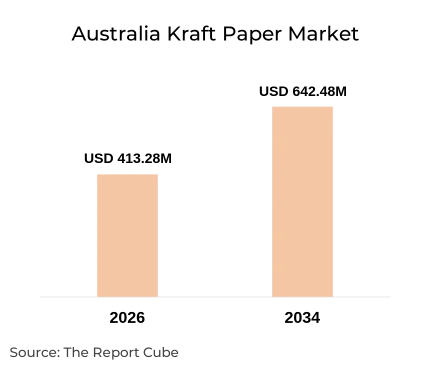
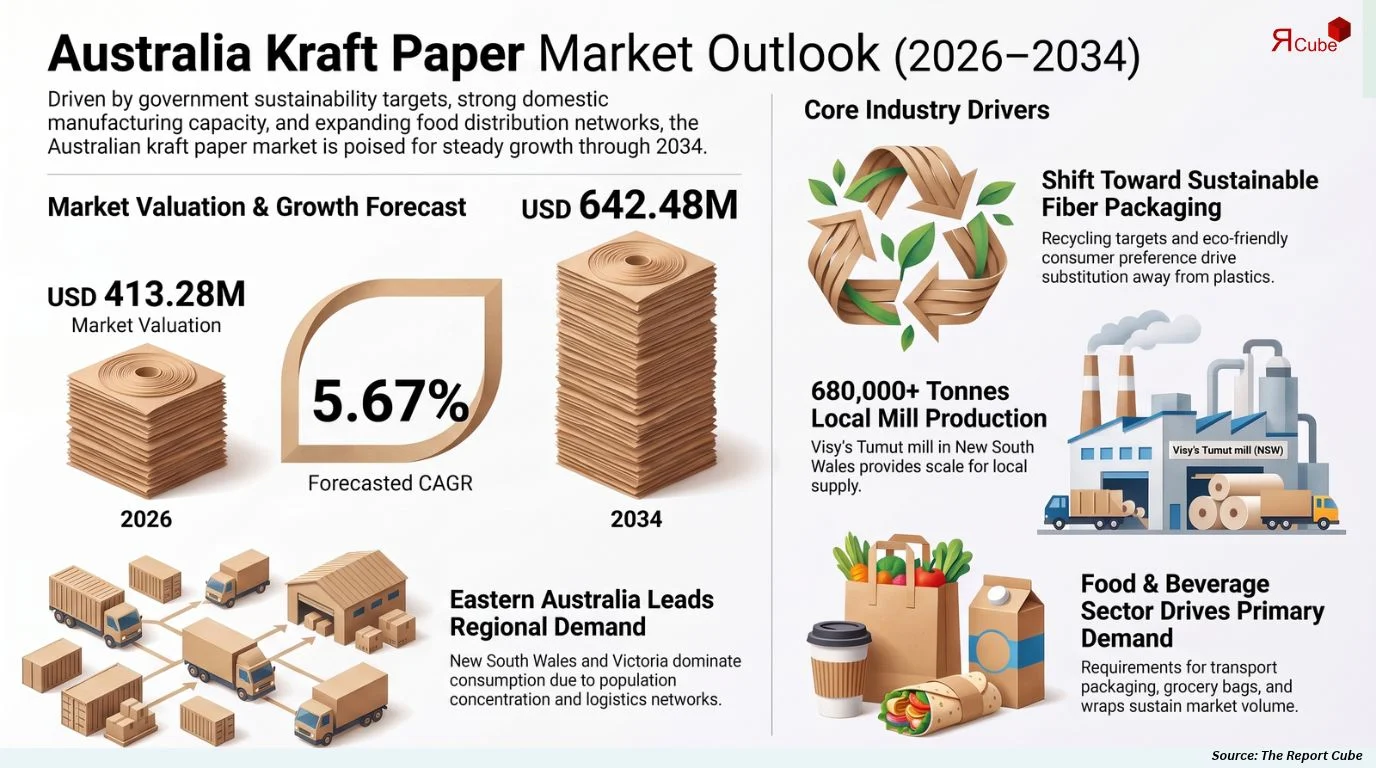
- The market is valued at USD 413.28 million in 2026.
- Market valuation is projected to reach USD 642.48 million by 2034.
- The forecast indicates a compound annual growth rate of 5.67%.
- Detmold Group, Visy Industries, and Opal Group are prominent competitors.
- Food and beverage packaging represents a major demand application.
- Eastern Australia benefits from concentrated population and industrial activity.
- Regional growth opportunities follow e-commerce and sustainable packaging adoption.
- Recyclability and responsible fiber sourcing increasingly influence purchasing decisions.
Australia Kraft Paper Market Insights & Analysis
The Australia Kraft Paper Market is anticipated to register a 5.67% CAGR during 2026-2034. The market size was valued at USD 413.28 million in 2026 and is projected to reach USD 642.48 million by 2034. This expansion reflects demand for durable, fiber-based packaging across food distribution, retail, manufacturing, and industrial supply chains. Kraft paper's strength, printability, and compatibility with recyclable packaging systems support its relevance as Australian businesses review packaging formats and environmental performance.
Domestic manufacturing capacity provides an important foundation for market development. Visy reports annual production exceeding 680,000 tonnes of kraft paper at its Tumut mill in New South Wales, demonstrating the scale of established local supply. Opal Australian Paper also manufactures unbleached kraft linerboard, fluting medium, and bag and sack papers. These capabilities connect paper production with downstream packaging conversion and industrial customers.
Policy and investment activity reinforce the commercial importance of fiber recovery, packaging recyclability, and domestic processing. Australia's packaging framework and National Packaging Targets encourage reusable, recyclable, or compostable packaging, alongside greater recycled content. Visy has also announced a multibillion-dollar investment program covering recycling and remanufacturing projects. Such initiatives support the broader packaging ecosystem, although their full contribution to kraft-paper-specific revenue cannot be quantified from the available public evidence.
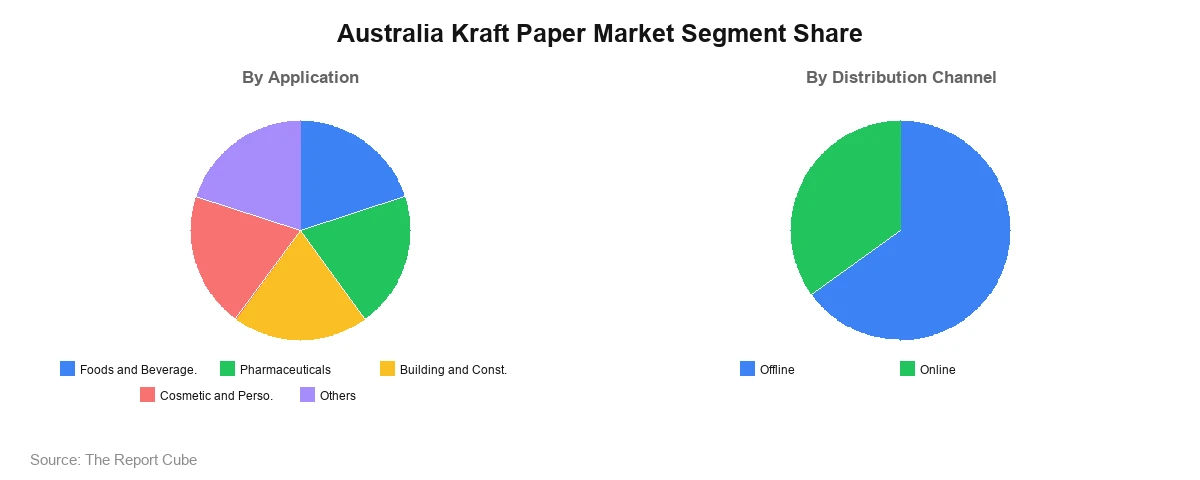
The market outlook nevertheless requires careful interpretation. The supplied valuation and growth rate provide the forecast baseline, but independently verifiable market-share percentages by application, distribution channel, and Australian subregion are not available in the reviewed sources. Accordingly, the analysis distinguishes documented company capabilities and policy developments from directional assessments of demand. This approach avoids presenting unsupported segment shares as measured market statistics.
Australia Kraft Paper Market Dynamics
Market momentum reflects the intersection of packaging demand, domestic paper manufacturing, environmental commitments, and changing retail distribution models. Kraft paper serves multiple functions, from protective food packaging and paper bags to corrugated packaging components and industrial sacks. Its commercial position depends on strength requirements, converting performance, moisture resistance, print quality, and suitability for recovery systems. Demand conditions vary by end-use industry, while the availability of domestically manufactured grades influences procurement strategies and supply-chain resilience.
|
Factor |
Type |
Specific Impact on Market |
Magnitude |
|
Sustainable packaging adoption |
Driver |
Encourages substitution toward recyclable fiber-based formats |
High |
|
Food and beverage distribution |
Driver |
Supports demand for bags, wraps, liners, and transport packaging |
High |
|
Domestic paper manufacturing |
Enabler |
Supports supply availability and downstream converting operations |
High |
|
Packaging regulation and recovery targets |
Policy influence |
Increases attention to recyclability and packaging design |
Moderate to high |
|
E-commerce and retail fulfillment |
Emerging driver |
Supports demand for protective, lightweight shipping formats |
Moderate to high |
Key Market Driver: Expanding Demand for Sustainable Packaging
Food distribution, grocery retail, takeaway services, and packaged consumer goods create recurring demand for functional paper packaging. Kraft paper can support shopping bags, protective wraps, secondary packaging, and corrugated structures, depending on grade and conversion method. Australia's packaging sustainability agenda further encourages businesses to assess recyclability and recycled content across their packaging portfolios. The government's packaging framework promotes recovery, reuse, recycling, and safe reprocessing, providing a policy context for fiber-based alternatives. Suppliers that combine mechanical performance with documented fiber sourcing and fit-for-purpose packaging design are positioned to benefit.
Major Industry Challenge: Maintaining Consistent Material Performance
Kraft paper producers and converters must balance strength, printability, moisture tolerance, and product protection across different applications. Food-contact uses can require suitable barrier systems, while chilled and frozen distribution places additional demands on packaging performance under humid conditions. Recyclability claims also depend on coatings, adhesives, inks, and the practical ability of local recovery systems to process finished packaging. Australia's circular-economy reporting identifies paper-grade separation and contamination as areas requiring attention. Manufacturers must therefore match paper specifications to end-use requirements while maintaining reliable quality and recovery compatibility.
Need Specific Data, Let’s Customize the Report for You
Request CustomizationEmerging Trend Shaping Outlook: Advancing Recyclable Fiber Packaging Design
Packaging development is increasingly focused on integrating recycled fiber, reducing unnecessary material, and improving usability throughout fulfillment and recovery. Opal has described packaging initiatives involving higher recycled content, durable corrugated solutions, and simplified e-commerce shipping formats. One reported customer collaboration increased recycled content in chilled meat boxes to 73%, demonstrating how material redesign can align environmental objectives with demanding distribution conditions. For kraft paper suppliers, the opportunity extends beyond selling paper rolls: technical support, application-specific grades, barrier innovation, and collaboration with converters can strengthen customer relationships.
Australia Kraft Paper Market Segment-wise Analysis
The market is assessed across the application and distribution-channel categories specified for this report. Application demand reflects packaging performance, product protection, branding, and supply-chain requirements. Distribution patterns depend on procurement volume, specification complexity, supplier relationships, and ordering convenience. The following analysis identifies the principal commercial considerations and likely growth opportunities without assigning unverified market-share percentages to individual segments.
By Application
- Foods and Beverage
- Pharmaceuticals
- Building and Construction
- Cosmetic and Personal Care
- Others
Food and beverage applications represent a major demand area because manufacturers, retailers, hospitality operators, and food distributors require packaging for handling, storage, transport, and presentation. Kraft paper can be converted into bags, wraps, liners, and components of corrugated packaging. Adoption depends on grade strength, converting efficiency, printing requirements, and the suitability of the finished structure for its intended food application. Moisture and grease resistance may require specialized treatments or compatible barrier materials. However, a defensible market-share percentage for this application was not established in the reviewed sources.
Pharmaceutical applications emphasize protective secondary packaging, labeling, handling, and reliable supply specifications. Building and construction demand includes paper used in sacks, protective packaging, and selected building-material packaging applications. Cosmetic and personal care brands can use kraft-based bags, cartons, and presentation formats where appearance and environmental positioning matter. Other applications include industrial packaging, retail uses, and specialized protective formats. Growth within these categories depends on product design, sector activity, and purchasing requirements. Pharmaceutical and cosmetic uses require particular attention to suitability and product protection rather than assuming all kraft grades are interchangeable.
By Distribution Channel
- Offline
- Online
Offline distribution remains strategically important for large-volume procurement, customized grades, and recurring industrial contracts. Direct manufacturer relationships, distributors, paper merchants, and packaging converters allow buyers to discuss grammage, roll dimensions, strength requirements, delivery schedules, and technical specifications. This channel is particularly relevant when customers require dependable replenishment or application-specific material. Established Australian producers and integrated packaging businesses provide a foundation for business-to-business supply. However, public evidence reviewed for this report does not establish a verified offline channel share, so dominance should be understood as a commercial assessment rather than a measured percentage.
Online distribution can expand access to standard paper products, smaller order quantities, product specifications, and repeat purchasing. Digital ordering may be attractive to smaller businesses, independent retailers, and organizations seeking convenient replenishment. Its development depends on product availability, delivery coverage, order-size flexibility, and the ease of comparing specifications. Complex industrial orders are less easily standardized than routine purchases, which can preserve a role for direct sales and specialist distributors. The fastest-growing channel cannot be conclusively identified without comparable channel-level sales data. Suppliers can nevertheless strengthen digital acquisition through clearer product information and integrated ordering processes.
Regional Projection of Australia Kraft Paper Market
Regional demand varies with population concentration, manufacturing activity, food production, construction, retail networks, and distribution infrastructure. New South Wales and Victoria offer substantial commercial bases for packaging consumption and conversion, while Queensland, Western Australia, Tasmania, and the territories present distinct industrial and geographic requirements. The regional groupings below follow the supplied segmentation. Verified market-share estimates for these groupings were not identified, so no precise percentages are assigned.
|
Region |
Estimated Market Share |
Key Growth Factors |
Consumer Trends |
|
Australia Capital Territory and New South Wales |
Not independently verified |
Population centers, manufacturing, retail, and logistics |
Recyclable packaging and reliable supply |
|
Victoria and Tasmania |
Not independently verified |
Consumer goods, manufacturing, food distribution |
Packaging performance and fiber recovery |
|
Queensland |
Not independently verified |
Food production, agriculture, logistics, and retail |
Durable transport and secondary packaging |
|
Northern Territory and Southern Australia |
Not independently verified |
Regional distribution, industrial demand, and food supply chains |
Practical packaging and supply reliability |
|
Western Australia |
Not independently verified |
Mining-related supply chains, food distribution, and retail |
Protective packaging and dependable replenishment |
- Australia Capital Territory and New South Wales: Sydney and surrounding commercial centers support retail, food distribution, manufacturing, and logistics activity. Visy's Tumut kraft-paper mill provides an established domestic production base in New South Wales.
- Victoria and Tasmania: Melbourne's manufacturing and distribution networks create demand for packaging across consumer goods and food supply chains. Victoria also has an established paper-manufacturing presence through Opal Australian Paper.
- Queensland: Agricultural production, food processing, retail distribution, and industrial logistics support demand for protective packaging. Regional opportunities depend on product mix, conversion capacity, and efficient movement between producers and end users.
- Northern Territory and Southern Australia: Smaller population centers and geographically dispersed customers place greater emphasis on reliable replenishment and practical transport packaging. Agricultural, industrial, and retail supply chains provide potential demand across varied applications.
- Western Australia: Mining supply chains, regional freight movements, food distribution, and retail activity create requirements for durable packaging. Geographic distances increase the importance of shipment protection, procurement planning, and consistent product availability.
Australia Kraft Paper Market: Recent Development (2025)
- Visy launched Visy Specialties in July 2025, uniting packaging brands to streamline premium cardboard supply.
- Opal and BlockTexx announced a partnership in April 2025 focused on textile-waste
- Opal and Bronte introduced recyclable beauty packaging in April 2025, addressing presentation and recovery objectives.
- Visy announced its Hemmant box plant would produce up to one million boxes each day.
Australia Kraft Paper Market Future Outlook (2034)
The market is projected to reach USD 642.48 million by 2034, expanding at the supplied CAGR of 5.67% from 2026. Growth opportunities include food packaging, industrial sacks, paper-based retail formats, e-commerce shipping, and specialized packaging for consumer products. Producers that combine consistent paper quality with responsible fiber sourcing and application-specific technical support may strengthen their position. Domestic manufacturing assets, established converting networks, and investments in recycling infrastructure provide a foundation for market development, although company investment announcements should not be interpreted as direct forecasts of kraft-paper revenue.
Technology advancement is expected to focus on more efficient paper production, improved fiber recovery, digital product specification, and packaging designs that balance durability with material efficiency. AI-enabled forecasting, production monitoring, and demand planning could help manufacturers improve operational visibility, anticipate order patterns, and manage inventory more effectively. These are prospective applications rather than evidence of industry-wide adoption. Over the longer term, market expansion will depend on packaging demand, regulatory developments, customer requirements, and the ability of manufacturers to deliver fit-for-purpose products. Regular monitoring of regional sales and end-use demand will be important for validating the forecast.
Australia Kraft Paper Market Report Coverage
|
Report Attribute |
Details |
|
Market Name |
Australia Kraft Paper Market |
|
Market Size (2026) |
USD 413.28 million |
|
Market Size (2034) |
USD 642.48 million |
|
Forecast Period |
2026–2034 |
|
CAGR |
5.67% |
|
Base Year |
2025 |
|
Historical Years |
2021–2025 |
|
Forecast Years |
2026–2034 |
|
Segments Covered |
By Product Type, By Packaging, By Application, By Distribution Channel |
|
Regions Covered |
Australia Capital Territory and New South Wales; Victoria and Tasmania; Queensland; Northern Territory and Southern Australia; Western Australia |
|
Key Companies |
Detmold Group, Oji Fibre Solutions, Pro-Pac Packaging, Norvickraft, Visy Industries, Opal Group (Paper Australia), Orora Limited, Others |
|
Report Format |
Market sizing, segmentation, competitive landscape, regional analysis, and forecast |
|
Customization |
Application-level, distribution-channel, regional, and company-specific analysis, subject to data availability |
Why Choose This Report?
- Understand market valuation and long-term growth expectations.
- Evaluate demand across key packaging applications and channels.
- Identify regional opportunities within Australia's packaging supply chain.
- Assess established manufacturers and competitive market positioning.
- Examine sustainability policies influencing packaging material selection.
- Review documented corporate developments from leading industry participants.
- Understand emerging opportunities in recyclable fiber-based packaging.
- Support strategic planning with structured market intelligence.
Table of Contents
- Introduction
- Objective of the Study
- Product Definition
- Market Segmentation
- Study Variables
- Research Methodology
- Secondary Data Points
- Companies Interviewed
- Primary Data Points
- Breakdown of Primary Interviews
- Secondary Data Points
- Executive Summary
- Market Dynamics
- Drivers
- Challenges
- Opportunity Assessment
- Recent Trends and Developments
- Policy and Regulatory Landscape
- Australia Kraft Paper Market Overview and Forecast Analysis (2021-2034)
- Market Size, By Value, By Growth Rate (CAGR/USD Millions)
- Demand – Supply Trends
- Market Share, By Product Type
- Unbleached
- Bleached
- Wrapping and Packaging
- Sack Kraft Paper
- Others
- Market Share, By Packaging
- Corrugated Box
- Grocery Bags
- Industrial Bags
- Wraps
- Pouches
- Others
- Market Share, By Application
- Foods and Beverage
- Pharmaceuticals
- Building and Construction
- Cosmetic and Personal Care
- Others
- Market Share, By Distribution Channel
- Offline
- Online
- Market Share, By Region
- Australia Capital Territory & New South Wales
- Victoria & Tasmania
- Queensland
- Northern Territory & Southern Australia
- Western Australia
- Market Share, By Competitors
- Competition Characteristics
- Revenue Shares
- Unbleached Australia Kraft Paper Market Overview, 2021-2034F
- By Value (USD Million)
- By Packaging – Market Size & Forecast 2021-2034, USD Million
- Corrugated Box
- Grocery Bags
- Industrial Bags
- Wraps
- Pouches
- Others
- Bleached Australia Kraft Paper Market Overview, 2021-2034F
- By Value (USD Million)
- By Packaging – Market Size & Forecast 2021-2034, USD Million
- Corrugated Box
- Grocery Bags
- Industrial Bags
- Wraps
- Pouches
- Others
- Wrapping and Packaging Australia Kraft Paper Market Overview, 2021-2034F
- By Value (USD Million)
- By Packaging – Market Size & Forecast 2021-2034, USD Million
- Corrugated Box
- Grocery Bags
- Industrial Bags
- Wraps
- Pouches
- Others
- Sack Kraft Paper Australia Kraft Paper Market Overview, 2021-2034F
- By Value (USD Million)
- By Packaging – Market Size & Forecast 2021-2034, USD Million
- Corrugated Box
- Grocery Bags
- Industrial Bags
- Wraps
- Pouches
- Others
- Others Australia Kraft Paper Market Overview, 2021-2034F
- By Value (USD Million)
- By Packaging – Market Size & Forecast 2021-2034, USD Million
- Corrugated Box
- Grocery Bags
- Industrial Bags
- Wraps
- Pouches
- Others
- Competitive Outlook (Company Profile - Partial List)
- Detmold Group
- Company Overview
- Business Segments
- Strategic Alliances/Partnerships
- Recent Developments
- Oji Fibre Solutions
- Company Overview
- Business Segments
- Strategic Alliances/Partnerships
- Recent Developments
- Pro-Pac Packaging
- Company Overview
- Business Segments
- Strategic Alliances/Partnerships
- Recent Developments
- Norvickraft
- Company Overview
- Business Segments
- Strategic Alliances/Partnerships
- Recent Developments
- Visy Industries
- Company Overview
- Business Segments
- Strategic Alliances/Partnerships
- Recent Developments
- Opal Group (Paper Australia)
- Company Overview
- Business Segments
- Strategic Alliances/Partnerships
- Recent Developments
- Orora Limited
- Company Overview
- Business Segments
- Strategic Alliances/Partnerships
- Recent Developments
- Others
- Detmold Group
- Contact Us & Disclaimer
Top Key Players & Market Share Outlook
- Detmold Group
- Oji Fibre Solutions
- Pro-Pac Packaging
- Norvickraft
- Visy Industries
- Opal Group (Paper Australia)
- Orora Limited
- Others
Frequently Asked Questions






