



Build Your Custom Market Intelligence Report
Customize Your ReportGlobal AI Agent Market Insights & Analysis
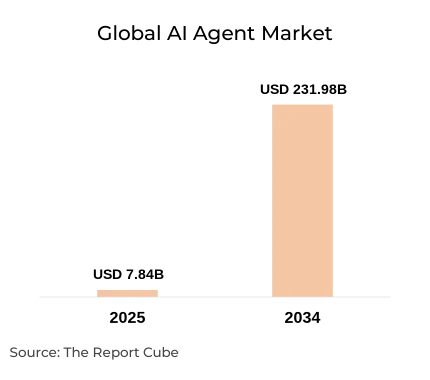
The Global AI Agent Market is anticipated to register a CAGR of 45.70% during 2026-2034. The market size was valued at USD 7.84 billion and is projected to reach USD 231.98 billion by 2034. This unprecedented growth reflects a paradigm shift in enterprise software, where static automation tools are being replaced by intelligent, autonomous, and goal-driven AI agents. These agents are capable of reasoning, planning, executing tasks, and learning from feedback, enabling organizations to fundamentally rethink how work is performed across digital environments.
AI agents are rapidly becoming the connective intelligence layer across modern enterprises. Unlike traditional chatbots or rule-based automation, AI agents can operate across multiple applications, data sources, and workflows with minimal human intervention. Enterprises are deploying agents to handle customer interactions, manage IT operations, support software development, conduct market research, and automate end-to-end business processes. The convergence of large language models (LLMs), cloud computing, API-first enterprise software, and scalable data infrastructure has created ideal conditions for AI agent adoption at scale, positioning this market as one of the fastest-growing segments in the global technology ecosystem.
Global AI Agent Market Recent Developments
- 2025: OpenAI and Microsoft expanded autonomous agent capabilities within enterprise productivity, coding, and workflow platforms.
- 2025: ServiceNow and Salesforce introduced domain-specific AI agents for IT service management and customer operations.
Government Initiatives & Policies
- U.S. National AI Strategy: Promotes enterprise AI adoption, automation, and responsible deployment frameworks.
- EU AI Act: Establishes regulatory governance impacting enterprise AI agent deployment.

Global AI Agent Market Dynamics
Key Driver: Enterprise Automation at Scale
The primary driver of the global AI agent market is the accelerating demand for enterprise-wide automation that goes beyond repetitive task execution. Organizations face rising operational complexity driven by digital channels, software fragmentation, and data volume growth. AI agents address these challenges by autonomously executing multi-step workflows, interacting with enterprise systems, and adapting to changing conditions. Enterprises deploying AI agents across customer service, IT operations, and back-office functions report productivity gains of 30%-45%, alongside measurable reductions in response time, error rates, and operational costs.
Major Challenge: Trust, Governance, and Predictability
A critical challenge restraining large-scale adoption is ensuring trust, governance, and predictable behavior in autonomous AI systems. Enterprises require agents to operate within defined boundaries, adhere to regulatory requirements, and provide auditability for decisions and actions. Concerns related to hallucinations, data exposure, and unintended system actions remain particularly relevant in regulated sectors such as banking, healthcare, and government. As a result, organizations increasingly favor agent architectures that incorporate human oversight, policy enforcement layers, and explainability mechanisms to mitigate operational risk.
Industry Trends: Multi-agent Architectures and Tool-native Agents
A defining industry trend is the evolution from single-task agents to coordinated multi-agent systems. In these environments, specialized agents collaborate to achieve broader objectives, such as handling sales inquiries, generating proposals, analyzing data, and updating CRM systems in parallel. Tool-native agents capable of securely invoking APIs, databases, and enterprise software platforms are becoming standard. This shift transforms AI agents from conversational assistants into active digital coworkers embedded directly into business processes.
Opportunity Ahead: Verticalized AI Agents with Embedded Expertise
Significant opportunities exist in vertical-specific AI agents designed for industries such as healthcare, finance, legal services, manufacturing, and logistics. These agents incorporate domain knowledge, compliance logic, and industry workflows, enabling higher accuracy and faster adoption. Vertical AI agents are increasingly deployed under long-term enterprise contracts, offering vendors stable revenue streams and premium pricing potential through 2034.
Global AI Agent Market Segment-wise Analysis
By Agent Type:
- Customer Service & Support Agents
- Sales & Marketing Agents
- IT Operations & DevOps Agents
- Productivity & Workplace Assistants
- Autonomous Process Automation Agents
- Data & Analytics / Research Agents
- Developer & Coding Assistants
- Domain-specific Vertical Agents
Customer service and support agents represent the largest segment, accounting for approximately 28% of global market revenue in 2025. Enterprises deploy these agents to manage Tier-1 and Tier-2 customer interactions, resolve common issues, and escalate complex cases to human agents. Adoption is particularly strong in e-commerce, telecom, and financial services, where AI agents reduce average handling time by up to 35% and improve first-contact resolution rates.
Developer and coding assistants are the fastest-growing segment, driven by demand from software development teams seeking faster release cycles and improved code quality. AI coding agents assist with code generation, debugging, documentation, and testing, reducing development time by an estimated 20%-40%. Data and research agents are also gaining traction, supporting market analysis, competitive intelligence, and internal knowledge discovery across enterprises.
By Technology Stack:
- LLM-based Agents
- Rule-based & Traditional Conversational Agents
- Hybrid (LLM + Symbolic / Workflow) Agents
LLM-based agents dominate the market with an estimated 61% share in 2025, reflecting their advanced reasoning, contextual understanding, and adaptability across tasks. These agents excel in unstructured environments where language understanding and flexible problem-solving are required. However, hybrid agents are gaining rapid adoption in enterprise environments, particularly where deterministic workflows, compliance controls, and reliability are essential. Hybrid architectures combine the creativity of LLMs with rule-based logic and workflow orchestration, offering a balanced approach to autonomy and control.
Regional Projection of Global AI Agent Industry
- North America
- Europe
- Asia-Pacific
- Middle East & Africa
- Latin America
North America leads the global AI agent market, accounting for approximately 42% of total revenue in 2025. The region benefits from early enterprise adoption, mature cloud infrastructure, and the presence of leading AI developers such as OpenAI, Microsoft, Google, Amazon, and Salesforce. Strong venture capital investment and enterprise innovation budgets further accelerate market expansion.
Europe represents a significant share, driven by enterprise automation initiatives and growing adoption of governed AI systems aligned with regulatory requirements. Demand is particularly strong in financial services, manufacturing, and public sector applications. Meanwhile, Asia-Pacific is the fastest-growing region, supported by rapid digital transformation, expanding developer ecosystems, and large-scale enterprise adoption across China, India, Japan, and Southeast Asia. Organizations in the region increasingly deploy AI agents to manage customer interactions, software development, and operational analytics at scale.
Why Choose This Report?
- Provides a comprehensive overview of the global AI agent market, including enterprise adoption patterns and technology evolution.
- Offers accurate, up-to-date insights into market size, growth forecasts, and high-impact segments.
- Delivers in-depth analysis of agent types, technology stacks, and real-world enterprise use cases.
- Includes competitive benchmarking of leading AI agent platforms and solution providers.
- Consolidates market intelligence to reduce research time and improve strategic clarity.
- Supports customized segmentation and risk mitigation strategies for enterprise AI investments.
- Identifies regulatory, governance, and operational challenges impacting deployment.
- Highlights emerging opportunities in verticalized and domain-specific AI agent solutions.
Table of Contents
- Introduction
- Objective of the Study
- Product/Category Definition
- Market Segmentation
- Study Variables
- Research Methodology
- Secondary Data Points
- Breakdown of Secondary Sources
- Primary Data Points
- Breakdown of Primary Interviews
- Secondary Data Points
- Executive Summary
- Market Dynamics
- Drivers
- Challenges
- Opportunity Assessment
- Recent Trends and Developments
- Policy and Regulatory Landscape
- Global AI Agent Market Overview (2020-2034)
- Market Size, By Volume & Value (Deployments / USD Million)
- Market Share, By Agent Type
- Customer Service & Support Agents
- Sales & Marketing Agents
- IT Operations & DevOps Agents
- Productivity & Workplace Assistants
- Autonomous Process Automation Agents
- Data & Analytics / Research Agents
- Developer & Coding Assistants
- Domain-specific Vertical Agents (Healthcare, Finance, Legal, etc.)
- Market Share, By Technology Stack
- LLM-based Agents
- Rule-based & Traditional Conversational Agents
- Hybrid (LLM + Symbolic / Workflow) Agents
- Market Share, By Deployment Mode
- Cloud-based
- On-premise
- Hybrid
- Market Share, By Integration / Interface
- Web & Mobile Applications
- Contact Center & IVR
- Collaboration Platforms (Email, Chat, Teams, Slack, etc.)
- Embedded / API-first Agents
- Market Share, By Organization Size
- Large Enterprises
- Small & Medium Enterprises (SMEs)
- Startups & Digital-native Businesses
- Market Share, By End User / Industry Vertical
- BFSI
- IT & Telecommunications
- Retail & E-commerce
- Healthcare & Life Sciences
- Manufacturing & Industry 4.0
- Media & Entertainment
- Education & EdTech
- Government & Public Sector
- Travel, Hospitality & Transportation
- Others (Energy, Real Estate, Professional Services, etc.)
- Market Share, By Region
- North America
- Europe
- Asia-Pacific
- Middle East & Africa
- Latin America
- Market Share, By Company
- Revenue Shares
- Competitive Landscape
- North America AI Agent Market
- Market Size, By Value (USD Million)
- Market Share, By Agent Type
- Market Share, By Deployment Mode
- Market Share, By End User / Industry Vertical
- Market Share, By Organization Size
- Europe AI Agent Market
- Market Size, By Value (USD Million)
- Market Share, By Agent Type
- Market Share, By Deployment Mode
- Market Share, By End User / Industry Vertical
- Market Share, By Organization Size
- Asia-Pacific AI Agent Market
- Market Size, By Value (USD Million)
- Market Share, By Agent Type
- Market Share, By Deployment Mode
- Market Share, By End User / Industry Vertical
- Market Share, By Organization Size
- Middle East & Africa AI Agent Market
- Market Size, By Value (USD Million)
- Market Share, By Agent Type
- Market Share, By Deployment Mode
- Market Share, By End User / Industry Vertical
- Market Share, By Organization Size
- Latin America AI Agent Market
- Market Size, By Value (USD Million)
- Market Share, By Agent Type
- Market Share, By Deployment Mode
- Market Share, By End User / Industry Vertical
- Market Share, By Organization Size
- Competitive Outlook & Company Profiles
- OpenAI
- Company Overview
- AI Agent & Platform Portfolio
- Key Use Cases & Deployments
- Partnerships & Ecosystem
- Recent Developments
- Microsoft Corporation
- Company Overview
- Copilot & Agentic Solutions
- Azure AI & Integration Capabilities
- Key Enterprise Deployments
- Recent Developments
- Google LLC (Google DeepMind)
- Company Overview
- Gemini-based Agents & Vertex AI
- Product & Workspace Integrations
- Key Industry Solutions
- Recent Developments
- Amazon Web Services (AWS)
- Company Overview
- Agent Services (Amazon Q, Lex, Bedrock Agents)
- Cloud & Contact Center Integrations
- Key Customer Case Studies
- Recent Developments
- IBM Corporation
- Company Overview
- watsonx Assistant & Enterprise Agents
- Industry-specific AI Solutions
- Partnerships & Alliances
- Recent Developments
- Salesforce, Inc. (Einstein & Agentforce)
- Company Overview
- CRM-embedded AI Agents
- Customer Service & Sales Use Cases
- Ecosystem & AppExchange
- Recent Developments
- ServiceNow, Inc.
- Company Overview
- Now Assist & Workflow Agents
- ITSM, HR & Operations Use Cases
- Key Enterprise Deployments
- Recent Developments
- Anthropic
- Company Overview
- Claude-based Agentic Solutions
- APIs & Enterprise Integrations
- Partner Ecosystem
- Recent Developments
- Adepto / Cognition / Other Emerging Agentic Platforms
- Company Overview
- Product & Agent Capabilities
- Target Verticals & Use Cases
- Recent Developments
- UiPath / Automation Anywhere (Agentic Automation Platforms)
- Company Overview
- AI Agents for Automation & RPA
- Key Enterprise Use Cases
- Recent Developments
- Others
- OpenAI
- Contact Us / Disclaimer
Top Key Players & Market Share Outlook
- OpenAI
- Microsoft Corporation
- Google LLC (Google DeepMind)
- Amazon Web Services (AWS)
- IBM Corporation
- Salesforce, Inc. (Einstein & Agentforce)
- ServiceNow, Inc.
- Anthropic
- Adepto / Cognition / Other Emerging Agentic Platforms
- UiPath / Automation Anywhere (Agentic Automation Platforms)
- Others
Frequently Asked Questions