



Build Your Custom Market Intelligence Report
Customize Your ReportGlobal Data Cleansing Market Insights & Analysis
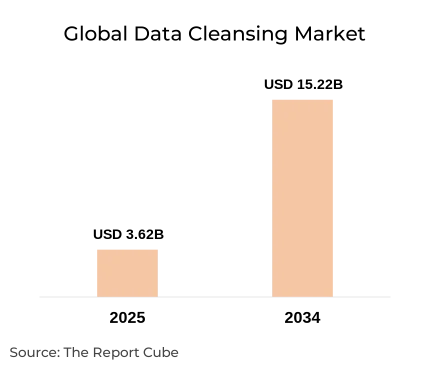
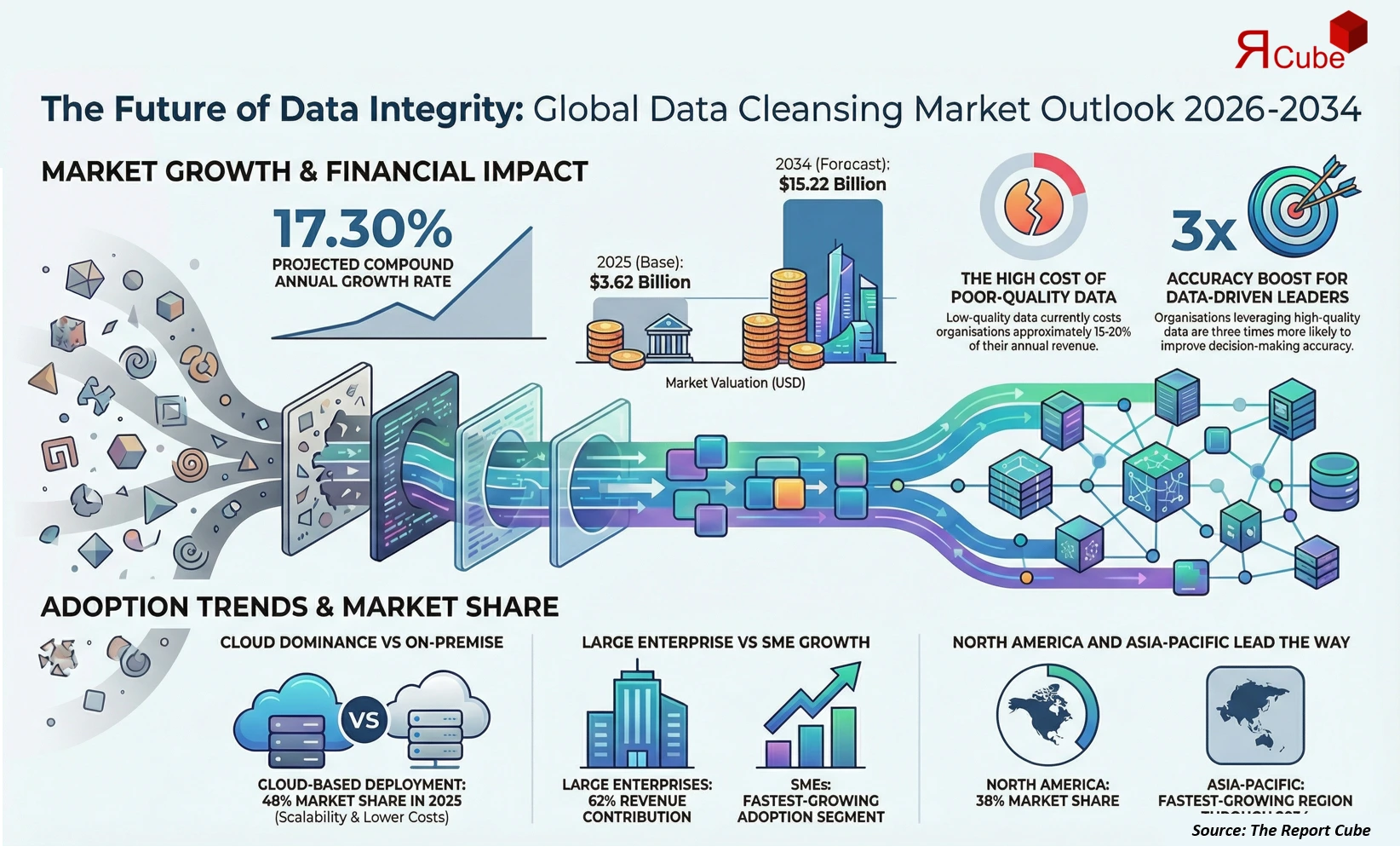
The Global Data Cleansing Market is anticipated to register a CAGR of 17.30% during 2026-2034. The market size was valued at USD 3.62 billion in 2025 and is projected to reach USD 15.22 billion by 2034. The market is experiencing rapid expansion as enterprises increasingly rely on data-driven decision-making, advanced analytics, and AI-enabled business processes.
Data quality has become a strategic priority across industries due to the rising volume, velocity, and variety of enterprise data. Studies indicate that poor-quality data costs organizations nearly 15-20% of annual revenue, accelerating the adoption of automated data cleansing platforms. The integration of cloud computing, big data analytics, and real-time processing tools has further strengthened demand for scalable and intelligent data cleansing solutions. Additionally, regulatory compliance requirements such as data accuracy, traceability, and governance have compelled enterprises to modernize their data management infrastructure.
The growing adoption of CRM, ERP, and business intelligence platforms has intensified the need for standardized, error-free datasets. As organizations expand omnichannel operations, inconsistencies across structured and unstructured datasets have increased, making data cleansing a foundational layer for digital transformation. With enterprises prioritizing operational efficiency, customer experience optimization, and AI-readiness, the Global Data Cleansing Market is expected to witness sustained, high-growth momentum through 2034.
Global Data Cleansing Market Recent Developments
- 2025: Informatica launched AI-powered data quality automation enhancements to improve real-time enterprise data accuracy.
- 2025: Microsoft expanded Azure Purview capabilities with advanced data cleansing and governance integrations.
Government Initiatives & Policies
- U.S. Federal Data Strategy: National initiative promoting data quality, standardization, and responsible data use across federal agencies.
- EU Digital Strategy & Data Governance Act: Regulatory framework emphasizing data accuracy, interoperability, and trust across digital ecosystems.
Global Data Cleansing Market Dynamics
Key Driver: Rising Dependence on Data-Driven Decision Making
The exponential growth of enterprise data volumes is the primary driver of the Global Data Cleansing Market. Organizations across BFSI, healthcare, retail, and IT sectors increasingly depend on analytics, AI, and machine learning models that require clean, standardized datasets. Research shows that organizations leveraging high-quality data are 3x more likely to achieve significant improvements in decision accuracy. As digital transformation initiatives scale, enterprises face challenges related to duplicate records, incomplete datasets, and inconsistent formats, directly impacting operational efficiency and customer insights.
Moreover, the adoption of cloud-native architectures and distributed data environments has increased data fragmentation. This has accelerated investments in automated data cleansing solutions capable of handling real-time data streams and multi-source integration. With enterprises seeking measurable ROI from analytics platforms, data cleansing has evolved from a backend IT function into a mission-critical business enabler, significantly driving market growth.
Book your FREE 30-minute expert consultation today
Contact UsIndustry Trends: AI-Driven and Cloud-Based Data Cleansing Solutions
Artificial intelligence and machine learning are reshaping the data cleansing landscape. Vendors are embedding AI-driven anomaly detection, pattern recognition, and predictive correction capabilities into their platforms. These technologies reduce manual intervention by over 40% while improving accuracy rates beyond traditional rule-based systems. Cloud-based deployment models are also gaining traction, accounting for a growing share of new implementations due to scalability, flexibility, and lower upfront costs.
Another prominent trend is the integration of data cleansing with data governance and master data management platforms. Organizations increasingly prefer unified solutions that address quality, compliance, lineage, and security within a single ecosystem. This convergence trend is enhancing vendor differentiation and increasing long-term platform adoption, particularly among large enterprises managing complex data environments.
Major Challenge: Complexity of Data Integration Across Heterogeneous Systems
Despite strong demand, the Global Data Cleansing Market faces challenges related to integration complexity. Enterprises operate across legacy systems, cloud platforms, third-party applications, and external data sources, making data harmonization difficult. The lack of standardized data formats across industries increases implementation timelines and costs, especially for large-scale deployments.
Additionally, organizations often underestimate the organizational change management required for successful data cleansing initiatives. Resistance from business units, skill gaps, and limited data literacy can hinder solution effectiveness. These challenges are particularly pronounced among SMEs, where budget constraints and limited technical expertise slow adoption rates.
Opportunity: Expansion of Data Cleansing in AI and Advanced Analytics Pipelines
The rapid adoption of AI, machine learning, and advanced analytics presents a significant growth opportunity for data cleansing providers. Clean training datasets are critical for improving AI model accuracy and reducing algorithmic bias. As enterprises deploy generative AI, predictive analytics, and real-time decision engines, demand for automated, scalable data cleansing solutions is accelerating.
Emerging use cases such as IoT analytics, fraud detection, and personalized customer engagement further amplify this opportunity. Vendors offering industry-specific data cleansing solutions and low-code automation capabilities are well-positioned to capture untapped demand, particularly in high-growth sectors such as healthcare, fintech, and e-commerce.
Global Data Cleansing Market Segment-wise Analysis
By Deployment Mode:
- Cloud-Based
- On-Premise
- Hybrid
- Managed Services
Cloud-based deployment dominates the Global Data Cleansing Market, accounting for approximately 48% market share in 2025. Organizations increasingly favor cloud solutions due to faster deployment, scalability, and lower infrastructure costs. Cloud platforms also enable seamless integration with analytics, AI, and business intelligence tools. On-premise solutions continue to hold relevance in highly regulated industries such as BFSI and government, where data sovereignty and security concerns remain critical.
By Organization Size:
- Large Enterprises
- Small and Medium Enterprises (SMEs)
- Startups
- Public Sector Organizations
Large enterprises lead adoption, contributing nearly 62% of total market revenue. Their complex, multi-source data environments necessitate advanced cleansing capabilities. However, SMEs represent the fastest-growing segment as affordable, cloud-based solutions reduce entry barriers. SMEs increasingly adopt data cleansing to improve CRM accuracy, marketing ROI, and operational efficiency.
Need insights for a specific region within this market?
Request Regional DataRegional Projection of Global Data Cleansing Industry
- North America
- Europe
- Asia Pacific
- Rest of the World
North America leads the Global Data Cleansing Market, holding approximately 38% market share in 2025. The region benefits from early technology adoption, strong presence of leading vendors, and high enterprise data maturity. The United States, in particular, drives demand due to widespread adoption of AI, cloud analytics, and regulatory compliance requirements.
Europe follows closely, supported by strict data governance regulations and digital transformation initiatives. Asia Pacific is expected to register the fastest CAGR through 2034, driven by rapid digitization, expanding e-commerce, and increasing investments in analytics across China, India, and Southeast Asia.
Why Choose This Report?
- Provides a comprehensive overview of the overall market analysis, encompassing key trends, consumer behavior analysis, and risk assessment to support strategic decision-making.
- Provides accurate, up-to-date insights into market size, segmentation, and emerging opportunities, helping to minimize risk & capitalizing on growth.
- Gives deep understanding of target audience preferences, investment habits, and communication channels for enhanced product development & marketing effectiveness.
- Delivers competitive analysis & benchmarking, uncovering the strengths & weaknesses of market competitors to guide strategies.
- Consolidate comprehensive market intelligence, reducing reasoning & streamlining research efforts.
- Facilitates customized market segmentation & risk mitigation strategies, fine-tuned to the business objectives.
- Aids in identifying both market challenges & untapped opportunities within the industry to drive long-term business growth.
- Provides valuable information based on actual customer data & search trends.
Table of Contents
- Introduction
- Objective of the Study
- Data Cleansing Definition
- Market Segmentation
- Study Variables
- Research Methodology
- Secondary Data Points
- Breakdown of Secondary Sources
- Primary Data Points
- Breakdown of Primary Interviews
- Secondary Data Points
- Executive Summary
- Market Dynamics
- Drivers
- Challenges
- Opportunity Assessment
- Recent Trends and Developments
- Regulatory and Policy Landscape
- Global Data Cleansing Market Overview (2020-2034)
- Market Size, By Value (USD Billion)
- Market Share, By Deployment Mode
- Cloud-Based
- On-Premise
- Market Share, By Organization Size
- Large Enterprises
- Small and Medium Enterprises (SMEs)
- Market Share, By Component
- Software
- Services
- Market Share, By Data Type
- Structured Data
- Semi-Structured Data
- Unstructured Data
- Market Share, By Application
- CRM Data Cleansing
- ERP Data Cleansing
- Big Data Analytics
- Business Intelligence
- Others
- Market Share, By End User
- Banking, Financial Services & Insurance (BFSI)
- Healthcare & Life Sciences
- Retail & eCommerce
- IT & Telecom
- Government & Public Sector
- Manufacturing
- Market Share, By Company
- Competition Characteristics
- Revenue Shares & Analysis
- Market Share, By Region
- North America Data Cleansing Market
- Market Size, By Value
- Market Share, By Component
- Market Share, By End User
- Europe Data Cleansing Market
- Market Size, By Value
- Market Share, By Component
- Market Share, By End User
- Asia Pacific Data Cleansing Market
- Market Size, By Value
- Market Share, By Component
- Market Share, By End User
- Middle East and Africa Data Cleansing Market
- Market Size, By Value
- Market Share, By Component
- Market Share, By End User
- South America Data Cleansing Market
- Market Size, By Value
- Market Share, By Component
- Market Share, By End User
- North America Data Cleansing Market
- Competitive Outlook and Company Profiles
- IBM
- Company Overview
- Data Cleansing Portfolio
- Strategic Alliances/Partnerships
- Recent Developments
- Oracle
- Company Overview
- Data Cleansing Solutions
- Strategic Alliances/Partnerships
- Recent Developments
- Microsoft
- Company Overview
- Data Quality & Cleansing Tools
- Strategic Alliances/Partnerships
- Recent Developments
- SAS Institute
- Company Overview
- Data Cleansing Portfolio
- Strategic Alliances/Partnerships
- Recent Developments
- Informatica
- Company Overview
- Data Cleansing Solutions
- Strategic Alliances/Partnerships
- Recent Developments
- Others
- Company Overview
- Business Segments
- Strategic Alliances/Partnerships
- Recent Developments
- IBM
- Contact Us / Disclaimer
Top Key Players & Market Share Outlook
-
IBM
-
Oracle
-
Microsoft
-
SAS Institute
-
Informatica
-
Others
Frequently Asked Questions






