




Build Your Custom Market Intelligence Report
Customize Your ReportGlobal Online Language Learning Market Insights & Analysis
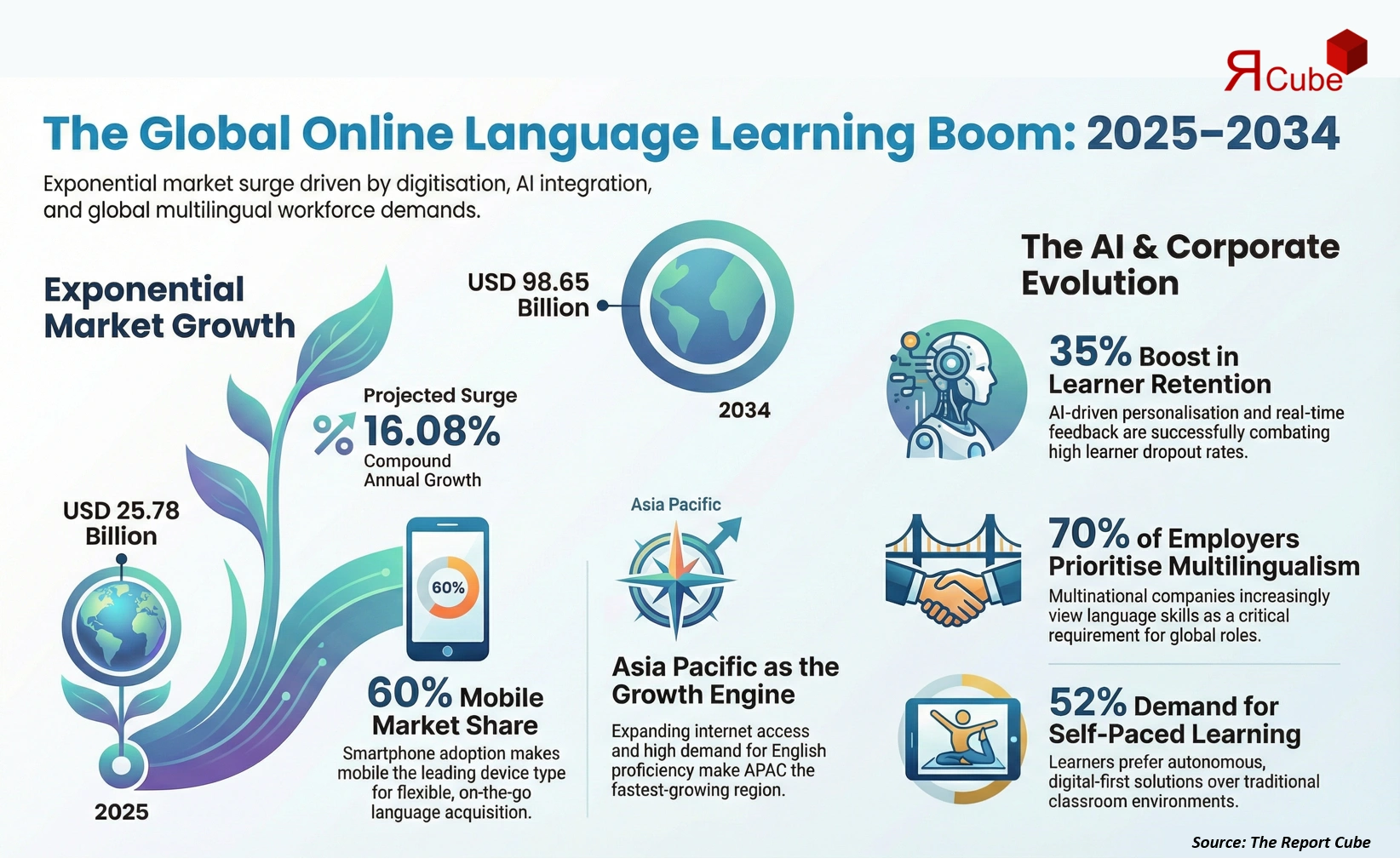
The Global Online Language Learning Market is anticipated to register a 16.08% CAGR during 2026-2034. The market size was valued at USD 25.78 billion in 2025 and is projected to reach USD 98.65 billion by 2034. The rapid digitalization of education, widespread smartphone adoption, and increasing globalization of workforces are accelerating demand for online language learning platforms. Learners across age groups are increasingly shifting from traditional classroom-based language education to flexible, digital-first solutions that offer personalization and accessibility.
Corporate demand for multilingual employees, rising international migration, and the growing influence of global content consumption are strengthening market fundamentals. Online platforms offer scalable, cost-effective, and interactive learning environments, making them suitable for individuals, enterprises, and educational institutions. The surge in remote work has further intensified the need for cross-border communication skills, particularly English, Mandarin, and Spanish.
Advancements in artificial intelligence, gamification, and adaptive learning technologies are reshaping learner engagement and outcomes. As digital education ecosystems mature and internet penetration deepens in emerging economies, the online language learning market is expected to experience sustained double-digit growth through 2034.
Global Online Language Learning Market Recent Developments
- 2025: Duolingo launched AI-powered conversation simulations to improve real-world language fluency.
- 2025: Babbel expanded its corporate language training platform with industry-specific modules.
Government Initiatives & Policies
- U.S. Digital Education Strategy: Promotes online learning platforms and lifelong skill development.
- EU Digital Education Action Plan: Supports digital learning tools and multilingual education access.
Global Online Language Learning Market Dynamics
Key Driver: Rising Global Demand for Multilingual Skills
The increasing need for multilingual communication across business, education, and social platforms is a primary driver of the online language learning market. Over 70% of multinational employers prioritize language skills when hiring for global roles, significantly boosting demand for scalable learning solutions. Online platforms enable learners to acquire language proficiency at their own pace, eliminating geographical and time constraints.
Additionally, the growth of international trade, tourism, and digital content consumption has expanded the learner base beyond students to working professionals and lifelong learners. English remains the dominant language, but demand for Mandarin, Spanish, and regional languages is rising rapidly, supporting long-term market expansion.
Book your FREE 30-minute expert consultation today
Contact UsIndustry Trends: AI-Driven Personalization and Gamified Learning
Artificial intelligence is transforming online language learning by enabling personalized learning paths, speech recognition, and real-time feedback. Platforms leveraging AI report up to 35% higher learner retention compared to static e-learning models. Gamification elements such as streaks, rewards, and competitive leaderboards are enhancing engagement and motivation.
Virtual reality and immersive simulations are also emerging, allowing learners to practice languages in real-life scenarios. These innovations are particularly effective in improving conversational fluency and pronunciation, making technology-driven platforms increasingly attractive.
Major Challenge: Learner Retention and Content Standardization
Despite strong demand, learner retention remains a challenge, with nearly 40% of users discontinuing courses within the first three months. Variations in content quality, lack of standardized curricula, and limited human interaction can impact learning outcomes. Platforms must continuously innovate to maintain engagement and ensure measurable proficiency improvements.
Opportunity: Corporate and Government Language Training Programs
Corporate upskilling initiatives and government-funded language programs present significant growth opportunities. Enterprises are investing heavily in language training to support global expansion, while governments are promoting digital language education for workforce competitiveness. Customized enterprise solutions and certification-based programs are expected to drive incremental revenue growth through 2034.
Global Online Language Learning Market Segment-wise Analysis
By Learning Mode:
- Self-Paced E-Learning
- Instructor-Led Online Training
- Blended Learning
Self-paced e-learning dominates the market, accounting for approximately 52% share in 2025. Its flexibility, affordability, and scalability make it the preferred choice for individual learners and corporates. AI-driven personalization further enhances its effectiveness.
By Device Type:
- Mobile
- Desktop/Laptop
- Tablet
Mobile devices lead with nearly 60% market share due to widespread smartphone adoption and app-based learning convenience. Mobile-first platforms enable microlearning and continuous engagement.
Need insights for a specific region within this market?
Request Regional DataRegional Projection of Global Online Language Learning Industry
- North America
- Europe
- Asia Pacific
- Middle East & Africa
North America leads the market with approximately 34% share in 2025, driven by strong corporate adoption and advanced digital infrastructure. Asia Pacific is the fastest-growing region, supported by expanding internet access, young demographics, and rising demand for English proficiency.
Why Choose This Report?
- Provides a comprehensive overview of the overall market analysis, encompassing key trends, consumer behavior analysis, and risk assessment to support strategic decision-making.
- Provides accurate, up-to-date insights into market size, segmentation, and emerging opportunities, helping to minimize risk & capitalizing on growth.
- Gives deep understanding of target audience preferences, investment habits, and communication channels for enhanced product development & marketing effectiveness.
- Delivers competitive analysis & benchmarking, uncovering the strengths & weaknesses of market competitors to guide strategies.
- Consolidate comprehensive market intelligence, reducing reasoning & streamlining research efforts.
- Facilitates customized market segmentation & risk mitigation strategies, fine-tuned to the business objectives.
- Aids in identifying both market challenges & untapped opportunities within the industry to drive long-term business growth.
- Provides valuable information based on actual customer data & search trends.
Table of Contents
- Introduction
- Objective of the Study
- Online Language Learning Definition
- Market Segmentation
- Study Variables
- Research Methodology
- Secondary Data Points
- Breakdown of Secondary Sources
- Primary Data Points
- Breakdown of Primary Interviews
- Secondary Data Points
- Executive Summary
- Market Dynamics
- Drivers
- Challenges
- Opportunity Assessment
- Recent Trends and Developments
- Regulatory and Policy Landscape
- Global Online Language Learning Market Overview (2020-2034)
- Market Size, By Value (USD Billion)
- Market Share, By Learning Mode
- Self-Paced E-Learning
- Instructor-Led Online Training
- Blended Learning
- Market Share, By Device Type
- Mobile
- Desktop/Laptop
- Tablet
- Market Share, By Language Type
- English
- Spanish
- Mandarin
- French
- German
- Other Languages
- Market Share, By End User
- Individuals
- Educational Institutions
- Corporate & Enterprises
- Government & Public Sector
- Market Share, By Technology
- Artificial Intelligence / ML
- Virtual Reality / AR
- Gamification
- Adaptive Learning
- Market Share, By Company
- Competition Characteristics
- Revenue Shares & Analysis
- Market Share, By Region
- North America Online Language Learning Market
- Market Size, By Value
- Market Share, By Learning Mode
- Market Share, By End User
- Europe Online Language Learning Market
- Market Size, By Value
- Market Share, By Learning Mode
- Market Share, By End User
- Asia Pacific Online Language Learning Market
- Market Size, By Value
- Market Share, By Learning Mode
- Market Share, By End User
- Middle East and Africa Online Language Learning Market
- Market Size, By Value
- Market Share, By Learning Mode
- Market Share, By End User
- South America Online Language Learning Market
- Market Size, By Value
- Market Share, By Learning Mode
- Market Share, By End User
- North America Online Language Learning Market
- Competitive Outlook and Company Profiles
- Duolingo
- Company Overview
- Online Language Learning Portfolio
- Strategic Alliances/Partnerships
- Recent Developments
- Babbel
- Company Overview
- Online Language Learning Portfolio
- Strategic Alliances/Partnerships
- Recent Developments
- Rosetta Stone (Proloquo Group)
- Company Overview
- Online Language Learning Portfolio
- Strategic Alliances/Partnerships
- Recent Developments
- Busuu
- Company Overview
- Online Language Learning Portfolio
- Strategic Alliances/Partnerships
- Recent Developments
- EF Education First
- Company Overview
- Online Language Learning Portfolio
- Strategic Alliances/Partnerships
- Recent Developments
- Others
- Company Overview
- Business Segments
- Strategic Alliances/Partnerships
- Recent Developments
- Duolingo
- Contact Us / Disclaimer
Top Key Players & Market Share Outlook
- Duolingo
- Babbel
- Rosetta Stone (Proloquo Group)
- Busuu
- EF Education First
- Others
Frequently Asked Questions