



Build Your Custom Market Intelligence Report
Customize Your ReportJapan AI Culinary Robots Market Key Highlights
By Type:
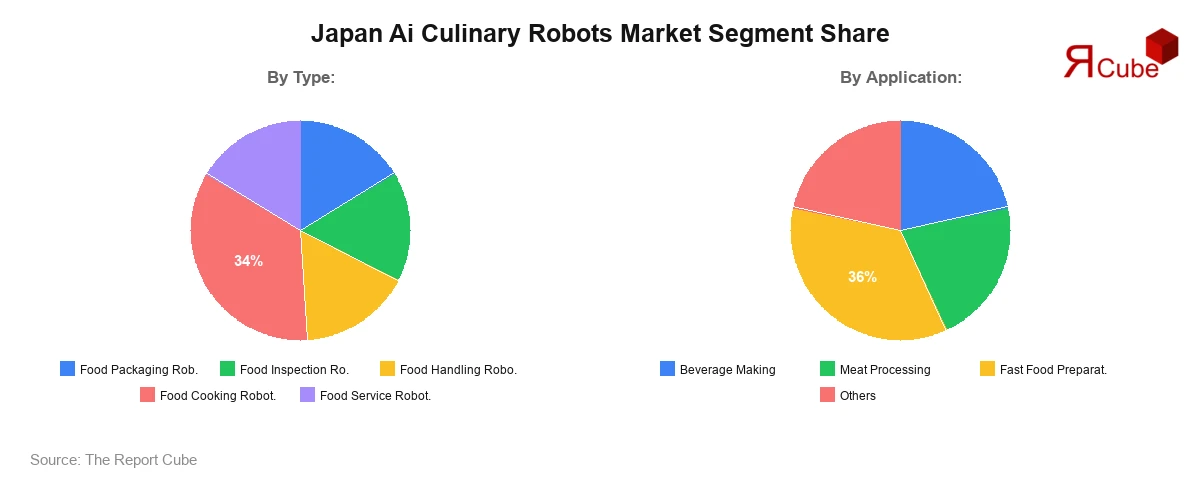
Food Cooking Robots segment leads the market with nearly 34% market share.
By Application:
Fast Food Preparation segment dominates the market with around 36% of revenue.
Regional Outlook:
Honshu region dominates the Japan AI Culinary Robots market with approximately 58% share.
Japan AI Culinary Robots Market Insights & Analysis
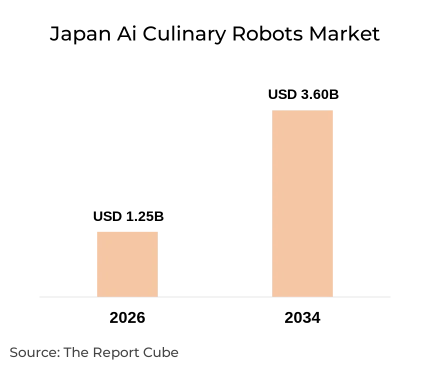
The Japan AI Culinary Robots Market is anticipated to register a CAGR of around 13.5% during the forecast period 2026-2034. The market size is valued at USD 1.25 billion in 2026 and is projected to reach USD 3.6 billion by 2034. The Japan AI Culinary Robots market size is expanding rapidly as automation becomes a core solution for labor shortages in the country’s foodservice sector. Japan’s aging population has led to a shrinking workforce, with over 29% of citizens aged above 65 in 2025, encouraging restaurants and food manufacturers to adopt robotic solutions for operational continuity.
Investments in robotics and artificial intelligence are accelerating innovation across commercial kitchens. In 2024, Japan allocated nearly USD 7.8 million toward AI-driven culinary automation, supporting startups and technology providers. Companies are introducing robots capable of multi-cuisine cooking, precision food handling, and real-time quality monitoring. These advancements enhance consistency and reduce food waste by up to 18% in high-volume kitchens. The integration of computer vision and machine learning enables robots to adjust cooking parameters dynamically, aligning with evolving consumer expectations for speed and quality. The Japan AI Culinary Robots market growth is also supported by rising demand from quick-service restaurants and smart vending ecosystems.
Japan AI Culinary Robots Market Dynamics
Key Driver: Rising Labor Shortages and Need for Operational Efficiency
The Japan AI Culinary Robots market is primarily driven by persistent labor shortages in the foodservice industry. By 2025, the hospitality sector faced a workforce gap exceeding 30%, pushing businesses to adopt automation. AI culinary robots help maintain service quality while reducing dependency on human labor. These robots can operate continuously, increasing productivity by nearly 25% in busy kitchens. Restaurants adopting robotic cooking systems report faster service times and improved order accuracy, directly enhancing customer satisfaction.
Additionally, operational efficiency has become a critical factor for profitability. AI-powered robots reduce ingredient wastage and optimize cooking cycles using data analytics. For example, automated frying and grilling systems can maintain precise temperatures, ensuring consistent output. This efficiency not only lowers operational costs but also improves scalability for food chains. As a result, the Japan AI Culinary Robots market growth is strongly linked to efficiency-driven adoption across commercial establishments.
Book your FREE 30-minute expert consultation today
Contact UsIndustry Trends: Integration of Smart Kitchens and AI-Driven Food Automation
A key trend shaping the Japan AI Culinary Robots market is the rise of fully automated smart kitchens. Restaurants are increasingly integrating robotics with IoT systems to create connected cooking environments. These systems allow real-time monitoring of food preparation, inventory, and equipment performance. By 2025, over 40% of large restaurant chains in Japan had initiated smart kitchen pilots, signaling a shift toward data-driven operations.
Another important trend is the use of AI for menu customization and predictive cooking. Robots equipped with machine learning algorithms can analyze customer preferences and adjust recipes accordingly. This level of personalization enhances customer experience while maintaining consistency. The adoption of robotic vending machines and automated beverage systems is also growing, particularly in urban areas. These trends are reshaping the Japan AI Culinary Robots market trends and strengthening its long-term value proposition.
Major Challenge: High Initial Investment and Integration Complexity
The high cost of deploying AI culinary robots remains a significant barrier for small and medium-sized businesses. Initial setup costs, including hardware, software, and integration, can exceed USD 100,000 per unit in advanced systems. This financial burden limits adoption among independent restaurants and smaller food outlets. Additionally, ongoing maintenance and software updates add to operational expenses.
Integration challenges further complicate adoption. Many existing kitchens are not designed for robotic systems, requiring structural modifications and workflow adjustments. Training staff to operate and maintain these systems also requires time and resources. These factors collectively slow down the adoption rate, particularly in traditional establishments, thereby impacting the overall Japan AI Culinary Robots market share in smaller segments.
Opportunity: Expansion of Robotic Solutions in Residential and Cloud Kitchens
The growing popularity of cloud kitchens and home automation presents a major opportunity for the Japan AI Culinary Robots market. Cloud kitchens are increasingly adopting robotic systems to streamline operations and handle high order volumes efficiently. These setups benefit from reduced labor costs and consistent food quality, making them ideal for AI integration.
In the residential segment, compact and user-friendly cooking robots are gaining traction among tech-savvy consumers. With urban lifestyles becoming busier, there is a rising demand for automated meal preparation solutions. Companies are developing affordable robotic appliances that cater to household needs. This expansion into new application areas is expected to significantly boost the Japan AI Culinary Robots market revenue in the coming years.
Japan AI Culinary Robots Market Segment-wise Analysis
By Type:
- Food Packaging Robots
- Food Inspection Robots
- Food Handling Robots
- Food Cooking Robots
- Food Service Robots
The food cooking robots segment holds the leading position, accounting for approximately 34% of the Japan AI Culinary Robots market share in 2026. These robots are widely used in quick-service restaurants and commercial kitchens where speed and consistency are essential. Their ability to perform complex cooking tasks such as frying, grilling, and assembling meals with precision makes them highly valuable. Adoption has increased significantly, particularly in urban regions, where high customer turnover demands efficient operations. Restaurants using cooking robots have reported up to 30% improvement in service speed and a reduction in food preparation errors.
Moreover, advancements in AI algorithms have enhanced the adaptability of cooking robots. They can now adjust cooking techniques based on ingredient variations and customer preferences. This capability improves food quality and customer satisfaction, further driving segment growth. The continuous development of multi-functional robots capable of handling multiple cooking processes is expected to strengthen this segment’s dominance in the Japan AI Culinary Robots market.
By Application:
- Beverage Making
- Meat Processing
- Fast Food Preparation
- Others
The fast food preparation segment dominates the market, contributing nearly 36% of total revenue. The demand for quick and consistent food service in urban areas has accelerated the adoption of AI culinary robots in this segment. Fast food chains are increasingly deploying robotic systems to handle repetitive tasks such as burger assembly, frying, and packaging. These systems improve efficiency and reduce waiting times, enhancing customer experience.
Additionally, the scalability of robotic solutions makes them ideal for fast food operations. Businesses can easily replicate automated systems across multiple outlets, ensuring uniform quality. The integration of AI-driven analytics allows restaurants to optimize menu offerings based on consumer demand patterns. This data-driven approach further supports the growth of the fast food preparation segment within the Japan AI Culinary Robots market.
Regional Projection of Japan AI Culinary Robots Industry
- Hokkaido
- Honshu
- Shikoku
- Kyushu
Honshu dominates the Japan AI Culinary Robots market, holding approximately 58% market share. The region includes major urban centers such as Tokyo and Osaka, which are hubs for technological innovation and high consumer demand. The concentration of restaurants, food chains, and technology companies in Honshu has accelerated the adoption of AI culinary robots. By 2025, over 60% of large-scale restaurant chains in this region had integrated some form of automation into their operations.
Furthermore, strong infrastructure and access to advanced technology providers support rapid deployment. Government-backed initiatives promoting robotics adoption in urban areas have also contributed to regional dominance. The presence of leading companies and research institutions fosters continuous innovation, ensuring sustained growth. As a result, Honshu remains the primary contributor to the Japan AI Culinary Robots market revenue.
Government Initiatives & Policies
- Japan Moonshot R&D Program: Government initiative supporting AI and robotics innovation for future industries including automated food systems.
- Society 5.0 Initiative: National strategy promoting AI-driven automation across industries, including foodservice and smart kitchens.
Japan AI Culinary Robots Industry Recent Developments
- 2025: TechMagic introduced its I-Robo cooking system, serving over 100,000 meals and winning CES Innovation Award, showcasing high-efficiency automated kitchen capabilities.
- 2025: Connected Robotics Inc expanded its robotic kitchen solutions across commercial chains, enhancing automation in food preparation and reducing labor dependency significantly.
Need insights for a specific region within this market?
Request Regional DataWhy Choose This Report?
- Provides a comprehensive overview of the overall market analysis, encompassing key trends, consumer behavior analysis, and risk assessment to support strategic decision-making.
- Provides accurate, up-to-date insights into market size, segmentation, and emerging opportunities, helping to minimize risk & capitalizing on growth.
- Gives deep understanding of target audience preferences, investment habits, and communication channels for enhanced product development & marketing effectiveness.
- Delivers competitive analysis & benchmarking, uncovering the strengths & weaknesses of market competitors to guide strategies.
- Consolidate comprehensive market intelligence, reducing reasoning & streamlining research efforts.
- Facilitates customized market segmentation & risk mitigation strategies, fine-tuned to the business objectives.
- Aids in identifying both market challenges & untapped opportunities within the industry to drive long-term business growth.
- Provides valuable information based on actual customer data & search trends.
Table of Contents
- Introduction
- Objective of the Study
- Product and Category Definition
- Market Segmentation
- Study Variables
- Research Methodology
- Secondary Data Points
- Breakdown of Secondary Sources
- Primary Data Points
- Breakdown of Primary Interviews
- Secondary Data Points
- Executive Summary
- Market Dynamics
- Drivers
- Challenges
- Opportunity Assessment
- Recent Trends and Developments
- Regulatory and Policy Landscape
- Japan AI Culinary Robots Market Overview (2021-2034)
- Market Size, By Value (USD Billion)
- Market Share, By Type
- Food Packaging Robots
- Food Inspection Robots
- Food Handling Robots
- Food Cooking Robots
- Food Service Robots
- Market Share, By Technology
- Machine Learning
- Computer Vision
- Data Analytics
- Others
- Market Share, By Application
- Beverage Making
- Meat Processing
- Fast Food Preparation
- Others
- Market Share, By End User
- Commercial
- Residential
- Market Share, By Region
- Hokkaido
- Honshu
- Shikoku
- Kyushu
- Market Share, By Company
- Revenue Shares and Analysis
- Competitive Landscape
- Hokkaido AI Culinary Robots Market
- Market Size, By Value (USD Billion/Million)
- Market Share, By Type
- Market Share, By Technology
- Market Share, By Application
- Market Share, By End User
- Honshu AI Culinary Robots Market
- Market Size, By Value (USD Billion/Million)
- Market Share, By Type
- Market Share, By Technology
- Market Share, By Application
- Market Share, By End User
- Shikoku AI Culinary Robots Market
- Market Size, By Value (USD Billion/Million)
- Market Share, By Type
- Market Share, By Technology
- Market Share, By Application
- Market Share, By End User
- Kyushu AI Culinary Robots Market
- Market Size, By Value (USD Billion/Million)
- Market Share, By Type
- Market Share, By Technology
- Market Share, By Application
- Market Share, By End User
- Competitive Outlook and Company Profiles
- Yaskawa Electric Corporation
- Company Overview
- Product Portfolio
- Strategic Alliances/Partnerships
- Recent Developments
- Fujitsu
- Company Overview
- Product Portfolio
- Strategic Alliances/Partnerships
- Recent Developments
- Connected Robotics Inc
- Company Overview
- Product Portfolio
- Strategic Alliances/Partnerships
- Recent Developments
- Uber Eats
- Company Overview
- Product Portfolio
- Strategic Alliances/Partnerships
- Recent Developments
- ZMP Inc
- Company Overview
- Product Portfolio
- Strategic Alliances/Partnerships
- Recent Developments
- Robot Chef Inc.
- Company Overview
- Product Portfolio
- Strategic Alliances/Partnerships
- Recent Developments
- Sony AI
- Company Overview
- Product Portfolio
- Strategic Alliances/Partnerships
- Recent Developments
- OryLab Inc
- Company Overview
- Product Portfolio
- Strategic Alliances/Partnerships
- Recent Developments
- TechMagic
- Company Overview
- Product Portfolio
- Strategic Alliances/Partnerships
- Recent Developments
- Mitsubishi Electric
- Company Overview
- Product Portfolio
- Strategic Alliances/Partnerships
- Recent Developments
- Others
- Yaskawa Electric Corporation
- Contact Us and Disclaimer
Top Key Players & Market Share Outlook
- Yaskawa Electric Corporation
- Fujitsu
- Connected Robotics Inc
- Uber Eats
- ZMP Inc
- Robot Chef Inc.
- Sony AI
- OryLab Inc
- TechMagic
- Mitsubishi Electric
Frequently Asked Questions






