



Build Your Custom Market Intelligence Report
Customize Your ReportJapan Commercial Insurance Market Insights & Analysis
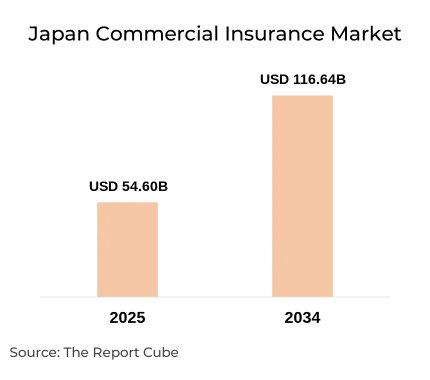
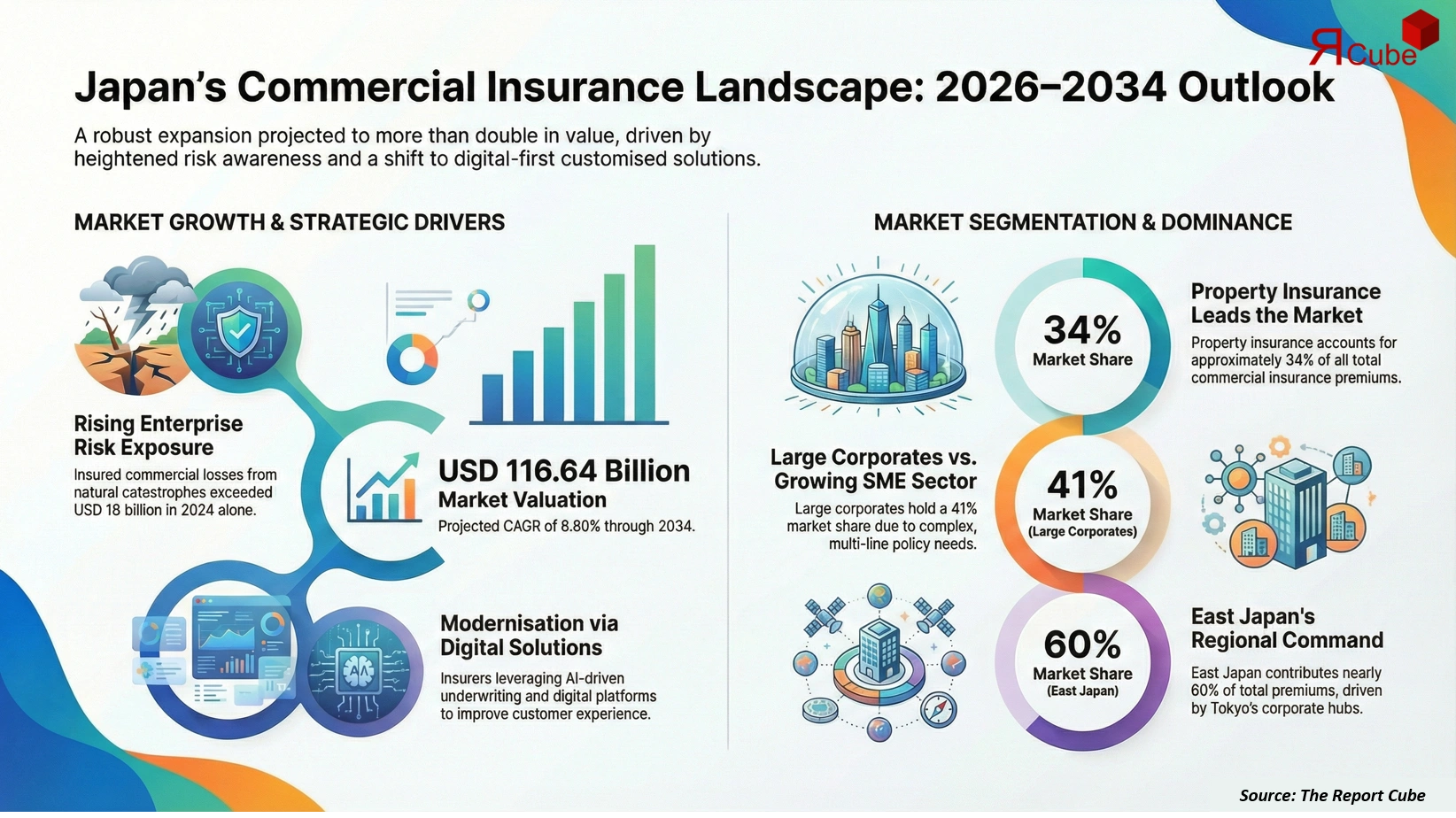
The Japan Commercial Insurance Market is anticipated to register a CAGR of 8.80% during the forecast period 2026-2034. The market size was valued at USD 54.6 billion in 2025 and is projected to reach USD 116.64 billion by 2034. This strong growth trajectory reflects rising risk awareness among businesses, increasing regulatory compliance requirements, and expanding coverage needs across diverse commercial sectors.
Japan’s highly developed economy, coupled with its exposure to natural disasters, cyber threats, and global supply chain risks, has significantly elevated the importance of comprehensive commercial insurance coverage. Enterprises are increasingly shifting from basic protection plans toward integrated insurance solutions covering property, liability, financial losses, and operational disruptions. This transition is particularly visible among export-oriented industries, manufacturing clusters, and service-based enterprises operating in digitally connected environments.
Moreover, structural changes such as an aging workforce, business consolidation, and overseas expansion of Japanese firms are influencing insurance demand patterns. Insurers are responding by enhancing underwriting sophistication, introducing customized products, and leveraging data analytics to improve risk pricing. As a result, the Japan Commercial Insurance Market continues to evolve as a critical pillar supporting business resilience and long-term economic stability.
Japan Commercial Insurance Market Recent Developments
- 2025: Tokio Marine expanded cyber and business interruption coverage tailored for mid-sized Japanese enterprises.
- 2025: Sompo Holdings launched parametric insurance solutions targeting climate-related commercial risks.
Government Initiatives & Policies
- Japan Financial Services Agency Insurance Reform Program: Strengthens transparency, solvency, and risk management standards.
- National Resilience Plan: Encourages disaster risk financing and insurance adoption among businesses.
Japan Commercial Insurance Market Dynamics
Key Driver: Rising Enterprise Risk Exposure Across Industries
The primary driver of the Japan Commercial Insurance Market is the rising exposure of enterprises to multifaceted risks. Japanese businesses face increasing threats from natural disasters such as earthquakes and typhoons, alongside cyberattacks, supply chain disruptions, and regulatory liabilities. In 2024 alone, insured commercial losses from natural catastrophes exceeded USD 18 billion, underscoring the need for robust coverage. As companies expand operations domestically and internationally, their risk profiles become more complex, driving demand for comprehensive insurance solutions. SMEs, in particular, are becoming more proactive in securing liability and property coverage to safeguard business continuity. This heightened risk awareness continues to push insurance penetration across sectors.
Book your FREE 30-minute expert consultation today
Contact UsIndustry Trends: Shift Toward Customized and Digital Insurance Solutions
A notable trend shaping the market is the shift toward customized and digitally enabled commercial insurance offerings. Insurers are increasingly leveraging advanced analytics, AI-driven underwriting, and digital distribution channels to deliver tailored products. Policyholders now expect flexible coverage structures aligned with specific industry risks, such as cyber liability for IT firms or marine insurance for export-driven manufacturers. Digital platforms are also simplifying policy management, claims processing, and renewals, improving customer experience. This trend not only enhances operational efficiency for insurers but also increases adoption rates among tech-savvy enterprises, reinforcing long-term market growth.
Major Challenge: Margin Pressure and Intensifying Competition
Despite strong growth prospects, margin pressure remains a key challenge in the Japan Commercial Insurance Market. Intense competition among established insurers and new digital entrants has led to pricing pressures, particularly in commoditized segments like motor and property insurance. Additionally, rising claim costs linked to natural disasters and litigation expenses are straining underwriting profitability. Maintaining adequate solvency while offering competitively priced products requires disciplined risk assessment and capital management. Smaller insurers, in particular, face challenges in balancing growth ambitions with profitability, potentially leading to market consolidation over the forecast period.
Opportunity: Expanding Coverage for SMEs and Emerging Risks
The expanding SME segment presents a significant opportunity for market participants. SMEs account for over 99% of businesses in Japan, yet insurance penetration remains uneven. Growing awareness of cyber risks, business interruption losses, and regulatory compliance is driving demand for affordable, bundled insurance solutions. Additionally, emerging risks related to ESG compliance, climate transition, and digital assets are creating new product avenues. Insurers that can design scalable, cost-effective offerings for SMEs while addressing emerging risk categories are well-positioned to capture incremental market share and sustain growth.
Japan Commercial Insurance Market Segment-wise Analysis
By Line of Business:
- Property Insurance
- Liability Insurance
- Motor Insurance
- Marine & Aviation
- Financial Lines
- Other Commercial
Property Insurance leads the market, accounting for approximately 34% of total commercial insurance premiums in 2025. This dominance is driven by Japan’s exposure to natural disasters and stringent asset protection requirements among corporates. Liability Insurance follows, supported by rising litigation risks and regulatory enforcement. Financial Lines, including directors’ and officers’ insurance, are witnessing faster growth due to corporate governance reforms. Marine & Aviation insurance remains vital for export-driven industries, while other commercial lines continue to expand through specialized coverage offerings.
By Customer Type:
- SMEs
- Large Corporates
- Public Sector
- Multinationals
Large Corporates dominate this segment with an estimated 41% market share, reflecting their complex risk profiles and higher coverage requirements. These organizations demand comprehensive, multi-line policies covering domestic and overseas operations. SMEs represent a rapidly growing segment as awareness and regulatory compliance increase. Multinationals rely on integrated global insurance programs, while the public sector focuses on infrastructure, liability, and disaster coverage. The diverse needs across customer types are driving insurers to adopt more segmented and client-centric strategies.
Regional Projection of Japan Commercial Insurance Industry
- East Japan
- West Japan
East Japan leads the Japan Commercial Insurance Market, contributing nearly 60% of total premiums. The region benefits from high economic concentration, including Tokyo’s financial and corporate hubs, dense industrial activity, and higher asset values. Businesses in East Japan exhibit greater insurance penetration due to elevated risk exposure and regulatory scrutiny. West Japan follows, supported by manufacturing clusters and port-based trade activities. While East Japan will continue to dominate, West Japan is expected to grow steadily as regional development initiatives and SME expansion increase insurance adoption.
Need insights for a specific region within this market?
Request Regional DataWhy Choose This Report?
- Provides a comprehensive overview of the overall market analysis, encompassing key trends, consumer behavior analysis, and risk assessment to support strategic decision-making.
- Provides accurate, up-to-date insights into market size, segmentation, and emerging opportunities, helping to minimize risk & capitalizing on growth.
- Gives deep understanding of target audience preferences, investment habits, and communication channels for enhanced product development & marketing effectiveness.
- Delivers competitive analysis & benchmarking, uncovering the strengths & weaknesses of market competitors to guide strategies.
- Consolidate comprehensive market intelligence, reducing reasoning & streamlining research efforts.
- Facilitates customized market segmentation & risk mitigation strategies, fine-tuned to the business objectives.
- Aids in identifying both market challenges & untapped opportunities within the industry to drive long-term business growth.
- Provides valuable information based on actual customer data & search trends.
Table of Contents
- Introduction
- Objective of the Study
- Product and Category Definition
- Market Segmentation
- Study Variables
- Research Methodology
- Secondary Data Points
- Breakdown of Secondary Sources
- Primary Data Points
- Breakdown of Primary Interviews
- Secondary Data Points
- Executive Summary
- Market Dynamics
- Drivers
- Challenges
- Opportunity Assessment
- Recent Trends and Developments
- Regulatory and Policy Landscape
- Japan Commercial Insurance Market Overview (2020-2034)
- Market Size, By Value (USD Billion)
- Market Share, By Line of Business
- Property Insurance
- Liability Insurance
- Motor Insurance
- Marine & Aviation
- Financial Lines
- Other Commercial
- Market Share, By Customer Type
- SMEs
- Large Corporates
- Public Sector
- Multinationals
- Market Share, By Distribution
- Agency Network
- Brokers
- Bancassurance
- Direct & Digital
- Market Share, By Risk Profile
- Standard Risks
- Catastrophe Risks
- Specialty Risks
- Cyber & Digital
- Market Share, By Region
- East
- West
- Market Share, By Company
- Competition Characteristics
- Revenue Shares & Analysis
- East Japan Commercial Insurance Market
- Market Size, By Value (USD Billion)
- Market Share, By Line of Business
- Market Share, By Customer Type
- Market Share, By Distribution
- Market Share, By Risk Profile
- West Japan Commercial Insurance Market
- Market Size, By Value (USD Billion)
- Market Share, By Line of Business
- Market Share, By Customer Type
- Market Share, By Distribution
- Market Share, By Risk Profile
- Competitive Outlook and Company Profiles
- Tokio Marine Holdings
- Company Overview
- Product Portfolio
- Strategic Alliances/Partnerships
- Recent Developments
- MS&AD Insurance Group
- Company Overview
- Product Portfolio
- Strategic Alliances/Partnerships
- Recent Developments
- Sompo Holdings
- Company Overview
- Product Portfolio
- Strategic Alliances/Partnerships
- Recent Developments
- Nippon Life Insurance
- Company Overview
- Product Portfolio
- Strategic Alliances/Partnerships
- Recent Developments
- Dai-ichi Life Holdings
- Company Overview
- Product Portfolio
- Strategic Alliances/Partnerships
- Recent Developments
- Japan Post Insurance
- Company Overview
- Product Portfolio
- Strategic Alliances/Partnerships
- Recent Developments
- Sumitomo Life Insurance
- Company Overview
- Product Portfolio
- Strategic Alliances/Partnerships
- Recent Developments
- Rakuten General Insurance
- Company Overview
- Product Portfolio
- Strategic Alliances/Partnerships
- Recent Developments
- Nisshin Fire & Marine
- Company Overview
- Product Portfolio
- Strategic Alliances/Partnerships
- Recent Developments
- Tokio Marine Nichido Fire
- Company Overview
- Product Portfolio
- Strategic Alliances/Partnerships
- Recent Developments
- Others
- Tokio Marine Holdings
- Contact Us and Disclaimer
Top Key Players & Market Share Outlook
- Tokio Marine Holdings
- MS&AD Insurance Group
- Sompo Holdings
- Nippon Life Insurance
- Dai-ichi Life Holdings
- Japan Post Insurance
- Sumitomo Life Insurance
- Rakuten General Insurance
- Nisshin Fire & Marine
- Tokio Marine Nichido Fire
- Others
Frequently Asked Questions






