



Build Your Custom Market Intelligence Report
Customize Your ReportUSA AI-Powered Cybersecurity Market Key Takeaways
- Market valued at USD 30.81 billion in 2026, reflecting accelerating enterprise AI security investments.
- Industry projected to reach USD 205.89 billion by 2034, expanding at a 26.80% CAGR.
- Machine learning dominates technology adoption due to superior threat detection performance.
- BFSI remains the leading end-use segment driven by fraud prevention and regulatory compliance.
- The West United States maintains regional leadership through major technology infrastructure and vendor concentration.
- Context-aware computing is emerging as the fastest-growing technology segment across enterprise deployments.
- Leading companies include CrowdStrike, Palo Alto Networks, SentinelOne, Microsoft, IBM, and Cisco Systems.
- Rising adversarial AI threats and federal cybersecurity mandates continue accelerating enterprise platform adoption.
USA AI-Powered Cybersecurity Market Insights & Analysis
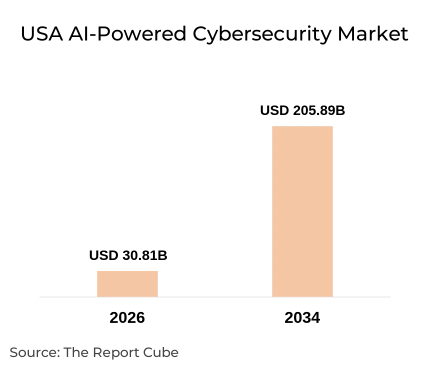
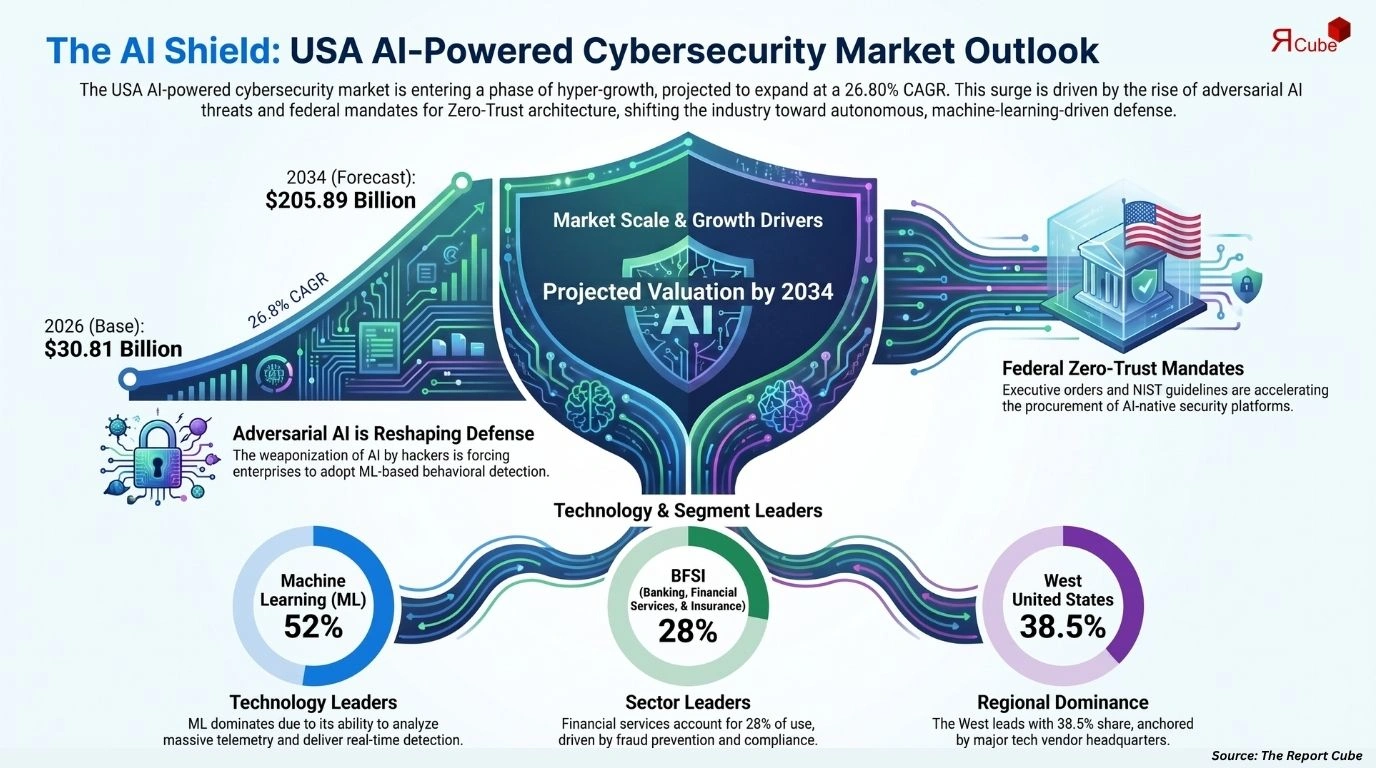
The USA AI-Powered Cybersecurity Market is anticipated to register a 26.80% CAGR during 2026–2034. The market size was valued at USD 30.81 billion in 2026 and is projected to reach USD 205.89 billion by 2034. The industry is benefiting from accelerating digital transformation across financial services, healthcare, and government sectors, combined with the rapid proliferation of AI-native attack vectors that demand more sophisticated, automated defense architectures. Federal agencies and enterprises are directing substantial investments toward cloud-native security operations, autonomous threat detection, and identity-centric zero-trust frameworks. In December 2025, the U.S. General Services Administration formalized a OneGov agreement with Palo Alto Networks to deliver AI security, cloud security, and zero-trust solutions across federal infrastructure at reduced costs, underscoring bipartisan commitment to AI-powered cyber resilience.
Demand is further reinforced by the compounding threat landscape, where adversarial AI enables cybercriminals to conduct large-scale, targeted campaigns with unprecedented speed and precision. The U.S. National Institute of Standards and Technology published preliminary guidance for an AI Cybersecurity Framework Profile in late 2025, establishing compliance anchors that are accelerating procurement of AI-driven security platforms across both public and private sectors. Investments in AI-powered endpoint detection and behavioral analytics platforms continue expanding as organizations prioritize real-time incident response, predictive threat intelligence, and security orchestration to protect increasingly distributed digital environments.
USA AI-Powered Cybersecurity Market Dynamics
Enterprise demand for AI-powered cybersecurity continues intensifying across U.S. financial institutions, defense agencies, healthcare networks, retail platforms, and telecommunications providers as attack surfaces expand with cloud migration, remote workforces, and agentic AI adoption. Escalating regulatory pressure, high-profile ransomware incidents targeting critical infrastructure, and rising investments in security operations centers are driving consolidation toward integrated AI security platforms that unify detection, investigation, and response across hybrid environments.
|
Factor |
Type |
Specific Impact on Market |
Magnitude |
|---|---|---|---|
|
Adversarial AI-powered cyberattacks |
Driver |
Accelerates demand for autonomous AI threat detection |
Very High |
|
Federal zero-trust mandate adoption |
Driver |
Boosts identity, access, and network security spending |
High |
|
Context-aware computing expansion |
Opportunity |
Enhances adaptive threat response across enterprise deployments |
High |
|
Agentic AI integration in SOC operations |
Trend |
Reduces mean detection and response times significantly |
Very High |
|
Regulatory compliance modernization |
Driver |
Increases procurement of AI-native compliance management platforms |
High |
Key Market Driver: Adversarial AI Escalating Enterprise Security Demand
The rapid weaponization of artificial intelligence by threat actors is fundamentally reshaping U.S. cybersecurity procurement priorities. AI-powered phishing campaigns, deepfake social engineering, and automated vulnerability exploitation are outpacing signature-based defenses, compelling enterprises to deploy machine learning models capable of behavioral anomaly detection and predictive threat containment. CrowdStrike's Falcon platform, powered by a threat graph processing trillions of weekly events, exemplifies the data-scale advantage now required for effective defense. Federal agencies and large financial institutions are increasing government defense cybersecurity investment strategies to counter state-sponsored AI-driven intrusions targeting critical infrastructure.
Major Industry Challenge: Legacy Security Architecture Integration Complexity
A significant portion of U.S. enterprises, particularly in manufacturing, healthcare, and government, continue operating fragmented security stacks built on siloed legacy tools that lack native AI capabilities. Integrating these environments with modern cloud-native AI security platforms requires substantial architectural re-engineering, increasing operational complexity and extending deployment timelines. The coexistence of on-premises infrastructure and multi-cloud workloads creates inconsistent telemetry coverage, weakening the data quality that AI threat models depend on. Organizations face pressure to modernize without disrupting critical operations, requiring phased migration strategies supported by managed security service providers.
Emerging Trend Shaping Outlook: Agentic AI Transforming Security Operations
Autonomous AI agents are rapidly redefining the security operations center by automating multi-step workflows across threat detection, triage, investigation, and remediation. CrowdStrike's Charlotte Agentic SOAR platform and SentinelOne's Purple AI investigation capabilities represent the leading commercial expressions of this shift, enabling analyst teams to manage exponentially larger threat volumes without proportional headcount increases. The expansion of agentic AI-driven managed detection and response services is enabling mid-market enterprises to access enterprise-grade automated security operations previously available only to the largest organizations, substantially broadening the addressable market across all U.S. regions.
Need Specific Data, Let’s Customize the Report for You
Request CustomizationUSA AI-Powered Cybersecurity Market Segment-wise Analysis
Enterprise security investments in the U.S. are increasingly concentrating across AI technology types and end-use verticals as organizations prioritize platforms that deliver measurable reductions in detection latency, false positive rates, and mean time to remediation. Advanced AI security platforms now protect financial institutions, federal agencies, healthcare networks, telecom infrastructure, and retail ecosystems from increasingly automated and targeted cyber threats.
By Technology Type
- Machine Learning
- Natural Language Processing
- Context-Aware Computing
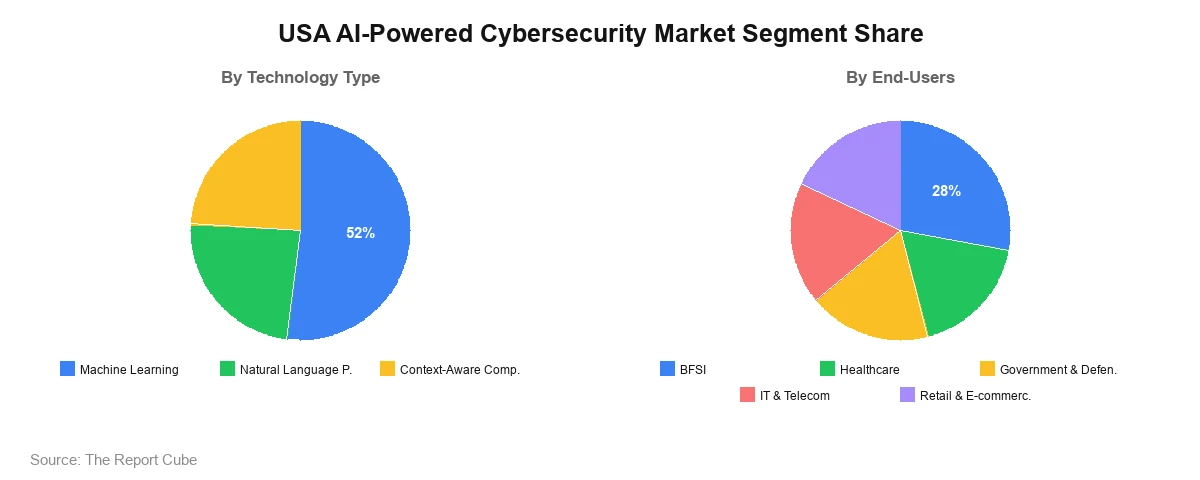
Machine learning dominates the technology segment with an estimated 52% market share, reflecting its proven capability to analyze massive volumes of security telemetry, identify attack patterns across endpoints and networks, and deliver real-time predictive threat detection with significantly lower false positive rates than rule-based systems. Enterprises across BFSI, government, and IT sectors are deploying supervised and unsupervised ML models for behavioral analytics, anomaly detection, and automated incident classification. The technology's ability to continuously retrain on evolving threat data gives it a durable advantage in environments where adversarial techniques shift rapidly.
Natural language processing is gaining strong traction for threat intelligence aggregation, dark web monitoring, and automated security report generation, enabling SOC analysts to process unstructured intelligence at scale. Context-aware computing represents the fastest-growing sub-segment, driven by expanding zero-trust architecture deployments that require adaptive, behavior-based access decisions rather than static policy enforcement. Platforms integrating context-aware identity and access management solutions are increasingly adopted by healthcare and financial services organizations requiring dynamic, risk-scored authentication across distributed user populations and hybrid cloud environments.
By End-Users
- BFSI
- Healthcare
- Government & Defense
- IT & Telecom
- Retail & E-commerce
BFSI leads the end-use segment with an estimated 28% market share, driven by the sector's acute exposure to financial fraud, insider threats, and regulatory mandates including SEC cybersecurity disclosure rules, PCI-DSS requirements, and evolving DORA compliance frameworks. U.S. banks, insurers, and asset managers are deploying AI-powered fraud detection, identity governance, and real-time transaction monitoring at enterprise scale. The density of high-value data assets and the direct financial consequences of breaches make BFSI the most aggressive adopter of AI-driven security operations platforms and threat intelligence services nationally.
Government and defense represents the second most significant end-use segment, supported by federal executive orders mandating zero-trust adoption across civilian agencies and the Department of Defense's continued investment in AI-enabled cyber command capabilities. Healthcare is emerging as the fastest-growing end-use vertical, accelerated by the increasing connectivity of medical devices, electronic health record proliferation, and proposed HIPAA Security Rule modernization requiring encryption and multifactor authentication. IT & Telecom providers and retail & e-commerce platforms are also expanding AI cybersecurity procurement in response to supply-chain attack risks and rising API-layer vulnerability exploitation across digital commerce infrastructure.
Regional Projection of USA AI-Powered Cybersecurity Market
The U.S. AI-powered cybersecurity market exhibits meaningful regional variation driven by differences in technology industry concentration, federal agency density, regulatory exposure, and the vertical composition of enterprise security buyers across each geography.
|
Region |
Estimated Market Share |
Key Growth Factors |
Consumer Trends |
|---|---|---|---|
|
West United States |
38.5% |
Major cybersecurity vendor HQs, deep cloud adoption, tech-sector density |
High adoption of AI-native platforms and cloud security |
|
Northeast United States |
27.4% |
BFSI concentration, regulatory pressure, financial services cybersecurity spend |
Strong demand for identity governance and fraud detection |
|
South United States |
20.1% |
Federal agency presence, defense contractor networks, expanding tech corridors |
Rising zero-trust and endpoint security procurement |
|
Midwest United States |
14.0% |
Manufacturing digitization, healthcare network expansion, critical infrastructure |
Increasing OT/IT convergence and managed security services |
- West United States: The West leads U.S. regional revenue with approximately 38.5% share, anchored by Silicon Valley's concentration of cybersecurity vendors including CrowdStrike, Palo Alto Networks, and SentinelOne, whose R&D investments and enterprise customer networks drive disproportionate regional spending and innovation velocity.
- Northeast United States: The Northeast commands strong AI cybersecurity demand driven by the region's dense BFSI sector, with New York financial institutions investing heavily in AI-powered fraud detection, regulatory compliance automation, and identity-centric security platforms that meet SEC and state-level data protection mandates.
- South United States: The South is expanding rapidly as federal agency concentrations in the Washington D.C. corridor, growing defense contractor ecosystems in Texas and Virginia, and emerging technology hubs in Atlanta and Austin drive sustained demand for zero-trust architectures and AI-native security operations across government and commercial clients.
- Midwest United States: The Midwest represents an important growth frontier where accelerating manufacturing sector digitization, hospital network expansion, and critical infrastructure modernization are generating increasing demand for operational technology cybersecurity platforms in industrial environments, particularly as IT/OT convergence creates new attack surface exposure in energy, utilities, and automotive production environments.
USA AI-Powered Cybersecurity Market: Recent Development (2025)
- CrowdStrike and IBM expanded their AI security partnership integrating Charlotte AI with IBM ATOM for agentic SOC.
- Palo Alto Networks completed acquisition of Protect AI, strengthening its Prisma AIRS comprehensive AI security platform.
- SentinelOne announced a multi-year collaboration with Google Cloud to develop advanced AI-powered cyber defense solutions.
- U.S. GSA finalized a OneGov agreement with Palo Alto Networks securing federal AI and zero-trust cybersecurity access.
USA AI-Powered Cybersecurity Market Future Outlook (2034)
The USA AI-Powered Cybersecurity Market is projected to expand at a 26.80% CAGR, reaching approximately USD 205.89 billion by 2034. The long-term growth trajectory will be sustained by deepening enterprise dependence on cloud-native security platforms, the continued proliferation of agentic AI threats requiring autonomous defense responses, and regulatory frameworks mandating measurable cyber resilience standards across financial services, healthcare, and critical infrastructure. Vendors capable of unifying network security, endpoint protection, identity governance, and cloud workload security under a single AI-driven platform will capture disproportionate market share as organizations prioritize vendor consolidation to reduce operational complexity and accelerate response times.
Technology advancement will be the central growth catalyst through 2034, with generative AI, federated learning, and explainable AI models enabling security platforms to deliver more precise threat attribution, faster vulnerability prioritization, and greater analyst trust in automated decision-making. The expansion of AI-powered cybersecurity solutions for retail and e-commerce platforms reflects a broader democratization of advanced security capabilities as AI reduces the expertise barrier for deployment. Federal investment in national AI cyber defense infrastructure, combined with private-sector M&A consolidation among platform vendors, will accelerate the market's maturation toward integrated, intelligence-driven security ecosystems that protect every layer of the U.S. digital economy.
USA AI-Powered Cybersecurity Market Report Coverage
|
Report Attribute |
Details |
|---|---|
|
Market Name |
USA AI-Powered Cybersecurity Market |
|
Market Size (2026) |
USD 30.81 Billion |
|
Market Size (2034) |
USD 205.89 Billion |
|
Forecast Period |
2026–2034 |
|
CAGR |
26.80% |
|
Base Year |
2026 |
|
Historical Years |
2021–2025 |
|
Forecast Years |
2026–2034 |
|
Segments Covered |
By Technology Type, By End-Users, By Security Type, By Deployment Mode¸ By Offering |
|
Regions Covered |
West United States, Northeast United States, South United States, Midwest United States |
|
Key Companies |
CrowdStrike, Palo Alto Networks, SentinelOne, Microsoft, IBM, Cisco Systems, Others |
|
Report Format |
PDF, Excel, PPT |
|
Customization |
Available as per client requirements |
Why Choose This Report?
- Comprehensive analysis of AI technology adoption across U.S. cybersecurity end-use verticals.
- Accurate market sizing with a reliable 26.80% CAGR forecast through 2034.
- Detailed segmentation covering machine learning, NLP, and context-aware computing dynamics.
- Regional insights across West, Northeast, South, and Midwest United States markets.
- Competitive profiling of CrowdStrike, Palo Alto Networks, SentinelOne, Microsoft, and IBM.
- Strategic analysis of agentic AI, zero-trust, and federal cybersecurity investment trends.
- Data-backed research aligned with NIST AI Cybersecurity Framework and regulatory mandates.
- Actionable intelligence supporting investment decisions and enterprise security planning.
Table of Contents
- Introduction
- Objective of the Study
- Product Definition
- Market Segmentation
- Study Variables
- Research Methodology
- Secondary Data Points
- Companies Interviewed
- Primary Data Points
- Breakdown of Primary Interviews
- Secondary Data Points
- Executive Summary
- Market Dynamics
- Drivers
- Challenges
- Opportunity Assessment
- Recent Trends and Developments
- Policy and Regulatory Landscape
- USA AI-Powered Cybersecurity Market Overview and Forecast Analysis (2021-2034)
- Market Size, By Value, By Growth Rate (CAGR/USD Billions)
- Demand – Supply Trends
- Market Share, By Offering
- Hardware
- Software
- Services
- Market Share, By Deployment Mode
- Cloud-based
- On-premise
- Market Share, By Security Type
- Network Security
- Endpoint Security
- Cloud Security
- Application Security
- Market Share, By Technology Type
- Machine Learning
- Natural Language Processing
- Context-Aware Computing
- Market Share, By End-Users
- BFSI
- Healthcare
- Government & Defense
- IT & Telecom
- Retail & E-commerce
- Market Share, By Region
- West United States
- Midwest United States
- Northeast United States
- South United States
- Market Share, By Competitors
- Competition Characteristics
- Revenue Shares
- Hardware USA AI-Powered Cybersecurity Market Overview, 2021-2034F
- By Value (USD Million)
- By Deployment Mode – Market Size & Forecast 2021-2034, USD Million
- Cloud-based
- On-premise
- Software USA AI-Powered Cybersecurity Market Overview, 2021-2034F
- By Value (USD Million)
- By Deployment Mode – Market Size & Forecast 2021-2034, USD Million
- Cloud-based
- On-premise
- Services USA AI-Powered Cybersecurity Market Overview, 2021-2034F
- By Value (USD Million)
- By Deployment Mode – Market Size & Forecast 2021-2034, USD Million
- Cloud-based
- On-premise
- Competitive Outlook (Company Profile – Partial List)
- CrowdStrike
- Company Overview
- Business Segments
- Strategic Alliances/Partnerships
- Recent Developments
- Palo Alto Networks
- Company Overview
- Business Segments
- Strategic Alliances/Partnerships
- Recent Developments
- SentinelOne
- Company Overview
- Business Segments
- Strategic Alliances/Partnerships
- Recent Developments
- Microsoft
- Company Overview
- Business Segments
- Strategic Alliances/Partnerships
- Recent Developments
- IBM
- Company Overview
- Business Segments
- Strategic Alliances/Partnerships
- Recent Developments
- Cisco Systems
- Company Overview
- Business Segments
- Strategic Alliances/Partnerships
- Recent Developments
- Others
- CrowdStrike
- Contact Us & Disclaimer
Top Key Players & Market Share Outlook
- CrowdStrike
- Palo Alto Networks
- SentinelOne
- Microsoft
- IBM
- Cisco Systems
- Others
Frequently Asked Questions






