



Build Your Custom Market Intelligence Report
Customize Your ReportUS Air Brake System Market Insights & Analysis
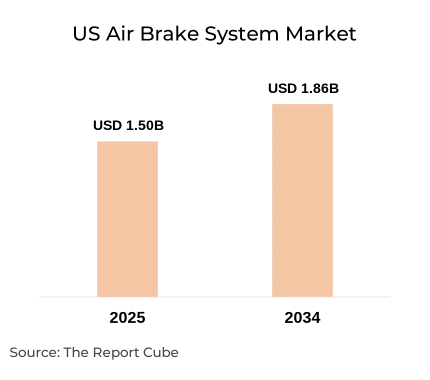
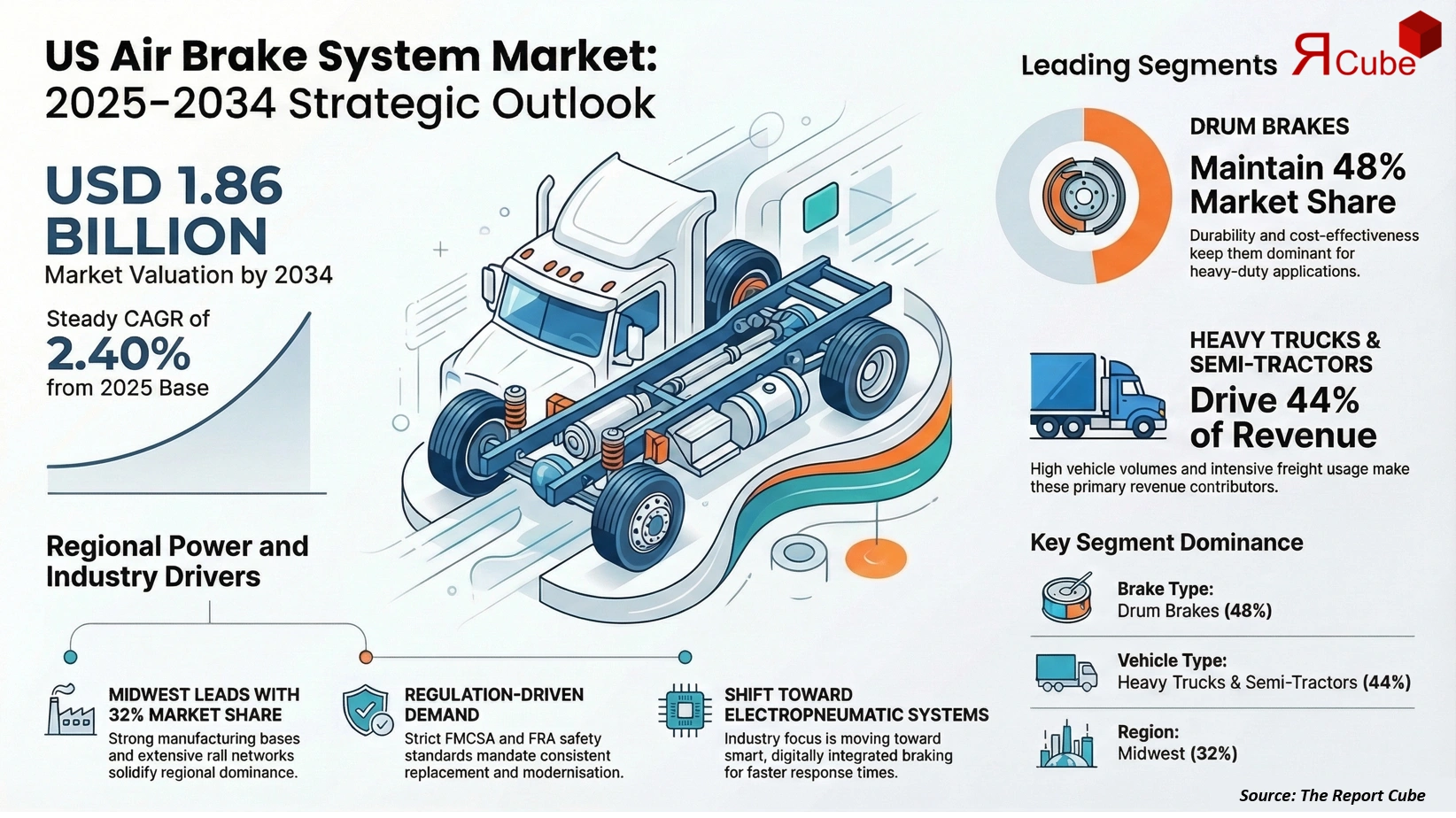
The US Air Brake System Market is anticipated to register a CAGR of 2.40% during the forecast period 2026-2034. The market size was valued at USD 1.5 billion and is projected to reach USD 1.86 billion by 2034. This steady growth reflects the mature nature of the U.S. commercial vehicle and rail transportation ecosystem, where safety compliance, fleet replacement cycles, and freight activity continue to drive consistent demand for advanced braking solutions.
The market is strongly supported by the extensive presence of heavy-duty trucks, buses, and rail networks across the country. Increasing freight volumes, driven by domestic manufacturing, construction activity, and e-commerce logistics, have reinforced the importance of reliable braking systems. Air brake systems remain the preferred choice for heavy vehicles due to their superior stopping power, durability, and safety under high-load conditions. In parallel, regulatory enforcement by transportation authorities continues to mandate stringent braking performance standards, ensuring recurring demand from both OEM and aftermarket channels.
Furthermore, technological advancements such as electropneumatic braking, predictive maintenance integration, and electronic stability enhancements are reshaping product offerings. Manufacturers are focusing on improving response time, reducing stopping distances, and enhancing system diagnostics. These developments, combined with ongoing investments in rail freight modernization and public transportation infrastructure, position the US Air Brake System Market for sustained, regulation-driven growth throughout the forecast period.
US Air Brake System Market Recent Developments
- 2025: Wabtec expanded advanced braking solutions for North American freight rail fleets.
- 2025: Knorr-Bremse introduced enhanced electropneumatic brake systems for heavy-duty trucks.
Government Initiatives & Policies
- FMCSA Commercial Vehicle Safety Regulations: Enforces mandatory braking performance and inspection standards.
- Federal Railroad Administration Safety Program: Supports modernization of rail braking and safety systems.
US Air Brake System Market Dynamics
Key Driver: Stringent Safety Regulations Across Commercial Vehicles and Rail
Stringent safety regulations remain the primary driver of the US Air Brake System Market. Federal and state transportation authorities mandate strict braking performance, inspection, and maintenance standards for heavy-duty trucks, buses, and rail vehicles. These regulations ensure consistent replacement and upgrading of braking components across fleets. With over 14 million commercial trucks operating nationwide, even marginal regulatory updates create substantial demand for compliant air brake systems. Rail safety oversight further reinforces this trend, as freight and passenger rail operators must meet federally enforced braking reliability standards. As compliance requirements evolve, fleet operators increasingly invest in advanced air brake technologies to minimize downtime, reduce accident risks, and avoid regulatory penalties, sustaining long-term market demand.
Book your FREE 30-minute expert consultation today
Contact UsIndustry Trends: Shift Toward Electropneumatic and Digitally Integrated Braking Systems
An important trend in the market is the gradual shift toward electropneumatic and electronically assisted air brake systems. These solutions offer faster response times, improved braking consistency, and enhanced integration with vehicle safety electronics. Fleet operators are adopting systems that support real-time diagnostics, predictive maintenance, and remote monitoring to improve uptime and reduce total cost of ownership. In the rail segment, electronically controlled pneumatic brakes are gaining traction due to their ability to shorten stopping distances and improve train handling. This trend aligns with broader digital transformation initiatives across the transportation sector, encouraging manufacturers to focus on smart braking solutions rather than purely mechanical systems.
Major Challenge: High Maintenance Costs and System Complexity
Despite their advantages, air brake systems present challenges related to maintenance complexity and lifecycle costs. These systems require regular inspections, skilled technicians, and periodic replacement of components such as compressors, valves, and hoses. For smaller fleet operators, maintenance expenses can strain operating budgets, particularly when managing aging vehicles. In rail applications, system downtime due to brake maintenance can disrupt schedules and increase operational costs. Additionally, the integration of electronic components adds complexity, requiring specialized diagnostic tools and training. These factors may limit rapid adoption of advanced systems among cost-sensitive operators, slightly restraining market growth.
Opportunity: Fleet Modernization and Infrastructure Investment
Ongoing fleet modernization initiatives present a significant opportunity for the US Air Brake System Market. Aging commercial vehicle and rail fleets are gradually being replaced or refurbished to improve safety, fuel efficiency, and regulatory compliance. Public investments in transportation infrastructure and rail freight capacity expansion further support this trend. As new vehicles enter service, OEM demand for modern air brake systems increases. Additionally, aftermarket opportunities remain strong, as operators seek upgraded braking solutions to extend vehicle life. These modernization efforts create long-term growth potential for manufacturers offering reliable, regulation-compliant, and digitally enabled braking systems.
US Air Brake System Market Segment-wise Analysis
By Brake Type:
- Drum Brakes
- Disc Brakes
- Electropneumatic
Drum brakes continue to dominate the US Air Brake System Market, accounting for approximately 48% of total demand due to their durability and cost-effectiveness in heavy-duty applications. Disc brakes are gaining adoption, particularly in buses and premium truck segments, driven by better heat dissipation and shorter stopping distances. Meanwhile, electropneumatic brakes represent the fastest-growing sub-segment, supported by regulatory focus on safety and operational efficiency. Their growing market share reflects increasing adoption in rail and advanced commercial vehicles, where precise braking control and reduced response time are critical.
By Vehicle Type:
- Rigid Trucks
- Heavy Trucks
- Semi-Tractors
- Buses
- Rail Freight
- Rail Passenger
Heavy trucks and semi-tractors collectively lead the market, contributing nearly 44% of total revenue. This dominance is driven by high vehicle volumes and intensive usage in freight transportation. Rail freight follows, supported by steady cargo movement and infrastructure upgrades. Buses and rail passenger vehicles represent stable demand segments, influenced by public transportation investments and urban mobility initiatives. The diverse application base ensures balanced demand across road and rail transportation, reinforcing market stability.
Regional Projection of US Air Brake System Industry
- East
- West
- Midwest
- South
The Midwest leads the US Air Brake System Market, accounting for approximately 32% market share. This leadership is attributed to the region’s strong manufacturing base, high concentration of freight corridors, and extensive rail networks. The South follows closely, supported by growing logistics hubs and expanding construction activity. The East and West regions maintain steady demand driven by public transportation systems, port activities, and urban transit networks. The Midwest is expected to retain its dominance throughout the forecast period due to sustained freight movement and industrial output.
Need insights for a specific region within this market?
Request Regional DataWhy Choose This Report?
- Provides a comprehensive overview of the overall market analysis, encompassing key trends, consumer behavior analysis, and risk assessment to support strategic decision-making.
- Provides accurate, up-to-date insights into market size, segmentation, and emerging opportunities, helping to minimize risk & capitalizing on growth.
- Gives deep understanding of target audience preferences, investment habits, and communication channels for enhanced product development & marketing effectiveness.
- Delivers competitive analysis & benchmarking, uncovering the strengths & weaknesses of market competitors to guide strategies.
- Consolidate comprehensive market intelligence, reducing reasoning & streamlining research efforts.
- Facilitates customized market segmentation & risk mitigation strategies, fine-tuned to the business objectives.
- Aids in identifying both market challenges & untapped opportunities within the industry to drive long-term business growth.
- Provides valuable information based on actual customer data & search trends.
Table of Contents
- Introduction
- Objective of the Study
- Product and Category Definition
- Market Segmentation
- Study Variables
- Research Methodology
- Secondary Data Points
- Breakdown of Secondary Sources
- Primary Data Points
- Breakdown of Primary Interviews
- Secondary Data Points
- Executive Summary
- Market Dynamics
- Drivers
- Challenges
- Opportunity Assessment
- Recent Trends and Developments
- Regulatory and Policy Landscape
- US Air Brake System Market Overview (2020-2034)
- Market Size, By Value (USD Billion)
- Market Share, By Brake Type
- Drum Brakes
- Disc Brakes
- Electropneumatic
- Market Share, By Vehicle Type
- Rigid Trucks
- Heavy Trucks
- Semi‑Tractors
- Buses
- Rail Freight
- Rail Passenger
- Market Share, By Component
- Compressor
- Valves
- Storage Tank
- Brake Chamber
- Slack Adjuster
- ECU & Sensors
- Market Share, By End Use
- OEM
- Aftermarket
- Market Share, By Region
- East
- West
- Midwest
- South
- Market Share, By Company
- Revenue Shares & Analysis
- Competitive Landscape
- East Air Brake System Market
- Market Size, By Value (USD Billion)
- Market Share, By Brake Type
- Market Share, By Vehicle Type
- Market Share, By Component
- Market Share, By End Use
- West Air Brake System Market
- Market Size, By Value (USD Billion)
- Market Share, By Brake Type
- Market Share, By Vehicle Type
- Market Share, By Component
- Market Share, By End Use
- Midwest Air Brake System Market
- Market Size, By Value (USD Billion)
- Market Share, By Brake Type
- Market Share, By Vehicle Type
- Market Share, By Component
- Market Share, By End Use
- South Air Brake System Market
- Market Size, By Value (USD Billion)
- Market Share, By Brake Type
- Market Share, By Vehicle Type
- Market Share, By Component
- Market Share, By End Use
- Competitive Outlook and Company Profiles
- Knorr‑Bremse AG
- Company Overview
- Product Portfolio
- Strategic Alliances/Partnerships
- Recent Developments
- Wabtec Corporation
- Company Overview
- Product Portfolio
- Strategic Alliances/Partnerships
- Recent Developments
- ZF Friedrichshafen AG
- Company Overview
- Product Portfolio
- Strategic Alliances/Partnerships
- Recent Developments
- Haldex AB
- Company Overview
- Product Portfolio
- Strategic Alliances/Partnerships
- Recent Developments
- Cummins (Meritor)
- Company Overview
- Product Portfolio
- Strategic Alliances/Partnerships
- Recent Developments
- Bendix CVS LLC
- Company Overview
- Product Portfolio
- Strategic Alliances/Partnerships
- Recent Developments
- Nabtesco Corporation
- Company Overview
- Product Portfolio
- Strategic Alliances/Partnerships
- Recent Developments
- TSE Brakes Inc.
- Company Overview
- Product Portfolio
- Strategic Alliances/Partnerships
- Recent Developments
- SORL Auto Parts Inc.
- Company Overview
- Product Portfolio
- Strategic Alliances/Partnerships
- Recent Developments
- Brakes India Ltd.
- Company Overview
- Product Portfolio
- Strategic Alliances/Partnerships
- Recent Developments
- Others
- Knorr‑Bremse AG
- Market Share, By Company
- Competition Characteristics
- Revenue Shares & Analysis
- Contact Us and Disclaimer
Top Key Players & Market Share Outlook
- Knorr‑Bremse AG
- Wabtec Corporation
- ZF Friedrichshafen AG
- Haldex AB
- Cummins (Meritor)
- Bendix CVS LLC
- Nabtesco Corporation
- TSE Brakes Inc.
- SORL Auto Parts Inc.
- Brakes India Ltd.
- Others
Frequently Asked Questions






