



Build Your Custom Market Intelligence Report
Customize Your ReportNorth America Air Conditioners Market Key Highlights
By Product Type:
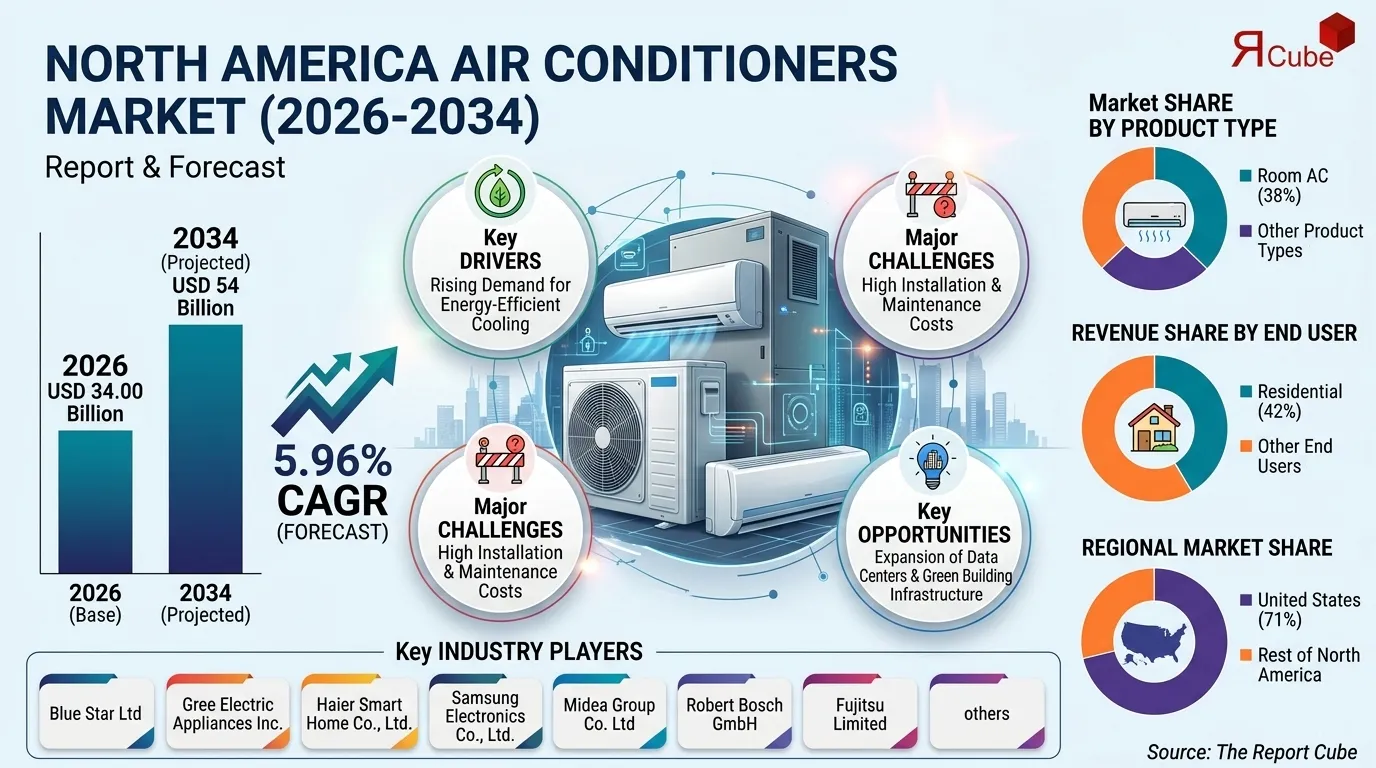
Room Air Conditioners segment leads the market with 38% share.
By End User:
Residential segment dominates the market with 42% of revenue.
Regional Outlook:
United States region dominates the North America Air Conditioners market with 71% share.
North America Air Conditioners Market Insights & Analysis
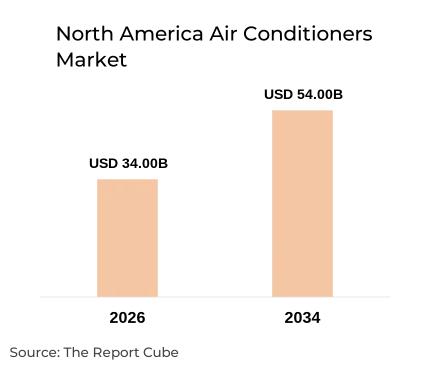
The North America Air Conditioners Market is anticipated to register a CAGR of around 5.96% during the forecast period 2026-2034. The market size is valued at USD 34.00 billion in 2026 and is projected to reach USD 54 billion by 2034. The market shows steady expansion driven by rising cooling demand linked to temperature fluctuations and urban infrastructure upgrades. Increasing construction of residential complexes and commercial buildings has strengthened installation rates across the United States and Canada. Consumer preference is shifting toward energy-efficient systems, supported by strict energy standards and rebate programs. This shift has encouraged manufacturers to focus on inverter technology and eco-friendly refrigerants, improving performance and reducing operational costs.
Investment activity is growing across smart HVAC solutions, with companies integrating IoT-based monitoring and automation features. Data centers and healthcare facilities are accelerating demand for precision cooling systems, creating a stable revenue stream for advanced air conditioning technologies. Government incentives promoting green buildings and energy conservation are shaping purchasing decisions. Major companies are expanding manufacturing and distribution networks within North America, improving supply chain efficiency and reducing dependency on imports, which further supports market size expansion and long-term demand stability.
North America Air Conditioners Market Impact Analysis
| Factor | Type | Specific Impact on Market | Magnitude | Business Implication |
|---|---|---|---|---|
| Steady Growth in AC Systems Market Size | Market | Moderate CAGR with expanding residential and commercial base | Medium | Prioritise share gain and portfolio breadth over deep discounting |
| Rising Temperatures and Extreme Heat Events | Environmental | More cooling-degree days lift baseline and peak AC demand | High | Align inventory, service capacity and promo bursts to heat waves |
| Replacement Demand from Aging Installed Base | Market | Large stock of older rooftop and split units due for upgrade | High | Design trade-in, retrofit and replacement-focused sales programs |
| Strict Energy Efficiency and SEER2 Regulations | Regulatory | Higher minimum standards push shift to efficient HVAC systems | High | Reengineer product lines and market compliance as value driver |
| Incentives for Heat Pumps and Low-Carbon Systems | Regulatory | Tax credits and rebates accelerate heat pump adoption curve | Medium | Expand qualifying SKUs and work with installers to push uptake |
| Adoption of Smart, Connected and IoT-Ready AC Units | Technological | Smart thermostats and apps reshape expectations on control | Medium | Bundle connectivity, partner with platforms and upsell services |
| Presence of Strong Incumbent HVAC Manufacturers | Competitive | Carrier, Trane, Lennox and others defend share aggressively | High | Target niches, regional gaps and service-led differentiation |
| Growth in Residential Smart-Home Construction | Market | New builds increasingly specify efficient, integrated systems | Medium | Forge builder alliances and offer pre-configured HVAC bundles |
| Commercial and Data-Centre Cooling Requirements | Market | Rising capacity additions sustain higher-value HVAC demand | Medium | Develop project sales teams and tailored commercial solutions |
| High Upfront System Costs and Price Sensitivity | Consumer | Sticker shock slows adoption despite lifecycle savings | Medium | Promote financing, TCO tools and phased upgrade offerings |
North America Air Conditioners Market Dynamics
Key Driver: Rising demand for energy-efficient cooling systems across residential and commercial sectors
Energy efficiency remains a central factor influencing the North America Air Conditioners Market size and demand. Consumers are increasingly aware of electricity consumption and long-term operating costs, which drives adoption of high-efficiency units such as inverter-based systems. Regulatory bodies across the region have introduced strict energy performance standards, pushing manufacturers to innovate and align with sustainability targets. This trend directly supports the expansion of energy-efficient product categories.
Urban population growth and higher disposable income have increased household appliance adoption rates. Residential buyers are upgrading older systems to meet new energy codes, while commercial spaces are investing in advanced cooling solutions to improve operational efficiency. Government rebate programs and tax incentives further encourage replacement cycles, strengthening market share across premium product segments.
Book your FREE 30-minute expert consultation today
Contact UsIndustry Trends: Integration of smart technologies and environmentally friendly refrigerants
Smart air conditioning systems are gaining traction as consumers demand convenience and remote control capabilities. Integration with mobile applications and home automation platforms allows users to monitor energy consumption and optimize cooling performance. This trend supports premium product demand and enhances user experience, contributing to higher average selling prices in the North America Air Conditioners Market.
Manufacturers are focusing on eco-friendly refrigerants such as R32 and R410A alternatives to meet environmental regulations. These refrigerants reduce carbon emissions and improve system efficiency. Industry participants are investing in research to develop sustainable cooling technologies that align with climate goals. This shift not only improves product appeal but also strengthens brand positioning in a competitive environment.
Major Challenge: High installation and maintenance costs limiting widespread adoption
Initial installation costs for advanced air conditioning systems remain a barrier for many consumers, particularly in small residential and mid-sized commercial segments. Systems such as VRF and ducted solutions require significant upfront investment, which can delay purchasing decisions. This factor affects market penetration in price-sensitive segments, slowing overall demand growth.
Maintenance expenses and technical complexity further impact adoption rates. Skilled technicians are required for installation and servicing, increasing operational costs for end users. Small businesses often opt for lower-cost alternatives, limiting the expansion of premium product categories. Addressing cost concerns through financing options and simplified system designs is critical for sustained market growth.
Opportunity: Expansion of data centers and green building infrastructure
The rapid expansion of data centers across North America presents a strong opportunity for the air conditioners market. These facilities require consistent and efficient cooling systems to maintain optimal performance. Demand for precision cooling units is increasing as digital infrastructure grows, creating new revenue streams for manufacturers.
Green building initiatives and sustainable construction practices are driving demand for advanced HVAC systems. Builders are incorporating energy-efficient air conditioning solutions to meet certification standards such as LEED. This trend encourages adoption of smart and environmentally friendly systems, supporting long-term market growth and innovation across multiple segments.
North America Air Conditioners Market Segment-wise Analysis
By Product Type:
- Chillers
- Room Air Conditioners
- Cassette Air Conditioners
- Packaged Air Conditioners
- Ducted Split Systems
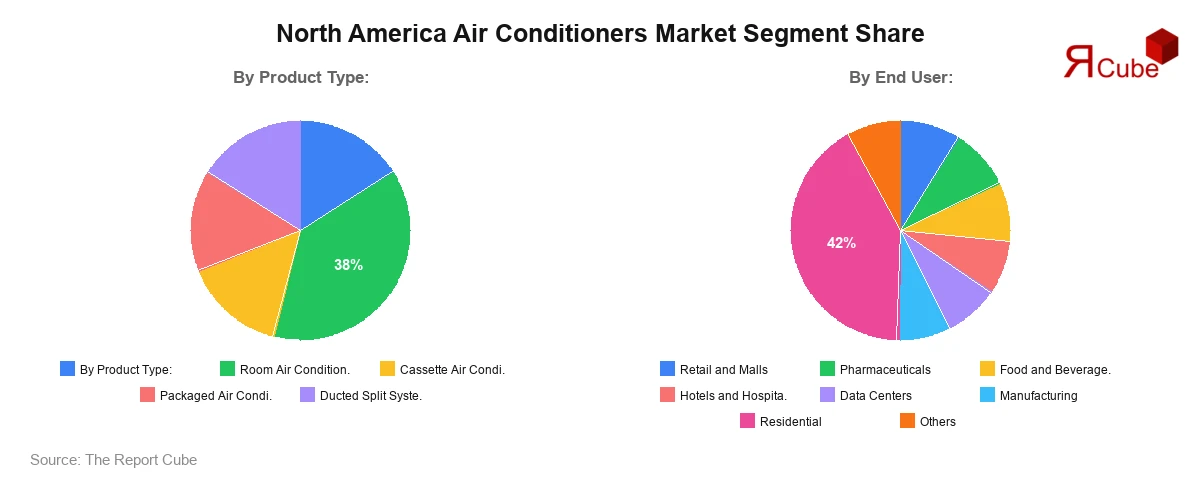
Room Air Conditioners hold a dominant share of 38% in the North America Air Conditioners Market due to strong residential demand and ease of installation. Split AC units are particularly popular because of their energy efficiency and quiet operation. Increasing urban housing projects and renovation activities contribute to steady product demand.
Consumers prefer flexible solutions that can be installed without major structural changes, which supports this segment’s leadership. Window AC units continue to serve budget-conscious consumers, especially in older buildings where central systems are not feasible. Manufacturers are enhancing product features such as smart connectivity and improved airflow design, further strengthening this segment’s market share and growth potential.
By End User:
- Retail and Malls
- Pharmaceuticals
- Food and Beverage
- Hotels and Hospitality
- Data Centers
- Offices
- Manufacturing
- Residential
- Educational Institutions
- Hospitals and Healthcare
- Other
The residential segment leads with a 42% revenue share, driven by increasing homeownership rates and rising temperatures across the region. Consumers are investing in modern air conditioning systems to improve indoor comfort and air quality. Smart home adoption has further boosted demand for connected AC units.
Replacement of older systems with energy-efficient models is a key factor supporting this segment. Government incentives for energy-saving appliances also encourage homeowners to upgrade existing units. Growth in suburban housing developments and multi-family apartments continues to strengthen demand, making residential applications a core contributor to overall market size and expansion.
Regional Projection of North America Air Conditioners Industry
- United States
- Canada
- Mexico
The United States dominates the North America Air Conditioners Market with a 71% share, supported by high demand across residential, commercial, and industrial sectors. The country experiences diverse climatic conditions, increasing the need for reliable cooling systems. Strong infrastructure development and widespread adoption of smart home technologies contribute to market growth.
The presence of leading manufacturers and well-established distribution networks further strengthens regional dominance. Data center expansion and healthcare facility upgrades are driving demand for advanced cooling solutions. Energy efficiency regulations and government incentives encourage adoption of modern systems, ensuring consistent market expansion and technological innovation across the region.
North America Air Conditioners Market Countries Analysis
The North America air conditioners market varies significantly across regions due to diverse climatic conditions, urban concentration, and economic activity.
| Country | Demand Level | Key Areas | System Dominance | Core Demand Logic | Growth Nature |
|---|---|---|---|---|---|
| United States | Very High | Sunbelt, major metros, data hubs | Central, split, smart and VRF AC | Climate, large homes, high ownership | Steady, replacement and upgrades |
| Canada | Medium | Ontario, Québec, urban corridors | Central AC, heat pumps, window AC | Hotter summers, urban multifamily stock | Gradual, climate and efficiency led |
| Mexico | High and rising | Northern belt, coastal and urban zones | Mini split, room AC, some VRF | Heat stress, rising middle class | Fast, new installs and regulation |
Need insights for a specific region within this market?
Request Regional DataGovernment Initiatives & Policies
- U.S. Department of Energy Energy Efficiency Standards (2026 Update): Updated HVAC efficiency standards mandate higher SEER ratings, pushing manufacturers to produce energy-saving air conditioners.
- Canada Greener Homes Initiative (2025 Expansion): Offers financial incentives for installing energy-efficient HVAC systems, encouraging residential upgrades and reducing emissions.
North America Air Conditioners Industry Recent Developments
- 2026: Haier Smart Home Co., Ltd. announced integration of residential air conditioning with smart building platforms, enhancing efficiency and connectivity. This move strengthens its position in North America by offering unified climate solutions across residential and commercial applications.
Why Choose This Report?
- Provides a comprehensive overview of the overall market analysis, encompassing key trends, consumer behavior analysis, and risk assessment to support strategic decision-making.
- Provides accurate, up-to-date insights into market size, segmentation, and emerging opportunities, helping to minimize risk & capitalizing on growth.
- Gives deep understanding of target audience preferences, investment habits, and communication channels for enhanced product development & marketing effectiveness.
- Delivers competitive analysis & benchmarking, uncovering the strengths & weaknesses of market competitors to guide strategies.
- Consolidate comprehensive market intelligence, reducing reasoning & streamlining research efforts.
- Facilitates customized market segmentation & risk mitigation strategies, fine-tuned to the business objectives.
- Aids in identifying both market challenges & untapped opportunities within the industry to drive long-term business growth.
- Provides valuable information based on actual customer data & search trends.
Table of Contents
- Introduction
- Objective of the Study
- Product and Category Definition
- Market Segmentation
- Study Variables
- Research Methodology
- Secondary Data Points
- Breakdown of Secondary Sources
- Primary Data Points
- Breakdown of Primary Interviews
- Secondary Data Points
- Executive Summary
- Market Dynamics
- Emerging Opportunities
- Adoption Trends
- Demand Drivers
- Disruption Analysis (Challenges)
- Industry Analysis and Strategic Insights
- Supply and Value Chain Analysis
- Pricing Analysis
- Go-To-Market Strategy
- BCG Matrix
- Recent Trends and Developments
- Import and Export Analysis
- Regulatory and Policy Landscape
- Region-wise Policies
- Government Initiatives
- North America Air Conditioners Market Overview and Forecast Analysis (2021-2034)
- Market Size, By Value, By Growth Rate (CAGR/USD Billion)
- Market Share, By Product Type
- Chillers
- Water-cooled Chillers
- Air-cooled Chillers
- Other Chillers
- Room Air Conditioners
- Split AC
- Up to 1 Ton
- 1 Ton to 1.5 Ton
- Above 1.6 to 2 Ton
- Above 2 Ton
- Window AC
- Up to 1 Ton
- 1 Ton to 2 Ton
- Above 2 Ton
- Split AC
- Cassette Air Conditioners
- Up to 2 Tons
- 2.1 to 4 Tons
- 4.1 to 5 Tons
- Above 5 Tons
- Packaged Air Conditioners
- Up to 5 Tons
- 6 to 10 Tons
- 11 to 20 Tons
- Above 20 Tons
- Ducted Split Systems
- VRF Systems
- Up to 5 Tons
- 6 to 10 Tons
- 11 to 20 Tons
- Above 20 Tons
- Others (Air Handling Units / Fan Coil Units, etc.)
- Chillers
- Market Share, By Refrigerant Type
- R290
- R410A
- R32
- R1234ze / R1234yf
- R134a
- Others
- Market Share, By Distribution Channel
- Multi-brand Stores
- Online
- Direct Sales
- Authorized Dealers and Distributors
- Market Share, By End User
- Retail and Malls
- Pharmaceuticals
- Food and Beverage
- Hotels and Hospitality
- Data Centers
- Offices
- Manufacturing
- Residential
- Educational Institutions
- Hospitals and Healthcare
- Other
- Market Share, By Country
- United States
- Canada
- Mexico
- United States Air Conditioners Market Overview and Forecast Analysis (2021-2034)
- Market Size, By Value, By Growth Rate (CAGR/USD Billion/Million)
- Market Share, By Product Type
- Market Share, By Refrigerant Type
- Market Share, By Distribution Channel
- Market Share, By End User
- Canada Air Conditioners Market Overview and Forecast Analysis (2021-2034)
- Market Size, By Value, By Growth Rate (CAGR/USD Billion/Million)
- Market Share, By Product Type
- Market Share, By Refrigerant Type
- Market Share, By Distribution Channel
- Market Share, By End User
- Mexico Air Conditioners Market Overview and Forecast Analysis (2021-2034)
- Market Size, By Value, By Growth Rate (CAGR/USD Billion/Million)
- Market Share, By Product Type
- Market Share, By Refrigerant Type
- Market Share, By Distribution Channel
- Market Share, By End User
- Competitive Analysis, 2026
- Market Share of Key Players
- Competitive Mapping for Each Segment and Companies Operating Regionally
- United States Air Conditioners Companies/Brands Share and Competitive Analysis, 2026
- Canada Air Conditioners Companies/Brands Share and Competitive Analysis, 2026
- Mexico Air Conditioners Companies/Brands Share and Competitive Analysis, 2026
- Company Profiles
- Blue Star Ltd
- Company Overview
- Product Portfolio
- Strategic Alliances/Partnerships
- Recent Developments
- Gree Electric Appliances Inc.
- Company Overview
- Product Portfolio
- Strategic Alliances/Partnerships
- Recent Developments
- Haier Smart Home Co., Ltd.
- Company Overview
- Product Portfolio
- Strategic Alliances/Partnerships
- Recent Developments
- Samsung Electronics Co., Ltd.
- Company Overview
- Product Portfolio
- Strategic Alliances/Partnerships
- Recent Developments
- Midea Group Co. Ltd
- Company Overview
- Product Portfolio
- Strategic Alliances/Partnerships
- Recent Developments
- Robert Bosch GmbH
- Company Overview
- Product Portfolio
- Strategic Alliances/Partnerships
- Recent Developments
- Fujitsu Limited
- Company Overview
- Product Portfolio
- Strategic Alliances/Partnerships
- Recent Developments
- Panasonic Corporation
- Company Overview
- Product Portfolio
- Strategic Alliances/Partnerships
- Recent Developments
- Whirlpool Corporation
- Company Overview
- Product Portfolio
- Strategic Alliances/Partnerships
- Recent Developments
- Toshiba Corporation
- Company Overview
- Product Portfolio
- Strategic Alliances/Partnerships
- Recent Developments
- Daikin Industries, Ltd.
- Company Overview
- Product Portfolio
- Strategic Alliances/Partnerships
- Recent Developments
- Hitachi-Johnson Controls Air Conditioning
- Company Overview
- Product Portfolio
- Strategic Alliances/Partnerships
- Recent Developments
- LG Electronics
- Company Overview
- Product Portfolio
- Strategic Alliances/Partnerships
- Recent Developments
- Mitsubishi Electric Corporation
- Company Overview
- Product Portfolio
- Strategic Alliances/Partnerships
- Recent Developments
- Others
- Blue Star Ltd
- Contact Us and Disclaimer
Top Key Players & Market Share Outlook
- Blue Star Ltd
- Gree Electric Appliances Inc.
- Haier Smart Home Co., Ltd.
- Samsung Electronics Co., Ltd.
- Midea Group Co. Ltd
- Robert Bosch GmbH
- Fujitsu Limited
- Panasonic Corporation
- Whirlpool Corporation
- Toshiba Corporation
- Daikin Industries, Ltd.
- Hitachi-Johnson Controls Air Conditioning
- LG Electronics
- Mitsubishi Electric Corporation
Frequently Asked Questions






