



Build Your Custom Market Intelligence Report
Customize Your ReportAsia Aircraft Engines Market Key Highlights
By Engine Type:
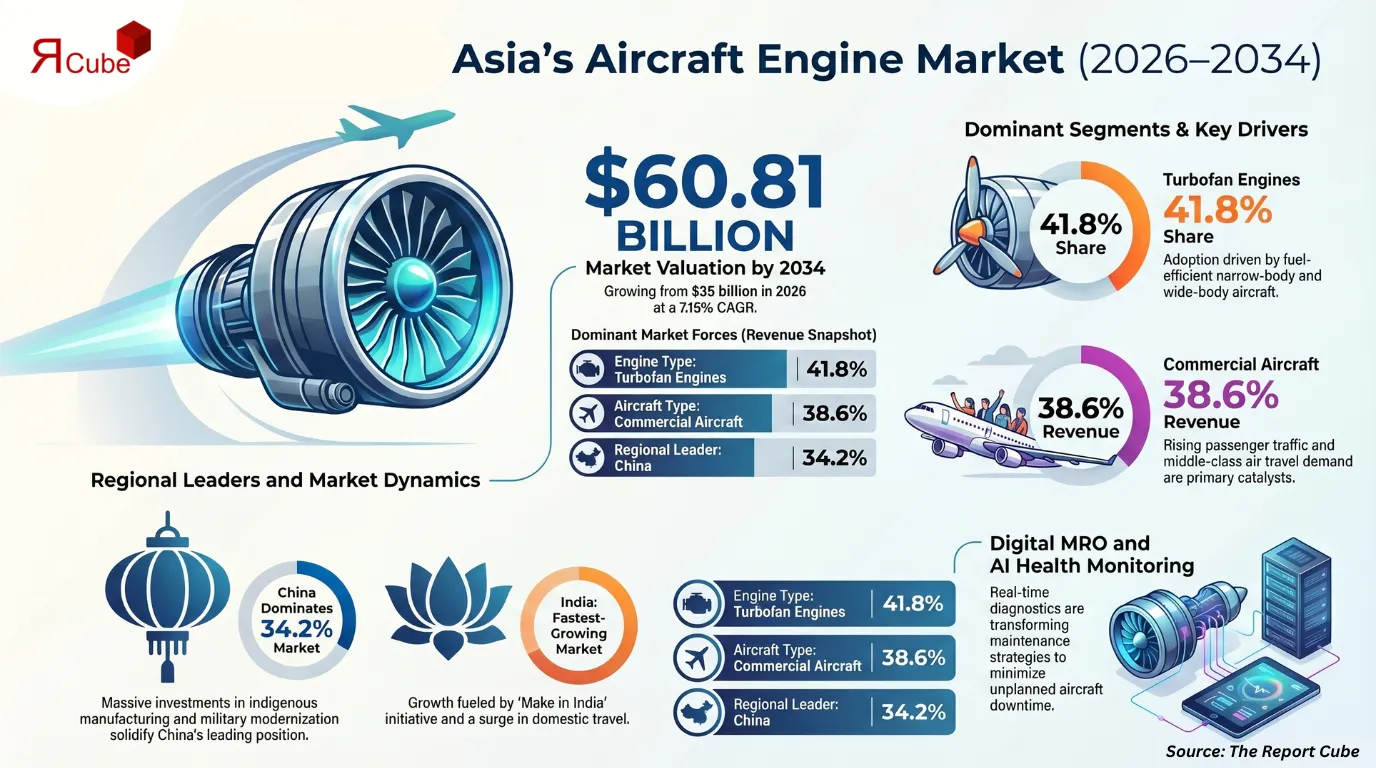
Turbofan Engine segment leads the market with nearly 41.8% share.
By Aircraft Type:
Commercial Aircraft segment dominates the market with approximately 38.6% of revenue.
Regional Outlook:
China dominates the Asia Aircraft Engines Market with around 34.2% share.
Asia Aircraft Engines Market Insights & Analysis
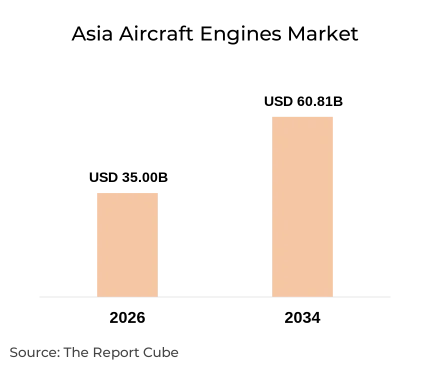
The Asia Aircraft Engines Market is anticipated to register a CAGR of around 7.15% during the forecast period 2026-2034. The market size is valued at USD 35.0 billion in 2026 and is projected to reach USD 60.81 billion by 2034. The aircraft engine market in Asia is experiencing significant momentum, driven by expanding aircraft procurement programs, growing airline fleets, and substantial investments in aviation infrastructure. As air travel demand continues to rise across countries such as China, India, Indonesia, Vietnam, and Thailand, airlines are increasingly seeking fuel-efficient turbofan engines and advanced propulsion technologies to enhance operational performance while reducing fuel consumption. This trend is also fueling demand for comprehensive maintenance, repair, and overhaul (MRO) services, creating long-term opportunities for engine manufacturers and aftermarket service providers throughout the region.
At the same time, defense modernization initiatives are playing a crucial role in accelerating market growth. Governments across Asia are allocating larger budgets toward the development of indigenous fighter jets, military helicopters, and unmanned aerial vehicle (UAV) programs to strengthen domestic aerospace capabilities and reduce dependence on foreign technologies. In response, aircraft engine manufacturers are expanding regional production facilities, adopting digital maintenance solutions, and integrating additive manufacturing technologies to improve engine reliability, extend service life, and lower maintenance expenses. Furthermore, strategic collaborations between aerospace companies, airline operators, research institutions, and defense agencies are fostering innovation in next-generation propulsion systems, sustainable aviation technologies, and high-thrust engine designs. These developments are expected to reinforce long-term demand for aircraft engines while supporting continued growth in aerospace manufacturing and investment across the Asian market.
Asia Aircraft Engines Market Impact Analysis
| Factor | Type | Specific Impact on Market | Magnitude | Business Implication |
|---|---|---|---|---|
| Rising Regional Air Passenger Traffic | Market | Higher commercial fleet orders lift demand for new engines | High | Supports long term production planning and capacity expansion |
| Fleet Modernization and Fuel Efficiency Push | Technological | Airlines replace older units with advanced fuel efficient models | High | Accelerates R&D in next generation turbofan and hybrid designs |
| Expansion of Low Cost Carriers in Asia | Market | Budget airlines grow narrow body fleets needing reliable engines | High | Drives volume contracts for single aisle aircraft powerplants |
| Rising Raw Material and Input Costs | Environmental | Nickel and titanium price spikes increase engine build costs | Medium | Necessitates pricing reviews and deeper supply risk management |
| Government Programs Supporting Local Production | Regulatory | Policies attract FDI and encourage regional engine manufacturing | Medium | Promotes joint ventures and localized assembly capabilities |
| Stricter Emission Norms and SAF Adoption | Environmental | Regulation pushes airlines toward SAF ready and low carbon engines | High | Creates premium for engines compatible with higher SAF blends |
| Growth in Engine MRO and Life Cycle Services | Competitive | Expanding active fleets increase regional overhaul workloads | Medium | Supports recurring revenue through long term service agreements |
Asia Aircraft Engines Market Dynamics
Key Driver: Expanding Aircraft Fleet Investments Accelerate Asia Aircraft Engines Market Growth
The Asia aircraft engines market is experiencing significant momentum as commercial airlines continue to expand their fleets to accommodate rising passenger traffic across the region. Countries such as China, India, Indonesia, Malaysia, and Vietnam are witnessing sustained growth in both domestic and international air travel, encouraging airlines to invest heavily in new aircraft acquisitions. As a result, demand for advanced aircraft engines continues to rise, supported by long-term procurement agreements and expanding maintenance partnerships.
Aircraft operators are increasingly prioritizing fuel-efficient propulsion systems to reduce operating costs and improve fleet performance. Modern turbofan engines have become a preferred choice due to their ability to enhance fuel economy while supporting airlines' sustainability objectives. At the same time, airport expansion and modernization initiatives across Asia are creating a favorable environment for aviation growth. The rapid expansion of low-cost carriers and increased procurement of narrow-body aircraft are further strengthening the demand for next-generation aircraft engines and associated aftermarket services.
Industry Trends: Advanced Engine Technologies and Expanding MRO Networks Shape Market Evolution
Technological innovation remains a defining trend within the Asia aircraft engines industry. Engine manufacturers are introducing advanced propulsion technologies, including geared turbofan systems, additive manufacturing techniques, predictive maintenance solutions, and digital engine monitoring platforms. These innovations help airlines improve engine performance, minimize operational disruptions, and extend maintenance intervals, contributing to improved profitability and fleet reliability.
The integration of artificial intelligence into engine diagnostics and real-time health monitoring systems is transforming maintenance strategies across the aviation sector. By enabling proactive maintenance and early fault detection, these technologies reduce unplanned downtime and improve aircraft availability.
Simultaneously, Maintenance, Repair, and Overhaul (MRO) capabilities are expanding rapidly throughout the region. Markets such as Singapore, India, South Korea, and China have emerged as major aerospace service hubs, benefiting from increasing fleet sizes and supportive aerospace investment policies. The development of localized repair and overhaul facilities enables operators to reduce maintenance turnaround times, improve supply chain efficiency, and lower long-term operating expenses.
Book your FREE 30-minute expert consultation today
Contact UsMajor Challenge: High Development Costs and Supply Chain Pressures Remain Key Market Challenges
Despite favorable growth prospects, the aircraft engines sector faces several structural challenges. Engine development requires substantial investments in research, engineering, testing, certification, and advanced manufacturing capabilities. The complexity of designing high-performance turbine systems, combined with stringent safety and regulatory requirements, creates significant barriers to entry for emerging manufacturers.
Additionally, ongoing supply chain disruptions continue to impact production timelines across the aerospace industry. Limited availability of specialized aerospace materials, semiconductor components, forged parts, and turbine blades has contributed to extended lead times and manufacturing delays. These constraints can affect aircraft delivery schedules, maintenance operations, and fleet expansion plans, creating operational pressures for both commercial airlines and defense organizations.
Smaller regional manufacturers often struggle to compete with established global engine producers that possess extensive technological expertise, mature supply networks, and proven certification credentials. As a result, market competition remains concentrated among a limited number of major industry participants.
Opportunity: Indigenous Aerospace Programs Create Long-Term Growth Opportunities
Government-backed aerospace development initiatives are opening new opportunities for aircraft engine manufacturers throughout Asia. Several countries are actively investing in indigenous defense aviation programs, advanced fighter aircraft development, military engine technologies, and unmanned aerial vehicle propulsion systems. These efforts are designed to strengthen domestic aerospace capabilities and reduce reliance on imported technologies.
In particular, investments in local manufacturing infrastructure, research collaborations, and advanced engineering programs are expected to accelerate the development of regionally produced aircraft engines. Such initiatives not only support national defense objectives but also contribute to broader aerospace industrialization strategies.
Beyond defense applications, sustainable aviation is emerging as a major area of opportunity. Industry stakeholders are increasingly investing in hybrid-electric propulsion systems, hydrogen-powered aircraft concepts, and low-emission engine technologies aimed at reducing aviation's environmental footprint. As airlines and governments pursue long-term decarbonization goals, companies capable of delivering innovative propulsion solutions and localized production capabilities are expected to gain a competitive advantage.
Asia Aircraft Engines Market Segment-wise Analysis
By Engine Type:
- Piston Engine
- Turbofan Engine
- Turbojet Engine
- Turboshaft Engine
- Turboprop Engine
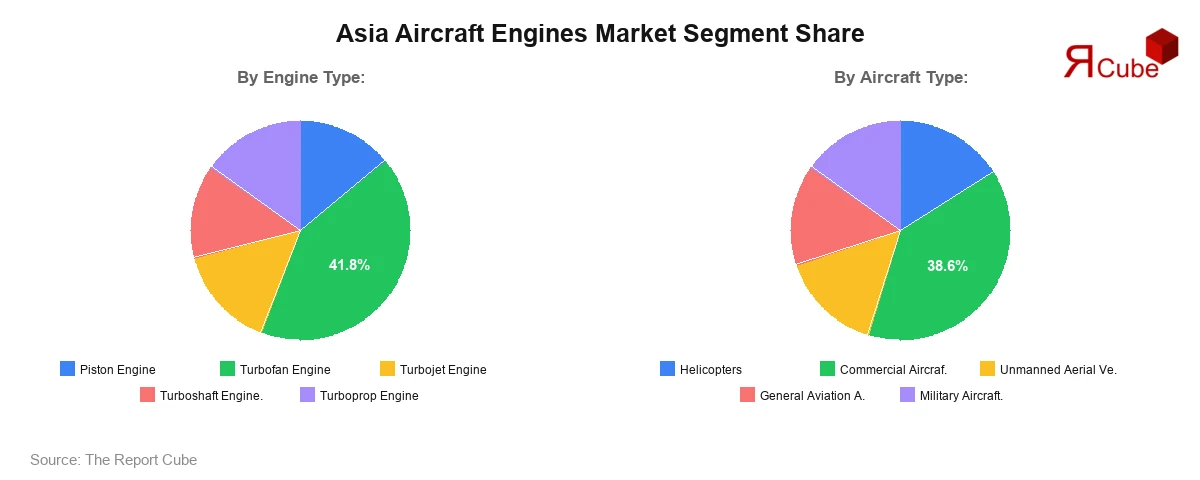
Turbofan engines account for the largest share of the Asia aircraft engines market and generated nearly 41.8% of total revenue during 2026. Strong deployment across commercial narrow-body and wide-body aircraft fleets continues to support segment expansion. Increasing deliveries of Airbus A320neo-family aircraft and Boeing 737 MAX platforms equipped with advanced fuel-efficient engines are accelerating demand.
Airlines are prioritizing engines that offer lower emissions, improved thrust efficiency, and reduced lifecycle maintenance costs. Growing regional passenger traffic and rising aircraft utilization rates across Southeast Asia, China, and India are supporting sustained turbofan engine procurement. Engine manufacturers are also introducing advanced composite materials and digital performance monitoring systems to improve fuel efficiency and operational reliability across commercial aviation operations.
By Aircraft Type:
- Helicopters
- Commercial Aircraft
- Unmanned Aerial Vehicles (UAVs)
- General Aviation Aircraft
- Military Aircraft
Commercial aircraft remain the leading aircraft type segment, accounting for approximately 38.6% of market revenue. Rapid expansion of regional airline networks, increasing middle-class air travel demand, and rising international tourism activities are supporting commercial fleet growth.
China and India continue to represent the largest aircraft acquisition markets in Asia, while Southeast Asian carriers are expanding low-cost airline operations. Growing investments in aviation infrastructure and airport development projects are further strengthening aircraft procurement activities. Engine manufacturers are benefiting from rising demand for long-term maintenance agreements, spare engine inventories, and predictive maintenance services linked to expanding commercial aircraft fleets operating throughout Asia.
By Point of Sale:
- Aftermarket
- OEM
The OEM segment maintains a significant market position due to ongoing aircraft production and fleet expansion activities. Aircraft manufacturers continue securing long-term engine supply contracts as airlines increase aircraft procurement plans. Rising deliveries of next-generation commercial and military aircraft platforms are expected to sustain OEM demand throughout the forecast period.
By Component:
- Fuel System
- Gearbox
- Combustion Chamber
- Turbine
- Exhaust System
- Compressor
- Others
The turbine segment generates substantial revenue due to its critical role in engine efficiency, thrust generation, and fuel consumption optimization. Continuous innovation in turbine blade materials and thermal efficiency technologies is supporting segment growth across both commercial and defense aviation applications.
Regional Projection of Asia Aircraft Engines Industry
- China
- Japan
- South Korea
- India
- Bangladesh
- Indonesia
- Thailand
- Vietnam
- Malaysia
- Others
China dominates the Asia aircraft engines market with an estimated 34.2% market share. The country continues investing aggressively in commercial aviation expansion, indigenous aerospace manufacturing, military modernization, and aircraft engine research programs. Rapid growth of domestic airlines and increasing aircraft procurement activities are creating substantial demand for advanced propulsion systems and aftermarket engine services. Aero Engine Corporation of China and AVIC Aero-Engine continue expanding domestic engine development capabilities to support national aerospace objectives.
India is emerging as one of the fastest-growing markets due to increasing defense procurement programs, airline fleet expansion, and investments in aerospace manufacturing. Japan and South Korea maintain strong positions through advanced aerospace engineering capabilities and participation in international engine development programs. Southeast Asian countries, including Indonesia, Vietnam, Malaysia, and Thailand, are witnessing rising aircraft engine demand driven by aviation sector growth, expanding airline operations, and increasing maintenance infrastructure investments across regional aviation markets.
Need insights for a specific region within this market?
Request Regional DataAsia Aircraft Engines Market Countries Analysis
The Asia aircraft engines market exhibits diverse growth dynamics across countries, driven by commercial aviation expansion, defense modernization, and MRO capabilities.
| Country | Demand Level | Key Areas | System Dominance | Core Demand Logic | Growth Nature |
|---|---|---|---|---|---|
| China | Extremely High | Beijing, Shanghai, Guangzhou | Turbofan engines | Massive fleet expansion & defense investment | Fastest-growing (13.54% CAGR) |
| Japan | High | Tokyo, Osaka, Nagoya | Turbofan engines (75% share) | Fleet modernization & defense capability upgrade | Premium growth (10.2% CAGR) |
| South Korea | High | Seoul, Busan, Incheon | Turbofan & military engines | Defense spending & commercial aviation growth | Steady growth (4.8% CAGR) |
| India | Very High | Delhi, Mumbai, Bangalore | Turbofan & indigenous engines | Make in India & air travel surge | Volume-led expansion |
| Indonesia | Medium to High | Jakarta, Bali, Surabaya | Turbofan for commercial fleet | SAF implementation & fleet modernization | Aviation sector modernization |
| Thailand | Medium | Bangkok, Phuket, Chiang Mai | Turbofan engines | Tourism-driven demand facing engine shortage | Constrained (4% capacity cap) |
| Vietnam | Medium | Hanoi, Ho Chi Minh, Da Nang | Commercial turbofan engines | Rapid aviation sector modernization | Emerging market growth |
| Malaysia | Medium | Kuala Lumpur, Selangor | Turbofan MRO & engine services | Regional MRO hub with strong infrastructure | MRO-driven (RM55B by 2030) |
| Bangladesh | Low to Medium | Dhaka, Chattogram | Boeing 787 & 737 MAX engines | Fleet acquisition (14 new Boeing aircraft) | Early-stage expansion |
| Others (APAC) | Low to Medium | Australia, Philippines, Pakistan | Mixed turbofan & turboprop | Fragmented markets with niche opportunities | Selective growth |
Government Initiatives & Policies
- India – Aero India 2025 & Indigenous Aerospace Manufacturing Initiative: India expanded support for indigenous aerospace manufacturing during Aero India 2025, promoting domestic aircraft, engine development, defense exports, and advanced aviation technologies under the Make in India framework.
- India – Defense Production and Aerospace Self-Reliance Programs 2025: The Department of Defence Production strengthened policies supporting aerospace localization, indigenous propulsion systems, advanced engine technologies, and domestic defense manufacturing capabilities to reduce import dependence
Asia Aircraft Engines Industry Recent Developments
- September 2025: GE Aerospace expanded its Singapore aircraft engine repair facility by investing nearly USD 11 million to strengthen additive manufacturing capabilities and maintenance support for GEnx and CFM LEAP engines. The expansion enhances regional MRO capacity and supports growing commercial aviation demand across Asia.
- February 2025: Pratt & Whitney secured additional GTF engine orders from Cebu Pacific for Airbus A320neo-family aircraft. The agreement included expanded long-term maintenance programs designed to improve engine performance, operational reliability, and lifecycle efficiency throughout the airline's growing fleet.
- October 2025: Safran Aircraft Engines and Tata Advanced Systems established a new manufacturing facility in Hyderabad to produce critical rotating components for CFM LEAP engines. The investment strengthens regional aerospace manufacturing capabilities and supports increasing aircraft engine demand across Asia. :contentReference[oaicite:2]{index=2}
- November 2025: Safran Aircraft Engine Services India inaugurated India's first global aircraft engine MRO facility in Hyderabad, supporting LEAP engine maintenance operations and strengthening the country's position as an emerging aviation maintenance hub. :contentReference[oaicite:3]{index=3}
Why Choose This Report?
- Provides a comprehensive overview of the overall market analysis, encompassing key trends, consumer behavior analysis, and risk assessment to support strategic decision-making.
- Provides accurate, up-to-date insights into market size, segmentation, and emerging opportunities, helping to minimize risk while capitalizing on growth.
- Gives deep understanding of target audience preferences, investment habits, and communication channels for enhanced product development and marketing effectiveness.
- Delivers competitive analysis and benchmarking, uncovering the strengths and weaknesses of market competitors to guide strategies.
- Consolidates comprehensive market intelligence, reducing research complexity and streamlining strategic planning efforts.
- Facilitates customized market segmentation and risk mitigation strategies tailored to evolving business objectives.
- Aids in identifying both market challenges and untapped opportunities within the industry to drive long-term business growth.
- Provides valuable information based on actual customer demand patterns, industry developments, and search trends.
Table of Contents
- Introduction
- Objective of the Study
- Product and Category Definition
- Market Segmentation
- Study Variables
- Research Methodology
- Secondary Data Points
- Breakdown of Secondary Sources
- Primary Data Points
- Breakdown of Primary Interviews
- Secondary Data Points
- Executive Summary
- Market Dynamics
- Emerging Opportunities
- Adoption Trends
- Demand Drivers
- Disruption Analysis (Challenges)
- Industry Analysis & Strategic Insights
- Supply/Value Chain Analysis
- Pricing Analysis
- Go-to-Market (GTM) Strategy
- BCG Matrix
- Recent Trends and Developments
- Import and Export Analysis
- Regulatory and Policy Landscape
- Region-wise Policies
- Government Initiatives
- Asia Aircraft Engines Market Overview and Forecast Analysis (2021-2034)
- Market Size, by Value, by Growth Rate (CAGR/USD Billion)
- Market Share, by Engine Type
- Piston Engine
- Turbofan Engine
- Turbojet Engine
- Turboshaft Engine
- Turboprop Engine
- Market Share, by Aircraft Type
- Helicopters
- Commercial Aircraft
- Unmanned Aerial Vehicles (UAVs)
- General Aviation Aircraft
- Military Aircraft
- Market Share, by Point of Sale
- Aftermarket
- OEM
- Market Share, by Component
- Fuel System
- Gearbox
- Combustion Chamber
- Turbine
- Exhaust System
- Compressor
- Others
- Market Share, by Thrust Range
- Below 10,000 lbs
- 10,000-20,000 lbs
- 20,000-50,000 lbs
- Above 50,000 lbs
- Market Share, by Region
- China
- Japan
- South Korea
- India
- Bangladesh
- Indonesia
- Thailand
- Vietnam
- Malaysia
- Rest of Asia
- Market Share, by Company
- Revenue Shares and Analysis
- Competitive Landscape
- China Aircraft Engines Market Overview and Forecast Analysis (2021-2034)
- Market Size, by Value, by Growth Rate (CAGR/USD Billion/Million)
- Market Share, by Engine Type
- Market Share, by Aircraft Type
- Market Share, by Point of Sale
- Market Share, by Component
- Market Share, by Thrust Range
- Japan Aircraft Engines Market Overview and Forecast Analysis (2021-2034)
- Market Size, by Value, by Growth Rate (CAGR/USD Billion/Million)
- Market Share, by Engine Type
- Market Share, by Aircraft Type
- Market Share, by Point of Sale
- Market Share, by Component
- Market Share, by Thrust Range
- South Korea Aircraft Engines Market Overview and Forecast Analysis (2021-2034)
- Market Size, by Value, by Growth Rate (CAGR/USD Billion/Million)
- Market Share, by Engine Type
- Market Share, by Aircraft Type
- Market Share, by Point of Sale
- Market Share, by Component
- Market Share, by Thrust Range
- India Aircraft Engines Market Overview and Forecast Analysis (2021-2034)
- Market Size, by Value, by Growth Rate (CAGR/USD Billion/Million)
- Market Share, by Engine Type
- Market Share, by Aircraft Type
- Market Share, by Point of Sale
- Market Share, by Component
- Market Share, by Thrust Range
- Bangladesh Aircraft Engines Market Overview and Forecast Analysis (2021-2034)
- Market Size, by Value, by Growth Rate (CAGR/USD Billion/Million)
- Market Share, by Engine Type
- Market Share, by Aircraft Type
- Market Share, by Point of Sale
- Market Share, by Component
- Market Share, by Thrust Range
- Indonesia Aircraft Engines Market Overview and Forecast Analysis (2021-2034)
- Market Size, by Value, by Growth Rate (CAGR/USD Billion/Million)
- Market Share, by Engine Type
- Market Share, by Aircraft Type
- Market Share, by Point of Sale
- Market Share, by Component
- Market Share, by Thrust Range
- Thailand Aircraft Engines Market Overview and Forecast Analysis (2021-2034)
- Market Size, by Value, by Growth Rate (CAGR/USD Billion/Million)
- Market Share, by Engine Type
- Market Share, by Aircraft Type
- Market Share, by Point of Sale
- Market Share, by Component
- Market Share, by Thrust Range
- Vietnam Aircraft Engines Market Overview and Forecast Analysis (2021-2034)
- Market Size, by Value, by Growth Rate (CAGR/USD Billion/Million)
- Market Share, by Engine Type
- Market Share, by Aircraft Type
- Market Share, by Point of Sale
- Market Share, by Component
- Market Share, by Thrust Range
- Malaysia Aircraft Engines Market Overview and Forecast Analysis (2021-2034)
- Market Size, by Value, by Growth Rate (CAGR/USD Billion/Million)
- Market Share, by Engine Type
- Market Share, by Aircraft Type
- Market Share, by Point of Sale
- Market Share, by Component
- Market Share, by Thrust Range
- Competitive Analysis, 2026
- Market Share of Key Players
- Competitive Mapping for Each Engine Type, Aircraft Type, Point of Sale, Component, and Thrust Range
- China Aircraft Engines Companies Share and Competitive Analysis, 2026
- Japan Aircraft Engines Companies Share and Competitive Analysis, 2026
- South Korea Aircraft Engines Companies Share and Competitive Analysis, 2026
- India Aircraft Engines Companies Share and Competitive Analysis, 2026
- Bangladesh Aircraft Engines Companies Share and Competitive Analysis, 2026
- Indonesia Aircraft Engines Companies Share and Competitive Analysis, 2026
- Thailand Aircraft Engines Companies Share and Competitive Analysis, 2026
- Vietnam Aircraft Engines Companies Share and Competitive Analysis, 2026
- Malaysia Aircraft Engines Companies Share and Competitive Analysis, 2026
- Company Profile (Partial List)
- Kawasaki Heavy Industries
- Company Overview
- Product Portfolio
- Strategic Alliances/Partnerships
- Recent Developments
- Safran Aircraft Engines
- Company Overview
- Product Portfolio
- Strategic Alliances/Partnerships
- Recent Developments
- Hanwha Aerospace
- Company Overview
- Product Portfolio
- Strategic Alliances/Partnerships
- Recent Developments
- GE Aerospace
- Company Overview
- Product Portfolio
- Strategic Alliances/Partnerships
- Recent Developments
- IHI Corporation
- Company Overview
- Product Portfolio
- Strategic Alliances/Partnerships
- Recent Developments
- Engine Alliance
- Company Overview
- Product Portfolio
- Strategic Alliances/Partnerships
- Recent Developments
- Rolls-Royce
- Company Overview
- Product Portfolio
- Strategic Alliances/Partnerships
- Recent Developments
- Hindustan Aeronautics Limited
- Company Overview
- Product Portfolio
- Strategic Alliances/Partnerships
- Recent Developments
- Aero Engine Corporation of China
- Company Overview
- Product Portfolio
- Strategic Alliances/Partnerships
- Recent Developments
- International Aero Engines (IAE)
- Company Overview
- Product Portfolio
- Strategic Alliances/Partnerships
- Recent Developments
- Mitsubishi Heavy Industries
- Company Overview
- Product Portfolio
- Strategic Alliances/Partnerships
- Recent Developments
- Pratt & Whitney (RTX)
- Company Overview
- Product Portfolio
- Strategic Alliances/Partnerships
- Recent Developments
- CFM International
- Company Overview
- Product Portfolio
- Strategic Alliances/Partnerships
- Recent Developments
- Korea Aerospace Industries
- Company Overview
- Product Portfolio
- Strategic Alliances/Partnerships
- Recent Developments
- Gas Turbine Research Establishment
- Company Overview
- Product Portfolio
- Strategic Alliances/Partnerships
- Recent Developments
- MTU Aero Engines
- Company Overview
- Product Portfolio
- Strategic Alliances/Partnerships
- Recent Developments
- AVIC Aero-Engine
- Company Overview
- Product Portfolio
- Strategic Alliances/Partnerships
- Recent Developments
- Others (Partial List)
- Kawasaki Heavy Industries
- Contact Us and Disclaimer
Top Key Players & Market Share Outlook
- Kawasaki Heavy Industries
- Safran Aircraft Engines
- Hanwha Aerospace
- GE Aerospace
- IHI Corporation
- Engine Alliance
- Rolls-Royce
- Hindustan Aeronautics Limited
- Aero Engine Corporation of China
- International Aero Engines (IAE)
- Mitsubishi Heavy Industries
- Pratt & Whitney (RTX)
- CFM International
- Korea Aerospace Industries
- Gas Turbine Research Establishment
- MTU Aero Engines
- AVIC Aero-Engine
Frequently Asked Questions






