



Build Your Custom Market Intelligence Report
Customize Your ReportKey Takeaways
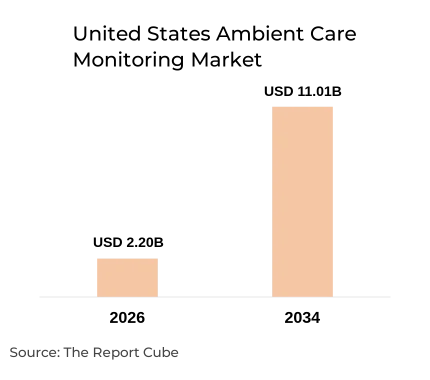
- United States Ambient Care Monitoring Market valued at USD 2.20 billion in 2026, reflecting accelerating clinical AI adoption.
- Market projected to reach USD 11.01 billion by 2034, expanding at a 22.30% CAGR through the forecast period.
- A comprehensive United States Ambient Care Monitoring Market Analysis reveals rapid displacement of manual documentation workflows across all care settings.
- Hospitals & Large Health Systems lead the care setting segment, commanding the dominant share of institutional procurement.
- Telehealth & Virtual Care Providers represent the fastest-growing end-user segment across the forecast period.
- Natural Language Processing leads the underlying technology segment, powering real-time clinical documentation at scale.
- Nuance Communications, Abridge AI, Suki AI, and Ambience Healthcare are the leading solution providers in this market.
- Physician burnout reduction and ambient AI-assisted documentation are reshaping care delivery investment priorities through 2034.
Market Overview
The United States Ambient Care Monitoring Market is anticipated to register a 22.30% CAGR during 2026–2034. Valued at USD 2.20 billion in 2026 and projected to reach USD 11.01 billion by 2034, the market is driven by escalating physician burnout, documentation burden reduction initiatives, and the rapid integration of AI-powered ambient listening technologies into hospital systems, outpatient clinics, and telehealth environments. Federal digital health programs and interoperability mandates under the 21st Century Cures Act are accelerating institutional procurement. Technology leaders including Nuance Communications, Abridge AI, and Philips Healthcare are expanding ambulatory and inpatient ambient monitoring deployments across U.S. health systems.
Growing adoption of virtual care delivery models continues generating consistent demand for ambient AI documentation platforms among telehealth providers, accountable care organizations, and ambulatory surgery centers. The United States' position as the global leader in clinical AI investment further sustains commercial-scale rollout of ambient monitoring products. Increasing clinician satisfaction requirements and payer-driven value-based care incentives are encouraging health system executives to prioritize ambient care solutions. Suki AI and Ambience Healthcare have deepened market engagement through specialty-specific ambient documentation programs targeting primary care, emergency medicine, and behavioral health workflows.
Market Size & Forecast
|
Metric |
Details |
|---|---|
|
Market Size (2026) |
USD 2.20 Billion |
|
Market Size (2034) |
USD 11.01 Billion |
|
CAGR (2026–2034) |
22.30% |
|
Base Year |
2026 |
|
Historical Years |
2021–2025 |
|
Forecast Years |
2026–2034 |
The United States Ambient Care Monitoring Market Size study values the industry at USD 2.20 billion in 2026, with projections indicating growth to USD 11.01 billion by 2034 at a 22.30% CAGR. This trajectory substantially outpaces the broader U.S. health IT sector average, driven by large-scale EHR-integrated ambient AI rollouts, expanding telehealth infrastructure, and measurable improvements in clinician retention tied directly to documentation burden reduction.
Market Dynamics
The United States Ambient Care Monitoring Market is expanding rapidly as healthcare systems seek scalable solutions to the clinical documentation crisis. Physician productivity constraints, increasing patient encounter volumes, and the maturation of conversational AI platforms are collectively driving institutional adoption across hospitals, ambulatory networks, and virtual care providers. Value-based reimbursement pressure and interoperability standards are reinforcing investment in ambient monitoring infrastructure across all care settings.
|
Factor |
Type |
Specific Impact on Market |
Magnitude |
|---|---|---|---|
|
Physician burnout and documentation burden |
Driver |
Accelerates institutional procurement of ambient AI documentation platforms |
High |
|
EHR system integration mandates |
Driver |
Expands ambient monitoring deployment across large hospital networks and IDNs |
High |
|
Privacy and data security regulatory complexity |
Restraint |
Raises compliance costs and slows enterprise procurement decision cycles |
Medium |
|
Expansion of value-based care models |
Opportunity |
Creates financial incentives for ambient monitoring adoption among ACOs and payers |
High |
|
Fragmented vendor ecosystem and interoperability gaps |
Challenge |
Slows cross-system integration and limits ambient solution scalability |
Medium |
|
Generative AI integration into ambient platforms |
Trend |
Enhances documentation accuracy and extends clinical decision support capabilities |
High |
- Growth Drivers - Physician Burnout and AI Documentation Demand: The United States Ambient Care Monitoring Market Growth is primarily driven by the national physician burnout crisis, with studies indicating clinicians spend over two hours on administrative documentation per hour of direct patient care. Major health systems including Mayo Clinic, Kaiser Permanente, and Cleveland Clinic have accelerated ambient AI procurement from Nuance Communications and Abridge AI to directly address EHR documentation burden and improve care team retention.
- Market Restraints - HIPAA Compliance and Data Privacy Constraints: Stringent HIPAA requirements, state-level patient data privacy legislation, and enterprise cybersecurity protocols impose significant compliance overhead on ambient monitoring procurement processes. Healthcare organizations require extensive data use agreements, Business Associate Agreements, and security audits before deploying ambient listening technologies, extending procurement timelines and increasing implementation costs for vendors and health systems alike.
- Market Opportunities - Value-Based Care and Payer Incentive Alignment: Value-based care contracts increasingly tie reimbursement to care quality metrics, patient experience scores, and clinical efficiency indicators - all of which ambient monitoring platforms directly support. CMS alternative payment models and commercial payer programs create documented financial return-on-investment pathways for ambient AI adoption, enabling vendors such as Suki AI and Ambience Healthcare to build compelling procurement business cases for hospital CFOs and CMOs.
- Industry Challenges - EHR Integration Complexity and Workflow Standardization: Integrating ambient monitoring platforms with fragmented EHR environments - spanning Epic, Oracle Health (Cerner), and Meditech - remains a significant technical and operational challenge. Customization requirements differ by specialty, practice size, and payer mix, creating deployment friction. Standardizing ambient AI workflows across multi-specialty health systems demands extensive clinician training investment, limiting rapid scalability beyond initial pilot deployments.
Need Specific Data, Let’s Customize the Report for You
Request CustomizationMarket Trends
- Emerging Trends: United States Ambient Care Monitoring Market Trends include the convergence of ambient listening, clinical decision support, and real-time prior authorization automation within single integrated platforms. Health systems are demanding ambient solutions that extend beyond note generation to surface care gap alerts, chronic disease management prompts, and population health flags during live patient encounters.
- Technology Trends: Large language model fine-tuning on proprietary clinical datasets is enabling ambient platforms to produce specialty-accurate documentation at accuracy rates exceeding 95% across primary care, cardiology, and behavioral health encounters. GE HealthCare and Philips Healthcare are embedding ambient AI capabilities within broader patient monitoring hardware ecosystems, integrating ambient documentation with physiological sensor data streams for continuous inpatient care monitoring.
- Consumer / Buyer Trends: Physician buyers and clinical informaticists increasingly evaluate ambient care solutions based on specialty-specific workflow compatibility, EHR integration depth, and measurable time-savings per encounter rather than general AI capability claims. Over 70% of health system procurement evaluations now require structured pilot programs with quantified burnout reduction metrics and documentation accuracy benchmarks before enterprise-wide deployment commitments are finalized.
- Regulatory Trends: The Office of the National Coordinator for Health Information Technology (ONC) continues advancing interoperability standards under the 21st Century Cures Act that directly shape ambient monitoring data exchange requirements. CMS is developing AI transparency guidance applicable to ambient clinical documentation tools, while the FDA is actively evaluating classification frameworks for AI-powered ambient monitoring that transitions beyond documentation into real-time clinical decision support functions.
United States Ambient Care Monitoring Market Segment Analysis
The United States Ambient Care Monitoring Market serves distinct care delivery environments and technology adoption profiles, each shaped by unique clinical workflow requirements, procurement authority structures, and integration complexity levels.
By Care Setting & End-User
- Hospitals & Large Health Systems
- Ambulatory & Outpatient Care Clinics
- Telehealth & Virtual Care Providers
- Ambient Assisted Living (AAL) & Home Care
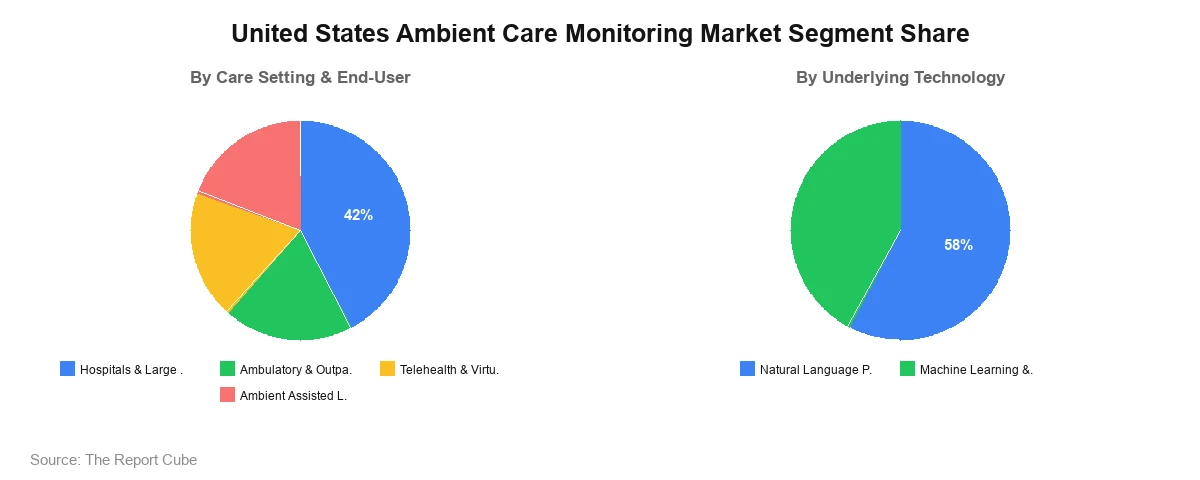
Hospitals & Large Health Systems lead the By Care Setting & End-User segment, commanding an estimated 42% United States Ambient Care Monitoring Market Share in 2026. Nuance Communications, through its DAX Copilot platform integrated with Epic and Oracle Health, supplies the majority of ambient documentation solutions deployed across U.S. hospital networks and integrated delivery networks. Ambulatory & Outpatient Care Clinics represent approximately 28% of end-user demand, with Suki AI and Abridge AI capturing significant share among multi-specialty group practices. Telehealth & Virtual Care Providers account for an estimated 20%, emerging as the fastest-growing care setting as virtual-first health organizations standardize ambient AI documentation across synchronous telehealth encounters. Ambient Assisted Living & Home Care contributes the remaining 10%, with BioIntelliSense and Honeywell International supplying ambient biosensor and remote patient monitoring platforms supporting home-based care programs.
By Underlying Technology
- Natural Language Processing
- Machine Learning & Deep Learning
Natural Language Processing leads the By Underlying Technology segment with an estimated 58% share in 2026, underpinning real-time clinical speech recognition, conversation summarization, and structured note generation across all care settings. Nuance Communications and Ambience Healthcare deploy advanced NLP architectures fine-tuned on clinical corpora exceeding one billion annotated medical encounters. Machine Learning & Deep Learning accounts for approximately 42% of the underlying technology landscape, powering predictive analytics, anomaly detection in continuous patient monitoring, and adaptive documentation personalization. GE HealthCare and Philips Healthcare integrate ML and deep learning models within ambient monitoring hardware platforms for real-time physiological pattern recognition, clinical alert generation, and deterioration risk stratification across hospital inpatient environments.
Regional Analysis
|
Region |
Estimated Market Share |
Key Growth Factors |
Consumer Trends |
|---|---|---|---|
|
Northeast |
34% |
Concentration of academic medical centers, early AI adopter health systems, dense telehealth infrastructure |
High NLP platform adoption, specialty-specific ambient documentation demand |
|
West |
28% |
Technology sector convergence with healthcare, high venture investment in ambient AI startups |
Strong telehealth ambient platform growth, physician burnout reduction prioritization |
|
South |
22% |
Expanding rural telehealth networks, large hospital system consolidation activity |
Growing AAL and home care ambient monitoring adoption, cost-efficiency procurement focus |
|
Midwest |
16% |
Large integrated health system networks, manufacturing sector occupational health monitoring expansion |
EHR-integrated ambient documentation adoption, value-based care program alignment |
- Northeast (34%): The Northeast commands the largest regional share of the United States Ambient Care Monitoring Market, anchored by a dense concentration of academic medical centers, major integrated delivery networks, and health system innovation programs in Boston, New York, and Philadelphia. Mass General Brigham and NYU Langone have deployed ambient AI at institutional scale, driving outsized procurement volumes from Nuance Communications and Abridge AI, and establishing reference sites that accelerate adoption across the broader region.
- West (28%): California and Washington State drive Western regional growth, supported by a deep technology venture ecosystem that has produced leading ambient AI companies including Abridge AI, Ambience Healthcare, and Suki AI. Health systems including Providence and Stanford Health Care are advancing enterprise-wide ambient monitoring deployments, and the region's high concentration of telehealth providers continues generating demand for virtual care ambient documentation across multispecialty and primary care settings.
- South (22%): Rapid hospital system consolidation in Texas, Florida, and Tennessee is expanding ambient monitoring procurement across newly integrated regional health networks. Growing rural telehealth infrastructure investments and AAL program expansions supported by Honeywell International and BioIntelliSense are driving South region growth, with cost-efficiency and care access objectives serving as the primary procurement rationale among community hospital and critical access hospital buyers.
- Midwest (16%): Large integrated delivery networks headquartered in Illinois, Ohio, and Minnesota - including Advocate Health, OhioHealth, and Allina Health - are adopting EHR-native ambient documentation platforms in alignment with value-based care contract obligations. The Midwest's growing emphasis on operational efficiency and clinician retention through documentation burden reduction is steadily increasing ambient monitoring platform procurement volumes across the forecast period.
Market Share & Competitive Landscape
The United States Ambient Care Monitoring Market's competitive structure is concentrated among specialized clinical AI vendors and diversified health technology conglomerates, with competition centered on EHR integration depth, specialty documentation accuracy, enterprise scalability, and demonstrated clinician satisfaction outcomes.
|
Company |
Competitive Strength |
Primary Segment Served |
|---|---|---|
|
Nuance Communications |
DAX Copilot platform, deep Epic/Oracle Health integration, largest installed base |
Hospitals & Large Health Systems |
|
Abridge AI |
Generative AI architecture, academic medical center partnerships, multi-language support |
Hospitals, Ambulatory Care |
|
Suki AI |
Lightweight API-first platform, fast specialty customization, strong ambulatory penetration |
Ambulatory & Outpatient Clinics |
|
Ambience Healthcare |
Multi-specialty ambient documentation, end-to-end workflow automation |
Hospitals, Telehealth Providers |
|
Philips Healthcare |
Integrated patient monitoring hardware with ambient AI, ICU care focus |
Hospitals & Large Health Systems |
|
GE HealthCare |
ML-embedded physiological monitoring, enterprise imaging AI integration |
Hospitals, Inpatient Settings |
|
Honeywell International |
Building-integrated ambient sensors, AAL and home care environment solutions |
AAL & Home Care |
|
BioIntelliSense |
Continuous biosensor platforms, remote patient monitoring, home care |
AAL & Home Care, Telehealth |
Key Companies in the United States Ambient Care Monitoring Market
Nuance Communications
Nuance Communications, headquartered in Burlington, Massachusetts and operating as a Microsoft subsidiary since 2022, is the market leader in clinical ambient AI with its DAX Copilot platform deployed across hundreds of U.S. health systems. In 2024–2025, Nuance expanded DAX Copilot's integration with Epic Systems and Oracle Health, achieving measurable reductions in documentation time and clinician burnout across ambulatory and inpatient care environments at scale.
Abridge AI
Abridge AI, headquartered in Pittsburgh, Pennsylvania, develops a generative AI-powered ambient documentation platform purpose-built for clinical use. In 2024, Abridge announced a major partnership with Epic Systems embedding its ambient technology directly within the Epic EHR workflow, accelerating adoption across over 700 health systems. Its academic medical center partnerships - including UCSF and University of Chicago Medicine - reinforce its clinical credibility and enterprise procurement pipeline.
Recent Developments
|
Year |
Company |
Development |
|---|---|---|
|
Feb 2025 |
Nuance Communications |
Expanded DAX Copilot availability across additional Epic-integrated health systems, adding new specialty-specific documentation workflows |
|
Jan 2025 |
Abridge AI |
Secured USD 250 million Series D funding round to accelerate enterprise health system deployments and expand global partnerships |
Future Outlook
The United States Ambient Care Monitoring Market Forecast projects continued expansion to USD 11.01 billion by 2034, advancing at a 22.30% CAGR through the forecast period. Sustained physician workforce pressures, accelerating telehealth adoption, and expanding CMS reimbursement frameworks for AI-assisted care delivery will drive enterprise ambient monitoring procurement across hospitals, ambulatory networks, and home care programs. Nuance Communications, Abridge AI, and Ambience Healthcare are expected to deepen penetration through specialty-specific ambient documentation expansion and broader EHR platform ecosystem integrations through 2034.
Ambient AI technology evolution - including multimodal monitoring combining speech recognition with physiological sensor data, predictive clinical alerting, and generative AI-powered care plan generation - will define competitive differentiation through the forecast horizon. Regulatory maturation of AI clinical documentation standards under ONC and FDA frameworks will establish clearer compliance pathways that reduce enterprise procurement friction. Sustainable deployment models emphasizing clinician-centered design, measurable burnout reduction, and demonstrable patient safety outcomes will become foundational procurement requirements as the United States Ambient Care Monitoring Market reaches institutional saturation in Tier 1 health systems and expands into community and rural care settings.
United States Ambient Care Monitoring Market Report Coverage
This United States Ambient Care Monitoring Market Report covers the complete forecast period 2026–2034, providing institutional buyers, investors, and health system executives with granular market sizing, segmentation, regional, and competitive intelligence.
|
Report Attribute |
Details |
|---|---|
|
Market Name |
United States Ambient Care Monitoring Market |
|
Market Size (2026) |
USD 2.20 Billion |
|
Market Size (2034) |
USD 11.01 Billion |
|
Forecast Period |
2026–2034 |
|
CAGR |
22.30% |
|
Base Year |
2026 |
|
Historical Years |
2021–2025 |
|
Forecast Years |
2026–2034 |
|
Segments Covered |
By Application & Functionality, By Component, By Care Setting & End-User, By Underlying Technology |
|
Regions Covered |
Northeast, West, South, Midwest |
|
Key Companies |
Nuance Communications, Abridge AI, Suki AI, Ambience Healthcare, Philips Healthcare, GE HealthCare, Honeywell International, BioIntelliSense, Others |
|
Report Format |
PDF, Excel, PPT |
|
Customization |
Available as per client requirements |
Why Choose This United States Ambient Care Monitoring Market Report?
- Comprehensive coverage of the U.S. ambient care monitoring industry across all major care settings and technology categories.
- Accurate market sizing from USD 2.20 billion in 2026 through the USD 11.01 billion 2034 forecast.
- Detailed segmentation by care setting & end-user and underlying technology with share percentage estimates.
- Regional insights covering Northeast, West, South, and Midwest with market share breakdowns and growth drivers.
- Competitive profiling of 8 leading ambient AI and patient monitoring companies with strength and segment mapping.
- In-depth analysis of clinical AI documentation trends reshaping physician workflow and care delivery procurement decisions.
- Forecast data supporting strategic investment planning, vendor evaluation, and health system partnership decisions.
- Research aligned with federal digital health policy priorities including ONC interoperability mandates and CMS value-based care programs.
Table of Contents
- Introduction
- Objective of the Study
- Product Definition
- Market Segmentation
- Study Variables
- Research Methodology
- Secondary Data Points
- Companies Interviewed
- Primary Data Points
- Breakdown of Primary Interviews
- Secondary Data Points
- Executive Summary
- Market Dynamics
- Drivers
- Challenges
- Opportunity Assessment
- Recent Trends and Developments
- Policy and Regulatory Landscape
- United States Ambient Care Monitoring Market Overview and Forecast Analysis (2021-2034)
- Market Size, By Value, By Growth Rate (CAGR/USD Billions)
- Demand – Supply Trends
- Market Share, By Application & Functionality
- Clinical Documentation & Digital Scribes
- Ambient Patient Monitoring & Safety
- Workflow & Decision Support Automation
- Market Share, By Component
- Software Platforms
- Hardware & Sensors
- Services
- Market Share, By Care Setting & End-User
- Hospitals & Large Health Systems
- Ambulatory & Outpatient Care Clinics
- Telehealth & Virtual Care Providers
- Ambient Assisted Living (AAL) & Home Care
- Market Share, By Underlying Technology
- Natural Language Processing
- Machine Learning & Deep Learning
- Market Share, By Region
- Midwest
- West
- South
- Northeast
- Market Share, By Competitors
- Competition Characteristics
- Revenue Shares
- Clinical Documentation & Digital Scribes United States Ambient Care Monitoring Market Overview, 2021-2034F
- By Value (USD Million)
- By Component – Market Size & Forecast 2021-2034, USD Million
- Software Platforms
- Hardware & Sensors
- Services
- Ambient Patient Monitoring & Safety United States Ambient Care Monitoring Market Overview, 2021-2034F
- By Value (USD Million)
- By Component – Market Size & Forecast 2021-2034, USD Million
- Software Platforms
- Hardware & Sensors
- Services
- Workflow & Decision Support Automation United States Ambient Care Monitoring Market Overview, 2021-2034F
- By Value (USD Million)
- By Component – Market Size & Forecast 2021-2034, USD Million
- Software Platforms
- Hardware & Sensors
- Services
- Competitive Outlook (Company Profile - Partial List)
- Nuance Communications
- Company Overview
- Business Segments
- Strategic Alliances/Partnerships
- Recent Developments
- Abridge AI
- Company Overview
- Business Segments
- Strategic Alliances/Partnerships
- Recent Developments
- Suki AI
- Company Overview
- Business Segments
- Strategic Alliances/Partnerships
- Recent Developments
- Ambience Healthcare
- Company Overview
- Business Segments
- Strategic Alliances/Partnerships
- Recent Developments
- Philips Healthcare
- Company Overview
- Business Segments
- Strategic Alliances/Partnerships
- Recent Developments
- GE HealthCare
- Company Overview
- Business Segments
- Strategic Alliances/Partnerships
- Recent Developments
- Honeywell International
- Company Overview
- Business Segments
- Strategic Alliances/Partnerships
- Recent Developments
- BioIntelliSense
- Company Overview
- Business Segments
- Strategic Alliances/Partnerships
- Recent Developments
- Others
- Nuance Communications
- Contact Us & Disclaimer
Top Key Players & Market Share Outlook
- Nuance Communications
- Abridge AI
- Suki AI
- Ambience Healthcare
- Philips Healthcare
- GE HealthCare
- Honeywell International
- BioIntelliSense
- Others
Frequently Asked Questions






