




Build Your Custom Market Intelligence Report
Customize Your ReportGlobal AI in Telehealth Market Key Highlights
By Function:
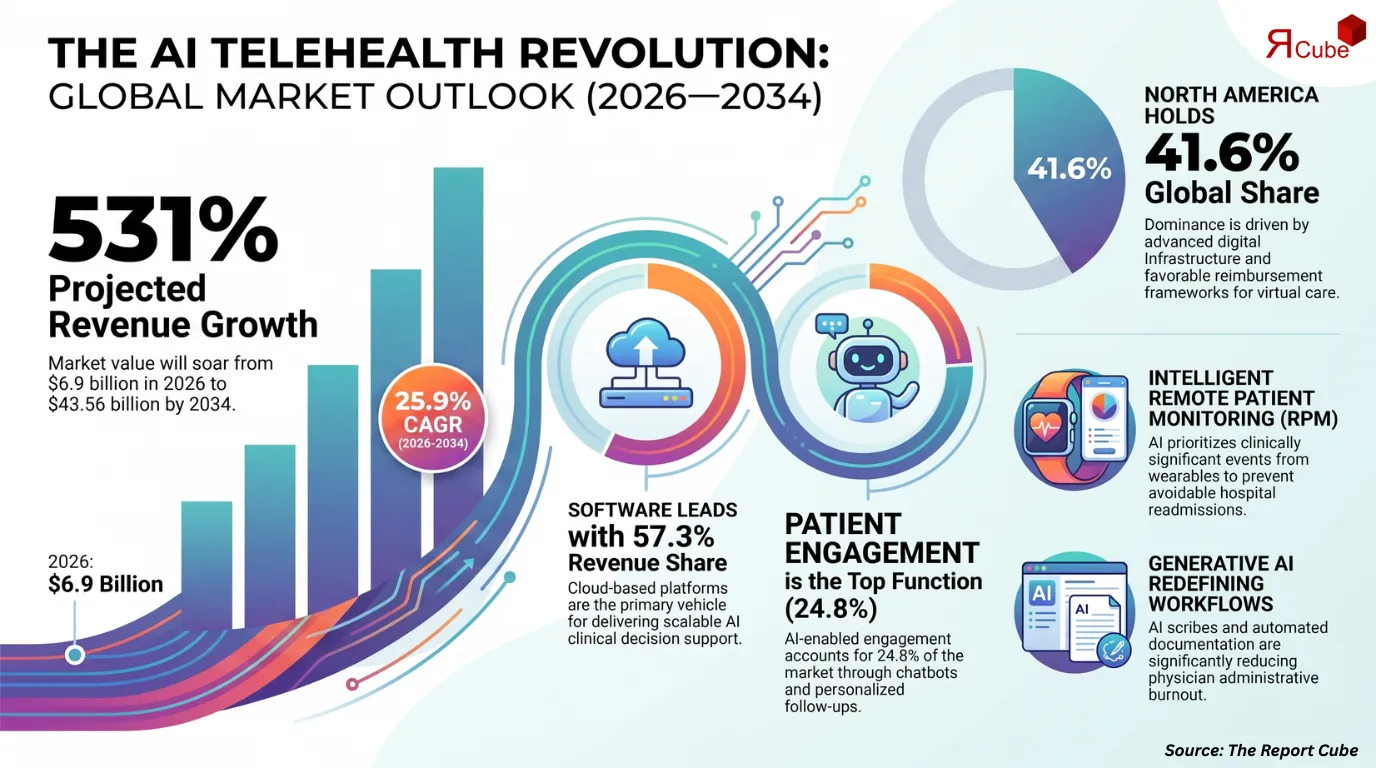
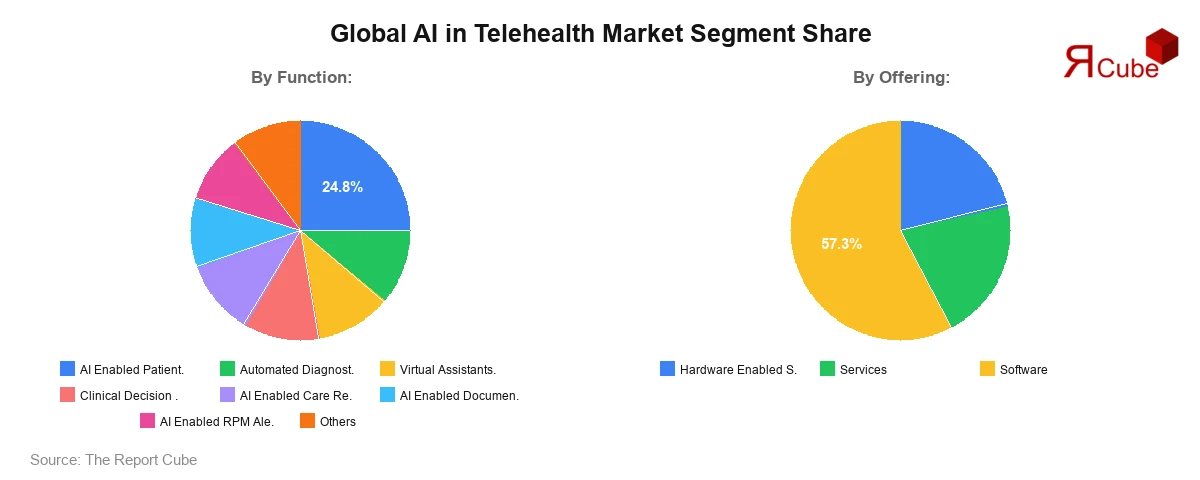
AI Enabled Patient Engagement segment leads the market with approximately 24.8% share.
By Offering:
Software segment dominates the market with nearly 57.3% of total revenue.
Regional Outlook:
North America dominates the Global AI in Telehealth Market with around 41.6% market share.
Global AI in Telehealth Market Insights & Analysis
The Global AI in Telehealth Market is anticipated to register a CAGR of around 25.90% during the forecast period of 2026-2034. The market size is valued at USD 6.9 Billion in 2026 and is projected to reach USD 43.56 Billion by 2034. Market expansion is being fueled by the rapid digital transformation of healthcare, increasing demand for remote care services, and the integration of artificial intelligence across clinical and administrative workflows. Healthcare providers are increasingly adopting AI-enabled virtual assistants, automated documentation, clinical decision support systems, and intelligent remote patient monitoring solutions to improve operational efficiency while delivering personalized patient care. Rising healthcare costs, physician shortages, and growing demand for continuous patient monitoring are also encouraging hospitals and telehealth providers to invest in AI-enabled platforms that enhance diagnostic accuracy and optimize healthcare resources.
Government initiatives promoting digital health infrastructure, expanding reimbursement support for telemedicine, and increasing investments in healthcare AI continue to strengthen industry growth. Technology companies are introducing advanced generative AI, predictive analytics, natural language processing, and computer vision capabilities into telehealth ecosystems, enabling faster consultations and more accurate clinical recommendations. Strategic collaborations between healthcare providers, cloud service companies, AI software developers, and medical device manufacturers are accelerating commercialization across developed and emerging markets. The growing adoption of AI-enabled remote patient monitoring, chronic disease management, behavioral health services, and virtual specialty consultations is expected to create significant long-term opportunities while supporting the overall growth, size, demand, and innovation across the AI in Telehealth Market.
Global AI in Telehealth Market Impact Analysis
| Factor | Type | Specific Impact on Market | Magnitude | Business Implication |
|---|---|---|---|---|
| Rapid Market Growth Trajectory | Market | Strong multi decade CAGR drives scale in AI telehealth spend | High | Enables aggressive investment in platforms and global rollouts |
| Advances in Core AI Technologies | Technological | Shift to deep learning boosts diagnostic accuracy and insights | High | Supports premium pricing for clinically validated AI solutions |
| Expansion of Remote Patient Monitoring | Market | Wearables and sensors feed real time data into telehealth tools | High | Creates recurring revenue from monitoring and analytics services |
| Regional Regulatory and Policy Support | Regulatory | Favorable rules and funding accelerate structured digital adoption | Medium | Encourages partnerships with health systems and public agencies |
| Infrastructure Gaps in Emerging Economies | Environmental | Limited networks and devices slow uptake of advanced AI tools | Medium | Requires phased deployment and lighter telehealth product variants |
| Data Privacy and Security Concerns | Regulatory | Strict rules on health data handling increase compliance effort | High | Drives investment in secure design and clear consent frameworks |
| Growing Acceptance by Clinicians and Patients | Consumer | Higher trust in AI support tools raises virtual care utilization | Medium | Strengthens demand for embedded AI features within telehealth apps |
Global AI in Telehealth Market Dynamics
Key Driver: Rising Clinical Demand for Intelligent Remote Patient Monitoring
Healthcare providers are expanding remote patient monitoring programs to manage chronic diseases more effectively while reducing avoidable hospital admissions. Artificial intelligence enables these programs to process continuous streams of physiological data collected through wearable sensors, connected medical devices, and home monitoring equipment. Instead of overwhelming clinicians with large volumes of patient information, AI algorithms prioritize clinically significant events, identify early indicators of deterioration, and generate timely alerts that support faster medical intervention. This approach improves care continuity for patients living with cardiovascular disease, diabetes, respiratory disorders, hypertension, and other long-term conditions requiring regular clinical oversight.
Growing reimbursement support for remote monitoring services has further encouraged hospitals, physician practices, and home healthcare providers to expand AI-enabled telehealth capabilities. Healthcare organizations are also recognizing measurable operational benefits, including shorter response times, fewer emergency readmissions, improved medication adherence, and more efficient utilization of clinical staff. As healthcare delivery continues shifting toward preventive and value-based care models, intelligent remote monitoring is expected to remain one of the strongest contributors to long-term market growth.
Industry Trend: Generative AI is Redefining Virtual Clinical Workflows
Healthcare organizations are rapidly integrating generative AI into telehealth platforms to simplify clinical documentation, improve consultation quality, and reduce physician administrative workload. AI-powered medical scribes now generate consultation summaries, organize electronic medical records, recommend clinical codes, and produce structured documentation in real time. These capabilities allow physicians to dedicate more attention to patient interactions instead of administrative tasks, improving both operational efficiency and patient satisfaction.
Beyond documentation, healthcare providers are deploying conversational AI to automate appointment scheduling, patient education, multilingual communication, medication reminders, and symptom assessment. Advances in natural language processing have significantly improved the accuracy of virtual assistants, enabling more personalized patient engagement throughout the care journey. As enterprise healthcare systems continue integrating AI with electronic health records, imaging platforms, and clinical decision support applications, intelligent workflow automation is becoming a defining characteristic of next-generation virtual healthcare delivery.
Book your FREE 30-minute expert consultation today
Contact UsMajor Challenge: Regulatory Compliance and Responsible AI Implementation
Although artificial intelligence delivers measurable clinical and operational benefits, healthcare organizations must navigate a complex regulatory landscape before deploying AI-enabled telehealth solutions at scale. Patient privacy regulations require healthcare providers to maintain rigorous standards for data protection, cybersecurity, consent management, and secure information exchange across digital care environments. Maintaining compliance becomes increasingly challenging as healthcare organizations integrate multiple software platforms, cloud environments, and connected medical devices into a unified telehealth ecosystem.
Clinical reliability also remains a priority for healthcare providers and regulators. AI models must demonstrate consistent performance across diverse patient populations while minimizing algorithmic bias and supporting transparent clinical decision-making. Vendors continue investing heavily in validation studies, regulatory approvals, cybersecurity certifications, and explainable AI technologies to strengthen provider confidence. Organizations capable of meeting these requirements are expected to establish stronger competitive positions as regulatory oversight continues to evolve globally.
Opportunity: Expansion of AI-Enabled Virtual Care Across Emerging Healthcare Systems
Healthcare modernization initiatives across Asia Pacific, Latin America, the Middle East, and parts of Africa are creating substantial opportunities for AI-powered telehealth providers. Governments are investing in broadband connectivity, national digital health programs, electronic health records, and telemedicine infrastructure to improve healthcare access in underserved communities. These initiatives create favorable conditions for cloud-based AI platforms capable of supporting virtual consultations, intelligent patient triage, and remote specialist access without requiring extensive physical healthcare infrastructure.
Technology vendors are responding by introducing scalable subscription-based platforms that reduce implementation costs for hospitals, clinics, and public healthcare systems. AI-enabled translation capabilities, predictive analytics, remote diagnostics, and automated patient engagement are improving healthcare accessibility while addressing physician shortages across many emerging markets. Continued investment from both public and private sectors is expected to accelerate commercialization, making emerging economies an increasingly important source of long-term revenue growth for the AI in Telehealth Market.
Global AI in Telehealth Market Segment-wise Analysis
By Function:
- AI Enabled Patient Engagement
- Automated Diagnostic Support
- Virtual Assistants and Patient Navigation
- Clinical Decision Support (CDS)
- AI Enabled Care Recommendation
- AI Enabled Documentation and Workflow Automation
- AI Enabled RPM Alert Prioritization
- Others
The AI-enabled patient engagement segment held the largest share of the Global AI in Telehealth Market at approximately 24.8% in 2026. Healthcare organizations are increasingly adopting AI-powered engagement platforms to strengthen communication throughout the patient journey, from appointment scheduling and virtual consultations to post-treatment follow-up and chronic disease management. Intelligent chatbots, virtual health assistants, and personalized care reminders help improve patient participation while reducing administrative workloads for healthcare professionals. These solutions also support multilingual communication and round-the-clock access to healthcare information, making virtual care more accessible across diverse patient populations.
Healthcare providers are further integrating patient engagement platforms with electronic health records, wearable devices, and remote patient monitoring systems to deliver personalized care recommendations based on real-time health data. AI-driven predictive analytics enable clinicians to identify patients at higher risk of non-adherence, missed appointments, or disease progression, allowing timely intervention before complications arise. Growing emphasis on preventive healthcare, patient-centered care models, and long-term disease management continues to support investment in intelligent engagement technologies, reinforcing this segment's leadership throughout the forecast period.
By Offering:
- Hardware Enabled Solution Components
- Services
- Software
The Software segment accounted for nearly 57.3% of total market revenue in 2026, making it the dominant offering within the Global Telehealth AI Market. Hospitals, physician practices, and telehealth service providers continue to prioritize software investments because they provide scalable and cost-effective access to AI-powered virtual care capabilities. Clinical decision support, automated documentation, intelligent patient triage, medical imaging analysis, and predictive analytics are increasingly delivered through cloud-based software platforms that integrate seamlessly with existing healthcare information systems.
Rapid advancements in generative AI, natural language processing, and machine learning have significantly expanded software functionality beyond virtual consultations. Modern telehealth platforms now automate physician documentation, generate clinical summaries, optimize workflow management, and deliver real-time clinical recommendations during patient interactions. Subscription-based deployment models and continuous software updates further encourage adoption by reducing infrastructure costs while ensuring compliance with evolving regulatory and cybersecurity requirements. These advantages position software as the largest revenue-generating offering across the AI in Telehealth Market.
Regional Projection of Global AI in Telehealth Industry
- North America
- Europe
- Asia Pacific
- Middle East and Africa
- South America
North America maintained the leading position in the Global AI in Telehealth Market with an estimated 41.6% revenue share in 2026. The region benefits from well-established digital healthcare infrastructure, extensive electronic health record adoption, high broadband penetration, and favorable reimbursement frameworks supporting virtual healthcare services. Healthcare providers across the United States and Canada continue expanding investments in AI-enabled clinical decision support, remote patient monitoring, automated documentation, and intelligent virtual care platforms to improve operational efficiency and patient outcomes. The presence of leading healthcare technology companies and strong venture capital funding further accelerates innovation and commercialization across the regional market.
Continued regulatory progress and healthcare modernization initiatives are expected to reinforce North America's market leadership over the forecast period. Increasing adoption of value-based care models is encouraging hospitals and integrated delivery networks to invest in AI technologies that reduce clinician workload while enhancing care quality. At the same time, growing prevalence of chronic diseases, aging demographics, and persistent healthcare workforce shortages are driving demand for scalable virtual healthcare solutions. Strategic collaborations between health systems, AI software developers, cloud service providers, and medical device manufacturers continue to expand the capabilities of telehealth platforms, supporting sustained regional market growth through 2034.
Need insights for a specific region within this market?
Request Regional DataRegional Analysis of Global AI in Telehealth Market
The AI in telehealth market shows distinct trends by region, shaped by policy, digital readiness, and care gaps.
| Region | Demand Level | Key Areas | System Dominance | Core Demand Logic | Growth Nature |
|---|---|---|---|---|---|
| North America | Very High | U.S., Canada, major metros | AI triage, RPM, EHR‑linked tools | Strong IT, high spend, payer support | Leadership with steady upscaling |
| Europe | High | UK, Germany, France, Nordics | AI decision support, e‑consults | Policy‑backed digital health, ethics focus | Regulated, trust‑driven expansion |
| Asia Pacific | Very High | China, India, Japan, ASEAN | AI triage bots, m‑health, virtual nurse | Huge patient base, mobile‑first care | Fastest‑growing regional market |
| Middle East & Africa | Medium | GCC hubs, South Africa, Nigeria | AI chatbots, remote consult hubs | Bridge rural gaps, smart hospital push | Emerging, investment‑led growth |
| South America | Medium | Brazil, Mexico, Chile, Argentina | AI‑enabled teleconsult and triage | Access gaps, public‑private pilots | Gradual, infrastructure‑linked rise |
Government Initiatives & Policies
- United States FDA Artificial Intelligence-Enabled Medical Devices: In 2026, the U.S. Food and Drug Administration continued expanding its regulatory oversight for AI-enabled medical technologies, supporting safe deployment of AI-based telehealth diagnostics through established review pathways and De Novo classifications.
- European Health Data Space (EHDS): The European Union continued implementation of the European Health Data Space framework during 2025-2026 to improve secure health data sharing, interoperability, digital healthcare innovation, and responsible AI adoption across member states, strengthening virtual healthcare delivery.
Global AI in Telehealth Industry Recent Developments
- 2026: TytoCare Ltd. secured U.S. FDA De Novo classification for Tyto Insights for ENT Suite, establishing a new regulatory category for AI-powered eardrum image analysis. The approval strengthens virtual ENT diagnostics by enabling clinicians to analyze otoscopy images remotely with improved diagnostic confidence and standardized AI-supported clinical workflows. :contentReference[oaicite:0]{index=0}
- 2026: Huma Therapeutics Limited launched Huma Intelligence Scribe, powered by NVIDIA AI technology. The solution provides real-time consultation transcription, automated clinical documentation, and actionable patient summaries, helping healthcare providers reduce administrative workload while improving consultation efficiency and documentation quality. :contentReference[oaicite:1]{index=1}
- 2026: AliveCor, Inc. received U.S. FDA clearance for expanded KAI 12L cardiac determinations on its Kardia 12L ECG System. The enhancement broadens AI-assisted cardiac interpretation capabilities, supporting faster remote cardiovascular assessments and improving telecardiology decision-making during virtual consultations.
Why Choose This Report?
- Provides a comprehensive overview of the overall market analysis, encompassing key trends, consumer behavior analysis, and risk assessment to support strategic decision-making.
- Provides accurate, up-to-date insights into market size, segmentation, and emerging opportunities, helping to minimize risk while capitalizing on growth.
- Gives deep understanding of target audience preferences, investment habits, and communication channels for enhanced product development and marketing effectiveness.
- Delivers competitive analysis and benchmarking, uncovering the strengths and weaknesses of market competitors to guide business strategies.
- Consolidates comprehensive market intelligence, reducing research efforts and streamlining strategic planning.
- Facilitates customized market segmentation and risk mitigation strategies that align with specific business objectives.
- Aids in identifying both market challenges and untapped opportunities within the industry to drive long-term business growth.
- Provides valuable information based on actual customer data, industry developments, and search trends.
Table of Contents
- Introduction
- Objective of the Study
- Product and Category Definition
- Market Segmentation
- Study Variables
- Research Methodology
- Secondary Data Points
- Breakdown of Secondary Sources
- Primary Data Points
- Breakdown of Primary Interviews
- Secondary Data Points
- Executive Summary
- Market Dynamics
- Emerging Opportunities
- Adoption Trends
- Demand Drivers
- Disruption Analysis (Challenges)
- Industry Analysis & Strategic Insights
- Supply/Value Chain Analysis
- Pricing Analysis
- Go-To-Market (GTM) Strategy
- BCG Matrix
- Recent Trends and Developments
- Regulatory and Policy Landscape
- Region-wise Policies
- Government Initiatives
- Global AI in Telehealth Market Overview and Forecast Analysis (2021-2034)
- Market Size, By Value, By Growth Rate (CAGR/USD Billion)
- Market Share, By Function
- AI Enabled Patient Engagement
- Automated Diagnostic Support
- Virtual Assistants and Patient Navigation
- CDS (Clinical Decision Support)
- AI Enabled Care Recommendation
- AI Enabled Documentation and Workflow Automation
- AI Enabled RPM Alert Prioritization
- Others
- Market Share, By Offering
- Hardware Enabled Solution Components
- Services
- Software
- Market Share, By Care Delivery Model
- Mobile Health Based Virtual Care
- Asynchronous Telehealth
- Hybrid Virtual Care
- AI Enabled RPM (Remote Patient Monitoring)
- Synchronous Telehealth
- Others
- Market Share, By Deployment Model
- On Premise
- Hybrid
- Cloud Based
- Market Share, By End-User
- Clinics and Physician Practices
- Home Healthcare Providers
- Government Healthcare Programs
- Payers and Insurance Providers
- Telehealth Service Providers
- Hospitals and Health Systems
- Employers
- Patients and Direct Consumers
- Others
- Market Share, By Business Model
- Per Consultation Fee
- Per Patient Monitoring Fee
- Per User License
- Per Provider License
- Enterprise Platform Contract
- Managed Service Contract
- Outcome Linked Contracting
- Subscription
- Others
- Market Share, By Region
- North America
- Europe
- Asia Pacific
- Middle East and Africa
- South America
- Market Share, By Company
- Revenue Shares and Analysis
- Competitive Landscape
- North America AI in Telehealth Market Overview and Forecast Analysis (2021-2034)
- Market Size, By Value, By Growth Rate (CAGR/USD Billion/Million)
- Market Share, By Function
- Market Share, By Offering
- Market Share, By Care Delivery Model
- Market Share, By Deployment Model
- Market Share, By End-User
- Market Share, By Business Model
- Market Share, By Country
- United States
- Canada
- Mexico
- Rest of North America
- Europe AI in Telehealth Market Overview and Forecast Analysis (2021-2034)
- Market Size, By Value, By Growth Rate (CAGR/USD Billion/Million)
- Market Share, By Function
- Market Share, By Offering
- Market Share, By Care Delivery Model
- Market Share, By Deployment Model
- Market Share, By End-User
- Market Share, By Business Model
- Market Share, By Country
- Germany
- United Kingdom
- France
- Italy
- Spain
- Netherlands
- Russia
- Poland
- Belgium
- Sweden
- Rest of Europe
- Asia Pacific AI in Telehealth Market Overview and Forecast Analysis (2021-2034)
- Market Size, By Value, By Growth Rate (CAGR/USD Billion/Million)
- Market Share, By Function
- Market Share, By Offering
- Market Share, By Care Delivery Model
- Market Share, By Deployment Model
- Market Share, By End-User
- Market Share, By Business Model
- Market Share, By Country
- China
- India
- Japan
- South Korea
- Australia
- Indonesia
- Thailand
- Malaysia
- Vietnam
- Philippines
- Singapore
- New Zealand
- Rest of Asia Pacific
- Middle East and Africa AI in Telehealth Market Overview and Forecast Analysis (2021-2034)
- Market Size, By Value, By Growth Rate (CAGR/USD Billion/Million)
- Market Share, By Function
- Market Share, By Offering
- Market Share, By Care Delivery Model
- Market Share, By Deployment Model
- Market Share, By End-User
- Market Share, By Business Model
- Market Share, By Country
- Saudi Arabia
- United Arab Emirates
- South Africa
- Egypt
- Nigeria
- Morocco
- Turkey
- Rest of Middle East and Africa
- South America AI in Telehealth Market Overview and Forecast Analysis (2021-2034)
- Market Size, By Value, By Growth Rate (CAGR/USD Billion/Million)
- Market Share, By Function
- Market Share, By Offering
- Market Share, By Care Delivery Model
- Market Share, By Deployment Model
- Market Share, By End-User
- Market Share, By Business Model
- Market Share, By Country
- Brazil
- Argentina
- Chile
- Colombia
- Peru
- Rest of South America
- Competitive Analysis, 2026
- Market Share of Key Players
- Competitive Mapping for Each Segment and Companies Operating Regionally
- North America AI in Telehealth Companies Share and Competitive Analysis, 2026
- Europe AI in Telehealth Companies Share and Competitive Analysis, 2026
- Asia Pacific AI in Telehealth Companies Share and Competitive Analysis, 2026
- Middle East and Africa AI in Telehealth Companies Share and Competitive Analysis, 2026
- South America AI in Telehealth Companies Share and Competitive Analysis, 2026
- Company Profile (Partial List)
- DexCom, Inc.
- Company Overview
- Product Portfolio
- Strategic Alliances/Partnerships
- Recent Developments
- American Well Corporation
- Company Overview
- Product Portfolio
- Strategic Alliances/Partnerships
- Recent Developments
- TytoCare Ltd.
- Company Overview
- Product Portfolio
- Strategic Alliances/Partnerships
- Recent Developments
- Best Buy Health, Inc.
- Company Overview
- Product Portfolio
- Strategic Alliances/Partnerships
- Recent Developments
- GE HealthCare Technologies Inc.
- Company Overview
- Product Portfolio
- Strategic Alliances/Partnerships
- Recent Developments
- Biofourmis, Inc.
- Company Overview
- Product Portfolio
- Strategic Alliances/Partnerships
- Recent Developments
- Infermedica Sp. z o.o.
- Company Overview
- Product Portfolio
- Strategic Alliances/Partnerships
- Recent Developments
- AliveCor, Inc.
- Company Overview
- Product Portfolio
- Strategic Alliances/Partnerships
- Recent Developments
- Koninklijke Philips N.V.
- Company Overview
- Product Portfolio
- Strategic Alliances/Partnerships
- Recent Developments
- ResMed Inc.
- Company Overview
- Product Portfolio
- Strategic Alliances/Partnerships
- Recent Developments
- Boston Scientific Corporation
- Company Overview
- Product Portfolio
- Strategic Alliances/Partnerships
- Recent Developments
- K Health, Inc.
- Company Overview
- Product Portfolio
- Strategic Alliances/Partnerships
- Recent Developments
- Abbott Laboratories
- Company Overview
- Product Portfolio
- Strategic Alliances/Partnerships
- Recent Developments
- Masimo Corporation
- Company Overview
- Product Portfolio
- Strategic Alliances/Partnerships
- Recent Developments
- Huma Therapeutics Limited
- Company Overview
- Product Portfolio
- Strategic Alliances/Partnerships
- Recent Developments
- Teladoc Health, Inc.
- Company Overview
- Product Portfolio
- Strategic Alliances/Partnerships
- Recent Developments
- iRhythm Technologies, Inc.
- Company Overview
- Product Portfolio
- Strategic Alliances/Partnerships
- Recent Developments
- Ada Health GmbH
- Company Overview
- Product Portfolio
- Strategic Alliances/Partnerships
- Recent Developments
- OMRON Healthcare Co., Ltd.
- Company Overview
- Product Portfolio
- Strategic Alliances/Partnerships
- Recent Developments
- Medtronic plc
- Company Overview
- Product Portfolio
- Strategic Alliances/Partnerships
- Recent Developments
- Others (Partial List)
- DexCom, Inc.
- Contact Us and Disclaimer
Top Key Players & Market Share Outlook
- DexCom, Inc.
- American Well Corporation
- TytoCare Ltd.
- Best Buy Health, Inc.
- GE HealthCare Technologies Inc.
- Biofourmis, Inc.
- Infermedica Sp. z o.o.
- AliveCor, Inc.
- Koninklijke Philips N.V.
- ResMed Inc.
- Boston Scientific Corporation
- K Health, Inc.
- Abbott Laboratories
- Masimo Corporation
- Huma Therapeutics Limited
- Teladoc Health, Inc.
- iRhythm Technologies, Inc.
- Ada Health GmbH
- OMRON Healthcare Co., Ltd.
- Medtronic plc
- Others
Frequently Asked Questions






