



Build Your Custom Market Intelligence Report
Customize Your ReportAsia Pacific Ammonium Sulfate Market Key Highlights
By Form:
Solid segment leads the market, accounting for nearly 74% of total revenue.
By Application:
Fertilizers segment dominates the market, representing around 81% share.
Regional Outlook:
China dominates the asia pacific ammonium sulfate market with approximately 38% share.
Government Initiatives & Policies
- India National Mission on Sustainable Agriculture (NMSA): Promotes balanced nutrient application and soil health management, indirectly boosting ammonium sulfate demand.
- China Fertilizer Reduction and Efficiency Action Plan: Encourages optimized nitrogen fertilizer usage and improved nutrient efficiency.
Asia Pacific Ammonium Sulfate Market Insights & Analysis
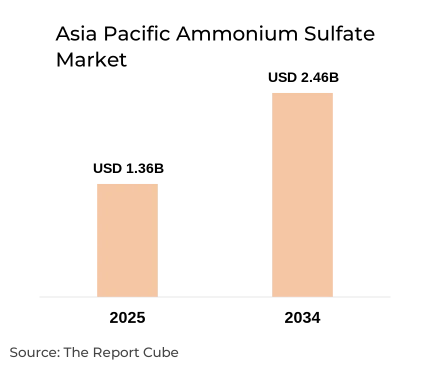
The Asia Pacific Ammonium Sulfate Market is anticipated to register a CAGR of 6.80% during 2026-2034. The market size was valued at USD 1.36 billion in 2025 and is projected to reach USD 2.46 billion by 2034. Ammonium sulfate remains a critical nitrogen and sulfur fertilizer widely used across Asia Pacific due to its cost efficiency, soil compatibility, and suitability for alkaline soils prevalent in major agricultural economies.
Agricultural intensification across China, India, Indonesia, and Vietnam continues to support sustained consumption. The region accounts for more than 55% of global rice and wheat production, creating steady nitrogen fertilizer requirements. Additionally, sulfur deficiency in soils has increased across South and Southeast Asia, prompting agronomists to recommend ammonium sulfate over urea in several cropping systems. Industrial demand from caprolactam and chemical manufacturing further supplements supply, creating a stable dual-demand structure. Strategic investments by regional producers to expand ammonia and downstream nitrogen capacity reinforce long-term supply reliability.
Asia Pacific Ammonium Sulfate Market Dynamics
Key Driver: Rising Agricultural Output and Sulfur Deficiency in Soils
Rapid agricultural expansion across Asia Pacific remains the primary growth engine for ammonium sulfate demand. Countries such as India and China together cultivate over 230 million hectares of arable land, requiring continuous nutrient replenishment. Studies across Southeast Asia indicate sulfur deficiency in nearly 45% of intensively farmed soils, directly supporting ammonium sulfate application as a dual nutrient source. Unlike urea, ammonium sulfate provides both nitrogen and sulfur, improving protein synthesis in crops such as rice, maize, and oilseeds. Government-backed soil health programs increasingly advocate balanced fertilization, which has lifted ammonium sulfate consumption by approximately 6-8% annually in major farming belts. As crop productivity targets rise to meet food security demands, farmers are prioritizing nutrient efficiency, strengthening long-term market stability.
Book your FREE 30-minute expert consultation today
Contact UsIndustry Trends: Capacity Expansion and Integration with Ammonia Value Chains
Producers across the region are aligning ammonium sulfate production with ammonia and caprolactam facilities to optimize cost structures. Integration reduces raw material volatility and enhances margin stability. In 2025, several manufacturers expanded nitrogen fertilizer capacities to meet domestic demand growth. Industry restructuring is also visible, with portfolio optimization affecting production footprints across Asia. Increasing preference for granular and crystalline solid forms improves distribution efficiency and storage life. Additionally, export opportunities from China and South Korea continue to influence regional trade flows, while India focuses on strengthening domestic production under fertilizer self-reliance initiatives.
Major Challenge: Volatility in Ammonia Prices and Environmental Regulations
Price fluctuations in ammonia, the primary feedstock, directly impact ammonium sulfate production economics. Ammonia price swings of up to 20% within a single quarter create cost uncertainty for manufacturers. Environmental compliance costs are also rising, particularly in China and South Korea, where emission standards for nitrogen compounds have tightened. Production units must invest in advanced emission control systems, increasing operational expenses. Competition from alternative nitrogen fertilizers such as urea and ammonium nitrate further intensifies pricing pressure. These combined factors create margin constraints, especially for smaller regional producers.
Opportunity: Growth in High-Value Crops and Export-Oriented Agriculture
Expansion of high-value crops including fruits, vegetables, and oilseeds presents strong growth potential. These crops require sulfur-enriched fertilization to enhance quality and yield. Southeast Asian countries such as Vietnam and Thailand are increasing export-oriented agricultural production, driving higher nutrient input per hectare. Controlled-release and specialty fertilizer blends incorporating ammonium sulfate are gaining traction among commercial farms. Rising awareness about soil health and balanced fertilization provides additional momentum. As governments push toward sustainable farming and yield optimization, ammonium sulfate is positioned as a reliable nutrient solution.
Asia Pacific Ammonium Sulfate Market Segment-wise Analysis
By Form:
- Solid
- Liquid
The solid segment dominates with nearly 74% market share in 2025 due to its logistical advantages and longer shelf life. Solid ammonium sulfate, available in crystalline and granular forms, is widely distributed through bulk fertilizer supply chains. It is particularly favored in large-scale cereal cultivation where cost efficiency and storage convenience are critical. Solid form application also aligns with mechanized spreading systems prevalent in China, Australia, and parts of India. Growing adoption of bulk handling infrastructure further supports segment leadership.
By Application:
- Fertilizers
- Industrial Uses
- Food Additives
- Pharmaceuticals
- Water Treatment
- Others
Fertilizers account for approximately 81% of total revenue, underscoring the agricultural foundation of the market. The nitrogen content of 21% combined with 24% sulfur makes ammonium sulfate particularly effective for sulfur-deficient soils. Demand is strongest in rice-growing regions of China, India, and Southeast Asia. Industrial uses such as caprolactam production represent a secondary but stable demand segment, while water treatment and pharmaceutical applications contribute niche volumes.
Regional Projection of Asia Pacific Ammonium Sulfate Industry
- China
- India
- Japan
- South Korea
- Australia
- Indonesia
- Malaysia
- Thailand
- Vietnam
- Rest of Asia Pacific
China leads the Asia Pacific ammonium sulfate market with roughly 38% share, supported by strong domestic production and export capabilities. India follows with significant growth driven by fertilizer subsidy programs and new ammonia-urea complex developments. Southeast Asian nations including Indonesia and Vietnam show increasing consumption tied to plantation agriculture and rice exports. Japan and South Korea maintain stable demand primarily linked to industrial and specialty applications.
Asia Pacific Ammonium Sulfate Market Recent Developments
- 2025: Sumitomo Chemical Co., Ltd. continued to be cited as a leading global ammonium sulfate producer, with strong demand growth linked to fertilizer applications across Asia Pacific agricultural markets.
- 2025: Hindustan Urvarak & Rasayan Ltd (HURL) indicated willingness to join a joint venture for the Namrup IV ammonia urea complex in Assam, targeting 1.27 million tonnes annual capacity to strengthen India’s fertilizer self-reliance.
- 2025: BASF’s Factbook highlighted restructuring within its ammonia value chain, including shutdown of an ammonium sulfate nitrate fertilizer plant as part of broader portfolio optimization efforts.
Need insights for a specific region within this market?
Request Regional DataWhy Choose This Report?
- Provides a comprehensive overview of the overall market analysis, encompassing key trends, consumer behavior analysis, and risk assessment to support strategic decision-making.
- Provides accurate, up-to-date insights into market size, segmentation, and emerging opportunities, helping to minimize risk & capitalizing on growth.
- Gives deep understanding of target audience preferences, investment habits, and communication channels for enhanced product development & marketing effectiveness.
- Delivers competitive analysis & benchmarking, uncovering the strengths & weaknesses of market competitors to guide strategies.
- Consolidate comprehensive market intelligence, reducing reasoning & streamlining research efforts.
- Facilitates customized market segmentation & risk mitigation strategies, fine-tuned to the business objectives.
- Aids in identifying both market challenges & untapped opportunities within the industry to drive long-term business growth.
- Provides valuable information based on actual customer data & search trends.
Table of Contents
- Introduction
- Objective of the Study
- Product and Category Definition
- Market Segmentation
- Study Variables
- Research Methodology
- Secondary Data Points
- Breakdown of Secondary Sources
- Primary Data Points
- Breakdown of Primary Interviews
- Secondary Data Points
- Executive Summary
- Market Dynamics
- Drivers
- Challenges
- Opportunity Assessment
- Recent Trends and Developments
- Regulatory and Policy Landscape
- Asia Pacific Ammonium Sulfate Market Overview (2021-2034)
- Market Size, By Value (USD Billion)
- Market Share, By Form
- Solid
- Liquid
- Market Share, By Application
- Fertilizers
- Industrial Uses
- Food Additives
- Pharmaceuticals
- Water Treatment
- Others
- Market Share, By Country
- China
- India
- Japan
- South Korea
- Australia
- Indonesia
- Malaysia
- Thailand
- Vietnam
- Rest of Asia Pacific
- Market Share, By Company
- Revenue Shares & Analysis
- Competitive Landscape
- China Ammonium Sulfate Market
- Market Size, By Value (USD Billion/Million)
- Market Share, By Form
- Market Share, By Application
- India Ammonium Sulfate Market
- Market Size, By Value (USD Billion/Million)
- Market Share, By Form
- Market Share, By Application
- Japan Ammonium Sulfate Market
- Market Size, By Value (USD Billion/Million)
- Market Share, By Form
- Market Share, By Application
- South Korea Ammonium Sulfate Market
- Market Size, By Value (USD Billion/Million)
- Market Share, By Form
- Market Share, By Application
- Australia Ammonium Sulfate Market
- Market Size, By Value (USD Billion/Million)
- Market Share, By Form
- Market Share, By Application
- Indonesia Ammonium Sulfate Market
- Market Size, By Value (USD Billion/Million)
- Market Share, By Form
- Market Share, By Application
- Malaysia Ammonium Sulfate Market
- Market Size, By Value (USD Billion/Million)
- Market Share, By Form
- Market Share, By Application
- Thailand Ammonium Sulfate Market
- Market Size, By Value (USD Billion/Million)
- Market Share, By Form
- Market Share, By Application
- Vietnam Ammonium Sulfate Market
- Market Size, By Value (USD Billion/Million)
- Market Share, By Form
- Market Share, By Application
- Competitive Outlook and Company Profiles
- Sumitomo Chemical Co., Ltd.
- Company Overview
- Product Portfolio
- Strategic Alliances/Partnerships
- Recent Developments
- UBE Corporation
- Company Overview
- Product Portfolio
- Strategic Alliances/Partnerships
- Recent Developments
- The Fertilisers and Chemicals Travancore Ltd (FACT)
- Company Overview
- Product Portfolio
- Strategic Alliances/Partnerships
- Recent Developments
- Zhejiang Juhua Co., Ltd.
- Company Overview
- Product Portfolio
- Strategic Alliances/Partnerships
- Recent Developments
- Taekwang Industrial Co., Ltd.
- Company Overview
- Product Portfolio
- Strategic Alliances/Partnerships
- Recent Developments
- Gujarat State Fertilizers & Chemicals (GSFC)
- Company Overview
- Product Portfolio
- Strategic Alliances/Partnerships
- Recent Developments
- PetroVietnam Fertilizer & Chemicals Corp (PVFCCo)
- Company Overview
- Product Portfolio
- Strategic Alliances/Partnerships
- Recent Developments
- Capro Corporation
- Company Overview
- Product Portfolio
- Strategic Alliances/Partnerships
- Recent Developments
- Deepak Fertilisers & Petrochemicals Corp
- Company Overview
- Product Portfolio
- Strategic Alliances/Partnerships
- Recent Developments
- Kanto Chemical Co., Inc.
- Company Overview
- Product Portfolio
- Strategic Alliances/Partnerships
- Recent Developments
- Shandong Mingyu Chemical Co., Ltd.
- Company Overview
- Product Portfolio
- Strategic Alliances/Partnerships
- Recent Developments
- Hindustan Urvarak & Rasayan Ltd (HURL)
- Company Overview
- Product Portfolio
- Strategic Alliances/Partnerships
- Recent Developments
- Toray Industries, Inc.
- Company Overview
- Product Portfolio
- Strategic Alliances/Partnerships
- Recent Developments
- Tokyo Chemical Industry (TCI)
- Company Overview
- Product Portfolio
- Strategic Alliances/Partnerships
- Recent Developments
- BASF (China) Co., Ltd.
- Company Overview
- Product Portfolio
- Strategic Alliances/Partnerships
- Recent Developments
- Kishida Chemical Co., Ltd.
- Company Overview
- Product Portfolio
- Strategic Alliances/Partnerships
- Recent Developments
- Vinipul Inorganic Pvt. Ltd.
- Company Overview
- Product Portfolio
- Strategic Alliances/Partnerships
- Recent Developments
- Others
- Sumitomo Chemical Co., Ltd.
- Contact Us and Disclaimer
Top Key Players & Market Share Outlook
- Sumitomo Chemical Co., Ltd.
- UBE Corporation
- The Fertilisers and Chemicals Travancore Ltd (FACT)
- Zhejiang Juhua Co., Ltd.
- Taekwang Industrial Co., Ltd.
- Gujarat State Fertilizers & Chemicals (GSFC)
- PetroVietnam Fertilizer & Chemicals Corp (PVFCCo)
- Capro Corporation
- Deepak Fertilisers & Petrochemicals Corp
- Kanto Chemical Co., Inc.
- Shandong Mingyu Chemical Co., Ltd.
- Hindustan Urvarak & Rasayan Ltd (HURL)
- Toray Industries, Inc.
- Tokyo Chemical Industry (TCI)
- BASF (China) Co., Ltd.
- Kishida Chemical Co., Ltd.
- Vinipul Inorganic Pvt. Ltd.
- Others
Frequently Asked Questions