



Build Your Custom Market Intelligence Report
Customize Your ReportAsia Pacific Aniline Market Key Highlights
By Technology:
Nitrobenzene Hydrogenation segment leads the market, accounting for nearly 74% of total production share.
By Application:
Methylene Diphenyl Diisocyanate (MDI) dominates the market, representing around 68% of total revenue.
Regional Outlook:
China dominates the Asia Pacific market with approximately 55% share.
Government Initiatives & Policies
- China 14th Five-Year Plan for Petrochemical Industry: Focuses on high-value chemical integration and green transformation.
- India Production Linked Incentive (PLI) Scheme for Chemicals: Encourages domestic manufacturing of specialty and bulk chemicals.
Asia Pacific Aniline Market Insights & Analysis
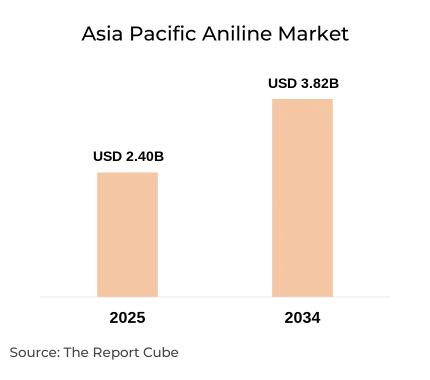
The Asia Pacific Aniline Market is anticipated to register a CAGR of 5.30% during 2026-2034. The market size was valued at USD 2.4 billion in 2025 and is projected to reach USD 3.82 billion by 2034. Aniline remains a strategic intermediate chemical, primarily used in the production of methylene diphenyl diisocyanate (MDI), which is essential for polyurethane foams across construction, automotive, appliances, and insulation applications.
Asia Pacific accounts for the largest global share of aniline production and consumption due to integrated petrochemical hubs in China, India, Japan, and South Korea. Over 80% of regional aniline output is consumed internally for MDI manufacturing, creating a tightly linked upstream-downstream value chain. Rising infrastructure spending across India and Southeast Asia, coupled with expanding automotive production in China and South Korea, continues to fuel polyurethane demand. Investments in capacity expansion, low-carbon production processes, and renewable-energy-powered chemical plants are further reshaping competitive positioning in the region.
Asia Pacific Aniline Market Dynamics
Key Driver: Expanding Polyurethane Demand Across Construction and Automotive Sectors
Rapid urbanization and industrialization across Asia Pacific remain primary growth engines for aniline consumption. Polyurethane foams derived from MDI are widely used in insulation panels, flexible seating foams, refrigeration systems, and automotive interiors. China alone accounted for more than 2.9 billion square meters of new construction floor space approvals in recent years, sustaining demand for insulation-grade polyurethane materials. Meanwhile, automotive production across Asia Pacific exceeded 50 million vehicles annually, with polyurethane components representing nearly 20% of interior polymer use. The strong linkage between aniline and MDI production ensures stable demand fundamentals. Infrastructure modernization programs, energy-efficient building mandates, and electric vehicle expansion further strengthen consumption trends. As construction standards increasingly emphasize thermal efficiency, rigid polyurethane foam demand rises, directly increasing aniline requirements for MDI synthesis.
Book your FREE 30-minute expert consultation today
Contact UsIndustry Trends: Transition Toward Low-Carbon and Bio-Based Aniline Production
Sustainability-driven transformation is shaping the Asia Pacific aniline market landscape. Manufacturers are investing in renewable energy integration, carbon capture utilization, and bio-based feedstocks to reduce environmental footprint. By late 2025, several major producers initiated pilot-scale bio-based aniline production processes to support low-carbon MDI applications. Green hydrogen adoption for nitrobenzene hydrogenation is emerging as a notable trend, aiming to lower Scope 1 emissions. Additionally, digitalization of process plants through advanced monitoring systems has improved operational efficiency by nearly 12%, reducing waste and optimizing raw material usage. Customers in construction and automotive sectors increasingly prioritize sustainable supply chains, influencing procurement strategies toward lower-carbon aniline sources.
Major Challenge: Volatility in Raw Material Prices and Environmental Regulations
Fluctuations in benzene and nitric acid prices significantly influence aniline production costs. Benzene price volatility of nearly 18-25% annually impacts profit margins for producers operating under long-term supply contracts. Environmental compliance requirements in China, Japan, and South Korea have tightened emissions thresholds, requiring additional capital investment in effluent treatment and emission control systems. Smaller producers face operational strain due to compliance costs and periodic plant shutdowns for inspections. Logistics disruptions and feedstock supply imbalances further contribute to pricing instability. These factors collectively create margin pressure, especially during periods of weak downstream demand.
Opportunity: Rising Demand from Agrochemicals and High-Performance Materials
Beyond polyurethane, diversified applications such as agrochemical intermediates, dyes, and specialty rubber chemicals present strong growth avenues. Asia Pacific remains the world’s largest agricultural input market, with crop protection chemical demand rising steadily. Aniline derivatives play a critical role in herbicide and pesticide manufacturing. Moreover, expansion in high-performance coatings and specialty elastomers offers incremental demand growth. Electric vehicle adoption also stimulates use of lightweight polyurethane components, indirectly boosting aniline consumption. Strategic collaborations between upstream aniline producers and downstream polyurethane manufacturers are expected to strengthen supply chain integration and support long-term expansion.
Asia Pacific Aniline Market Segment-wise Analysis
By Technology:
- Nitrobenzene Hydrogenation
- Chlorobenzene Ammonolysis
- Reduction of Nitroaromatics
- Others
Nitrobenzene Hydrogenation dominates the Asia Pacific aniline market with nearly 74% share due to its operational efficiency and compatibility with large-scale integrated plants. The process offers higher yield efficiency exceeding 95% conversion rates and lower by-product formation compared to alternative methods. China and Japan host several world-scale plants utilizing continuous hydrogenation technology, enabling cost competitiveness. Integration with upstream benzene units and downstream MDI facilities further enhances supply chain stability and economies of scale.
By Application:
- Methylene Diphenyl Diisocyanate
- Rubber Processing Chemicals
- Dyes and Pigments
- Agrochemical Intermediates
- Pharmaceutical Intermediates
- Others
Methylene Diphenyl Diisocyanate accounts for approximately 68% of total regional aniline consumption. Strong demand for rigid polyurethane foam in insulation and flexible foam in automotive seating underpins this dominance. Asia Pacific polyurethane production capacity exceeded 25 million metric tons annually, reflecting sustained industrial and residential growth. Integration of aniline and MDI production within chemical complexes reduces logistics costs and enhances pricing stability. Expansion of cold chain infrastructure and appliance manufacturing further reinforces application growth.
Regional Projection of Asia Pacific Aniline Industry
- China
- India
- Japan
- South Korea
- Australia
- Rest of Asia Pacific
China leads the Asia Pacific aniline market with roughly 55% share, supported by integrated chemical parks and dominant MDI production capacity. India follows with rising domestic demand from construction and agriculture sectors. Japan and South Korea emphasize high-value specialty chemicals and sustainable manufacturing processes. Australia and Southeast Asian countries represent emerging demand centers, driven by infrastructure development and expanding manufacturing bases. Regional diversification reduces supply risk while strengthening export capabilities.
Asia Pacific Aniline Market Recent Developments
- 2025: Wanhua Chemical showcased advanced polyurethane and low-VOC coating systems at CHINACOAT, highlighting strong integration between aniline and MDI production for construction and automotive customers across Asia Pacific.
- 2025: BASF expanded amines capacity at its Nanjing site, nearly doubling DMAPA output and increasing PEA production by 25%, powered entirely by renewable electricity to reduce carbon emissions.
- 2025: GNFC approved an INR 450 crore AN Melt II project, aiming to nearly double ammonium nitrate melt capacity to around 338,000 tonnes annually, strengthening downstream chemical value chains.
- 2025: Kumho Mitsui Chemicals reinforced its integrated aniline and MDA production chain, supporting secure MDI supply for Asia Pacific polyurethane markets.
- 2025: Covestro advanced industrialization of bio-based aniline technology for lower-carbon MDI production, preparing regional customers for sustainable insulation and appliance solutions.
Need insights for a specific region within this market?
Request Regional DataWhy Choose This Report?
- Provides a comprehensive overview of the overall market analysis, encompassing key trends, consumer behavior analysis, and risk assessment to support strategic decision-making.
- Provides accurate, up-to-date insights into market size, segmentation, and emerging opportunities, helping to minimize risk & capitalizing on growth.
- Gives deep understanding of target audience preferences, investment habits, and communication channels for enhanced product development & marketing effectiveness.
- Delivers competitive analysis & benchmarking, uncovering the strengths & weaknesses of market competitors to guide strategies.
- Consolidate comprehensive market intelligence, reducing reasoning & streamlining research efforts.
- Facilitates customized market segmentation & risk mitigation strategies, fine-tuned to the business objectives.
- Aids in identifying both market challenges & untapped opportunities within the industry to drive long-term business growth.
- Provides valuable information based on actual customer data & search trends.
Table of Contents
- Introduction
- Objective of the Study
- Product and Category Definition
- Market Segmentation
- Study Variables
- Research Methodology
- Secondary Data Points
- Breakdown of Secondary Sources
- Primary Data Points
- Breakdown of Primary Interviews
- Secondary Data Points
- Executive Summary
- Market Dynamics
- Drivers
- Challenges
- Opportunity Assessment
- Recent Trends and Developments
- Regulatory and Policy Landscape
- Asia Pacific Aniline Market Overview (2021-2034)
- Market Size, By Value (USD Billion)
- Market Share, By Technology
- Nitrobenzene Hydrogenation
- Chlorobenzene Ammonolysis
- Reduction of Nitroaromatics
- Others
- Market Share, By Application
- Methylene Diphenyl Diisocyanate
- Rubber Processing Chemicals
- Dyes and Pigments
- Agrochemical Intermediates
- Pharmaceutical Intermediates
- Others
- Market Share, By End-Use Industry
- Building and Construction
- Automotive and Transportation
- Consumer Goods and Appliances
- Textile and Leather
- Agriculture and Crop Protection
- Electronics and Electrical
- Others
- Market Share, By Country
- China
- India
- Japan
- South Korea
- Australia
- Rest of Asia Pacific
- Market Share, By Company
- Revenue Shares and Analysis
- Competitive Landscape
- China Aniline Market
- Market Size, By Value (USD Billion/Million)
- Market Share, By Technology
- Market Share, By Application
- Market Share, By End-Use Industry
- India Aniline Market
- Market Size, By Value (USD Billion/Million)
- Market Share, By Technology
- Market Share, By Application
- Market Share, By End-Use Industry
- Japan Aniline Market
- Market Size, By Value (USD Billion/Million)
- Market Share, By Technology
- Market Share, By Application
- Market Share, By End-Use Industry
- South Korea Aniline Market
- Market Size, By Value (USD Billion/Million)
- Market Share, By Technology
- Market Share, By Application
- Market Share, By End-Use Industry
- Australia Aniline Market
- Market Size, By Value (USD Billion/Million)
- Market Share, By Technology
- Market Share, By Application
- Market Share, By End-Use Industry
- Competitive Outlook and Company Profiles
- Wanhua Chemical Group
- Company Overview
- Product Portfolio
- Strategic Alliances/Partnerships
- Recent Developments
- Sinopec (NJCH)
- Company Overview
- Product Portfolio
- Strategic Alliances/Partnerships
- Recent Developments
- BASF East Asia
- Company Overview
- Product Portfolio
- Strategic Alliances/Partnerships
- Recent Developments
- GNFC (Gujarat Narmada)
- Company Overview
- Product Portfolio
- Strategic Alliances/Partnerships
- Recent Developments
- Sumitomo Chemical
- Company Overview
- Product Portfolio
- Strategic Alliances/Partnerships
- Recent Developments
- Mitsui Chemicals
- Company Overview
- Product Portfolio
- Strategic Alliances/Partnerships
- Recent Developments
- Tosoh Corporation
- Company Overview
- Product Portfolio
- Strategic Alliances/Partnerships
- Recent Developments
- SP Chemicals
- Company Overview
- Product Portfolio
- Strategic Alliances/Partnerships
- Recent Developments
- Jilin Connell Chemical
- Company Overview
- Product Portfolio
- Strategic Alliances/Partnerships
- Recent Developments
- Shandong Jinling Group
- Company Overview
- Product Portfolio
- Strategic Alliances/Partnerships
- Recent Developments
- Kumho Mitsui Chemicals
- Company Overview
- Product Portfolio
- Strategic Alliances/Partnerships
- Recent Developments
- Mitsubishi Chemical
- Company Overview
- Product Portfolio
- Strategic Alliances/Partnerships
- Recent Developments
- Covestro
- Company Overview
- Product Portfolio
- Strategic Alliances/Partnerships
- Recent Developments
- Shanghai Huayi Group
- Company Overview
- Product Portfolio
- Strategic Alliances/Partnerships
- Recent Developments
- Huntsman
- Company Overview
- Product Portfolio
- Strategic Alliances/Partnerships
- Recent Developments
- Zhejiang Longsheng
- Company Overview
- Product Portfolio
- Strategic Alliances/Partnerships
- Recent Developments
- Others
- Wanhua Chemical Group
- Contact Us and Disclaimer
Top Key Players & Market Share Outlook
- Wanhua Chemical Group
- Sinopec (NJCH)
- BASF East Asia
- GNFC (Gujarat Narmada)
- Sumitomo Chemical
- Mitsui Chemicals
- Tosoh Corporation
- SP Chemicals
- Jilin Connell Chemical
- Shandong Jinling Group
- Kumho Mitsui Chemicals
- Mitsubishi Chemical
- Covestro
- Shanghai Huayi Group
- Huntsman
- Zhejiang Longsheng
- Others
Frequently Asked Questions






