



Build Your Custom Market Intelligence Report
Customize Your ReportGermany Anticaking Market Key Takeaways
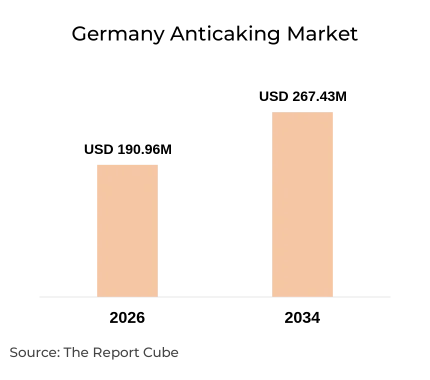
- Germany Anticaking Market was valued at USD 190.96 million in 2026, signaling steady specialty chemicals demand.
- Industry projected to reach USD 267.43 million by 2034, expanding at a 4.30% CAGR.
- Food and beverage remains the dominant application segment, driven by processed food production growth.
- Calcium compounds lead the type segment owing to widespread food-grade and industrial applications.
- Germany maintains regional leadership within European anticaking due to robust chemical manufacturing infrastructure.
- Clean-label and natural anticaking agent adoption is accelerating across food and personal care sectors.
- Leading companies include Evonik Industries AG, BASF SE, Kao Corporation, K+S Minerals and Agriculture GmbH, and Denk Ingredients GmbH.
- Rising processed food consumption, expanding personal care formulations, and thriving agriculture sector fuel long-term market expansion.
Germany Anticaking Market Insights & Analysis
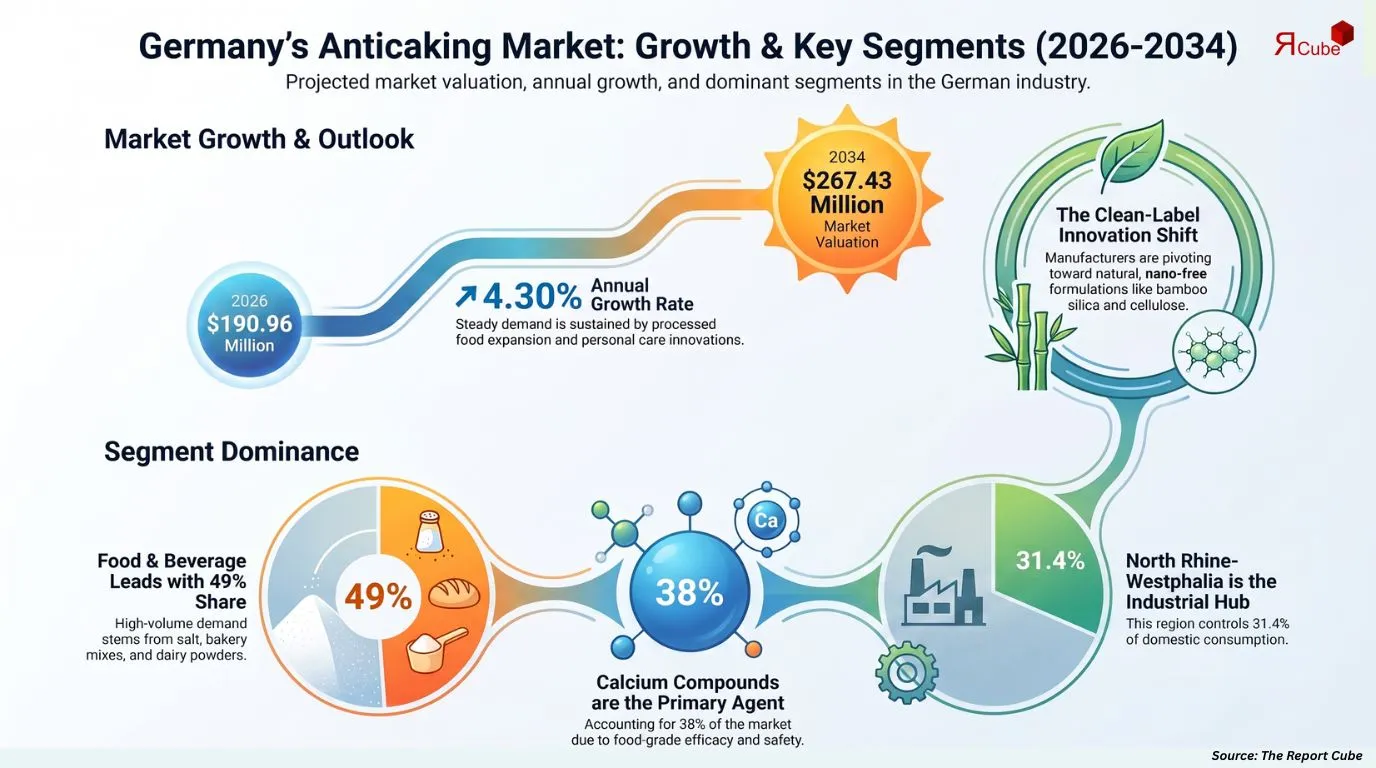
The Germany Anticaking Market is anticipated to register a 4.30% CAGR during 2026–2034. The market size was valued at USD 190.96 million in 2026 and is projected to reach USD 267.43 million by 2034. Germany's position as Europe's largest food processing economy and a global specialty chemicals hub continues reinforcing consistent demand for high-performance anticaking agents across food manufacturing, animal feed production, personal care formulation, and agricultural inputs. Regulatory compliance under EU food additive frameworks and growing investments in sustainable ingredient development are creating additional momentum across both domestic producers and multinational chemical companies active in the German market.
Consumer preferences for clean-label, minimally processed, and transparently formulated products are reshaping procurement strategies among Germany's leading food manufacturers. Key players such as Evonik Industries AG and BASF SE are investing in silica-based and magnesium silicate anticaking systems that meet EU Regulation (EC) No 1333/2008 standards while supporting natural-sourcing mandates. Increasing deployment of powdered nutraceuticals, functional dairy ingredients, protein supplements, and instant beverage formulations further broadens the addressable market for anticaking agents in Germany, sustaining a positive long-term demand trajectory through the forecast period.
Germany Anticaking Market Dynamics
Germany's anticaking ingredients sector continues expanding as food manufacturers, cosmetics producers, agricultural input suppliers, and specialty chemical distributors increase procurement of high-performance flow-enhancement additives. Strict EU food safety regulations, expanding processed food categories, growing animal nutrition industries, and increasing consumer demand for premium personal care formulations are collectively reinforcing market momentum. Innovations in biodegradable and nano-free anticaking formulations further support the transition toward sustainable product portfolios across industrial and consumer-facing applications.
|
Factor |
Type |
Specific Impact on Market |
Magnitude |
|---|---|---|---|
|
Rising processed food consumption |
Driver |
Accelerates anticaking agent demand across bakery, dairy, and seasoning segments |
Very High |
|
Clean-label ingredient shift |
Trend |
Boosts natural anticaking agent adoption in food and nutraceutical formulations |
High |
|
EU food additive compliance |
Driver |
Reinforces procurement of certified, regulation-compliant calcium and sodium compound agents |
High |
|
Expanding personal care sector |
Opportunity |
Increases magnesium stearate and silica demand in cosmetic powder formulations |
High |
|
Agricultural input modernization |
Driver |
Drives anticaking agent use in fertilizer granulation and compound feed manufacturing |
Moderate |
Key Market Driver: Processed Food Industry Expansion Accelerating Demand
Germany processes approximately 185 billion euros worth of food and beverage products annually, making it the largest food manufacturing economy in Europe. This scale creates substantial and consistent demand for anticaking agents across salt, powdered spices, dried dairy, instant soup, bakery mixes, and seasoning blends. German food producers are increasingly adopting calcium silicate and silicon dioxide-based agents that conform to EU additive specifications while enabling improved powder flow, moisture resistance, and extended shelf stability across high-volume manufacturing environments. Growing exports of German processed food products to over 180 countries further amplify domestic anticaking ingredient procurement volumes, supporting sustained market expansion through anticaking applications in the food ingredients sector.
Major Industry Challenge: Stringent EU Regulatory Compliance Burden
Germany's anticaking market operates under one of the world's most rigorous food additive and chemical substance regulatory frameworks, including EU Regulation (EC) No 1333/2008, REACH compliance requirements, and ongoing European Food Safety Authority re-evaluation processes for permitted additives. Manufacturers must continuously validate the purity, safety, and application-specific concentration limits of calcium, sodium, and magnesium compound-based anticaking agents. These compliance obligations increase formulation costs, extend product approval timelines, and create barriers for smaller ingredient suppliers attempting to introduce novel anticaking substances, which collectively constrain market entry and slow portfolio diversification across certain specialty applications.
Emerging Trend Shaping Outlook: Natural and Nano-Free Formulation Innovation
German food producers and cosmetics manufacturers are increasingly demanding anticaking agents derived from natural sources such as bamboo silica, organic rice flour, powdered cellulose, and corn starch in response to clean-label consumer trends. Simultaneously, regulators are scrutinizing nano-particle-based additives, prompting R&D investment in nano-free silica alternatives that maintain equivalent flow enhancement performance. Evonik Industries AG has specifically advanced its AEROSIL silica product lines to address these requirements, while BASF SE continues developing compliant, biodegradable anticaking formulations. This natural ingredient pivot is reshaping supplier qualification standards and long-term procurement strategies across Germany's food, feed, and personal care anticaking formulations.
Need Specific Data, Let’s Customize the Report for You
Request CustomizationGermany Anticaking Market Segment-wise Analysis
Germany's anticaking ingredients market encompasses a diverse portfolio of compound types and end-use applications, reflecting the country's deep industrial base in food manufacturing, specialty chemicals, personal care production, and agricultural inputs. Both type-based and application-based demand patterns exhibit distinct growth trajectories driven by regulatory evolution, consumer preferences, and sector-specific formulation requirements.
By Type
- Calcium Compounds
- Sodium Compounds
- Magnesium Compounds
- Other Types
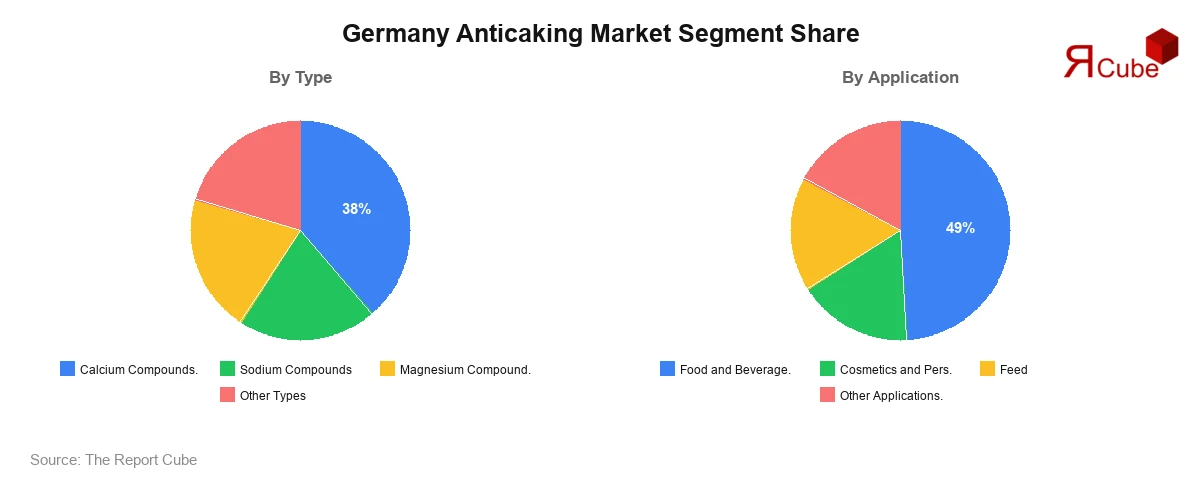
Calcium compounds dominate Germany's anticaking market by type, accounting for an estimated 38% market share. Calcium silicate, calcium carbonate, and dibasic calcium phosphate are widely adopted across food manufacturing applications including table salt, powdered dairy ingredients, bakery premixes, and pharmaceutical excipients due to their proven moisture absorption efficacy, regulatory acceptance under EU standards, and broad compatibility with organic and inorganic substrates. Their dual functionality as both anticaking agents and calcium fortification sources further supports their preference among food-grade ingredient manufacturers. K+S Minerals and Agriculture GmbH and BASF SE remain the primary domestic suppliers of industrial and food-grade calcium compound anticaking agents in Germany.
Sodium compounds, including sodium aluminosilicate and sodium ferrocyanide, represent a significant secondary segment with an estimated 27% market share, particularly within table salt and processed cheese applications. Magnesium compounds, especially magnesium stearate and magnesium carbonate, are gaining accelerating traction in personal care powder formulations and nutraceutical capsules, driven by their superior lubrication properties and compatibility with sensitive skin formulations. The other types segment, encompassing silicon dioxide and tricalcium phosphate, is expanding through specialty silicon dioxide anticaking applications in premium instant beverage and protein supplement manufacturing, reflecting evolving functional ingredient demands across Germany's health-focused food categories.
By Application
- Food and Beverage
- Cosmetics and Personal Care
- Feed
- Other Applications
The food and beverage segment dominates Germany's anticaking market by application, commanding an estimated 49% market share. Germany's large-scale production of salt, bakery goods, powdered dairy products, instant soups, dry seasonings, and ready-to-eat meal components creates continuous high-volume demand for effective anticaking solutions. EU food additive regulations governing permitted substances and maximum concentration limits drive procurement toward established calcium and sodium compound-based agents that offer consistent performance across automated food manufacturing lines. Growing product development activity in powdered functional foods, protein fortification systems, and clean-label seasoning blends is further broadening demand across this leading segment.
The cosmetics and personal care application segment is emerging as the fastest-growing category, supported by Germany's position as Europe's third-largest cosmetics market generating over 13 billion euros in annual revenues. Magnesium stearate and silica-based anticaking agents are increasingly incorporated in loose powder foundations, dry shampoos, setting powders, and skincare formulations to prevent clumping and ensure consistent texture across diverse humidity conditions. The animal feed segment, supported by Germany's robust livestock and poultry production sectors, relies on calcium and silicon dioxide-based agents to maintain pellet integrity and compound feed flowability. Other applications, including fertilizer granulation and industrial detergents, continue contributing to baseline volume demand through agricultural anticaking agent applications.
Regional Projection of Germany Anticaking Market
As a country-level market report, the following section provides regional insights within Germany's key consumption geographies, supplemented by Germany's position within the broader European anticaking landscape, where distinct demand patterns, industrial concentrations, and regulatory dynamics shape growth across different areas of the country.
|
Region |
Estimated Market Share |
Key Growth Factors |
Consumer Trends |
|---|---|---|---|
|
North Rhine-Westphalia |
31.4% |
Dense food processing and chemical manufacturing cluster |
High demand for calcium and sodium compound agents |
|
Bavaria |
22.7% |
Strong dairy, bakery, and personal care production base |
Rising clean-label natural anticaking adoption |
|
Baden-Württemberg |
16.3% |
Specialty chemicals, pharma, and nutraceutical manufacturing |
Magnesium compound demand in pharmaceutical excipients |
|
Lower Saxony |
14.8% |
Animal feed production and agricultural input manufacturing |
Growing feed-grade anticaking procurement |
|
Other German Regions |
14.8% |
Distributed food manufacturing and SME chemical producers |
Emerging adoption in artisanal and specialty food categories |
- North Rhine-Westphalia: North Rhine-Westphalia leads domestic consumption with approximately 31.4% share, anchored by BASF and Evonik's major chemical production facilities and Germany's densest food processing industrial cluster.
- Bavaria: Bavaria's substantial dairy processing, bakery goods manufacturing, and expanding personal care sector drive sustained calcium compound and magnesium stearate procurement across Munich and Nuremberg production corridors.
- Baden-Württemberg: Strong pharmaceutical excipient manufacturing and nutraceutical production in Stuttgart and Mannheim support growing magnesium compound anticaking demand in capsule and tablet formulation applications.
- Lower Saxony: Germany's leading animal feed and agricultural input manufacturing region sustains consistent feed-grade anticaking agent volumes across major livestock and poultry production operations.
- Other German Regions: Remaining states including Saxony, Hesse, and Brandenburg contribute incremental growth through distributed food processing, specialty chemical distribution, and emerging organic food production operations seeking natural anticaking solutions.
Germany Anticaking Market: Recent Development (2025)
- Evonik Industries AG launched TEGO Powder Aid F05, enhancing powder coating flowability and anti-caking performance in industrial applications.
- BASF SE expanded its sustainable food-grade anticaking agent range aligned with EU clean-label ingredient compliance and REACH obligations.
- K+S Minerals and Agriculture GmbH strengthened its feed-grade mineral product portfolio, addressing rising anticaking demand in German animal nutrition.
- Denk Ingredients GmbH extended its specialty ingredient distribution network, improving anticaking agent availability across German food manufacturers.
Germany Anticaking Market Future Outlook (2034)
The Germany Anticaking Market is projected to expand at a steady 4.30% CAGR, reaching approximately USD 267.43 million by 2034. Sustained growth in Germany's processed food production, expanding cosmetics and personal care formulation activity, and increasing animal nutrition industry investments will maintain consistent demand for calcium, sodium, and magnesium compound-based anticaking agents. Accelerating adoption of natural, biodegradable, and nano-free anticaking ingredient platforms will create premium product development opportunities for specialty chemical manufacturers while reinforcing Germany's position as Europe's leading anticaking ingredients innovation hub through future anticaking market developments in Europe.
Long-term market expansion will be further supported by increasing R&D investment in silicon dioxide and plant-derived cellulose-based anticaking agents, growing demand for pharmaceutical-grade flow enhancement additives, and rising export volumes of German-manufactured food ingredients requiring superior powder stability. Regulatory modernization within the EU, including ongoing EFSA re-evaluations and expanded clean-label mandates, will continue influencing supplier qualification priorities and formulation strategies. Companies investing in traceable, sustainably sourced, and REACH-compliant anticaking ingredient portfolios are well positioned to capture disproportionate market share growth through the 2034 forecast horizon.
Germany Anticaking Market Report Coverage
|
Report Attribute |
Details |
|---|---|
|
Market Name |
Germany Anticaking Market |
|
Market Size (2026) |
USD 190.96 Million |
|
Market Size (2034) |
USD 267.43 Million |
|
Forecast Period |
2026–2034 |
|
CAGR |
4.30% |
|
Base Year |
2026 |
|
Historical Years |
2021–2025 |
|
Forecast Years |
2026–2034 |
|
Segments Covered |
By Type (Calcium Compounds, Sodium Compounds, Magnesium Compounds, Other Types), By Application (Food and Beverage, Cosmetics and Personal Care, Feed, Other Applications) |
|
Regions Covered |
North Rhine-Westphalia, Bavaria, Baden-Württemberg, Lower Saxony, Other German Regions |
|
Key Companies |
Evonik Industries AG, Kao Corporation, BASF SE, Denk Ingredients GmbH, K+S Minerals and Agriculture GmbH, Par Drugs and Chemical Limited, Others |
|
Report Format |
PDF, Excel, PPT |
|
Customization |
Available as per client requirements |
Why Choose This Report?
- Comprehensive analysis of Germany's anticaking market across all major type and application segments.
- Accurate market sizing with reliable 4.30% CAGR forecast through 2034.
- Detailed segmentation identifying calcium compounds as the revenue-leading market category.
- Country-level regional insights covering key German industrial consumption geographies.
- Competitive profiling of Evonik Industries AG, BASF SE, K+S, and other key players.
- Analysis of clean-label, nano-free, and natural anticaking ingredient adoption trends.
- Regulatory landscape coverage including EU food additive and REACH compliance frameworks.
- Strategic insights supporting sourcing, investment, and product development planning.
Table of Contents
- Introduction
- Objective of the Study
- Product Definition
- Market Segmentation
- Study Variables
- Research Methodology
- Secondary Data Points
- Companies Interviewed
- Primary Data Points
- Breakdown of Primary Interviews
- Secondary Data Points
- Executive Summary
- Market Dynamics
- Drivers
- Challenges
- Opportunity Assessment
- Recent Trends and Developments
- Policy and Regulatory Landscape
- Germany Anticaking Market Overview and Forecast Analysis (2021-2034)
- Market Size, By Value, By Growth Rate (CAGR/USD Millions)
- Demand – Supply Trends
- Market Share, By Type
- Calcium Compounds
- Sodium Compounds
- Magnesium Compounds
- Other Types
- Market Share, By Application
- Food and Beverage
- Cosmetics and Personal Care
- Feed
- Other Applications
- Market Share, By Region
- North Rhine-Westphalia
- Bavaria
- Baden-Württemberg
- Lower Saxony
- Other German Regions
- Market Share, By Competitors
- Competition Characteristics
- Revenue Shares
- Calcium Compounds Germany Anticaking Market Overview, 2021-2034F
- By Value (USD Million)
- By Application – Market Size & Forecast 2021-2034, USD Million
- Food and Beverage
- Cosmetics and Personal Care
- Feed
- Other Applications
- Sodium Compounds Germany Anticaking Market Overview, 2021-2034F
- By Value (USD Million)
- By Application – Market Size & Forecast 2021-2034, USD Million
- Food and Beverage
- Cosmetics and Personal Care
- Feed
- Other Applications
- Magnesium Compounds Germany Anticaking Market Overview, 2021-2034F
- By Value (USD Million)
- By Application – Market Size & Forecast 2021-2034, USD Million
- Food and Beverage
- Cosmetics and Personal Care
- Feed
- Other Applications
- Other Types Germany Anticaking Market Overview, 2021-2034F
- By Value (USD Million)
- By Application – Market Size & Forecast 2021-2034, USD Million
- Food and Beverage
- Cosmetics and Personal Care
- Feed
- Other Applications
- Competitive Outlook (Company Profile – Partial List)
- Evonik Industries AG
- Company Overview
- Business Segments
- Strategic Alliances/Partnerships
- Recent Developments
- Kao Corporation
- Company Overview
- Business Segments
- Strategic Alliances/Partnerships
- Recent Developments
- BASF SE
- Company Overview
- Business Segments
- Strategic Alliances/Partnerships
- Recent Developments
- Denk Ingredients GmbH
- Company Overview
- Business Segments
- Strategic Alliances/Partnerships
- Recent Developments
- K+S Minerals and Agriculture GmbH
- Company Overview
- Business Segments
- Strategic Alliances/Partnerships
- Recent Developments
- Par Drugs and Chemical Limited
- Company Overview
- Business Segments
- Strategic Alliances/Partnerships
- Recent Developments
- Others
- Evonik Industries AG
- Contact Us & Disclaimer
Top Key Players & Market Share Outlook
- Evonik Industries AG
- Kao Corporation
- BASF SE
- Denk Ingredients GmbH
- K+S Minerals and Agriculture GmbH
- Par Drugs and Chemical Limited
- Others
Frequently Asked Questions






