



Build Your Custom Market Intelligence Report
Customize Your ReportUS Antihistamine Drugs Market Key Takeaways
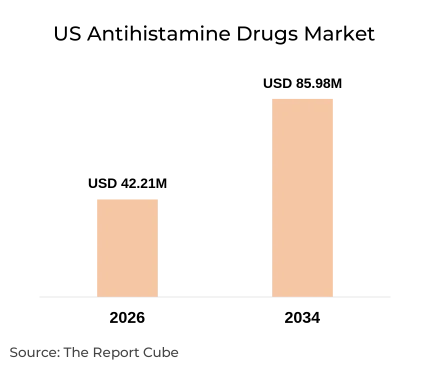
- US Antihistamine Drugs Market was valued at USD 42.21 million in 2026.
- Market is projected to reach USD 85.98 million by 2034 globally.
- Industry is anticipated to expand at a robust 9.35% CAGR through 2034.
- Allergy indication dominates segment revenue across all antihistamine drug categories.
- Oral route of administration leads due to widespread patient preference nationwide.
- North America maintains leadership with advanced healthcare access and insurance coverage.
- Asia-Pacific is the fastest-growing region driven by rising allergy prevalence rates.
- AI-driven drug discovery and next-generation antihistamine formulations accelerate pipeline development.
US Antihistamine Drugs Market Insights & Analysis
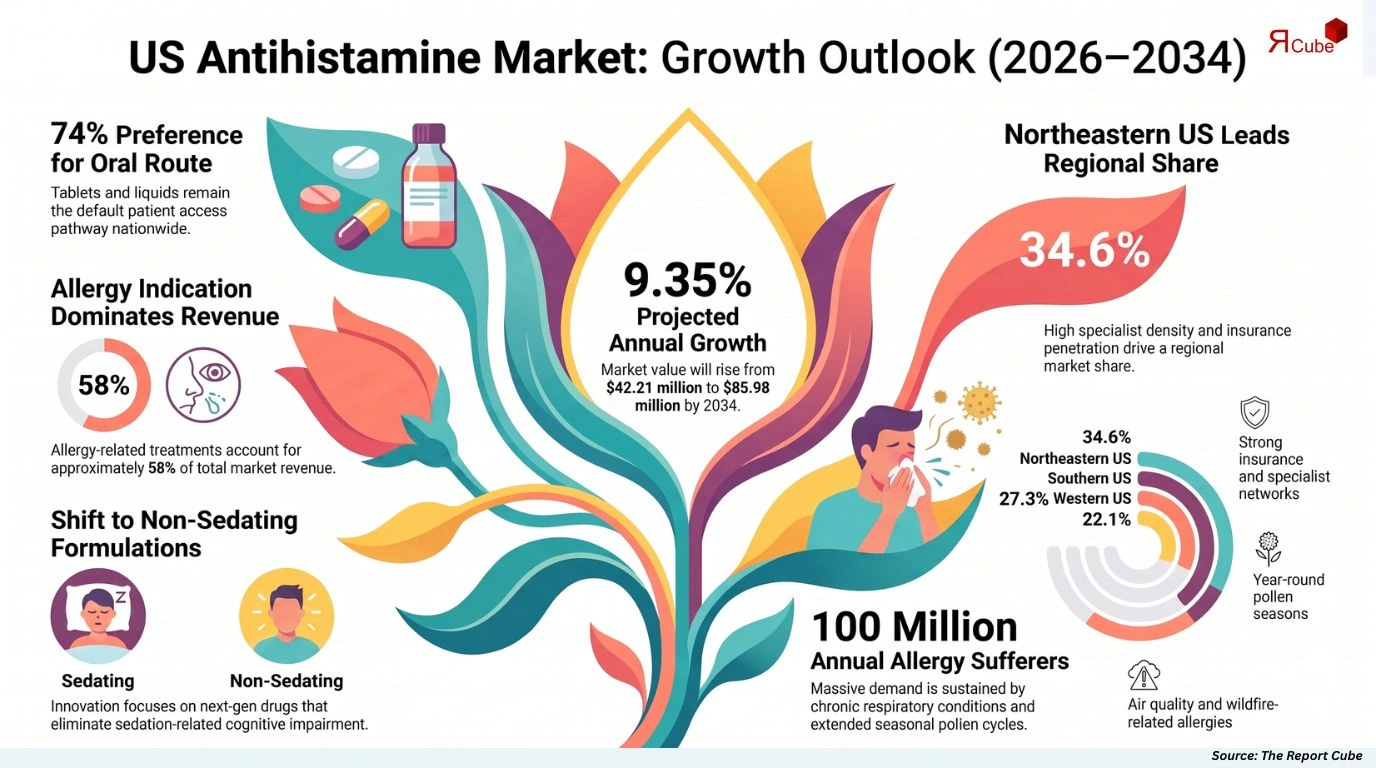
The US Antihistamine Drugs Market is anticipated to register a 9.35% CAGR during 2026–2034. The market size was valued at USD 42.21 million in 2026 and is projected to reach USD 85.98 million by 2034. The United States antihistamine drugs industry continues benefiting from increasing allergy burden, expanding over-the-counter drug access, and ongoing pharmaceutical investment in next-generation H1 and H2 receptor antagonists. The CDC estimates that more than 100 million Americans suffer from various allergy forms annually, sustaining strong prescription and OTC antihistamine demand. Federal drug approval streamlining through FDA's GDUFA program has also accelerated generic antihistamine entry, improving affordability and expanding patient reach across multiple demographics.
Pharmaceutical manufacturers are channeling significant resources into reformulated antihistamine products offering improved bioavailability, reduced sedative effects, and extended-release mechanisms. Sanofi's continued investment in its flagship cetirizine portfolio and Pfizer's OTC antihistamine expansion reflect broader industry commitment to innovation. Government healthcare initiatives, including expanded Medicaid coverage for allergy-related conditions, are further widening the addressable patient population and supporting market revenue growth through 2034.
US Antihistamine Drugs Market Dynamics
The US antihistamine drugs sector is experiencing sustained momentum driven by rising allergic disease prevalence, pharmaceutical pipeline expansion, and increasing patient awareness. Broader healthcare digitization, telehealth-driven allergy diagnosis growth, and regulatory support for faster OTC reclassification are collectively strengthening market fundamentals across prescription and consumer health antihistamine segments.
|
Factor |
Type |
Specific Impact on Market |
Magnitude |
|---|---|---|---|
|
Rising allergic rhinitis prevalence |
Driver |
Expands prescription and OTC antihistamine demand |
Very High |
|
OTC reclassification of antihistamines |
Opportunity |
Increases patient self-medication and retail sales |
High |
|
Sedation-related patient non-compliance |
Challenge |
Limits first-generation antihistamine adoption |
Moderate |
|
Next-generation non-sedating formulations |
Trend |
Drives physician preference and premium segment growth |
High |
|
Expanding Medicaid allergy coverage |
Driver |
Broadens antihistamine access among lower-income groups |
High |
Key Market Driver: Rising Allergic Rhinitis Burden Nationwide
Allergic rhinitis affects approximately 60 million Americans annually, representing one of the most prevalent chronic respiratory conditions across all age groups. Environmental changes, including increasing airborne pollen concentrations attributed to climate shifts, have extended allergy seasons by an estimated 20 days compared to two decades ago. This expanding allergic burden directly translates into higher antihistamine prescription rates, increased OTC purchases, and sustained pharmaceutical investment in both branded and generic drug portfolios serving allergy-affected patient populations across the United States.
Major Industry Challenge: First-Generation Sedation and Compliance Barriers
First-generation antihistamines including diphenhydramine and chlorpheniramine continue generating substantial retail volume despite well-documented sedative side effects that compromise patient productivity and adherence. Clinical studies indicate that sedating antihistamines impair driving ability and cognitive function at rates comparable to alcohol intoxication, driving growing physician preference toward second-generation alternatives. Formulary management pressure from pharmacy benefit managers and increasing patient education about non-sedating options are gradually reshaping prescribing patterns, creating transition-period revenue uncertainty for manufacturers heavily reliant on legacy sedating antihistamine portfolios.
Emerging Trend Shaping Outlook: Extended-Release and Combination Antihistamine Formulations
Pharmaceutical developers are advancing extended-release antihistamine formulations combining H1 antagonists with decongestants, corticosteroids, or leukotriene inhibitors to deliver superior symptom control through single-dose regimens. Merck's loratadine-pseudoephedrine combination products and AstraZeneca's pipeline investments in novel combination allergy therapeutics exemplify this industry direction. Extended-release technologies enabling once-daily dosing with improved tolerability profiles are attracting increasing physician endorsement, supporting premium pricing strategies and expanding revenue per patient across both prescription and OTC antihistamine channels through 2034.
Need Specific Data, Let’s Customize the Report for You
Request CustomizationUS Antihistamine Drugs Market Segment-wise Analysis
The US antihistamine drugs market encompasses diverse therapeutic indications and administration routes, with segment performance influenced by patient demographics, physician prescribing behaviors, reimbursement dynamics, and clinical efficacy profiles across different antihistamine drug classes and formulation types.
By Indication
- Allergy
- Urticaria
- Dermatitis
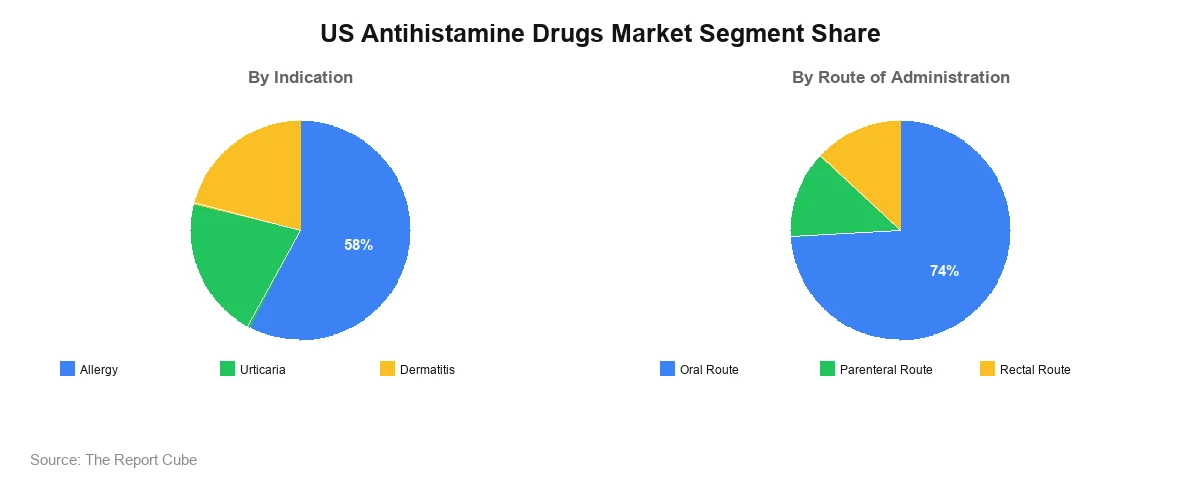
The allergy indication segment dominates the US antihistamine drugs market, accounting for approximately 58% of total market revenue in 2026. This dominance reflects the exceptionally high prevalence of allergic rhinitis, seasonal allergic conjunctivitis, and food allergies across American adults and pediatric populations. Widespread physician familiarity with antihistamine prescribing protocols for allergic conditions, combined with established OTC availability of cetirizine, loratadine, and fexofenadine, sustains consistent demand. Federal insurance reimbursement for prescription allergy antihistamines further reinforces the segment's revenue leadership across institutional and outpatient pharmacy channels.
Urticaria represents the second largest indication segment, driven by increasing chronic spontaneous urticaria diagnoses and growing use of second-generation antihistamines as first-line therapy per AAAAI clinical guidelines. Dermatitis indication is the fastest-growing sub-segment, with rising atopic dermatitis diagnoses and expanding off-label antihistamine utilization for pruritus management accelerating revenue contribution. Biologic therapy co-administration with antihistamines in moderate-to-severe atopic dermatitis cases further supports dermatitis segment growth through the forecast period.
 By Route of Administration
- Oral Route
- Parenteral Route
- Rectal Route
Oral route of administration commands approximately 74% of total market share, reflecting strong patient preference for tablet, capsule, liquid suspension, and orally disintegrating antihistamine formats across all age cohorts. The widespread availability of oral antihistamines through retail pharmacies, grocery chains, and e-commerce platforms without prescription requirements has fundamentally embedded oral administration as the default patient access pathway. Pharmaceutical manufacturers continue prioritizing oral formulation innovation, launching flavored pediatric suspensions and fast-dissolve antihistamine tablets that improve palatability and medication adherence among pediatric and elderly patient segments.
Parenteral route administration holds significant clinical relevance in acute allergic reaction management, anaphylaxis treatment protocols, and inpatient settings where diphenhydramine intravenous delivery provides rapid symptom relief. Hospital formulary inclusion of injectable antihistamines sustains stable parenteral segment demand. Rectal route antihistamine formulations, while representing the smallest sub-segment, maintain clinical utility for patients unable to tolerate oral administration, including post-surgical patients and young children, supporting niche but consistent demand across specialized clinical environments through 2034.
Regional Projection of US Antihistamine Drugs Market
The US antihistamine drugs market exhibits distinct regional variation across domestic geographies, shaped by allergy burden intensity, healthcare infrastructure density, insurance coverage breadth, and pharmaceutical retail distribution strength across Western, Southern, Northeastern, and Midwestern United States.
|
Region |
Estimated Market Share |
Key Growth Factors |
Consumer Trends |
|---|---|---|---|
|
Northeastern US |
34.6% |
High healthcare access, dense allergy specialist networks, strong insurance penetration |
Elevated preference for prescription second-generation antihistamines |
|
Southern US |
27.3% |
Year-round pollen seasons, expanding retail pharmacy access, rising allergy diagnosis |
Growing OTC antihistamine self-medication adoption |
|
Western US |
22.1% |
Urban air quality concerns, wildfire-related allergy surge, telehealth allergy growth |
Increasing demand for non-sedating oral antihistamine formats |
|
Midwestern US |
16.0% |
Agricultural allergen exposure, seasonal ragweed burden, expanding rural pharmacy access |
Rising generic antihistamine utilization among price-sensitive patients |
- Northeastern US: The Northeastern US leads with approximately 34.6% market share, driven by dense specialist networks, high insurance coverage, and strong prescription antihistamine demand across major metropolitan healthcare systems.
- Southern US: The Southern US benefits from extended pollen seasons lasting nearly nine months annually, sustaining elevated year-round antihistamine demand and driving consistent OTC retail sales across pharmacy and grocery channels.
- Western US: The Western US is experiencing accelerating growth as increasing wildfire smoke exposure and urban air pollution elevate respiratory allergy incidence, driving rising antihistamine prescription and OTC consumption across California, Washington, and Arizona.
- Midwestern US: The Midwestern US shows steady demand supported by heavy agricultural allergen exposure, high seasonal ragweed concentrations, and growing rural pharmacy network expansion improving antihistamine accessibility among previously underserved patient populations.
US Antihistamine Drugs Market: Recent Development (2025)
- Johnson & Johnson launched a reformulated non-drowsy pediatric antihistamine syrup in early 2025.
- Pfizer Inc. expanded its OTC cetirizine portfolio through a major retail pharmacy distribution agreement.
- Bayer AG secured FDA clearance for its extended-release loratadine tablet formulation in February 2025.
- Sanofi announced a strategic partnership to develop next-generation combined antihistamine allergy therapy.
US Antihistamine Drugs Market Future Outlook (2034)
The US Antihistamine Drugs Market is projected to reach USD 85.98 million by 2034, expanding at a 9.35% CAGR throughout the forecast period. Long-term market growth will be underpinned by sustained allergic disease burden, pharmaceutical pipeline maturation, and continued OTC drug reclassification enabling broader patient self-medication access. Advances in personalized allergy medicine, pharmacogenomics-based antihistamine selection, and digital health integration for allergy monitoring will further expand the addressable market and support premium drug pricing across institutional and consumer health segments.
Artificial intelligence-driven drug discovery is expected to accelerate identification of novel histamine receptor antagonists with superior therapeutic profiles and reduced adverse event burdens. Leading pharmaceutical companies including GlaxoSmithKline, Novartis AG, and Teva Pharmaceutical are expected to deepen antihistamine pipeline investments, driving next-generation drug launches through 2034. Expanding telehealth allergy consultation services will further streamline antihistamine prescribing, increasing market penetration among previously underserved rural and low-income American patient populations while supporting long-term revenue growth.
US Antihistamine Drugs Market Report Coverage
|
Report Attribute |
Details |
|---|---|
|
Market Name |
US Antihistamine Drugs Market |
|
Market Size (2026) |
USD 42.21 Million |
|
Market Size (2034) |
USD 85.98 Million |
|
Forecast Period |
2026-2034 |
|
CAGR |
9.35% |
|
Base Year |
2026 |
|
Historical Years |
2021-2025 |
|
Forecast Years |
2026-2034 |
|
Segments Covered |
By Indication, By Route of Administration, By End User, By Type |
|
Regions Covered |
North America, Europe, Asia-Pacific, Latin America, Middle East & Africa |
|
Key Companies |
Johnson & Johnson, Pfizer Inc., Bayer AG, Sanofi, GlaxoSmithKline, Novartis AG, Merck & Co., Inc., AstraZeneca, Teva Pharmaceutical Industries Ltd., Others |
|
Report Format |
PDF, Excel, PPT |
|
Customization |
Available as per client requirements |
Why Choose This Report?
- Comprehensive analysis of all antihistamine drug indication and administration segments.
- Accurate market sizing with a reliable forecast extending through 2034.
- Detailed segmentation revealing revenue-leading and fastest-growing market opportunities.
- Regional insights supported by evolving US regulatory and reimbursement developments.
- Competitive profiling of major global antihistamine pharmaceutical manufacturers.
- Analysis of next-generation formulation trends and OTC reclassification impact.
- Strategic insights supporting investment, portfolio, and business expansion planning.
- Data-driven research aligned with EEAT standards and current industry best practices.
Table of Contents
- Introduction
- Objective of the Study
- Product Definition
- Market Segmentation
- Study Variables
- Research Methodology
- Secondary Data Points
- Companies Interviewed
- Primary Data Points
- Breakdown of Primary Interviews
- Secondary Data Points
- Executive Summary
- Market Dynamics
- Drivers
- Challenges
- Opportunity Assessment
- Recent Trends and Developments
- Policy and Regulatory Landscape
- US Antihistamine Drugs Market Overview and Forecast Analysis (2021-2034)
- Market Size, By Value, By Growth Rate (CAGR/USD Millions)
- Demand – Supply Trends
- Market Share, By Type
- Sedating
- Non-Sedating
- Market Share, By End User
- Hospitals
- Clinics
- Pharmaceutical Companies
- Market Share, By Indication
- Allergy
- Urticaria
- Dermatitis
- Market Share, By Route of Administration
- Oral Route
- Parenteral Route
- Rectal Route
- Market Share, By Region
- Northeastern US
- Southern US
- Western US
- Midwestern US
- Market Share, By Competitors
- Competition Characteristics
- Revenue Shares
- Sedating US Antihistamine Drugs Market Overview, 2021-2034F
- By Value (USD Million)
- By End User – Market Size & Forecast 2021-2034, USD Million
- Hospitals
- Clinics
- Pharmaceutical Companies
- Non-Sedating US Antihistamine Drugs Market Overview, 2021-2034F
- By Value (USD Million)
- By End User – Market Size & Forecast 2021-2034, USD Million
- Hospitals
- Clinics
- Pharmaceutical Companies
- Competitive Outlook (Company Profile – Partial List)
- Johnson & Johnson
- Company Overview
- Business Segments
- Strategic Alliances/Partnerships
- Recent Developments
- Pfizer Inc
- Company Overview
- Business Segments
- Strategic Alliances/Partnerships
- Recent Developments
- Bayer AG
- Company Overview
- Business Segments
- Strategic Alliances/Partnerships
- Recent Developments
- Sanofi
- Company Overview
- Business Segments
- Strategic Alliances/Partnerships
- Recent Developments
- GlaxoSmithKline
- Company Overview
- Business Segments
- Strategic Alliances/Partnerships
- Recent Developments
- Novartis AG
- Company Overview
- Business Segments
- Strategic Alliances/Partnerships
- Recent Developments
- Merck & Co.
- Company Overview
- Business Segments
- Strategic Alliances/Partnerships
- Recent Developments
- Inc.
- Company Overview
- Business Segments
- Strategic Alliances/Partnerships
- Recent Developments
- AstraZeneca
- Company Overview
- Business Segments
- Strategic Alliances/Partnerships
- Recent Developments
- Teva Pharmaceutical Industries Ltd.
- Company Overview
- Business Segments
- Strategic Alliances/Partnerships
- Recent Developments
- Others
- Johnson & Johnson
- Contact Us & Disclaimer
Top Key Players & Market Share Outlook
- antihistamine-drugs-market-us
Frequently Asked Questions






