



Build Your Custom Market Intelligence Report
Customize Your ReportJapan Automotive Aftermarket Market Insights & Analysis
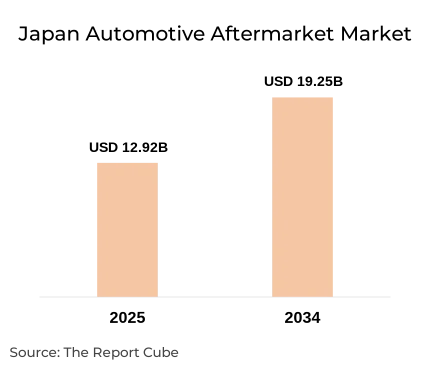
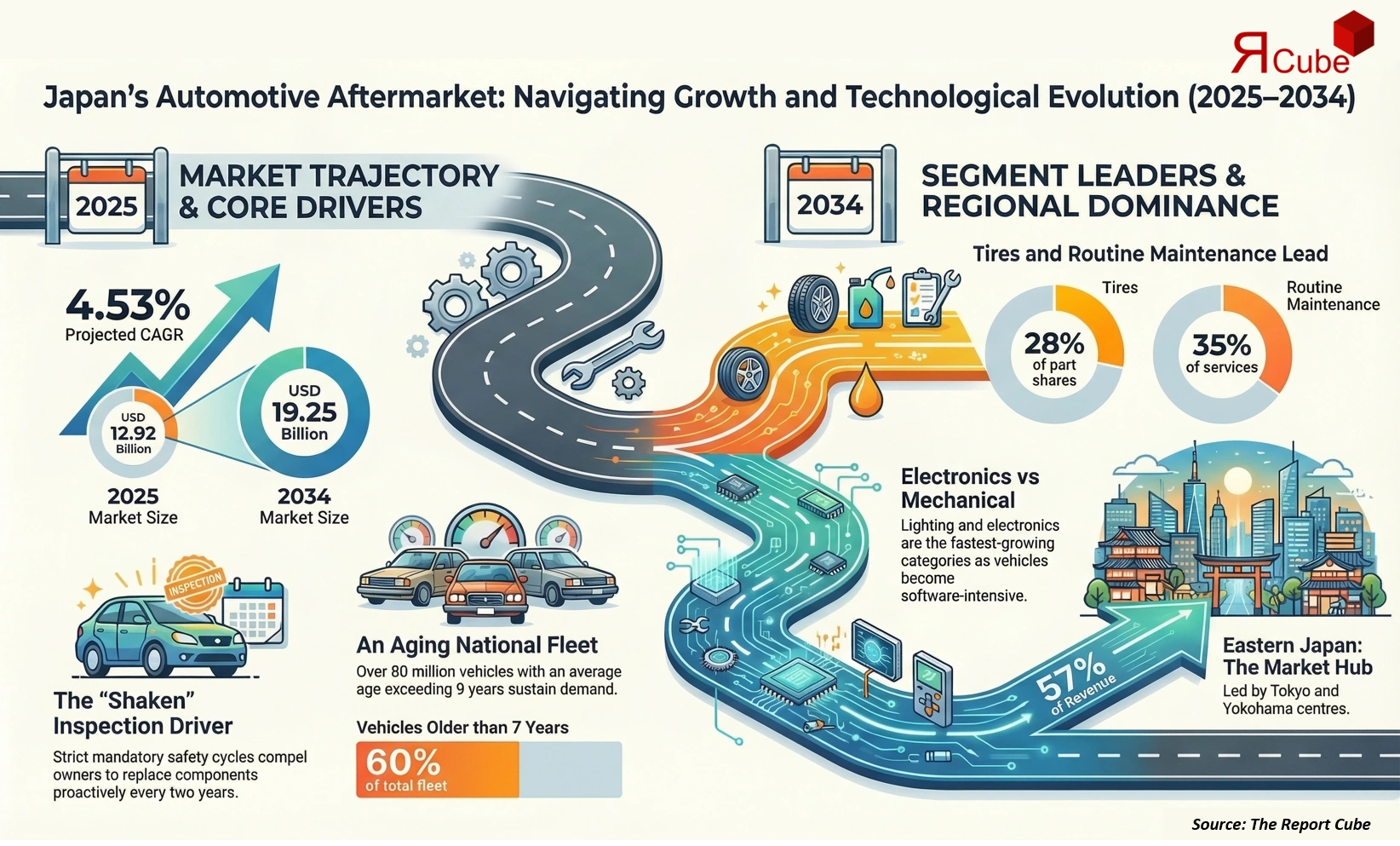
The Japan Automotive Aftermarket Market is anticipated to register a CAGR of 4.53% during the forecast period 2026-2034. The market size was valued at USD 12.92 billion in 2025 and is projected to reach USD 19.25 billion by 2034. This growth trajectory reflects Japan’s large and aging vehicle parc, high vehicle ownership rates, and strong consumer preference for regular maintenance and quality replacement parts.
Japan’s automotive ecosystem is characterized by long vehicle lifecycles, strict inspection regulations, and high safety standards, which collectively sustain aftermarket demand. With over 80 million registered vehicles and an average vehicle age exceeding 9 years, routine servicing, component replacement, and performance upgrades remain essential. Consumers increasingly prefer reliable branded parts and professional services, supporting both organized service centers and specialized parts retailers.
Furthermore, the transition toward advanced electronics, hybrid systems, and connected vehicle technologies is reshaping the aftermarket landscape. While electrification slightly moderates demand for certain mechanical parts, it simultaneously creates new opportunities in diagnostics, electronics, tires, and accessories. As a result, the Japan Automotive Aftermarket Market continues to evolve steadily, balancing traditional maintenance needs with emerging vehicle technologies.
Japan Automotive Aftermarket Market Recent Developments
- 2025: Denso expanded advanced diagnostics and electronic aftermarket solutions for hybrid and connected vehicles.
- 2025: Autobacs Seven launched upgraded digital service platforms enhancing customer engagement and maintenance scheduling.
Government Initiatives & Policies
- Vehicle Inspection and Maintenance Program (Shaken): Enforces strict safety and emissions standards, driving regular aftermarket demand.
- Green Growth Strategy: Supports sustainable mobility and aftermarket readiness for electrified vehicles.
Japan Automotive Aftermarket Market Dynamics
Key Driver: Aging Vehicle Fleet and Mandatory Inspection Cycles
The primary driver of the Japan Automotive Aftermarket Market is the country’s aging vehicle fleet combined with mandatory inspection and maintenance cycles. Japan’s rigorous “Shaken” inspection system requires vehicles to undergo detailed checks every two years, compelling owners to replace worn components proactively. As vehicles age beyond their warranty periods, demand for aftermarket tires, brake parts, batteries, and filters rises consistently. In 2024, vehicles older than seven years accounted for more than 60% of Japan’s total vehicle parc, directly supporting sustained aftermarket revenues. This structural characteristic ensures stable demand regardless of new vehicle sales fluctuations, making the aftermarket a resilient segment within Japan’s automotive industry.
Book your FREE 30-minute expert consultation today
Contact UsIndustry Trends: Digitalization and Growth of Organized Service Networks
A key trend shaping the market is the increasing digitalization of aftermarket services and the expansion of organized service networks. Leading players are investing in online booking platforms, predictive maintenance tools, and customer loyalty programs to enhance service transparency and convenience. Diagnostics and tuning services are gaining popularity as vehicles become more electronically complex. Additionally, consumers are shifting from informal garages to branded service chains that offer standardized pricing and quality assurance. This trend improves customer trust and encourages repeat servicing, strengthening long-term market growth. The integration of data-driven diagnostics with traditional maintenance is redefining service delivery across Japan.
Major Challenge: Impact of Vehicle Electrification on Traditional Parts Demand
The gradual rise of electric and hybrid vehicles presents a notable challenge for the Japan Automotive Aftermarket Market. Electrified vehicles require fewer moving parts, reducing demand for components such as exhaust systems and certain engine parts. As electric vehicle adoption increases, traditional aftermarket suppliers face the risk of declining volumes in select categories. Additionally, high-voltage systems require specialized skills and equipment, raising entry barriers for smaller workshops. These factors may pressure margins for conventional parts suppliers, necessitating strategic adaptation toward electronics, software diagnostics, and EV-compatible components.
Opportunity: Expansion of Advanced Electronics and Diagnostics Services
Despite electrification challenges, significant opportunities exist in advanced electronics, diagnostics, and accessories. Modern vehicles rely heavily on sensors, control units, and software-driven systems, increasing demand for specialized diagnostic tools and electronic replacement parts. The Lighting & Electronics and Diagnostics & Tuning segments are witnessing faster growth than traditional mechanical services. Additionally, consumer interest in vehicle personalization and accessories remains strong, supporting steady demand for styling upgrades. Companies that diversify into high-value electronic components and digital services are well-positioned to capture emerging growth opportunities in Japan’s evolving aftermarket landscape.
Japan Automotive Aftermarket Market Segment-wise Analysis
By Part Type:
- Tires
- Batteries
- Brake Parts
- Filters
- Body Parts
- Lighting & Electronics
- Wheels
- Exhaust Parts
- Turbochargers
Tires represent the leading sub-segment, accounting for approximately 28% of the total market share in 2025. Frequent replacement cycles, seasonal tire changes, and strict safety standards drive consistent demand. Batteries and brake parts follow closely, supported by high urban driving intensity and aging vehicles. Lighting & Electronics is the fastest-growing category, benefiting from advanced driver assistance systems and infotainment upgrades. Together, these segments demonstrate a balanced demand structure combining high-volume consumables with emerging technology-driven components.
By Service Type:
- Mechanical Repair
- Crash Repair
- Routine Maintenance
- Diagnostics & Tuning
- Accessories & Styling
Routine Maintenance dominates the service segment, contributing nearly 35% of total service revenues. Regular inspections, oil changes, and component replacements underpin this leadership. Mechanical Repair remains essential for older vehicles, while Diagnostics & Tuning is gaining momentum as vehicles become more software-intensive. Accessories & Styling services maintain steady demand due to strong consumer interest in personalization. The service mix highlights Japan’s emphasis on preventive maintenance and high-quality vehicle care.
Regional Projection of Japan Automotive Aftermarket Industry
- Eastern Japan
- Western Japan
Eastern Japan leads the market, holding approximately 57% of total aftermarket revenue. The region benefits from higher vehicle density, major urban centers such as Tokyo and Yokohama, and a strong presence of organized service networks. Western Japan follows with robust demand driven by regional manufacturing hubs and extensive highway networks. Eastern Japan’s dominance is reinforced by higher adoption of advanced diagnostics and premium services, positioning it as the primary growth engine for the Japan Automotive Aftermarket Market during the forecast period.
Need insights for a specific region within this market?
Request Regional DataWhy Choose This Report?
- Provides a comprehensive overview of the overall market analysis, encompassing key trends, consumer behavior analysis, and risk assessment to support strategic decision-making.
- Provides accurate, up-to-date insights into market size, segmentation, and emerging opportunities, helping to minimize risk & capitalizing on growth.
- Gives deep understanding of target audience preferences, investment habits, and communication channels for enhanced product development & marketing effectiveness.
- Delivers competitive analysis & benchmarking, uncovering the strengths & weaknesses of market competitors to guide strategies.
- Consolidate comprehensive market intelligence, reducing reasoning & streamlining research efforts.
- Facilitates customized market segmentation & risk mitigation strategies, fine-tuned to the business objectives.
- Aids in identifying both market challenges & untapped opportunities within the industry to drive long-term business growth.
- Provides valuable information based on actual customer data & search trends.
Table of Contents
- Introduction
- Objective of the Study
- Product and Category Definition
- Market Segmentation
- Study Variables
- Research Methodology
- Secondary Data Points
- Breakdown of Secondary Sources
- Primary Data Points
- Breakdown of Primary Interviews
- Secondary Data Points
- Executive Summary
- Market Dynamics
- Drivers
- Challenges
- Opportunity Assessment
- Recent Trends and Developments
- Regulatory and Policy Landscape
- Japan Automotive Aftermarket Overview (2020-2034)
- Market Size, By Value (USD Billion)
- Market Share, By Part Type
- Tires
- Batteries
- Brake Parts
- Filters
- Body Parts
- Lighting & Electronics
- Wheels
- Exhaust Parts
- Turbochargers
- Market Share, By Service Type
- Mechanical Repair
- Crash Repair
- Routine Maintenance
- Diagnostics & Tuning
- Accessories & Styling
- Market Share, By Vehicle Type
- Passenger Cars
- Light Commercial
- Heavy Commercial
- Two-Wheelers
- Market Share, By Distribution
- Authorized Workshops
- Independent Garages
- Retail Stores
- Online Channels
- Market Share, By Region
- Eastern
- Western
- Market Share, By Company
- Competition Characteristics
- Revenue Shares & Analysis
- Eastern Japan Aftermarket
- Market Size, By Value (USD Billion)
- Market Share, By Part Type
- Market Share, By Service Type
- Market Share, By Vehicle Type
- Market Share, By Distribution
- Western Japan Aftermarket
- Market Size, By Value (USD Billion)
- Market Share, By Part Type
- Market Share, By Service Type
- Market Share, By Vehicle Type
- Market Share, By Distribution
- Competitive Outlook and Company Profiles
- Denso Corporation
- Company Overview
- Product Portfolio
- Strategic Alliances/Partnerships
- Recent Developments
- Aisin Corporation
- Company Overview
- Product Portfolio
- Strategic Alliances/Partnerships
- Recent Developments
- Autobacs Seven
- Company Overview
- Product Portfolio
- Strategic Alliances/Partnerships
- Recent Developments
- Up Garage
- Company Overview
- Product Portfolio
- Strategic Alliances/Partnerships
- Recent Developments
- Enkei Corporation
- Company Overview
- Product Portfolio
- Strategic Alliances/Partnerships
- Recent Developments
- Bridgestone Corporation
- Company Overview
- Product Portfolio
- Strategic Alliances/Partnerships
- Recent Developments
- NGK Spark Plug
- Company Overview
- Product Portfolio
- Strategic Alliances/Partnerships
- Recent Developments
- GMB Corporation
- Company Overview
- Product Portfolio
- Strategic Alliances/Partnerships
- Recent Developments
- KYB Corporation
- Company Overview
- Product Portfolio
- Strategic Alliances/Partnerships
- Recent Developments
- Hitachi Astemo
- Company Overview
- Product Portfolio
- Strategic Alliances/Partnerships
- Recent Developments
- Others
- Denso Corporation
- Contact Us and Disclaimer
Top Key Players & Market Share Outlook
- Denso Corporation
- Aisin Corporation
- Autobacs Seven
- Up Garage
- Enkei Corporation
- Bridgestone Corporation
- NGK Spark Plug
- GMB Corporation
- KYB Corporation
- Hitachi Astemo
- Others
Frequently Asked Questions






