



Build Your Custom Market Intelligence Report
Customize Your ReportJapan Tire Market Insights & Analysis
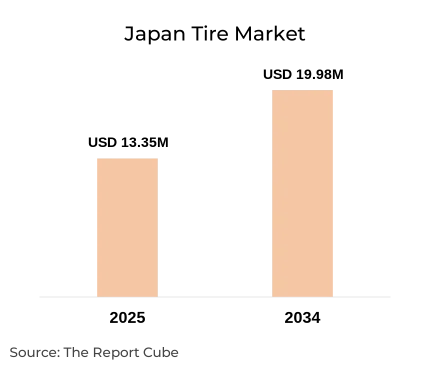
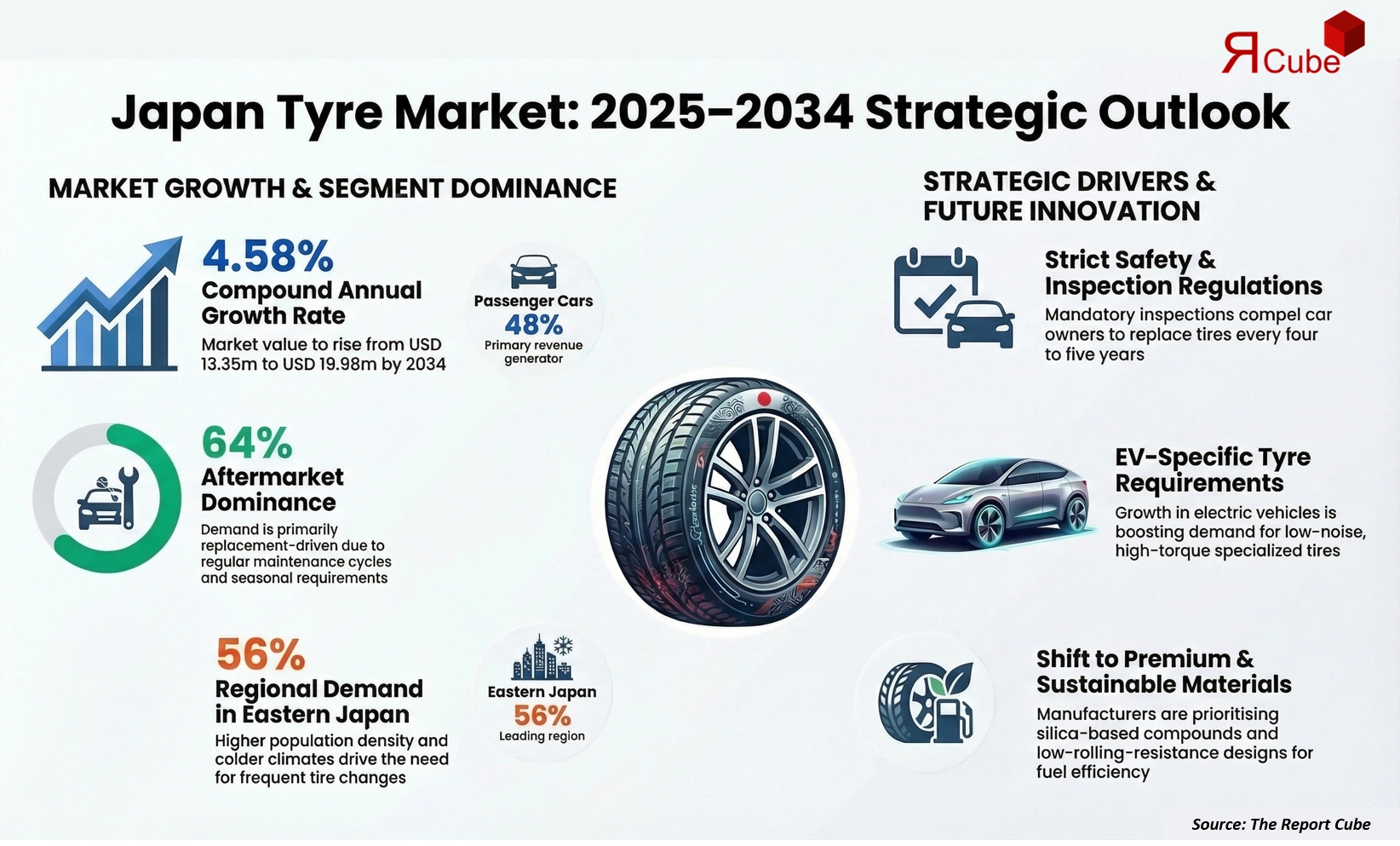
The Japan Tire Market is anticipated to register a CAGR of 4.58% during the forecast period 2026-2034. The market size was valued at USD 13.35 million in 2025 and is projected to reach USD 19.98 million by 2034. This steady growth reflects Japan’s mature automotive ecosystem, high vehicle ownership rates, and consistent replacement demand driven by strict safety standards and consumer preference for premium-quality tires.
Japan’s tire market is deeply interconnected with its advanced automotive manufacturing base and strong aftermarket network. While new vehicle sales have shown moderate growth, tire demand remains resilient due to regular replacement cycles, seasonal tire changes, and increasing penetration of high-performance and eco-friendly tires. Consumers in Japan emphasize durability, safety, and fuel efficiency, prompting manufacturers to focus on advanced rubber compounds and innovative tread designs. This has resulted in a market that balances stable volumes with value-driven growth.
Furthermore, the gradual shift toward electric vehicles and hybrid cars is influencing tire specifications, encouraging demand for low-rolling-resistance and noise-reduction tires. Combined with infrastructure quality and regulatory oversight, these factors position the Japan Tire Market as a technologically advanced yet replacement-driven market with consistent long-term growth prospects.
Japan Tire Market Recent Developments
- 2025: Bridgestone expanded its sustainable tire materials program to support low-emission mobility solutions in Japan.
- 2025: Yokohama Rubber introduced advanced all-season tires designed for improved fuel efficiency and wet-road performance.
Government Initiatives & Policies
- Green Growth Strategy: Promotes low-carbon mobility and adoption of energy-efficient automotive components.
- Automotive Safety Standards Program: Strengthens vehicle and tire safety regulations nationwide.
Japan Tire Market Dynamics
Key Driver: Strong Replacement Demand Supported by Safety Regulations
The primary driver of the Japan Tire Market is consistent replacement demand supported by strict road safety and vehicle inspection regulations. Japan enforces mandatory vehicle inspections that emphasize tire condition, tread depth, and overall roadworthiness, compelling vehicle owners to replace tires regularly. On average, passenger car tires in Japan are replaced every four to five years, ensuring stable aftermarket demand. Additionally, widespread use of seasonal tires, particularly winter tires in colder regions, further increases replacement frequency. This regulatory environment, combined with consumer awareness regarding safety and performance, sustains demand even during periods of slower vehicle sales, making replacement cycles a reliable growth driver for the market.
Book your FREE 30-minute expert consultation today
Contact UsIndustry Trends: Shift Toward Premium and Eco-Friendly Tires
A key trend shaping the Japan Tire Market is the growing preference for premium and environmentally friendly tires. Consumers increasingly opt for tires offering enhanced fuel efficiency, reduced rolling resistance, and lower noise levels. This trend aligns with Japan’s broader sustainability goals and rising adoption of hybrid and electric vehicles. Manufacturers are investing heavily in advanced materials, such as silica-based compounds, to meet performance and environmental expectations. Additionally, smart tire technologies that improve durability and monitoring are gradually gaining traction. As a result, value growth is outpacing volume growth, with premium segments contributing a higher share of total revenue.
Major Challenge: Market Maturity and Limited New Vehicle Growth
Market maturity poses a notable challenge for the Japan Tire Market. With vehicle ownership already high and population growth slowing, opportunities from new vehicle sales remain limited. This constrains OEM tire demand and intensifies competition among manufacturers in the aftermarket. Price sensitivity among consumers, despite their preference for quality, also pressures margins. Furthermore, intense competition from both domestic and international brands requires continuous innovation and marketing investment. These factors collectively limit rapid expansion, making differentiation and operational efficiency critical for sustaining profitability.
Opportunity: Rising Adoption of EV-Specific and High-Performance Tires
The gradual rise in electric and hybrid vehicle adoption presents a significant opportunity for the Japan Tire Market. EVs require specialized tires capable of handling higher torque, heavier vehicle weight, and reduced noise expectations. This has opened opportunities for manufacturers to develop EV-specific and high-performance tires with premium pricing. Additionally, off-the-road and commercial segments are witnessing increased demand from logistics and construction activities. By aligning product portfolios with evolving vehicle technologies and mobility trends, tire manufacturers can unlock new revenue streams within Japan’s otherwise mature market.
Japan Tire Market Segment-wise Analysis
By Vehicle Type:
- Passenger Cars
- Light Commercial
- Heavy Commercial
- Two-Wheelers
- Off-The-Road
Passenger Cars dominate the Japan Tire Market, accounting for approximately 48% of total market share in 2025. This dominance is driven by high passenger vehicle ownership and frequent tire replacement cycles. Light Commercial Vehicles follow, supported by urban logistics and e-commerce growth. Heavy Commercial and Off-The-Road tires contribute smaller but stable shares due to infrastructure and industrial activities. Two-Wheeler tires maintain niche demand, primarily in urban commuting. Overall, the passenger car segment remains the primary revenue generator due to higher volumes and growing preference for premium tire variants.
By Demand Type:
- OEM
- Aftermarket
The Aftermarket segment leads the Japan Tire Market, holding nearly 64% of total demand. This leadership reflects frequent replacement requirements, seasonal tire changes, and consumer focus on safety compliance. OEM demand remains comparatively lower due to modest new vehicle sales growth. However, OEM tires continue to benefit from technological collaboration between automakers and tire manufacturers. The dominance of the aftermarket highlights the market’s replacement-driven nature and emphasizes the importance of strong distribution networks and brand loyalty.
Regional Projection of Japan Tire Industry
- Eastern Japan
- Western Japan
Eastern Japan leads the Japan Tire Market, accounting for around 56% of total demand. The region benefits from higher population density, greater vehicle concentration, and colder climatic conditions that increase seasonal tire usage. Major metropolitan areas such as Tokyo and surrounding prefectures drive both OEM and aftermarket demand. Western Japan follows with steady demand supported by urban mobility and commercial activities. Eastern Japan’s dominance is expected to continue through the forecast period due to higher replacement frequency and stronger consumer spending on premium tire products.
Need insights for a specific region within this market?
Request Regional DataWhy Choose This Report?
- Provides a comprehensive overview of the overall market analysis, encompassing key trends, consumer behavior analysis, and risk assessment to support strategic decision-making.
- Provides accurate, up-to-date insights into market size, segmentation, and emerging opportunities, helping to minimize risk & capitalizing on growth.
- Gives deep understanding of target audience preferences, investment habits, and communication channels for enhanced product development & marketing effectiveness.
- Delivers competitive analysis & benchmarking, uncovering the strengths & weaknesses of market competitors to guide strategies.
- Consolidate comprehensive market intelligence, reducing reasoning & streamlining research efforts.
- Facilitates customized market segmentation & risk mitigation strategies, fine-tuned to the business objectives.
- Aids in identifying both market challenges & untapped opportunities within the industry to drive long-term business growth.
- Provides valuable information based on actual customer data & search trends.
Table of Contents
- Introduction
- Objective of the Study
- Product and Category Definition
- Market Segmentation
- Study Variables
- Research Methodology
- Secondary Data Points
- Breakdown of Secondary Sources
- Primary Data Points
- Breakdown of Primary Interviews
- Secondary Data Points
- Executive Summary
- Market Dynamics
- Drivers
- Challenges
- Opportunity Assessment
- Recent Trends and Developments
- Regulatory and Policy Landscape
- Japan Tire Market Overview (2020-2034)
- Market Size, By Value (USD Million)
- Market Share, By Vehicle Type
- Passenger Cars
- Light Commercial
- Heavy Commercial
- Two-Wheelers
- Off-The-Road
- Market Share, By Demand Type
- OEM
- Aftermarket
- Market Share, By Tire Type
- Radial Tires
- Bias Tires
- Market Share, By Season Type
- Summer Tires
- Winter Tires
- All-Season Tires
- Market Share, By Rim Size
- Up to 15 Inches
- 15-20 Inches
- Above 20 Inches
- Market Share, By Propulsion
- ICE Vehicles
- Hybrid Vehicles
- Electric Vehicles
- Market Share, By Region
- Eastern
- Western
- Market Share, By Company
- Competition Characteristics
- Revenue Shares & Analysis
- Eastern Japan Tire Market
- Market Size, By Value (USD Million)
- Market Share, By Vehicle Type
- Market Share, By Demand Type
- Market Share, By Tire Type
- Market Share, By Season Type
- Market Share, By Rim Size
- Market Share, By Propulsion
- Western Japan Tire Market
- Market Size, By Value (USD Million)
- Market Share, By Vehicle Type
- Market Share, By Demand Type
- Market Share, By Tire Type
- Market Share, By Season Type
- Market Share, By Rim Size
- Market Share, By Propulsion
- Competitive Outlook and Company Profiles
- Bridgestone Corporation
- Company Overview
- Product Portfolio
- Strategic Alliances/Partnerships
- Recent Developments
- Yokohama Rubber
- Company Overview
- Product Portfolio
- Strategic Alliances/Partnerships
- Recent Developments
- Sumitomo Rubber
- Company Overview
- Product Portfolio
- Strategic Alliances/Partnerships
- Recent Developments
- Toyo Tire
- Company Overview
- Product Portfolio
- Strategic Alliances/Partnerships
- Recent Developments
- Nexen Tire
- Company Overview
- Product Portfolio
- Strategic Alliances/Partnerships
- Recent Developments
- Michelin
- Company Overview
- Product Portfolio
- Strategic Alliances/Partnerships
- Recent Developments
- Goodyear
- Company Overview
- Product Portfolio
- Strategic Alliances/Partnerships
- Recent Developments
- Continental
- Company Overview
- Product Portfolio
- Strategic Alliances/Partnerships
- Recent Developments
- Pirelli
- Company Overview
- Product Portfolio
- Strategic Alliances/Partnerships
- Recent Developments
- Hankook Tire
- Company Overview
- Product Portfolio
- Strategic Alliances/Partnerships
- Recent Developments
- Others
- Bridgestone Corporation
- Contact Us and Disclaimer
Top Key Players & Market Share Outlook
- Bridgestone Corporation
- Yokohama Rubber
- Sumitomo Rubber
- Toyo Tire
- Nexen Tire
- Michelin
- Goodyear
- Continental
- Pirelli
- Hankook Tire
- Others
Frequently Asked Questions






