




Build Your Custom Market Intelligence Report
Customize Your ReportJapan Electric Vehicle Tire Market Insights & Analysis
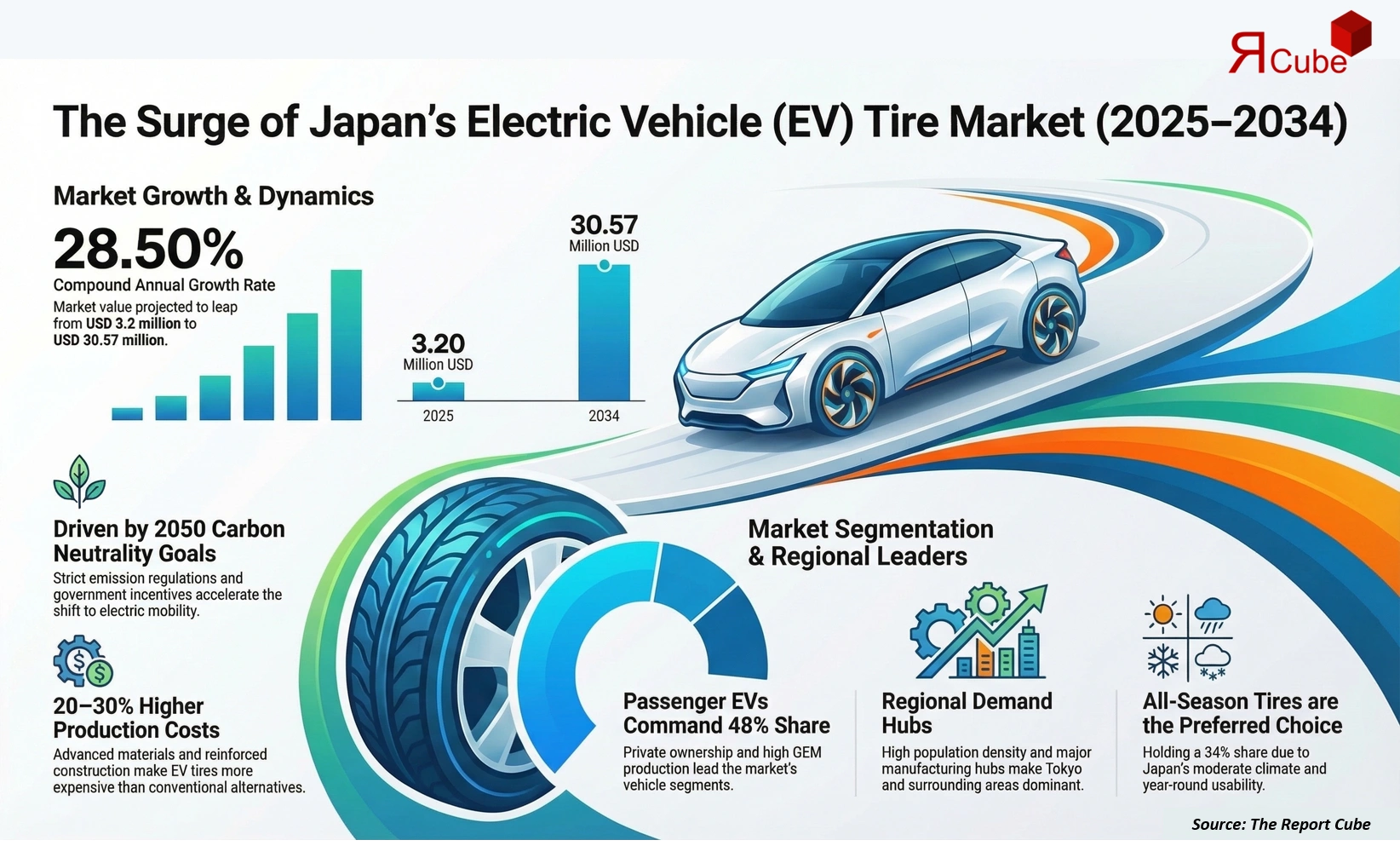
The Japan Electric Vehicle Tire Market is anticipated to register a CAGR of 28.50% during the forecast period 2026-2034. The market size was valued at USD 3.2 million in 2025 and is projected to reach USD 30.57 million by 2034. This exceptional growth reflects Japan’s accelerating electric vehicle adoption, driven by strict emission regulations, rising fuel efficiency awareness, and strong government backing for vehicle electrification.
Japan’s automotive ecosystem is uniquely positioned to support rapid EV tire market expansion due to its mature tire manufacturing base, advanced material science capabilities, and strong domestic demand for high-performance vehicles. As EV penetration increases across passenger cars, commercial fleets, and two-wheelers, demand for specialized tires designed to handle higher torque, heavier battery loads, and low rolling resistance is rising sharply. EV tires also play a crucial role in extending driving range, reducing noise, and improving overall ride comfort, making them a critical component in EV performance optimization.
Furthermore, automakers and tire manufacturers are collaborating closely to develop next-generation EV-specific tires tailored to Japan’s urban driving conditions. The growing replacement tire market, combined with original equipment manufacturer demand, ensures consistent revenue generation. As a result, the Japan Electric Vehicle Tire Market is transitioning from a niche segment into a core growth pillar of the broader automotive tire industry.
Japan Electric Vehicle Tire Market Recent Developments
- 2025: Bridgestone introduced next-generation EV tires focusing on ultra-low rolling resistance and enhanced durability.
- 2025: Yokohama Rubber expanded EV-specific tire production capacity to meet rising domestic OEM demand.
Government Initiatives & Policies
- Green Growth Strategy: Japan’s roadmap promoting EV adoption and carbon neutrality across transportation.
- Next-Generation Vehicle Promotion Program: Incentives supporting EV manufacturing and component localization.
Japan Electric Vehicle Tire Market Dynamics
Key Driver: Rapid Growth in Electric Vehicle Adoption Across Japan
The primary driver of the Japan Electric Vehicle Tire Market is the rapid increase in EV adoption across both private and commercial transportation. Japan’s commitment to achieving carbon neutrality by 2050 has significantly accelerated the shift toward electric mobility. EV sales in Japan recorded double-digit growth in recent years, increasing demand for tires specifically engineered to withstand higher vehicle weights and instant torque delivery. Unlike conventional tires, EV tires require reinforced structures, advanced tread compounds, and optimized designs to minimize energy loss. As automakers roll out new EV models across multiple price segments, OEM demand for EV-specific tires is rising steadily. This demand is further supported by fleet electrification initiatives in logistics, public transportation, and shared mobility, creating a strong and sustained growth foundation for the market.
Book your FREE 30-minute expert consultation today
Contact UsIndustry Trends: Development of Low-Noise and Energy-Efficient Tire Technologies
A key trend shaping the market is the increasing focus on low-noise and energy-efficient tire technologies. EVs operate almost silently, making tire noise more noticeable, particularly in urban Japan. To address this, manufacturers are investing heavily in noise-reduction tread patterns and sound-absorbing materials. At the same time, low rolling resistance has become a critical design parameter, as it directly impacts EV driving range. Advanced silica compounds and lightweight construction techniques are being widely adopted to enhance efficiency without compromising safety. Additionally, smart tire technologies, including embedded sensors for pressure and wear monitoring, are gaining traction. These innovations align well with Japan’s preference for high-quality, technology-driven automotive solutions.
Major Challenge: Higher Cost of EV-Specific Tires
Despite strong growth prospects, the higher cost of EV-specific tires poses a notable challenge to market expansion. EV tires typically cost 20-30% more than conventional tires due to advanced materials, reinforced construction, and specialized R&D requirements. Price-sensitive consumers may delay replacement or opt for standard tires, limiting penetration in the aftermarket segment. Moreover, frequent tire wear caused by higher EV torque can increase ownership costs, affecting consumer perception. While economies of scale are expected to reduce costs over time, price remains a short-term barrier, particularly for mass-market EV buyers and small fleet operators.
Opportunity: Expansion of Replacement Tire Market and Aftermarket Demand
The expanding replacement tire market presents a major opportunity for the Japan Electric Vehicle Tire Market. EV tires experience faster wear due to higher torque and vehicle weight, resulting in shorter replacement cycles compared to internal combustion vehicles. This creates recurring demand, particularly in densely populated urban regions with high annual mileage. Tire manufacturers are increasingly targeting the aftermarket with EV-specific branding, performance warranties, and digital sales channels. As EV ownership rises, replacement demand is expected to account for a growing share of total market revenue, offering long-term growth stability beyond OEM sales.
Japan Electric Vehicle Tire Market Segment-wise Analysis
By Tire Type:
- Summer Tires
- All-Season Tires
- Winter Tires
- Performance Tires
- All-Terrain Tires
All-Season Tires dominate the Japan Electric Vehicle Tire Market, accounting for approximately 34% market share in 2025. Their popularity stems from Japan’s moderate climate and consumer preference for year-round usability. These tires balance durability, low rolling resistance, and noise reduction, making them ideal for daily EV commuting. Summer tires follow closely, driven by performance-focused EV models, while winter tires maintain steady demand in northern regions. Performance tires are gaining traction among premium EV owners, reflecting Japan’s growing interest in high-end electric vehicles.
By Vehicle Type:
- Passenger EVs
- Light Commercial EVs
- Heavy Commercial EVs
- Buses and Coaches
- Two/Three-Wheeler EVs
Passenger EVs lead the market with nearly 48% share, driven by rising private EV ownership and strong OEM production. Light commercial EVs are the fastest-growing segment, supported by urban delivery electrification and last-mile logistics growth. Two- and three-wheeler EVs also contribute significantly, reflecting Japan’s strong two-wheeler culture. While heavy commercial EVs and electric buses currently hold smaller shares, government-backed fleet electrification programs are expected to boost their contribution over the forecast period.
Regional Projection of Japan Electric Vehicle Tire Industry
- East Japan
- West Japan
East Japan leads the Japan Electric Vehicle Tire Market, accounting for nearly 57% of total demand. The region benefits from higher population density, greater EV adoption, and the presence of major automotive manufacturing hubs. Metropolitan areas such as Tokyo and surrounding prefectures drive strong OEM and replacement tire demand. West Japan follows, supported by growing EV infrastructure and regional manufacturing activity. As charging networks expand nationwide, regional demand is expected to become more balanced, though East Japan is likely to retain its leadership position.
Need insights for a specific region within this market?
Request Regional DataWhy Choose This Report?
- Provides a comprehensive overview of the overall market analysis, encompassing key trends, consumer behavior analysis, and risk assessment to support strategic decision-making.
- Provides accurate, up-to-date insights into market size, segmentation, and emerging opportunities, helping to minimize risk & capitalizing on growth.
- Gives deep understanding of target audience preferences, investment habits, and communication channels for enhanced product development & marketing effectiveness.
- Delivers competitive analysis & benchmarking, uncovering the strengths & weaknesses of market competitors to guide strategies.
- Consolidate comprehensive market intelligence, reducing reasoning & streamlining research efforts.
- Facilitates customized market segmentation & risk mitigation strategies, fine-tuned to the business objectives.
- Aids in identifying both market challenges & untapped opportunities within the industry to drive long-term business growth.
- Provides valuable information based on actual customer data & search trends.
Table of Contents
- Introduction
- Objective of the Study
- Product and Category Definition
- Market Segmentation
- Study Variables
- Research Methodology
- Secondary Data Points
- Breakdown of Secondary Sources
- Primary Data Points
- Breakdown of Primary Interviews
- Secondary Data Points
- Executive Summary
- Market Dynamics
- Drivers
- Challenges
- Opportunity Assessment
- Recent Trends and Developments
- Regulatory and Policy Landscape
- Japan Electric Vehicle Tire Market Overview (2020-2034)
- Market Size, By Value (USD Million)
- Market Share, By Tire Type
- Summer Tires
- All-Season Tires
- Winter Tires
- Performance Tires
- All-Terrain Tires
- Market Share, By Vehicle Type
- Passenger EVs
- Light Commercial EVs
- Heavy Commercial EVs
- Buses and Coaches
- Two/Three-Wheeler EVs
- Market Share, By Rim Size
- Below 16 Inch
- 16-18 Inch
- Above 18 Inch
- Market Share, By Demand Category
- OEM Fitment
- Replacement
- Market Share, By Propulsion
- Battery Electric
- Plug-In Hybrid
- Hybrid Electric
- Market Share, By Region
- East
- West
- Market Share, By Company
- Competition Characteristics
- Revenue Shares & Analysis
- East Japan EV Tire Market
- Market Size, By Value (USD Million)
- Market Share, By Tire Type
- Market Share, By Vehicle Type
- Market Share, By Rim Size
- Market Share, By Demand Category
- Market Share, By Propulsion
- Market Share, By Major Prefecture
- Kanto Region
- Tohoku Region
- Hokkaido
- Rest of East Japan
- West Japan EV Tire Market
- Market Size, By Value (USD Million)
- Market Share, By Tire Type
- Market Share, By Vehicle Type
- Market Share, By Rim Size
- Market Share, By Demand Category
- Market Share, By Propulsion
- Market Share, By Major Prefecture
- Kansai Region
- Chubu Region
- Chugoku/Shikoku
- Kyushu/Okinawa
- Competitive Outlook and Company Profiles
- Bridgestone Corporation
- Company Overview
- Product Portfolio
- Strategic Alliances/Partnerships
- Recent Developments
- Yokohama Rubber
- Company Overview
- Product Portfolio
- Strategic Alliances/Partnerships
- Recent Developments
- Sumitomo Rubber
- Company Overview
- Product Portfolio
- Strategic Alliances/Partnerships
- Recent Developments
- Toyo Tire Corporation
- Company Overview
- Product Portfolio
- Strategic Alliances/Partnerships
- Recent Developments
- Michelin Group
- Company Overview
- Product Portfolio
- Strategic Alliances/Partnerships
- Recent Developments
- Goodyear Tire & Rubber
- Company Overview
- Product Portfolio
- Strategic Alliances/Partnerships
- Recent Developments
- Continental AG
- Company Overview
- Product Portfolio
- Strategic Alliances/Partnerships
- Recent Developments
- Pirelli & C. S.p.A.
- Company Overview
- Product Portfolio
- Strategic Alliances/Partnerships
- Recent Developments
- Hankook Tire
- Company Overview
- Product Portfolio
- Strategic Alliances/Partnerships
- Recent Developments
- Nokian Tyres
- Company Overview
- Product Portfolio
- Strategic Alliances/Partnerships
- Recent Developments
- Others
- Bridgestone Corporation
- Contact Us and Disclaimer
Top Key Players & Market Share Outlook
- Bridgestone Corporation
- Yokohama Rubber
- Sumitomo Rubber
- Toyo Tire Corporation
- Michelin Group
- Goodyear Tire & Rubber
- Continental AG
- Pirelli & C. S.p.A.
- Hankook Tire
- Nokian Tyres
- Others
Frequently Asked Questions






