



Build Your Custom Market Intelligence Report
Customize Your ReportJapan Replacement Tyre Market Insights & Analysis
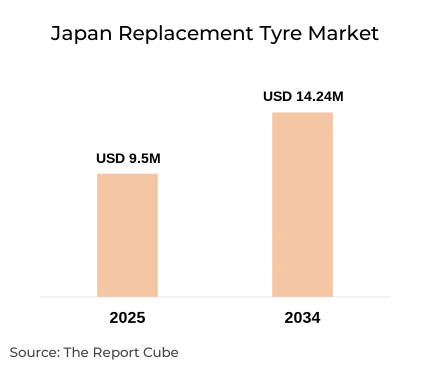
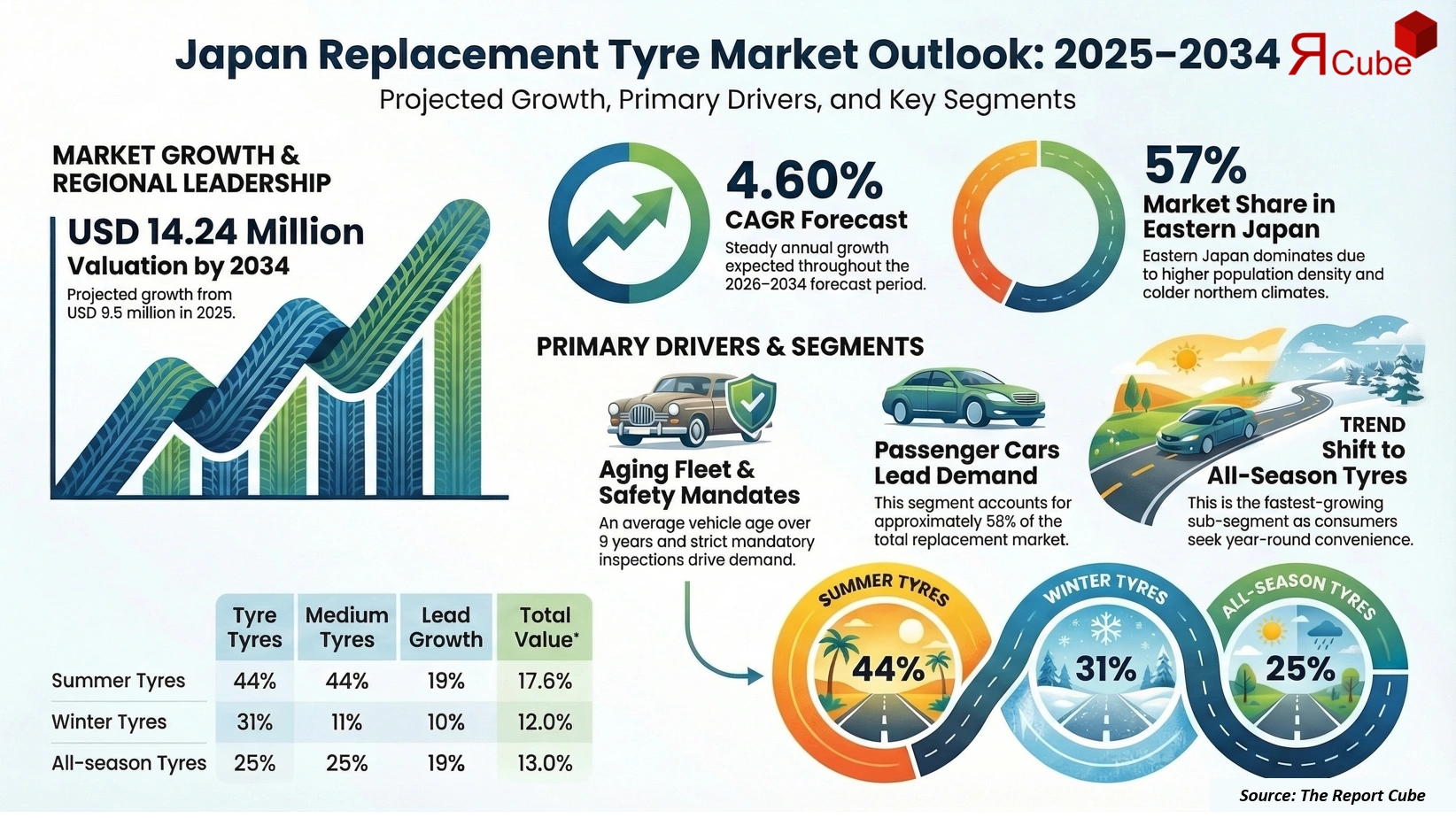
The Japan Replacement Tyre Market is anticipated to register a CAGR of 4.60% during the forecast period 2026-2034. The market size was valued at USD 9.5 million in 2025 and is projected to reach USD 14.24 million by 2034. This steady growth reflects Japan’s mature automotive ecosystem, high vehicle ownership rates, and a strong emphasis on vehicle safety and performance.
Japan’s replacement tyre demand is largely supported by its aging vehicle fleet, where the average vehicle age exceeds nine years. As consumers retain vehicles longer, regular tyre replacement becomes critical for safety, fuel efficiency, and ride comfort. Seasonal driving conditions, including heavy rainfall and snow in northern regions, further accelerate replacement cycles, particularly for winter and all-season tyres. Additionally, stringent road safety standards and inspection requirements encourage timely tyre replacement, reinforcing stable market demand.
Moreover, technological advancements in tyre materials, tread design, and durability are reshaping consumer preferences. Premium and mid-range tyres with enhanced mileage, low rolling resistance, and improved wet-grip performance are gaining traction. These factors, combined with Japan’s strong aftermarket distribution network and growing awareness of eco-friendly mobility solutions, position the replacement tyre market for sustained expansion through 2034.
Japan Replacement Tyre Market Recent Developments
- 2025: Bridgestone introduced next-generation eco-friendly replacement tyres with improved mileage and lower rolling resistance.
- 2025: Yokohama Rubber expanded its winter tyre lineup to address rising demand in northern Japan.
Government Initiatives & Policies
- Green Growth Strategy: Promotes low-emission mobility solutions, indirectly supporting demand for fuel-efficient tyres.
- Road Transport Vehicle Act: Enforces periodic vehicle inspections, encouraging timely replacement of worn tyres.
Japan Replacement Tyre Market Dynamics
Key Driver: Aging Vehicle Fleet and Mandatory Safety Inspections
The primary driver of the Japan Replacement Tyre Market is the country’s aging vehicle fleet combined with strict safety inspection requirements. With many vehicles remaining in operation beyond a decade, tyre wear becomes a frequent concern for owners. Japan’s mandatory vehicle inspection system ensures that tyres meet minimum tread depth and safety standards, directly boosting replacement demand. Passenger cars account for the majority of replacements, as urban commuting and frequent short-distance travel accelerate tyre wear. Additionally, rising consumer awareness regarding braking performance and wet-road safety further supports timely tyre replacement. These interconnected factors ensure consistent baseline demand across economic cycles, making safety-driven replacement a key growth pillar.
Book your FREE 30-minute expert consultation today
Contact UsIndustry Trends: Shift Toward All-Season and Eco-Friendly Tyres
A major trend in the market is the growing adoption of all-season and environmentally friendly tyres. Consumers increasingly prefer tyres that perform reliably across varying weather conditions, reducing the need for frequent seasonal changes. At the same time, low rolling resistance tyres are gaining popularity as drivers seek better fuel efficiency and lower carbon emissions. Manufacturers are responding with advanced rubber compounds and lightweight designs that extend tyre life while maintaining performance. Digital platforms and authorized dealer networks are also enhancing consumer access to premium replacement options. This shift toward performance-efficient tyres reflects broader mobility and sustainability trends shaping the Japanese automotive aftermarket.
Major Challenge: Market Maturity and Price Sensitivity
The Japan Replacement Tyre Market faces challenges stemming from its maturity and increasing price sensitivity among consumers. With high penetration of established brands, differentiation becomes difficult, leading to intense competition. Price-conscious buyers often compare offerings across domestic and international brands, pressuring margins. Additionally, the growing availability of durable tyres with longer lifespans slightly extends replacement cycles. These factors limit rapid volume growth, especially in urban markets. Manufacturers must balance innovation with affordability to maintain market share, making competitive pricing and value-added services essential for sustained performance.
Opportunity: Growth in Commercial and Off-Highway Applications
Emerging opportunities lie in the expansion of commercial and off-highway replacement tyre demand. Growth in logistics, construction, and infrastructure maintenance activities is increasing tyre wear for light and heavy commercial vehicles. Off-highway tyres used in agriculture and construction are also witnessing higher replacement rates due to intensive usage. Manufacturers offering durable, application-specific tyres stand to benefit from this trend. Furthermore, fleet operators increasingly prioritize total cost of ownership, favoring tyres with longer service life and retread compatibility. These dynamics create attractive growth avenues beyond the highly competitive passenger car segment.
Japan Replacement Tyre Market Segment-wise Analysis
By Vehicle Type:
- Passenger Cars
- Light Commercial
- Heavy Commercial
- Two-Wheelers
- Off-Highway
Passenger Cars dominate the Japan Replacement Tyre Market, accounting for approximately 58% of total demand in 2025. High car ownership, urban commuting, and frequent inspections drive consistent replacement cycles. Light Commercial Vehicles follow, supported by growing last-mile delivery and logistics activities. Heavy Commercial and Off-Highway segments contribute a smaller but steadily rising share due to infrastructure and construction projects. Two-Wheeler tyres represent a niche yet stable segment, particularly in dense urban areas. The dominance of passenger cars highlights the importance of safety, comfort, and fuel efficiency in replacement purchasing decisions.
By Tyre Type:
- Summer Tyres
- Winter Tyres
- All-Season Tyres
Summer Tyres hold the largest market share at nearly 44%, driven by widespread use in moderate climate regions. Winter Tyres account for around 31% of the market, reflecting strong demand in northern and mountainous areas with heavy snowfall. All-Season Tyres are the fastest-growing sub-segment, capturing close to 25% share, as consumers seek convenience and year-round usability. The gradual shift toward all-season options underscores evolving consumer preferences for versatility and cost efficiency.
Regional Projection of Japan Replacement Tyre Industry
- Eastern Japan
- Western Japan
Eastern Japan leads the replacement tyre market with an estimated 57% share, driven by higher population density, greater vehicle concentration, and colder climatic conditions in northern areas. Regions such as Kanto and Tohoku contribute significantly to winter and all-season tyre demand. Western Japan follows with steady growth, supported by urban centers and commercial vehicle activity. While Eastern Japan maintains leadership, Western Japan is expected to witness gradual growth through expanding logistics and regional mobility needs.
Need insights for a specific region within this market?
Request Regional DataWhy Choose This Report?
- Provides a comprehensive overview of the overall market analysis, encompassing key trends, consumer behavior analysis, and risk assessment to support strategic decision-making.
- Provides accurate, up-to-date insights into market size, segmentation, and emerging opportunities, helping to minimize risk & capitalizing on growth.
- Gives deep understanding of target audience preferences, investment habits, and communication channels for enhanced product development & marketing effectiveness.
- Delivers competitive analysis & benchmarking, uncovering the strengths & weaknesses of market competitors to guide strategies.
- Consolidate comprehensive market intelligence, reducing reasoning & streamlining research efforts.
- Facilitates customized market segmentation & risk mitigation strategies, fine-tuned to the business objectives.
- Aids in identifying both market challenges & untapped opportunities within the industry to drive long-term business growth.
- Provides valuable information based on actual customer data & search trends.
Table of Contents
- Introduction
- Objective of the Study
- Product and Category Definition
- Market Segmentation
- Study Variables
- Research Methodology
- Secondary Data Points
- Breakdown of Secondary Sources
- Primary Data Points
- Breakdown of Primary Interviews
- Secondary Data Points
- Executive Summary
- Market Dynamics
- Drivers
- Challenges
- Opportunity Assessment
- Recent Trends and Developments
- Regulatory and Policy Landscape
- Japan Replacement Tyre Market Overview (2020-2034)
- Market Size, By Value (USD Million)
- Market Share, By Vehicle Type
- Passenger Cars
- Light Commercial
- Heavy Commercial
- Two-Wheelers
- Off-Highway
- Market Share, By Tyre Type
- Summer Tyres
- Winter Tyres
- All-Season Tyres
- Market Share, By Rim Size
- Below 15 Inches
- 15-18 Inches
- Above 18 Inches
- Market Share, By Demand
- ICE Vehicles
- Hybrid Vehicles
- Electric Vehicles
- Market Share, By Distribution
- Dealers
- Retail Chains
- Online Channels
- Market Share, By Region
- Eastern
- Western
- Market Share, By Company
- Competition Characteristics
- Revenue Shares & Analysis
- Eastern Japan Replacement Tyre Market
- Market Size, By Value (USD Million)
- Market Share, By Vehicle Type
- Market Share, By Tyre Type
- Market Share, By Rim Size
- Market Share, By Demand
- Market Share, By Distribution
- Western Japan Replacement Tyre Market
- Market Size, By Value (USD Million)
- Market Share, By Vehicle Type
- Market Share, By Tyre Type
- Market Share, By Rim Size
- Market Share, By Demand
- Market Share, By Distribution
- Market Share, By Company
- Market Share, By Company
- Market Share, By Company
- Competition Characteristics
- Revenue Shares & Analysis
- Market Share, By Company
- Competitive Outlook and Company Profiles
- Bridgestone Corporation
- Company Overview
- Product Portfolio
- Strategic Alliances/Partnerships
- Recent Developments
- Yokohama Rubber
- Company Overview
- Product Portfolio
- Strategic Alliances/Partnerships
- Recent Developments
- Toyo Tire Corporation
- Company Overview
- Product Portfolio
- Strategic Alliances/Partnerships
- Recent Developments
- Sumitomo Rubber
- Company Overview
- Product Portfolio
- Strategic Alliances/Partnerships
- Recent Developments
- Michelin Japan
- Company Overview
- Product Portfolio
- Strategic Alliances/Partnerships
- Recent Developments
- Goodyear Japan
- Company Overview
- Product Portfolio
- Strategic Alliances/Partnerships
- Recent Developments
- Continental Japan
- Company Overview
- Product Portfolio
- Strategic Alliances/Partnerships
- Recent Developments
- Pirelli Japan
- Company Overview
- Product Portfolio
- Strategic Alliances/Partnerships
- Recent Developments
- Kumho Tire Japan
- Company Overview
- Product Portfolio
- Strategic Alliances/Partnerships
- Recent Developments
- Hankook Tire Japan
- Company Overview
- Product Portfolio
- Strategic Alliances/Partnerships
- Recent Developments
- Others
- Bridgestone Corporation
- Contact Us and Disclaimer
Top Key Players & Market Share Outlook
- Bridgestone Corporation
- Yokohama Rubber
- Toyo Tire Corporation
- Sumitomo Rubber
- Michelin Japan
- Goodyear Japan
- Continental Japan
- Pirelli Japan
- Kumho Tire Japan
- Hankook Tire Japan
- Others
Frequently Asked Questions






