




Build Your Custom Market Intelligence Report
Customize Your ReportAsia Forestry Tire Market Insights & Analysis
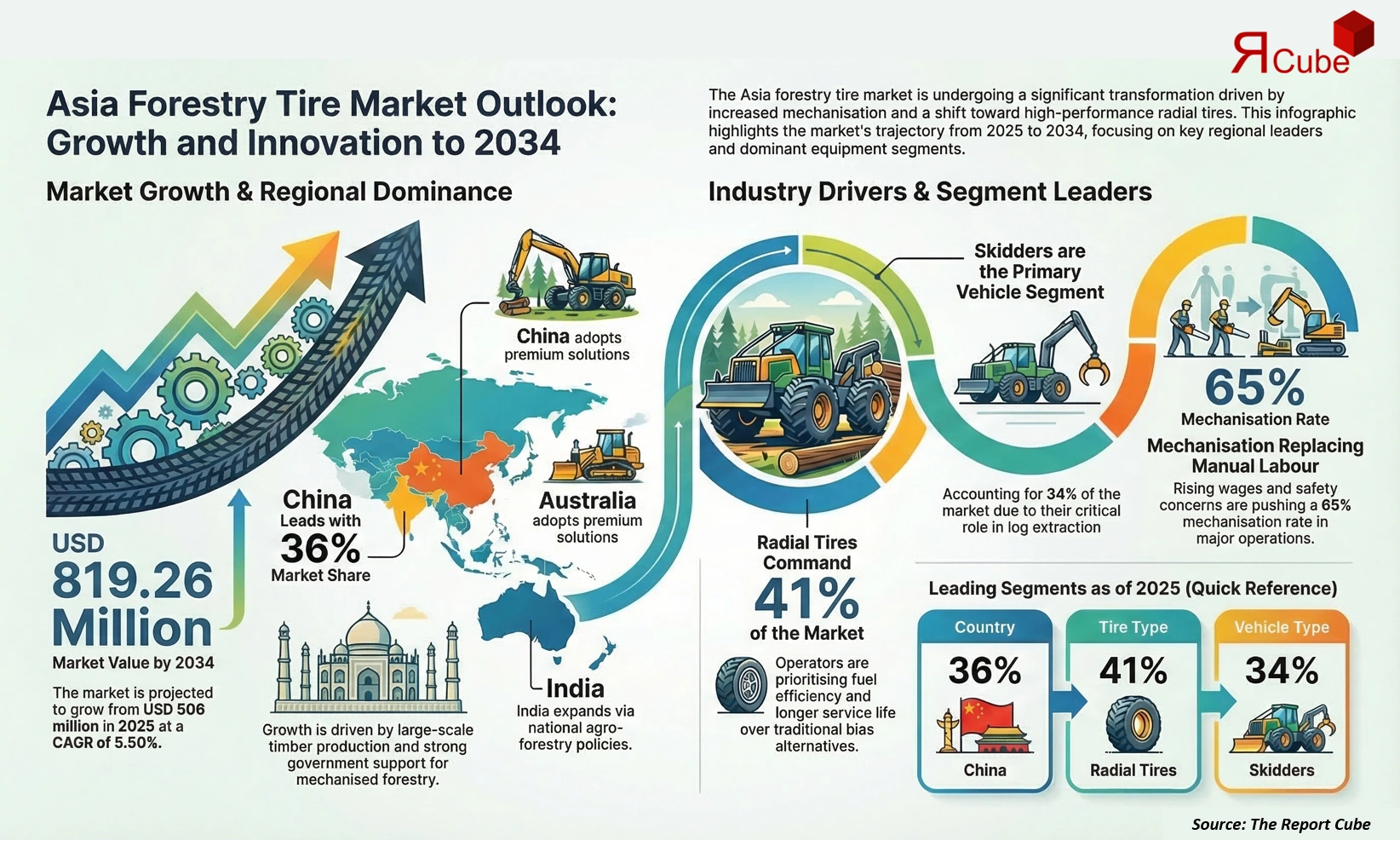
The Asia Forestry Tire Market is anticipated to register a CAGR of 5.50% during the forecast period 2026-2034. The market size was valued at USD 506 million in 2025 and is projected to reach USD 819.26 million by 2034. This growth is closely linked to rising mechanization in forestry operations, increasing demand for timber and wood-based products, and expanding plantation activities across emerging Asian economies.
Forestry operators across Asia are increasingly adopting advanced machinery such as skidders, forwarders, and harvesters to improve productivity, reduce labor dependency, and enhance operational safety. This transition is directly boosting demand for durable, high-traction forestry tires capable of performing in harsh terrains and extreme weather conditions. Countries including China, India, and Australia are investing heavily in sustainable forestry management, further supporting equipment upgrades and aftermarket tire demand.
In addition, the replacement cycle of forestry tires is shortening due to higher machine utilization rates and expanding commercial forestry operations. Manufacturers are responding by introducing reinforced radial and bias tires with improved load-bearing capacity, cut resistance, and longer service life. Collectively, these factors are creating a resilient growth environment for the Asia Forestry Tire Market throughout the forecast period.
Asia Forestry Tire Market Recent Developments
- 2025: Michelin expanded its forestry tire portfolio in Asia with enhanced tread designs for heavy-duty logging applications.
- 2025: BKT increased regional distribution capacity to support rising demand from mechanized forestry operations.
Government Initiatives & Policies
- China National Forestry Development Plan: Promotes mechanized and sustainable forestry practices.
- India National Agro-Forestry Policy: Encourages plantation expansion and equipment modernization.
Asia Forestry Tire Market Dynamics
Key Driver: Rising Mechanization in Forestry Operations
The primary driver of the Asia Forestry Tire Market is the accelerating mechanization of forestry activities across both developed and developing countries. Labor shortages, rising wages, and safety concerns are pushing operators to adopt mechanized solutions such as harvesters, forwarders, and skidders. These machines require specialized tires with superior traction, puncture resistance, and load capacity to operate efficiently on uneven, muddy, and debris-filled terrains. In countries like China and Australia, over 65% of large-scale forestry operations now rely on mechanized equipment, significantly increasing demand for high-performance forestry tires. As mechanization expands into smaller and mid-sized forestry enterprises, tire demand is expected to grow steadily, reinforcing market momentum.
Book your FREE 30-minute expert consultation today
Contact UsIndustry Trends: Shift Toward Radial and High-Durability Tires
A key trend shaping the market is the growing preference for radial forestry tires over traditional bias alternatives. Radial tires offer longer service life, better fuel efficiency, and improved operator comfort, making them increasingly attractive for intensive forestry applications. Manufacturers are also integrating advanced rubber compounds and reinforced sidewalls to reduce downtime caused by cuts and punctures. Additionally, demand for customized tire solutions tailored to specific vehicle types and terrain conditions is rising. This trend reflects a broader shift toward performance optimization and total cost-of-ownership reduction, encouraging forestry operators to invest in premium tire solutions.
Major Challenge: High Cost of Premium Forestry Tires
Despite strong demand fundamentals, the high cost of premium forestry tires remains a notable challenge. Advanced radial and solid tires often carry price premiums of 30-40% compared to conventional alternatives, limiting adoption among small-scale forestry operators. In price-sensitive markets such as India and parts of Southeast Asia, cost considerations continue to influence purchasing decisions. Additionally, fluctuating raw material prices and logistics costs can impact tire affordability. These factors may slow the transition to high-end products, particularly in emerging markets, slightly restraining overall market growth.
Opportunity: Expansion of Sustainable Forestry and Plantation Projects
The expansion of sustainable forestry and commercial plantation projects presents a significant opportunity for the Asia Forestry Tire Market. Governments and private investors are increasingly focusing on afforestation, reforestation, and certified timber production to meet environmental goals. These projects often rely on modern, mechanized equipment to improve efficiency and minimize ecological impact. As a result, demand for specialized forestry tires designed to reduce soil compaction and enhance traction is rising. Tire manufacturers that align product development with sustainability requirements are well-positioned to capture emerging opportunities across the region.
Asia Forestry Tire Market Segment-wise Analysis
By Vehicle Type:
- Skidders
- Forwarders
- Harvesters
- Tractors
- Others
Skidders represent the leading vehicle type segment, accounting for approximately 34% of the market share in 2025. Their extensive use in log extraction and transport across rugged terrains drives consistent tire demand. Forwarders and harvesters follow closely, supported by their growing adoption in large-scale, mechanized forestry operations. Tractors also contribute steadily, particularly in mixed-use agricultural and forestry applications. The dominance of skidders reflects their critical role in timber handling, making them a focal point for tire replacement and performance upgrades.
By Tire Type:
- Bias Tires
- Radial Tires
- Solid Tires
Radial tires dominate the Asia Forestry Tire Market, holding nearly 41% of total market share. Their superior durability, reduced heat buildup, and longer lifespan make them ideal for high-intensity forestry operations. Bias tires remain relevant in cost-sensitive applications, particularly among smaller operators, while solid tires are gaining traction in niche applications requiring extreme puncture resistance. The gradual shift toward radial tires underscores the industry’s emphasis on efficiency, safety, and long-term operational savings.
Regional Projection of Asia Forestry Tire Industry
- China
- India
- Japan
- South Korea
- Australia
- Rest of Asia
China leads the Asia Forestry Tire Market with an estimated 36% market share, driven by extensive commercial forestry operations and strong government support for mechanization. The country’s large-scale timber production and infrastructure investments sustain high demand for forestry equipment and replacement tires. Australia follows, supported by advanced forestry practices and high adoption of premium tire solutions. India is emerging as a high-growth market due to expanding plantation forestry and policy-driven mechanization initiatives. Together, these regions shape a diversified and steadily growing regional market landscape.
Need insights for a specific region within this market?
Request Regional DataWhy Choose This Report?
- Provides a comprehensive overview of the overall market analysis, encompassing key trends, consumer behavior analysis, and risk assessment to support strategic decision-making.
- Provides accurate, up-to-date insights into market size, segmentation, and emerging opportunities, helping to minimize risk & capitalizing on growth.
- Gives deep understanding of target audience preferences, investment habits, and communication channels for enhanced product development & marketing effectiveness.
- Delivers competitive analysis & benchmarking, uncovering the strengths & weaknesses of market competitors to guide strategies.
- Consolidate comprehensive market intelligence, reducing reasoning & streamlining research efforts.
- Facilitates customized market segmentation & risk mitigation strategies, fine-tuned to the business objectives.
- Aids in identifying both market challenges & untapped opportunities within the industry to drive long-term business growth.
- Provides valuable information based on actual customer data & search trends.
Table of Contents
- Introduction
- Objective of the Study
- Product and Category Definition
- Market Segmentation
- Study Variables
- Research Methodology
- Secondary Data Points
- Breakdown of Secondary Sources
- Primary Data Points
- Breakdown of Primary Interviews
- Secondary Data Points
- Executive Summary
- Market Dynamics
- Drivers
- Challenges
- Opportunity Assessment
- Recent Trends and Developments
- Regulatory and Policy Landscape
- Asia Forestry Tire Market Overview (2020-2034)
- Market Size, By Value (USD Million)
- Market Share, By Vehicle Type
- Skidders
- Forwarders
- Harvesters
- Tractors
- Others
- Market Share, By Tire Type
- Bias Tires
- Radial Tires
- Solid Tires
- Market Share, By Application
- Logging
- Transportation
- Construction
- Others
- Market Share, By Sales Channel
- OEM
- Aftermarket
- Market Share, By Country
- China
- India
- Japan
- South Korea
- Australia
- Rest of Asia
- Market Share, By Company
- Competition Characteristics
- Revenue Shares & Analysis
- China Forestry Tire Market
- Market Size, By Value (USD Million)
- Market Share, By Vehicle Type
- Market Share, By Tire Type
- Market Share, By Application
- Market Share, By Sales Channel
- India Forestry Tire Market
- Market Size, By Value (USD Million)
- Market Share, By Vehicle Type
- Market Share, By Tire Type
- Market Share, By Application
- Market Share, By Sales Channel
- Japan Forestry Tire Market
- Market Size, By Value (USD Million)
- Market Share, By Vehicle Type
- Market Share, By Tire Type
- Market Share, By Application
- Market Share, By Sales Channel
- South Korea Forestry Tire Market
- Market Size, By Value (USD Million)
- Market Share, By Vehicle Type
- Market Share, By Tire Type
- Market Share, By Application
- Market Share, By Sales Channel
- Australia Forestry Tire Market
- Market Size, By Value (USD Million)
- Market Share, By Vehicle Type
- Market Share, By Tire Type
- Market Share, By Application
- Market Share, By Sales Channel
- Competitive Outlook and Company Profiles
- Michelin
- Company Overview
- Product Portfolio
- Strategic Alliances/Partnerships
- Recent Developments
- Bridgestone
- Company Overview
- Product Portfolio
- Strategic Alliances/Partnerships
- Recent Developments
- Trelleborg
- Company Overview
- Product Portfolio
- Strategic Alliances/Partnerships
- Recent Developments
- Nokian Tyres
- Company Overview
- Product Portfolio
- Strategic Alliances/Partnerships
- Recent Developments
- Titan International
- Company Overview
- Product Portfolio
- Strategic Alliances/Partnerships
- Recent Developments
- Balkrishna Industries (BKT)
- Company Overview
- Product Portfolio
- Strategic Alliances/Partnerships
- Recent Developments
- Yokohama Rubber
- Company Overview
- Product Portfolio
- Strategic Alliances/Partnerships
- Recent Developments
- Camso
- Company Overview
- Product Portfolio
- Strategic Alliances/Partnerships
- Recent Developments
- Nortec
- Company Overview
- Product Portfolio
- Strategic Alliances/Partnerships
- Recent Developments
- Interco Tire
- Company Overview
- Product Portfolio
- Strategic Alliances/Partnerships
- Recent Developments
- Others
- Michelin
- Contact Us and Disclaimer
Top Key Players & Market Share Outlook
- Michelin
- Bridgestone
- Trelleborg
- Nokian Tyres
- Titan International
- Balkrishna Industries (BKT)
- Yokohama Rubber
- Camso
- Nortec
- Interco Tire
- Others
Frequently Asked Questions






