



Build Your Custom Market Intelligence Report
Customize Your ReportJapan Automotive Fuel Tank Market Key Takeaways
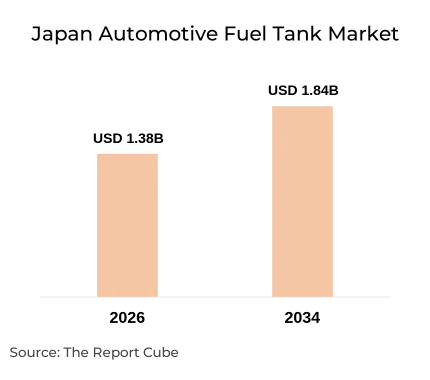
- Japan automotive fuel tank market valued at USD 1.38 billion in 2026, reflecting stable domestic demand.
- Industry projected to reach USD 1.84 billion by 2034 at a 3.67% CAGR.
- Market expanding at a consistent 3.67% CAGR through the 2034 forecast period.
- Passenger vehicles lead the vehicle type segment driven by sustained domestic production volumes.
- OEMs dominate Japan's fuel tank sales channel landscape as the primary procurement route.
- Aftermarket channel remains the fastest-growing sales segment across Japan's vehicle servicing network.
- OPmobility SE, Kautex Textron, and Yachiyo Automotive Systems lead fuel tank supply in Japan.
- Lightweighting and hybrid-compatible multi-layer tank adoption are reshaping fuel system procurement specifications.
Japan Automotive Fuel Tank Market Overview
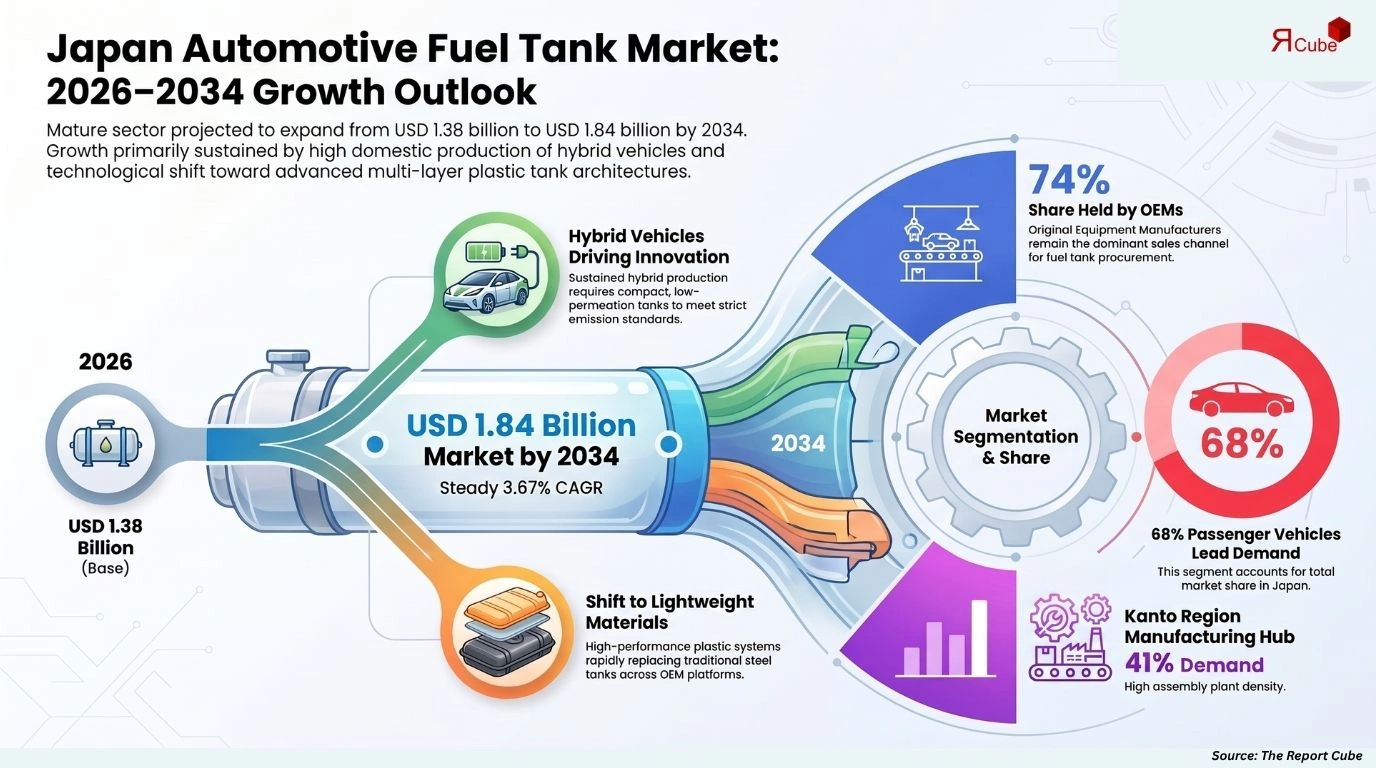
The Japan Automotive Fuel Tank Market is anticipated to register a 3.67% CAGR during 2026–2034. The market size was valued at USD 1.38 billion in 2026 and is projected to reach USD 1.84 billion by 2034. Japan's deep-rooted automotive manufacturing ecosystem, anchored by Toyota, Honda, and Nissan production platforms, sustains consistent OEM-level procurement of high-density polyethylene and multi-layer blow-molded fuel tank systems. Government initiatives promoting fuel efficiency and emissions compliance further reinforce demand for advanced tank engineering among domestic Tier-1 suppliers. A detailed Japan Automotive Fuel Tank Market analysis reveals how vehicle production volumes, regulatory mandates, and material innovation collectively define procurement patterns across the forecast period.
Continued hybrid and plug-in hybrid vehicle production in Japan sustains demand for compact, low-permeation fuel tanks engineered to meet stringent Japanese domestic market evaporative emission standards. Suppliers including OPmobility SE, Kautex Textron GmbH & Co. KG, and Yachiyo Automotive Systems Co. Ltd. have deepened their technical partnerships with domestic automakers. Increasing focus on sustainability-aligned supply chain practices and domestic content optimization is encouraging further localization of fuel tank component manufacturing, reinforcing Japan's position as a precision-engineering hub for automotive fluid system suppliers serving both domestic and export production programs.
Japan Automotive Fuel Tank Market Size & Forecast
|
Metric |
Details |
|---|---|
|
Market Size (2026) |
USD 1.38 Billion |
|
Market Size (2034) |
USD 1.84 Billion |
|
CAGR (2026–2034) |
3.67% |
|
Base Year |
2026 |
|
Historical Years |
2021–2025 |
|
Forecast Years |
2026–2034 |
The Japan Automotive Fuel Tank Market size was valued at USD 1.38 billion in 2026 and is projected to reach USD 1.84 billion by 2034, advancing at a 3.67% CAGR through the forecast period. Sustained hybrid vehicle production schedules by major domestic automakers and increasing adoption of multi-layer plastic tank architectures designed for low-permeation evaporative emission compliance represent the primary differentiating growth factors driving this market through 2034.
Japan Automotive Fuel Tank Market Dynamics
Japan's automotive fuel tank sector operates within a mature, precision-driven manufacturing environment shaped by strict domestic emissions standards, vehicle lightweighting requirements, and the ongoing transition toward hybrid powertrain integration. OEM procurement strategies, advanced material adoption, and supply chain localization collectively define the Japan Automotive Fuel Tank Market growth trajectory across the forecast period.
|
Factor |
Type |
Specific Impact on Market |
Magnitude |
|---|---|---|---|
|
Sustained hybrid vehicle production |
Driver |
Increases demand for compact, low-permeation multi-layer fuel tank systems |
High |
|
Stringent evaporative emission regulations |
Driver |
Accelerates adoption of advanced HDPE and multi-layer blow-molded tank technologies |
High |
|
Lightweighting material innovation |
Opportunity |
Supports replacement of steel tanks with high-performance plastic systems across OEM platforms |
Medium |
|
Declining internal combustion engine vehicle share |
Challenge |
Reduces total addressable OEM market as BEV adoption compresses conventional fuel tank demand |
Medium |
|
Domestic content localization trend |
Trend |
Encourages Tier-1 suppliers to expand Japan-based production and engineering support infrastructure |
Medium |
- Growth Drivers - Hybrid and plug-in hybrid vehicle production programs maintained by Toyota, Honda, and Mazda sustain high-volume OEM procurement of engineered plastic fuel tank systems. Japan's stringent domestic evaporative emission standards (JAMA-compliant) further incentivize adoption of advanced low-permeation multi-layer tank configurations across passenger vehicle platforms, reinforcing Tier-1 supplier investment in domestic manufacturing capacity through 2034.
- Market Opportunities - Lightweighting mandates and fuel efficiency targets are generating sustained demand for advanced plastic and composite fuel tank systems replacing traditional steel configurations across commercial vehicle segments. Additionally, Japan's large and aging vehicle fleet sustains aftermarket replacement demand for fuel tanks, providing suppliers with a durable secondary revenue channel independent of new vehicle production fluctuations through the forecast period.
- Industry Challenges - Volatile raw material costs for high-density polyethylene and engineering-grade plastics expose fuel tank manufacturers to margin compression risks during commodity price cycles. Simultaneously, evolving JAMA evaporative emission testing protocols and compliance upgrade requirements increase product development lead times and certification costs for Tier-1 suppliers serving both OEM and aftermarket channels across Japan's automotive fuel system market.
Japan Automotive Fuel Tank Market Trends
- Emerging Trends - Japan Automotive Fuel Tank Market trends highlight growing integration of multi-layer blow-molded HDPE tanks featuring low-permeation barrier layers as automakers prioritize evaporative emission compliance across hybrid and conventional powertrain platforms. Artisan-scale composite tank development for motorsport and specialty vehicle segments is also expanding across Kanto-based manufacturing clusters.
- Technology Trends - Robotic blow-molding lines, automated leak detection systems, and digital twin-based tank design validation platforms are advancing manufacturing precision among Japanese Tier-1 fuel system suppliers. AI-driven production monitoring tools are reducing defect rates and improving cycle times across high-volume fuel tank manufacturing facilities serving domestic OEM assembly programs.
- Consumer / Buyer Trends - OEM procurement teams increasingly specify fuel tank systems with integrated in-tank module assemblies, including fuel pumps, sensors, and level gauges, sourced from single-supplier solutions. Aftermarket buyers prioritize OEM-equivalent specification, extended warranty coverage, and rapid delivery fulfillment from domestic distribution networks for vehicle maintenance and collision repair programs across Japan's service channel.
Need Specific Data, Let’s Customize the Report for You
Request CustomizationJapan Automotive Fuel Tank Market Segment Analysis
Japan's automotive fuel tank market serves distinct procurement requirements across vehicle type and sales channel categories. The Japan Automotive Fuel Tank Market share is distributed across passenger and commercial vehicle OEM platforms, with aftermarket replacement channels representing a growing secondary procurement avenue for both domestic distributors and specialist repairers.
By Vehicle Type
|
Sub-Segment |
Estimated Share (2026) |
Key Characteristics |
|---|---|---|
|
Passenger Vehicles |
68% |
High-volume OEM procurement; multi-layer plastic tank systems; hybrid-platform compatibility |
|
Commercial Vehicles |
32% |
Larger capacity steel and HDPE tanks; route durability requirements; truck and van procurement focus |
Passenger vehicles lead the vehicle type segment with an estimated 68% share in 2026, reflecting Japan's high domestic passenger vehicle production volumes anchored by Toyota Motor Corporation, Honda Motor Co., and Suzuki Motor Corporation platforms. OPmobility SE and Yachiyo Automotive Systems Co. Ltd. are primary suppliers of engineered plastic tank systems to domestic passenger OEM programs. Commercial vehicles, representing approximately 32%, are served by Kautex Textron GmbH & Co. KG and TI Fluid Systems plc, which supply durable, high-capacity fuel tank solutions across light commercial and heavy truck manufacturing programs.
By Sales Channel
|
Sub-Segment |
Estimated Share (2026) |
Growth Outlook |
|---|---|---|
|
OEMs |
74% |
Stable; dominant procurement driven by sustained vehicle production schedules across domestic platforms |
|
Aftermarket |
26% |
Fastest-growing; driven by aging vehicle fleet maintenance and collision repair demand growth |
OEMs represent the dominant sales channel at an estimated 74% market share in 2026, supplying fuel tank systems directly into Toyota, Honda, Nissan, and Mazda assembly programs through Tier-1 contracts managed by Yachiyo Automotive Systems Co. Ltd., OPmobility SE, and Magna International Inc. The aftermarket channel, accounting for approximately 26% of segment demand, is the fastest-growing sales route. YAPP Automotive Systems Co. Ltd. and TI Fluid Systems plc are expanding aftermarket distribution in Japan to serve the country's large fleet of aging internal combustion engine vehicles requiring replacement fuel tanks.
Japan Automotive Fuel Tank Market Regional Analysis
|
Region |
Estimated Market Share |
Key Growth Factors |
Consumer Trends |
|---|---|---|---|
|
Kanto |
41% |
Dense OEM assembly plant concentration; Tier-1 supplier cluster proximity |
High multi-layer plastic tank demand; OEM-specification procurement |
|
Chubu |
33% |
Toyota City manufacturing hub; major passenger and commercial vehicle OEM activity |
Precision-engineered tank system procurement; hybrid platform supply focus |
|
Kansai |
17% |
Honda and Daihatsu production facilities; commercial vehicle manufacturing activity |
Durable HDPE tank adoption; mixed OEM and aftermarket procurement |
|
Others |
9% |
Regional distribution networks; aftermarket servicing demand in Kyushu and Tohoku |
Aftermarket replacement tank demand; standard HDPE and steel configurations |
- Kanto - Accounting for approximately 41% of total market demand, the Kanto region houses Japan's highest density of automotive assembly operations and Tier-1 fuel system suppliers. Proximity to Yokohama, Tokyo, and Kanagawa manufacturing clusters positions Kanto as the primary OEM procurement hub, with OPmobility SE and Yachiyo Automotive Systems supplying multi-layer tank systems to domestic automaker assembly lines concentrated across this region.
- Chubu - With an estimated 33% share, Chubu anchors the Japan Automotive Fuel Tank Market through Toyota Motor Corporation's primary manufacturing base in Toyota City, Aichi Prefecture. Kautex Textron GmbH & Co. KG and Magna International Inc. supply engineered fuel tank systems to Chubu-based assembly programs covering both passenger and light commercial vehicle platforms, reinforcing the region's central role in Japan's fuel tank supply chain.
- Kansai - The Kansai region, representing approximately 17% of market demand, hosts Honda and Daihatsu production operations alongside a growing commercial vehicle manufacturing base. Fuel tank procurement in Kansai spans both OEM-direct and aftermarket channels, with TI Fluid Systems plc and YAPP Automotive Systems Co. Ltd. active in supplying tank assemblies to regional manufacturing and vehicle servicing operations.
- Others - Regions including Kyushu, Tohoku, and Hokkaido collectively account for approximately 9% of market demand, primarily through aftermarket replacement channel activity and regional light vehicle assembly operations. Expanding vehicle servicing networks and growing independent repairer demand for OEM-equivalent fuel tank replacements are supporting incremental aftermarket volume growth across these areas through 2034.
Japan Automotive Fuel Tank Market Share & Competitive Landscape
The Japan Automotive Fuel Tank Market competitive landscape is concentrated among global Tier-1 automotive component manufacturers with established domestic OEM partnerships and localized production capabilities. Competitors differentiate through material engineering expertise, evaporative emission compliance credentials, supply reliability, and integration of in-tank module assemblies within complete fuel system solutions.
|
Company |
Competitive Strength |
Primary Segment Served |
|---|---|---|
|
OPmobility SE |
Advanced plastic tank systems; global OEM partnerships; low-permeation barrier expertise |
Passenger vehicles; OEM channel |
|
YAPP Automotive Systems Co. Ltd. |
High-volume blow-molded tank manufacturing; cost-competitive supply |
Passenger and commercial vehicles; OEM and aftermarket |
|
Kautex Textron GmbH & Co. KG |
Multi-layer HDPE engineering; emission-compliant tank design capabilities |
Passenger and commercial vehicles; OEM |
|
TI Fluid Systems plc |
Integrated fuel delivery system expertise; global OEM supply agreements |
Passenger vehicles; OEM and aftermarket |
|
Yachiyo Automotive Systems Co. Ltd. |
Deep Honda OEM partnership; Japan-specific tank engineering capabilities |
Passenger vehicles; OEM channel |
|
Magna International Inc. |
Diversified automotive systems capability; cross-platform supply scale |
Commercial vehicles; OEM |
|
Others |
Regional supply capability; aftermarket and specialty vehicle tank sourcing |
Aftermarket channel; regional OEMs |
Key Companies in the Japan Automotive Fuel Tank Market
OPmobility SE
OPmobility SE, headquartered in Levallois-Perret, France, is one of the world's leading automotive exterior and fuel system component manufacturers, operating across more than 30 countries with over 150 production sites globally. In 2025, OPmobility advanced its Japan market engagement by strengthening supply agreements with domestic OEM partners for multi-layer blow-molded HDPE fuel tank systems compliant with Japan's updated evaporative emission testing protocols. The company's proprietary low-permeation barrier technology and integrated in-tank module capabilities position it as a preferred Tier-1 supplier across Japan's passenger vehicle assembly programs.
Yachiyo Automotive Systems Co. Ltd.
Yachiyo Automotive Systems Co. Ltd., headquartered in Tokyo, Japan, is a specialized automotive fuel tank and sunroof system manufacturer with deep integration into Honda Motor Co.'s domestic and export vehicle production programs. As a Honda-affiliated Tier-1 supplier, Yachiyo maintains dedicated engineering and manufacturing infrastructure calibrated to Japanese OEM specifications, hybrid powertrain compatibility requirements, and JAMA evaporative emission compliance standards. In 2024, Yachiyo expanded its hybrid-compatible fuel tank production capacity to meet increasing demand from Honda's growing domestic hybrid vehicle assembly volumes.
Japan Automotive Fuel Tank Market Recent Developments
|
Year |
Company |
Development |
|---|---|---|
|
2025 |
OPmobility SE |
Strengthened Japan OEM supply agreements for multi-layer HDPE fuel tank systems with enhanced low-permeation barrier compliance |
|
2025 |
Kautex Textron GmbH & Co. KG |
Advanced emission-compliant plastic fuel tank program for hybrid platforms targeting Japan domestic OEM production schedules |
Japan Automotive Fuel Tank Market Future Outlook
The Japan Automotive Fuel Tank Market forecast projects the market reaching USD 1.84 billion by 2034, expanding at a 3.67% CAGR through the forecast period. Sustained hybrid vehicle production volumes from Toyota, Honda, and Mazda will anchor OEM procurement demand for engineered plastic and multi-layer fuel tank systems. OPmobility SE, Kautex Textron GmbH & Co. KG, and Yachiyo Automotive Systems are expected to deepen their Japan OEM partnerships through technology-aligned product development programs targeting low-permeation compliance and in-tank module integration.
Technological advancement in blow-molding precision, robotic assembly integration, and AI-driven production quality control will progressively reduce manufacturing costs while improving compliance consistency across Japan's Tier-1 fuel system supply base. Sustainability-aligned procurement standards, including lifecycle carbon assessment and recyclable material content requirements, will increasingly shape OEM sourcing specifications. Regulatory tightening of Japan's evaporative emission standards will continue elevating engineering requirements, reinforcing barriers to entry and consolidating market share among established, compliance-capable Tier-1 fuel tank manufacturers through 2034.
Japan Automotive Fuel Tank Market Report Coverage
The Japan Automotive Fuel Tank Market Report provides comprehensive, data-driven coverage of Japan's automotive fuel tank industry across all key vehicle segments, sales channels, and regional production clusters for the 2026–2034 forecast period.
|
Report Attribute |
Details |
|---|---|
|
Market Name |
Japan Automotive Fuel Tank Market |
|
Market Size (2026) |
USD 1.38 Billion |
|
Market Size (2034) |
USD 1.84 Billion |
|
Forecast Period |
2026–2034 |
|
CAGR |
3.67% |
|
Base Year |
2026 |
|
Historical Years |
2021–2025 |
|
Forecast Years |
2026–2034 |
|
Segments Covered |
By Capacity, By Material, By Vehicle Type, By Sales Channel |
|
Regions Covered |
Kanto, Chubu, Kansai, Others |
|
Key Companies |
OPmobility SE, YAPP Automotive Systems Co. Ltd., Kautex Textron GmbH & Co. KG, TI Fluid Systems plc, Yachiyo Automotive Systems Co. Ltd., Magna International Inc., Others |
|
Report Format |
PDF, Excel, PPT |
|
Customization |
Available as per client requirements |
Why Choose This Japan Automotive Fuel Tank Market Report?
- Comprehensive coverage of Japan's automotive fuel tank industry across OEM and aftermarket supply channels.
- Accurate market sizing from USD 1.38 billion in 2026 through the 2034 forecast with validated CAGR projections.
- Detailed segmentation by vehicle type (Passenger vs. Commercial) and sales channel (OEM vs. Aftermarket) with share estimates.
- Regional insights covering Kanto, Chubu, Kansai, and additional prefectural clusters with demand share analysis.
- Competitive profiling of 6 leading global and domestic fuel tank system suppliers with strength and segment mapping.
- Analysis of lightweighting, low-permeation barrier technology, and hybrid-compatible tank trends reshaping OEM procurement.
- Forecast data supporting strategic investment, supplier partnership, and market entry planning through 2034.
- Research aligned with Japan's fuel efficiency policy frameworks and automotive industry electrification transition roadmaps.
Table of Contents
- Introduction
- Objective of the Study
- Product Definition
- Market Segmentation
- Study Variables
- Research Methodology
- Secondary Data Points
- Companies Interviewed
- Primary Data Points
- Breakdown of Primary Interviews
- Secondary Data Points
- Executive Summary
- Market Dynamics
- Drivers
- Challenges
- Opportunity Assessment
- Recent Trends and Developments
- Policy and Regulatory Landscape
- Japan Automotive Fuel Tank Market Overview and Forecast Analysis (2021-2034)
- Market Size, By Value, By Growth Rate (CAGR/USD Billions)
- Demand – Supply Trends
- Market Share, By Capacity
- Below 45L
- In Between 45-70L
- Above 70L
- Market Share, By Material
- Aluminium
- Steel
- Plastic
- Market Share, By Vehicle Type
- Passenger Vehicles
- Commercial Vehicles
- Market Share, By Sales Channel
- OEMs
- Aftermarket
- Market Share, By Region
- Kanto
- Kansai
- Chubu
- Others
- Market Share, By Competitors
- Competition Characteristics
- Revenue Shares
- Below 45L Japan Automotive Fuel Tank Market Overview, 2021-2034F
- By Value (USD Million)
- By Material – Market Size & Forecast 2021-2034, USD Million
- Aluminium
- Steel
- Plastic
- In Between 45-70L Japan Automotive Fuel Tank Market Overview, 2021-2034F
- By Value (USD Million)
- By Material – Market Size & Forecast 2021-2034, USD Million
- Aluminium
- Steel
- Plastic
- Above 70L Japan Automotive Fuel Tank Market Overview, 2021-2034F
- By Value (USD Million)
- By Material – Market Size & Forecast 2021-2034, USD Million
- Aluminium
- Steel
- Plastic
- Competitive Outlook (Company Profile - Partial List)
- OPmobility SE
- Company Overview
- Business Segments
- Strategic Alliances/Partnerships
- Recent Developments
- YAPP Automotive Systems Co. Ltd.
- Company Overview
- Business Segments
- Strategic Alliances/Partnerships
- Recent Developments
- Kautex Textron GmbH & Co. KG
- Company Overview
- Business Segments
- Strategic Alliances/Partnerships
- Recent Developments
- TI Fluid Systems plc
- Company Overview
- Business Segments
- Strategic Alliances/Partnerships
- Recent Developments
- Yachiyo Automotive Systems Co. Ltd.
- Company Overview
- Business Segments
- Strategic Alliances/Partnerships
- Recent Developments
- Magna International Inc.
- Company Overview
- Business Segments
- Strategic Alliances/Partnerships
- Recent Developments
- Others
- OPmobility SE
- Contact Us & Disclaimer
Top Key Players & Market Share Outlook
- OPmobility SE
- YAPP Automotive Systems Co. Ltd.
- Kautex Textron GmbH & Co. KG
- TI Fluid Systems plc
- Yachiyo Automotive Systems Co. Ltd.
- Magna International Inc.
- Others
Frequently Asked Questions






