



Build Your Custom Market Intelligence Report
Customize Your ReportGlobal Automotive Material and Component Testing Market Key Highlights
By Testing Type:
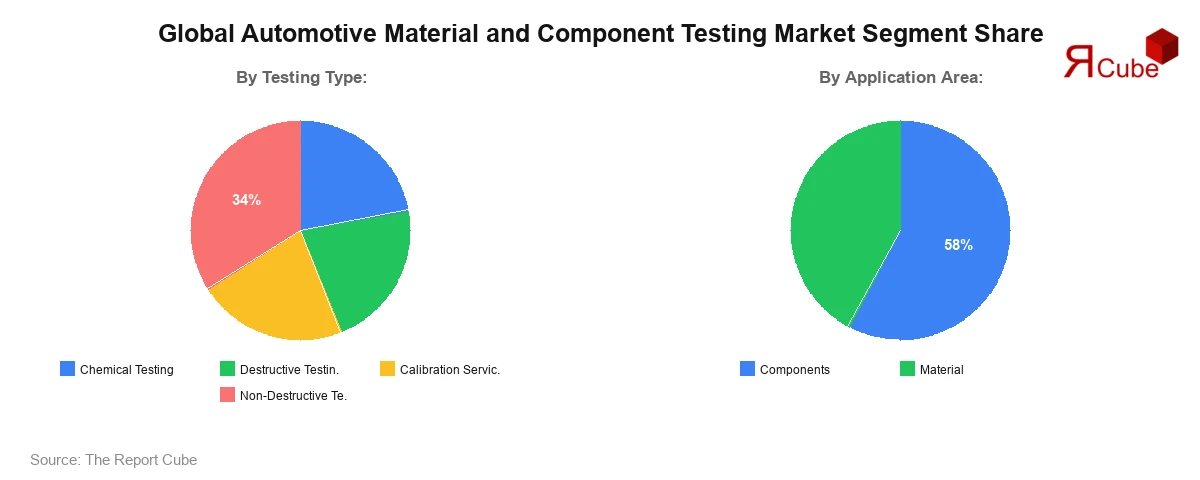
Non-Destructive Testing segment leads the market with nearly 34% share.
By Application Area:
Components segment dominates the market with approximately 58% of revenue.
Regional Outlook:
Asia Pacific region dominates the Global Automotive Material and Component Testing market with around 36% share.
Global Automotive Material and Component Testing Market Insights & Analysis
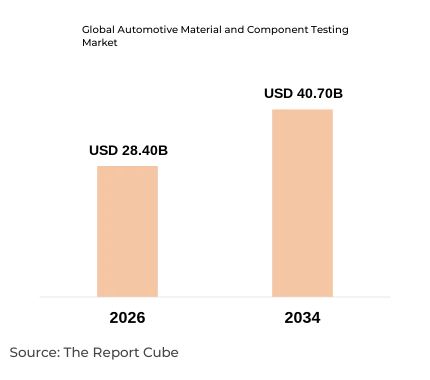
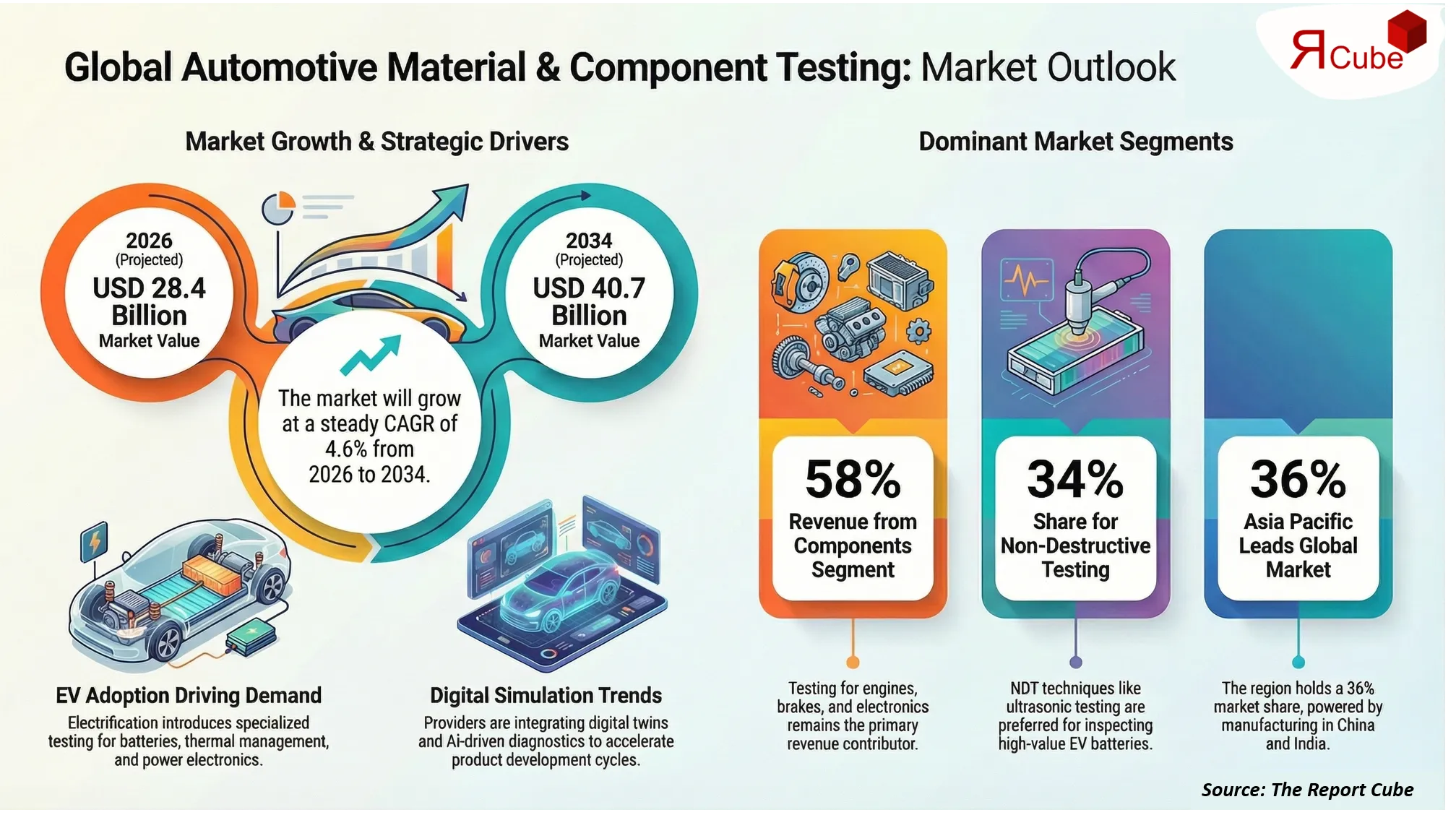
The Global Automotive Material and Component Testing Market is anticipated to register a CAGR of around 4.6% during the forecast period 2026-2034. The market size is valued at USD 28.4 billion in 2026 and is projected to reach USD 40.7 billion by 2034. The steady expansion of this market is closely tied to rising vehicle complexity, growing electrification trends, and stringent regulatory frameworks across developed and emerging economies. Governments and regulatory bodies are mandating advanced validation standards for safety, durability, and emissions, which continues to drive testing demand globally.
Increasing investments in electric vehicles, lightweight materials, and autonomous systems are reshaping the automotive material and component testing market expansion. OEMs and suppliers are focusing on validating advanced materials such as composites, high-strength alloys, and battery systems. Testing providers are integrating digital diagnostics, simulation tools, and real-time analytics to improve testing accuracy and turnaround time. Moreover, partnerships between testing agencies and automotive manufacturers are increasing, ensuring faster product development cycles while maintaining compliance and safety benchmarks.
Global Automotive Material and Component Testing Market Dynamics
Key Driver: Increasing Stringency in Automotive Safety and Emission Standards
The automotive material and component testing market is primarily driven by the tightening of global safety and emission regulations. Regulatory authorities across North America, Europe, and Asia Pacific are enforcing strict compliance standards related to crash safety, fuel efficiency, and emissions control. This has significantly increased the need for comprehensive testing across materials and vehicle components.
Additionally, the shift toward electric mobility has introduced new testing requirements, especially for batteries, thermal management systems, and electronic components. Automotive manufacturers are investing heavily in validation procedures to ensure product reliability and regulatory approval, which directly contributes to sustained demand for advanced testing services.
Book your FREE 30-minute expert consultation today
Contact UsIndustry Trends: Integration of Advanced Testing Technologies and Digital Simulation
The market is witnessing a strong trend toward integrating digital technologies such as simulation-driven testing, automation, and data analytics. Testing providers are leveraging digital twins and predictive analytics to simulate real-world performance conditions, reducing physical testing cycles and improving efficiency.
Another notable trend is the increasing use of non-destructive testing techniques, which allow for detailed inspection without damaging components. These technologies are particularly critical in testing high-value automotive parts such as battery systems and lightweight composite materials, supporting faster innovation cycles in the automotive industry.
Major Challenge: High Cost and Complexity of Advanced Testing Infrastructure
One of the key challenges in the automotive material and component testing market is the high cost associated with advanced testing infrastructure. Establishing state-of-the-art laboratories equipped with modern testing technologies requires significant capital investment, which can be a barrier for smaller testing agencies.
Moreover, the complexity of testing next-generation automotive systems, including electric drivetrains and autonomous technologies, demands specialized expertise and continuous technological upgrades. This increases operational costs and creates challenges in maintaining standardization across global testing facilities.
Opportunity: Rising Demand for Electric Vehicles and Lightweight Materials
The rapid adoption of electric vehicles presents substantial growth opportunities for the automotive material and component testing market. EVs require extensive testing for batteries, power electronics, and charging systems, creating new revenue streams for testing service providers.
Furthermore, the growing focus on lightweight materials such as carbon fiber composites and aluminum alloys is increasing the need for specialized testing procedures. These materials require precise validation to ensure durability and safety, thereby expanding the scope of testing services across the automotive value chain.
Global Automotive Material and Component Testing Market Segment-wise Analysis
By Testing Type:
- Chemical Testing
- Destructive Testing
- Calibration Service
- Non-Destructive Testing
Non-destructive testing holds a leading position in the automotive material and component testing market share, accounting for approximately 34% in 2026. This dominance is attributed to its ability to inspect components without causing damage, making it highly suitable for high-value automotive parts such as batteries, engine components, and structural elements. Techniques like ultrasonic testing and radiography are widely used for detecting internal defects, ensuring product reliability.
Furthermore, the increasing adoption of electric vehicles and advanced materials has amplified the need for non-destructive testing methods. Automotive manufacturers are relying on these techniques to maintain quality assurance while reducing waste and operational costs. This segment is expected to witness steady growth due to its efficiency and cost-effectiveness in modern automotive production processes.
By Application Area:
- Components
- Transmission
- Interiors
- Brakes
- Sensors and Electronics
- Seating
- Wiring
- Steering
- Suspension
- Other
- Material
- Polymers and Plastics
- Metals and Alloys
- Paints and Coatings
- Ceramics and Refractories
- Textiles and Leather
- Rubber and Elastomers
- Others
The components segment dominates the automotive material and component testing market, contributing nearly 58% of total revenue. This is primarily due to the extensive testing required for critical vehicle systems such as engines, braking systems, electronics, and transmission components. Each component must undergo rigorous validation to meet safety and performance standards.
In addition, the growing integration of electronics and sensor-based systems in vehicles has further increased testing demand within this segment. With the rise of connected and autonomous vehicles, testing requirements for electronic components have surged, reinforcing the dominance of the components segment in the global market.
Regional Projection of Global Automotive Material and Component Testing Industry
- North America
- Europe
- Asia Pacific
- Middle East and Africa
- South America
Asia Pacific leads the automotive material and component testing market with an estimated 36% share, driven by strong automotive manufacturing bases in countries such as China, India, and Japan. The region has witnessed rapid industrialization and increasing vehicle production, which has significantly boosted demand for testing services.
Additionally, government initiatives supporting electric mobility and domestic manufacturing have strengthened the region’s position. Investments in testing infrastructure and collaborations between global testing agencies and local manufacturers are further accelerating market growth. Asia Pacific is expected to maintain its dominance due to continuous advancements in automotive technologies and expanding production capacities.
Government Initiatives & Policies
- India Automotive Mission Plan 2026: Focuses on strengthening automotive testing infrastructure and safety standards.
- EU Vehicle Safety Regulation 2025: Mandates advanced testing protocols for vehicle safety and emissions compliance.
Global Automotive Material and Component Testing Industry Recent Developments
- 2025: Detection Technology Plc launched the X-Cargo detector modules designed for high-speed, high-energy inspection, enabling enhanced non-destructive testing of automotive components and battery systems with improved accuracy and throughput.
Need insights for a specific region within this market?
Request Regional DataWhy Choose This Report?
- Provides a comprehensive overview of the overall market analysis, encompassing key trends, consumer behavior analysis, and risk assessment to support strategic decision-making.
- Provides accurate, up-to-date insights into market size, segmentation, and emerging opportunities, helping to minimize risk & capitalizing on growth.
- Gives deep understanding of target audience preferences, investment habits, and communication channels for enhanced product development & marketing effectiveness.
- Delivers competitive analysis & benchmarking, uncovering the strengths & weaknesses of market competitors to guide strategies.
- Consolidate comprehensive market intelligence, reducing reasoning & streamlining research efforts.
- Facilitates customized market segmentation & risk mitigation strategies, fine-tuned to the business objectives.
- Aids in identifying both market challenges & untapped opportunities within the industry to drive long-term business growth.
- Provides valuable information based on actual customer data & search trends.
Table of Contents
- Introduction
- Objective of the Study
- Product and Category Definition
- Market Segmentation
- Study Variables
- Research Methodology
- Secondary Data Points
- Breakdown of Secondary Sources
- Primary Data Points
- Breakdown of Primary Interviews
- Secondary Data Points
- Executive Summary
- Market Dynamics
- Drivers
- Challenges
- Opportunity Assessment
- Recent Trends and Developments
- Regulatory and Policy Landscape
- Global Automotive Material and Component Testing Market Overview (2021-2034)
- Market Size, By Value (USD Billion)
- Market Share, By Testing Type
- Chemical Testing
- Wet Chemical Testing
- Spectroscopy
- Combustion Testing
- Other Chemical Testing
- Destructive Testing
- Fatigue Testing
- Hardness Testing
- Tensile Testing
- Fracture Testing
- Corrosion Testing
- NVH Testing
- Impact Testing
- Temperature Cycling
- Fluid Dynamics Testing
- Shock Testing
- Metallography Testing
- E&E Testing
- Creep and Stress Rupture Testing
- IP Testing
- Others
- Calibration Service
- Non-Destructive Testing
- Eddy Current Testing
- Ultrasonic Testing
- Thermography Testing
- Visual Testing
- Magnetic Particle Inspection
- Radiography Testing
- Dye Penetration Inspection
- Dimension and Metrology Testing
- Others
- Chemical Testing
- Market Share, By Application Area
- Components
- Transmission
- Interiors
- Brakes
- Sensors and Electronics
- Seating
- Wiring
- Steering
- Fuel Systems and Exhaust
- Doors, Hinges, and Latches
- Engine Parts
- Lighting
- Body in White
- Suspension
- Other
- Material
- Polymers and Plastics
- ABS
- Polypropylene
- CFRP
- Nylon
- GFRP
- Other
- Metals and Alloys
- Titanium and Alloys
- Aluminum and Alloys
- High Strength Steel
- Copper and Alloys
- Superalloys
- Other
- Paints and Coatings
- Ceramics and Refractories
- Textiles and Leather
- Rubber and Elastomers
- Others
- Polymers and Plastics
- Components
- Market Share, By Vehicle Type
- Three Wheelers
- Passenger Vehicle
- Off-Highway Vehicle
- Two Wheelers
- Commercial Vehicle
- Market Share, By Testing Agency
- Government Agency
- Inhouse Testing or Captive Testing
- TIC Service Provider
- Others
- Market Share, By Project Type
- Annual Maintenance Contract
- One Off Analysis or Walk in Analysis
- Project Based
- Others
- Market Share, By Region
- North America
- Europe
- Asia Pacific
- Middle East and Africa
- South America
- Market Share, By Company
- Revenue Shares and Analysis
- Competitive Landscape
- North America Automotive Material and Component Testing Market
- Market Size, By Value (USD Billion/Million)
- Market Share, By Testing Type
- Market Share, By Application Area
- Market Share, By Vehicle Type
- Market Share, By Testing Agency
- Market Share, By Project Type
- Market Share, By Country
- United States
- Canada
- Mexico
- Europe Automotive Material and Component Testing Market
- Market Size, By Value (USD Billion/Million)
- Market Share, By Testing Type
- Market Share, By Application Area
- Market Share, By Vehicle Type
- Market Share, By Testing Agency
- Market Share, By Project Type
- Market Share, By Country
- Germany
- France
- United Kingdom
- Italy
- Spain
- Northern and Nordic Countries
- BENELUX
- Rest of Europe
- Asia Pacific Automotive Material and Component Testing Market
- Market Size, By Value (USD Billion/Million)
- Market Share, By Testing Type
- Market Share, By Application Area
- Market Share, By Vehicle Type
- Market Share, By Testing Agency
- Market Share, By Project Type
- Market Share, By Country
- China
- India
- Japan
- South Korea
- Australia
- Rest of Asia Pacific
- Middle East and Africa Automotive Material and Component Testing Market
- Market Size, By Value (USD Billion/Million)
- Market Share, By Testing Type
- Market Share, By Application Area
- Market Share, By Vehicle Type
- Market Share, By Testing Agency
- Market Share, By Project Type
- Market Share, By Country
- Saudi Arabia
- United Arab Emirates
- South Africa
- Rest of Middle East and Africa
- South America Automotive Material and Component Testing Market
- Market Size, By Value (USD Billion/Million)
- Market Share, By Testing Type
- Market Share, By Application Area
- Market Share, By Vehicle Type
- Market Share, By Testing Agency
- Market Share, By Project Type
- Market Share, By Country
- Brazil
- Argentina
- Rest of South America
- Competitive Outlook and Company Profiles
- Intertek
- Company Overview
- Product Portfolio
- Strategic Alliances/Partnerships
- Recent Developments
- Automotive Research Association of India
- Company Overview
- Product Portfolio
- Strategic Alliances/Partnerships
- Recent Developments
- DEKRA
- Company Overview
- Product Portfolio
- Strategic Alliances/Partnerships
- Recent Developments
- TÜV Rheinland
- Company Overview
- Product Portfolio
- Strategic Alliances/Partnerships
- Recent Developments
- Bureau Veritas
- Company Overview
- Product Portfolio
- Strategic Alliances/Partnerships
- Recent Developments
- TÜV SÜD
- Company Overview
- Product Portfolio
- Strategic Alliances/Partnerships
- Recent Developments
- Underwriters Laboratories
- Company Overview
- Product Portfolio
- Strategic Alliances/Partnerships
- Recent Developments
- Atharva Labs
- Company Overview
- Product Portfolio
- Strategic Alliances/Partnerships
- Recent Developments
- TÜV NORD
- Company Overview
- Product Portfolio
- Strategic Alliances/Partnerships
- Recent Developments
- SGS
- Company Overview
- Product Portfolio
- Strategic Alliances/Partnerships
- Recent Developments
- Others
- Intertek
- Contact Us and Disclaimer
Top Key Players & Market Share Outlook
- Intertek
- Automotive Research Association of India
- DEKRA
- TÜV Rheinland
- Bureau Veritas
- TÜV SÜD
- Underwriters Laboratories
- Atharva Labs
- TÜV NORD
- SGS
Frequently Asked Questions






