




Build Your Custom Market Intelligence Report
Customize Your ReportIndonesia Baby Skincare Products Market Insights & Analysis
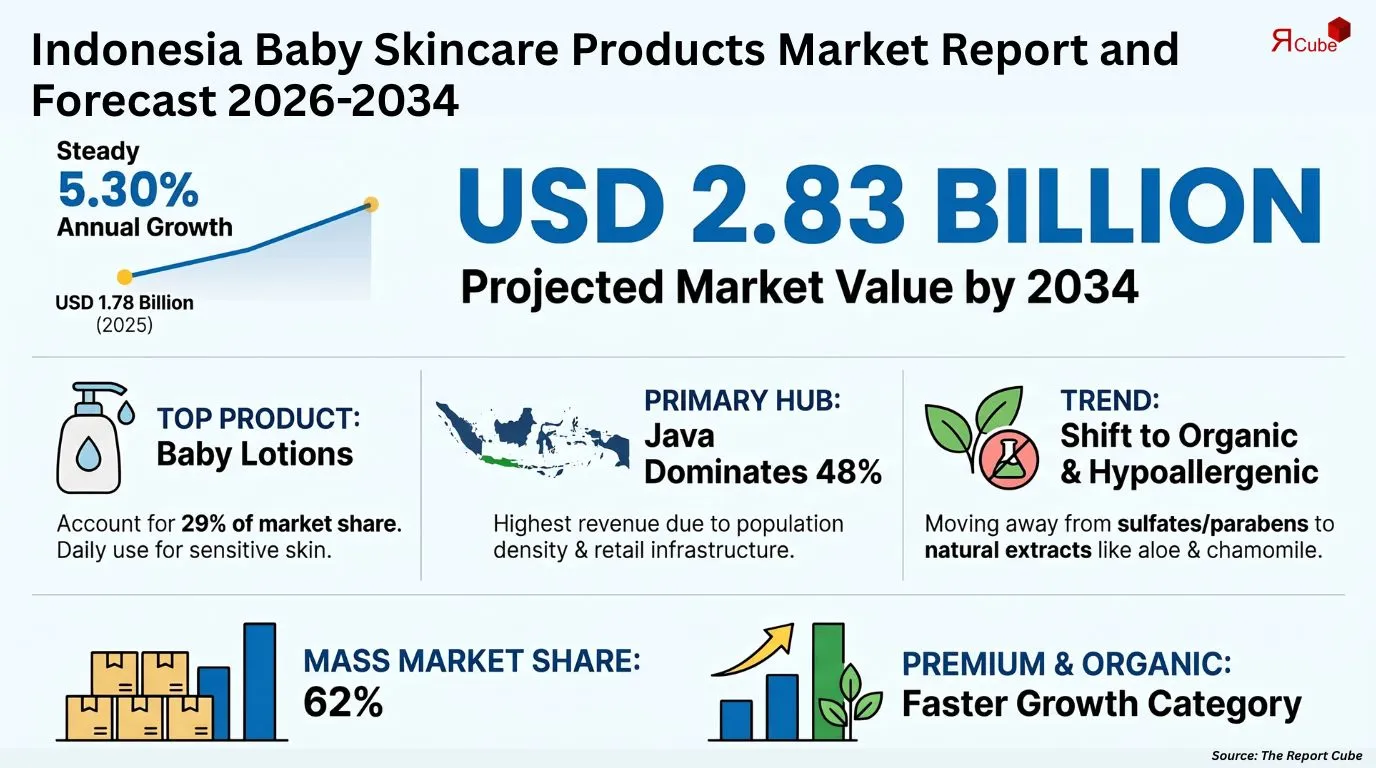
The Indonesia Baby Skincare Products Market is anticipated to register a CAGR of 5.30% during 2026-2034. The market size was valued at USD 1.78 billion in 2025 and is projected to reach USD 2.83 billion by 2034. This growth trajectory reflects Indonesia’s large infant population base, rising parental awareness regarding baby hygiene, and increasing spending on specialized personal care products designed specifically for infants.
Indonesia continues to experience steady birth rates, particularly across densely populated regions such as Java and Sumatra, which directly supports sustained demand for baby skincare products. Parents are becoming more informed about infant skin sensitivity, leading to higher adoption of dermatologically tested, mild, and chemical-free formulations. This awareness is reinforced by pediatric recommendations, digital parenting platforms, and aggressive marketing by established brands.
Moreover, the expansion of modern retail formats and online marketplaces has significantly improved product accessibility, allowing both mass and premium baby skincare brands to reach a wider consumer base. As a result, the Indonesia Baby Skincare Products Market is transitioning from basic hygiene solutions toward value-added, preventive, and therapeutic skincare offerings, setting a solid foundation for long-term growth.
Indonesia Baby Skincare Products Market Recent Developments
- 2025: Johnson & Johnson expanded its Johnson’s Baby gentle skincare portfolio with plant-based ingredients for tropical climates.
- 2025: Unilever Indonesia launched improved baby bath and lotion variants focusing on skin barrier protection.
Government Initiatives & Policies
- National Strategy for Maternal and Child Health: Program supporting infant health, hygiene awareness, and safe personal care usage.
- BPOM Cosmetic Safety Regulations: Strengthened oversight on baby skincare product safety and ingredient transparency.
Indonesia Baby Skincare Products Market Dynamics
Key Driver: Rising Parental Awareness and Focus on Infant Skin Health
Growing parental awareness regarding infant skin sensitivity is a major driver of the Indonesia Baby Skincare Products Market. Indonesian parents are increasingly educated about conditions such as diaper rash, eczema, and skin allergies, which has shifted demand toward specialized baby lotions, creams, and oils formulated with mild and hypoallergenic ingredients. This awareness is further supported by pediatric consultations, hospital-based education programs, and online parenting communities. As disposable incomes rise, particularly among middle-class households, parents are more willing to invest in trusted baby skincare brands that ensure safety and comfort, thereby reinforcing consistent market growth.
Book your FREE 30-minute expert consultation today
Contact UsIndustry Trends: Shift Toward Organic and Hypoallergenic Baby Skincare
An important trend shaping the Indonesia Baby Skincare Products Market is the increasing preference for organic and hypoallergenic formulations. Consumers are gradually moving away from products containing parabens, sulfates, and artificial fragrances, favoring natural extracts such as aloe vera, chamomile, and calendula. This trend aligns with global clean-label movements and is particularly strong among urban, digitally connected parents. Manufacturers are responding by reformulating existing products and introducing premium organic lines, which not only enhance brand differentiation but also contribute to higher average selling prices.
Major Challenge: Price Sensitivity in Mass Consumer Segments
Despite rising awareness, price sensitivity remains a key challenge within the Indonesia Baby Skincare Products Market. A significant portion of the population still prioritizes affordability over premium features, especially in rural and semi-urban areas. This limits the penetration of premium and organic baby skincare products. Additionally, intense competition among domestic and international brands exerts pricing pressure, compelling manufacturers to balance quality, compliance, and cost efficiency to sustain margins.
Opportunity: Rapid Growth of Online Retail and Digital Parenting Platforms
The expansion of e-commerce and digital parenting platforms presents a strong opportunity for the Indonesia Baby Skincare Products Market. Online retail channels allow brands to educate consumers, offer detailed product information, and promote targeted offerings. Subscription models, influencer-driven marketing, and bundled baby care kits are gaining traction, enabling brands to build long-term consumer relationships. This digital shift supports market expansion beyond traditional retail limitations.
Indonesia Baby Skincare Products Market Segment-wise Analysis
By Product Type:
- Baby Lotions
- Baby Creams
- Baby Oils
- Baby Powders
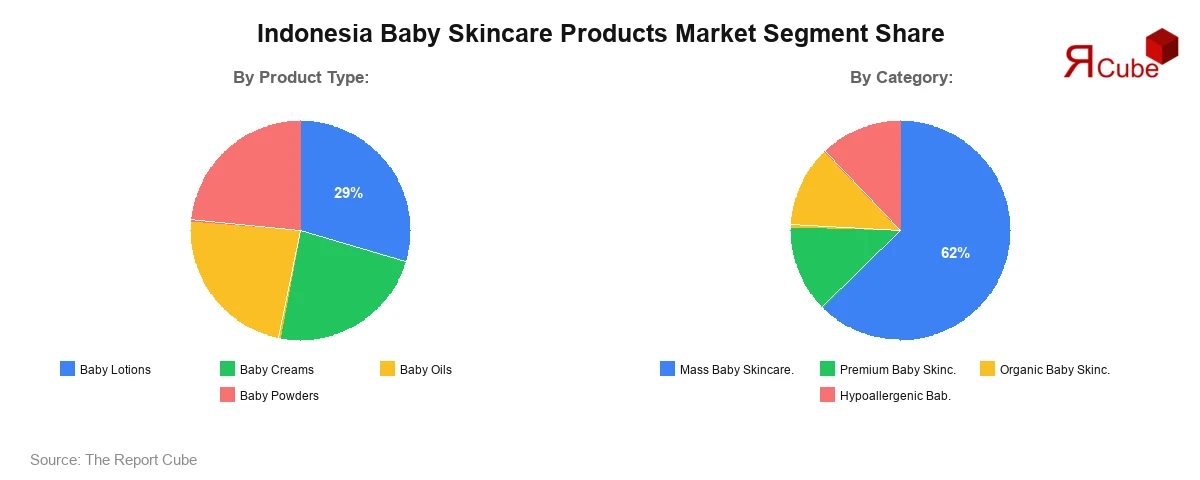
Baby lotions represent the leading segment in the Indonesia Baby Skincare Products Market, accounting for approximately 29% of total market share in 2025. Their daily usage for moisturizing and protecting sensitive infant skin drives consistent demand across all income groups. This segment benefits from strong brand loyalty and frequent repurchase behavior, making it a cornerstone for both mass and premium players.
By Category:
- Mass Baby Skincare
- Premium Baby Skincare
- Organic Baby Skincare
- Hypoallergenic Baby Skincare
Mass baby skincare dominates the Indonesia Baby Skincare Products Market with nearly 62% market share, supported by wide availability and affordability. However, organic and hypoallergenic categories are growing at a faster pace, driven by health-conscious urban consumers. This gradual category shift reflects changing consumer priorities and supports long-term value growth.
Regional Projection of Indonesia Baby Skincare Products Industry
- Sumatra
- Java
- Kalimantan
- Sulawesi
- Bali and Nusa Tenggara
- Maluku and Papua
Java leads the Indonesia Baby Skincare Products Market, contributing approximately 48% of total revenue. This dominance is attributed to high population density, stronger purchasing power, and well-developed retail infrastructure. Major urban centers such as Jakarta and Surabaya act as key consumption hubs, supported by extensive distribution networks. As awareness and retail penetration improve in outer islands, regional contribution from Sumatra and Sulawesi is expected to increase steadily through 2034.
Need insights for a specific region within this market?
Request Regional DataWhy Choose This Report?
- Provides a comprehensive overview of the overall market analysis, encompassing key trends, consumer behavior analysis, and risk assessment to support strategic decision-making.
- Provides accurate, up-to-date insights into market size, segmentation, and emerging opportunities, helping to minimize risk & capitalizing on growth.
- Gives deep understanding of target audience preferences, investment habits, and communication channels for enhanced product development & marketing effectiveness.
- Delivers competitive analysis & benchmarking, uncovering the strengths & weaknesses of market competitors to guide strategies.
- Consolidate comprehensive market intelligence, reducing reasoning & streamlining research efforts.
- Facilitates customized market segmentation & risk mitigation strategies, fine-tuned to the business objectives.
- Aids in identifying both market challenges & untapped opportunities within the industry to drive long-term business growth.
- Provides valuable information based on actual customer data & search trends.
Table of Contents
- Introduction
- Objective of the Study
- Product and Category Definition
- Market Segmentation
- Study Variables
- Research Methodology
- Secondary Data Points
- Breakdown of Secondary Sources
- Primary Data Points
- Breakdown of Primary Interviews
- Secondary Data Points
- Executive Summary
- Market Dynamics
- Drivers
- Challenges
- Opportunity Assessment
- Recent Trends and Developments
- Regulatory and Policy Landscape
- Indonesia Baby Skincare Products Market Overview (2021-2034)
- Market Size, By Value (USD Billion)
- Market Share, By Product Type
- Baby Lotions
- Baby Creams
- Baby Oils
- Baby Powders
- Baby Wipes
- Baby Bath Products
- Baby Sun Care
- Market Share, By Category
- Mass Baby Skincare
- Premium Baby Skincare
- Organic Baby Skincare
- Hypoallergenic Baby Skincare
- Market Share, By Formulation
- Cream-Based
- Lotion-Based
- Oil-Based
- Gel-Based
- Market Share, By Distribution Channel
- Supermarkets and Hypermarkets
- Convenience Stores
- Specialty Baby Stores
- Pharmacies and Drugstores
- Online Retail
- Market Share, By Region
- Sumatra
- Java
- Kalimantan
- Sulawesi
- Bali and Nusa Tenggara
- Maluku and Papua
- Market Share, By Company
- Revenue Shares and Analysis
- Competitive Landscape
- Sumatra Indonesia Baby Skincare Products Market
- Market Size, By Value (USD Billion)
- Market Share, By Product Type
- Market Share, By Category
- Market Share, By Formulation
- Market Share, By Distribution Channel
- Java Indonesia Baby Skincare Products Market
- Market Size, By Value (USD Billion)
- Market Share, By Product Type
- Market Share, By Category
- Market Share, By Formulation
- Market Share, By Distribution Channel
- Kalimantan Indonesia Baby Skincare Products Market
- Market Size, By Value (USD Billion)
- Market Share, By Product Type
- Market Share, By Category
- Market Share, By Formulation
- Market Share, By Distribution Channel
- Sulawesi Indonesia Baby Skincare Products Market
- Market Size, By Value (USD Billion)
- Market Share, By Product Type
- Market Share, By Category
- Market Share, By Formulation
- Market Share, By Distribution Channel
- Bali and Nusa Tenggara Indonesia Baby Skincare Products Market
- Market Size, By Value (USD Billion)
- Market Share, By Product Type
- Market Share, By Category
- Market Share, By Formulation
- Market Share, By Distribution Channel
- Maluku and Papua Indonesia Baby Skincare Products Market
- Market Size, By Value (USD Billion)
- Market Share, By Product Type
- Market Share, By Category
- Market Share, By Formulation
- Market Share, By Distribution Channel
- Competitive Outlook and Company Profiles
- Johnson & Johnson (Johnson's Baby)
- Company Overview
- Product Portfolio
- Strategic Alliances/Partnerships
- Recent Developments
- Unilever Indonesia Tbk
- Company Overview
- Product Portfolio
- Strategic Alliances/Partnerships
- Recent Developments
- Pigeon Indonesia
- Company Overview
- Product Portfolio
- Strategic Alliances/Partnerships
- Recent Developments
- Kao Indonesia (Merries and Baby Skincare)
- Company Overview
- Product Portfolio
- Strategic Alliances/Partnerships
- Recent Developments
- Wipro Consumer Care (Enchanteur and Baby Brands)
- Company Overview
- Product Portfolio
- Strategic Alliances/Partnerships
- Recent Developments
- Lion Wings Indonesia
- Company Overview
- Product Portfolio
- Strategic Alliances/Partnerships
- Recent Developments
- Johnson Home Hygiene Products Indonesia
- Company Overview
- Product Portfolio
- Strategic Alliances/Partnerships
- Recent Developments
- Mustela Indonesia
- Company Overview
- Product Portfolio
- Strategic Alliances/Partnerships
- Recent Developments
- Sebamed Indonesia
- Company Overview
- Product Portfolio
- Strategic Alliances/Partnerships
- Recent Developments
- Others
- Johnson & Johnson (Johnson's Baby)
- Contact Us and Disclaimer
Top Key Players & Market Share Outlook
- Johnson & Johnson (Johnson's Baby)
- Unilever Indonesia Tbk
- Pigeon Indonesia
- Kao Indonesia (Merries and Baby Skincare)
- Wipro Consumer Care (Enchanteur and Baby Brands)
- Lion Wings Indonesia
- Johnson Home Hygiene Products Indonesia
- Mustela Indonesia
- Sebamed Indonesia
- Others
Frequently Asked Questions






