



Build Your Custom Market Intelligence Report
Customize Your ReportBrazil Banking as a Service (BaaS) Market Key Highlights
By Component:
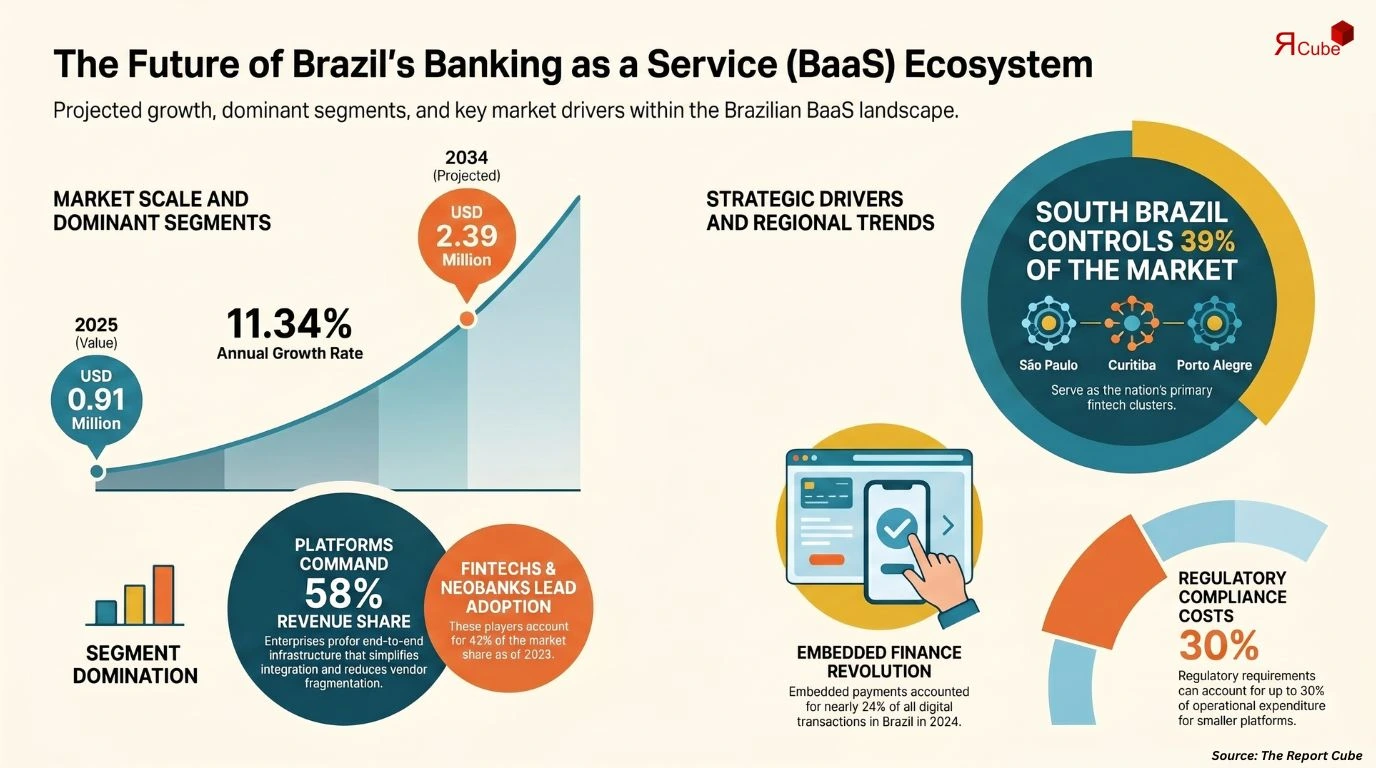
Platforms segment leads the market, contributing nearly 58% of total revenue.
By End-User:
Fintechs & neobanks dominate the market, accounting for around 42% share.
Regional Outlook:
South Brazil holds the largest share of the Brazilian Banking as a Service (BaaS) Market at approximately 39%.
Government Initiatives & Policies
- Banco Central do Brasil - Open Finance Initiative: Regulatory framework enabling API-based financial data sharing, accelerating BaaS adoption.
- PIX Instant Payments Program: National real-time payment infrastructure supporting embedded finance and BaaS platforms.
Brazil Banking as a Service (BaaS) Market Insights & Analysis
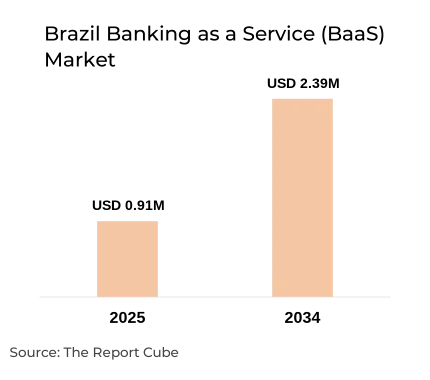
The Brazil Banking as a Service (BaaS) Market is anticipated to register a CAGR of 11.34% during 2026-2034. The market size was valued at USD 0.91 million in 2025 and is projected to reach USD 2.39 million by 2034. Banking as a Service has emerged as a foundational layer within Brazil’s rapidly digitizing financial ecosystem, enabling non-bank enterprises to embed regulated financial services through APIs without holding a banking license.
Brazil represents one of the most mature digital banking environments in Latin America, supported by strong regulatory backing and high consumer acceptance of digital payments. Over 70% of Brazilian adults actively use digital banking applications, creating fertile ground for embedded finance models. BaaS platforms allow merchants, SaaS providers, and marketplaces to integrate payments, lending, wallets, and compliance capabilities seamlessly into their offerings. Investments into Brazilian fintech infrastructure exceeded USD 4.5 billion between 2021 and 2024, a portion of which directly fueled BaaS platform expansion. As financial services increasingly shift toward platform-based distribution, BaaS is evolving from a niche backend solution into a strategic growth enabler across multiple industries.
Brazil Banking as a Service (BaaS) Market Dynamics
Key Driver: Accelerated Growth of Embedded Finance Across Digital Platforms
One of the strongest growth drivers for the Brazil Banking as a Service Market is the rapid expansion of embedded finance across e-commerce, retail, and software platforms. Brazilian merchants increasingly prefer integrated financial solutions that reduce dependency on traditional banks while improving customer retention. Embedded payments alone accounted for nearly 24% of all digital transactions in Brazil during 2024. BaaS enables companies to launch branded cards, wallets, and credit offerings in under six months, compared to multi-year timelines under traditional banking models. This speed-to-market advantage is critical in Brazil’s highly competitive digital economy. Additionally, widespread adoption of PIX has normalized instant digital payments, pushing platforms to offer end-to-end financial experiences. As customer expectations shift toward seamless financial journeys, BaaS providers are becoming indispensable infrastructure partners.
Book your FREE 30-minute expert consultation today
Contact UsIndustry Trends: API Standardization and Modular Financial Architecture
A major trend shaping the Brazil BaaS Market is the move toward standardized APIs and modular financial stacks. Enterprises are no longer seeking monolithic banking solutions; instead, they demand flexible components that can be deployed independently. API-based core banking, payments, and compliance modules allow organizations to tailor financial services based on their customer use cases. Over 60% of Brazilian fintechs launched after 2021 rely on third-party BaaS providers for at least one core banking function. Another notable trend is the integration of compliance-by-design tools, where AML, KYC, and fraud detection are embedded directly into service workflows. This reduces regulatory friction and improves onboarding conversion rates by nearly 18%. The market is clearly moving toward composable finance models.
Major Challenge: Regulatory Complexity and Compliance Burden
Regulatory compliance remains a key challenge for the Brazil Banking as a Service Market. While Brazil’s regulatory environment is progressive, it is also highly structured, requiring strict adherence to Central Bank guidelines. BaaS providers must continuously invest in compliance infrastructure, reporting systems, and audit readiness. For smaller platforms, regulatory costs can account for up to 30% of operational expenditure. Frequent updates to data protection, open finance, and payment regulations increase operational complexity. Additionally, liability sharing between licensed banks and BaaS platforms requires carefully structured agreements, often slowing partnership formation. These compliance demands create entry barriers and limit the pace of innovation for emerging providers.
Opportunity: Expansion of BaaS into Non-Financial Verticals
Significant opportunity exists in extending BaaS adoption beyond fintech into non-financial verticals such as logistics, healthcare, agribusiness, and education. These sectors increasingly require embedded payments, working capital financing, and digital wallets tailored to their operational needs. In Brazil, agribusiness alone represents over 24% of GDP, yet remains underserved by customized financial infrastructure. BaaS platforms can enable vertical SaaS providers to offer sector-specific financial products, improving cash flow visibility and transaction efficiency. Furthermore, small and medium enterprises are actively seeking alternatives to traditional banks due to credit access limitations. By enabling contextual finance, BaaS providers can unlock new revenue streams while driving financial inclusion.
Brazil Banking as a Service (BaaS) Market Segment-wise Analysis
By Component:
- Services
- Platforms
Platforms segment leads the market with approximately 58% share in 2025. This dominance reflects rising demand for end-to-end BaaS infrastructure that includes core banking, payment processing, compliance, and reporting. Enterprises prefer platforms that reduce vendor fragmentation and simplify integration. Platform-based BaaS solutions also enable scalability, allowing clients to expand offerings without rebuilding backend systems. Continuous upgrades and subscription-based pricing models further strengthen this segment’s revenue contribution.
By End-User:
- Merchants & Retail Chains
- Banks & Licensed Institutions
- Vertical SaaS Platforms
- Consumer Platforms & Marketplaces
- Fintechs & Neobanks
Fintechs and neobanks represent the largest end-user group, accounting for nearly 42% of the Brazil BaaS Market. These players rely heavily on BaaS to launch compliant products quickly while focusing resources on customer experience and growth. Over 80% of newly licensed fintechs in Brazil utilize external BaaS platforms for core banking or payment services. As competition intensifies, fintechs increasingly differentiate through customized financial features enabled by BaaS partnerships.
Regional Projection of Brazil Banking as a Service (BaaS) Industry
- Northeast
- South
- Central-West
South Brazil leads the market with approximately 39% share, supported by strong fintech clusters in São Paulo, Curitiba, and Porto Alegre. The region benefits from advanced digital infrastructure, higher enterprise technology adoption, and proximity to major financial institutions. The Northeast region is witnessing faster growth, driven by rising digital inclusion initiatives and SME digitization. Central-West shows steady adoption, particularly within agribusiness platforms seeking embedded finance solutions. Regional diversification is expected to strengthen as BaaS platforms expand nationwide.
Brazil Banking as a Service (BaaS) Market Recent Developments
- 2025: QI Tech, a leading provider of BaaS infrastructure, successfully secured a USD 63 million Series B extension to enhance its API-driven financial infrastructure. The funding will support strategic mergers and acquisitions and accelerate the growth of embedded banking and insurance services within Brazil’s digital financial ecosystem.
- 2025: With the completion of its latest funding round, QI Tech highlighted a USD 25 billion in assets under management (AUM), alongside rapid expansion in the insurance and foreign exchange sectors. The company established itself as a pivotal "engine room" driving Brazil’s digital finance and embedded banking ecosystem.
- 2025: Dock solidified its position as a key regional player in BaaS and payment processing, managing more than 70 million cards and processing 7.5 billion transactions annually, including 1.3 billion via Pix. The company expanded its cloud-native platform for banking and card issuing services to 11 countries across Latin America.
- 2025: Dock further emphasized its role in the fintech landscape with the introduction of its modular "Dock One" banking stack. The company also formed new partnerships with industry giants such as Visa and Mastercard, facilitating the launch of debit and credit card programs for fintechs and retailers throughout Brazil and the broader region.
- 2025: Nubank enhanced its embedded, app-based financial ecosystem, launching innovative products like Caixinhas Turbo—a large-scale debt renegotiation initiative benefiting over 6 million customers. Additionally, the company reported a significant 133% growth in its secured credit portfolios, underscoring its commitment to a digital-first financial infrastructure.
Need insights for a specific region within this market?
Request Regional DataWhy Choose This Report?
- Provides a comprehensive overview of the overall market analysis, encompassing key trends, consumer behavior analysis, and risk assessment to support strategic decision-making.
- Provides accurate, up-to-date insights into market size, segmentation, and emerging opportunities, helping to minimize risk & capitalizing on growth.
- Gives deep understanding of target audience preferences, investment habits, and communication channels for enhanced product development & marketing effectiveness.
- Delivers competitive analysis & benchmarking, uncovering the strengths & weaknesses of market competitors to guide strategies.
- Consolidate comprehensive market intelligence, reducing reasoning & streamlining research efforts.
- Facilitates customized market segmentation & risk mitigation strategies, fine-tuned to the business objectives.
- Aids in identifying both market challenges & untapped opportunities within the industry to drive long-term business growth.
- Provides valuable information based on actual customer data & search trends.
Table of Contents
- Introduction
- Objective of the Study
- Product and Category Definition
- Market Segmentation
- Study Variables
- Research Methodology
- Secondary Data Points
- Breakdown of Secondary Sources
- Primary Data Points
- Breakdown of Primary Interviews
- Secondary Data Points
- Executive Summary
- Market Dynamics
- Drivers
- Challenges
- Opportunity Assessment
- Recent Trends and Developments
- Regulatory and Policy Landscape
- Brazil Banking as a Service (BaaS) Market Overview (2021-2034)
- Market Size, By Value (USD Million)
- Market Share, By Component
- Services
- Platforms
- Market Share, By Service Component
- Credit, Lending & BNPL APIs
- Fraud, Risk & Compliance Engines
- Digital Onboarding, KYC & AML
- Core Banking & Ledger APIs
- Payments, Cards & Wallet APIs
- Value-Added Financial APIs
- Market Share, By Deployment Model
- Hybrid (Bank Core + BaaS APIs)
- Public Cloud Multi-Tenant BaaS
- Bank-Hosted BaaS (Licensed Entity Stack)
- Dedicated / Single-Tenant Cloud BaaS
- Market Share, By Organization Size
- Small
- Large
- Market Share, By End-User
- Merchants & Retail Chains
- Banks & Licensed Institutions
- Vertical SaaS Platforms
- Consumer Platforms & Marketplaces
- Fintechs & Neobanks
- Market Share, By Region
- Northeast
- South
- Central-West
- Market Share, By Company
- Revenue Shares & Analysis
- Competitive Landscape
- Northeast Brazil Banking as a Service (BaaS) Market
- Market Size, By Value (USD Million)
- Market Share, By Component
- Market Share, By Service Component
- Market Share, By Deployment Model
- Market Share, By Organization Size
- Market Share, By End-User
- South Brazil Banking as a Service (BaaS) Market
- Market Size, By Value (USD Million)
- Market Share, By Component
- Market Share, By Service Component
- Market Share, By Deployment Model
- Market Share, By Organization Size
- Market Share, By End-User
- Central-West Brazil Banking as a Service (BaaS) Market
- Market Size, By Value (USD Million)
- Market Share, By Component
- Market Share, By Service Component
- Market Share, By Deployment Model
- Market Share, By Organization Size
- Market Share, By End-User
- Competitive Outlook and Company Profiles
- PagSeguro
- Company Overview
- Product Portfolio
- Strategic Alliances/Partnerships
- Recent Developments
- Banco Topázio
- Company Overview
- Product Portfolio
- Strategic Alliances/Partnerships
- Recent Developments
- Zoop
- Company Overview
- Product Portfolio
- Strategic Alliances/Partnerships
- Recent Developments
- Nubank
- Company Overview
- Product Portfolio
- Strategic Alliances/Partnerships
- Recent Developments
- QI Tech
- Company Overview
- Product Portfolio
- Strategic Alliances/Partnerships
- Recent Developments
- Dock
- Company Overview
- Product Portfolio
- Strategic Alliances/Partnerships
- Recent Developments
- Fitbank
- Company Overview
- Product Portfolio
- Strategic Alliances/Partnerships
- Recent Developments
- Bradesco
- Company Overview
- Product Portfolio
- Strategic Alliances/Partnerships
- Recent Developments
- Pomelo
- Company Overview
- Product Portfolio
- Strategic Alliances/Partnerships
- Recent Developments
- Zro Bank
- Company Overview
- Product Portfolio
- Strategic Alliances/Partnerships
- Recent Developments
- Banco Inter
- Company Overview
- Product Portfolio
- Strategic Alliances/Partnerships
- Recent Developments
- Celcoin
- Company Overview
- Product Portfolio
- Strategic Alliances/Partnerships
- Recent Developments
- Baru BaaS
- Company Overview
- Product Portfolio
- Strategic Alliances/Partnerships
- Recent Developments
- Others
- PagSeguro
- Contact Us and Disclaimer
Top Key Players & Market Share Outlook
- PagSeguro
- Banco Topázio
- Zoop
- Nubank
- QI Tech
- Dock
- Fitbank
- Bradesco
- Pomelo
- Zro Bank
- Banco Inter
- Celcoin
- Baru BaaS
- Others
Frequently Asked Questions






