



Build Your Custom Market Intelligence Report
Customize Your ReportSoutheast Asia Battery and Battery Recycling Market Key Highlights
By Battery Type:
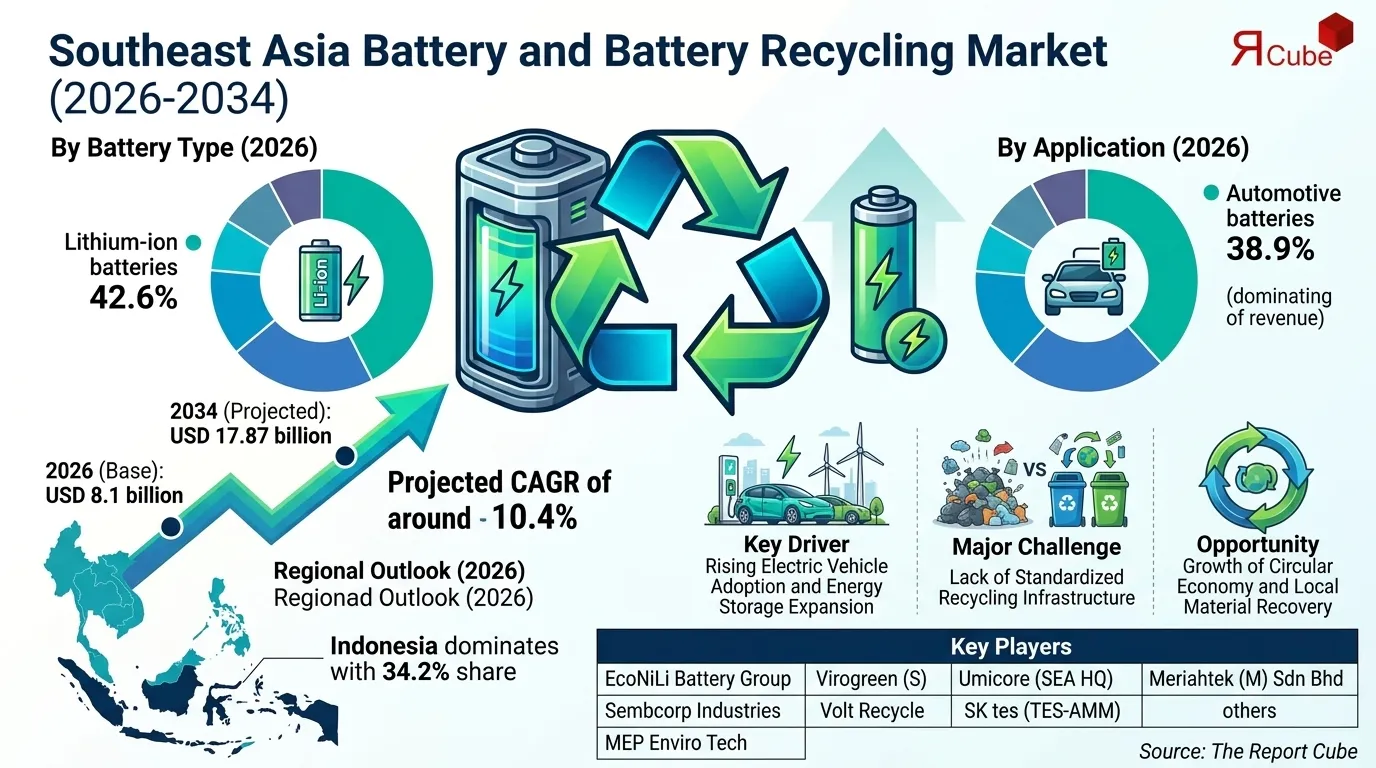
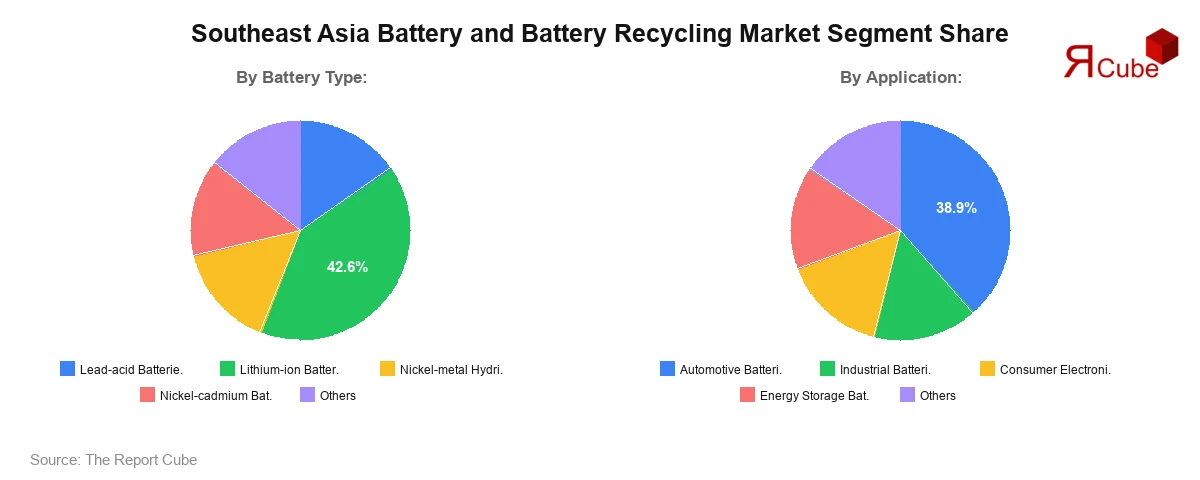
Lithium-ion batteries segment leads the market with 42.6% share.
By Application:
Automotive batteries segment dominates the market with 38.9% of revenue.
Regional Outlook:
Indonesia dominates the Southeast Asia Battery and Battery Recycling market with 34.2% share.
Southeast Asia Battery and Battery Recycling Market Insights & Analysis
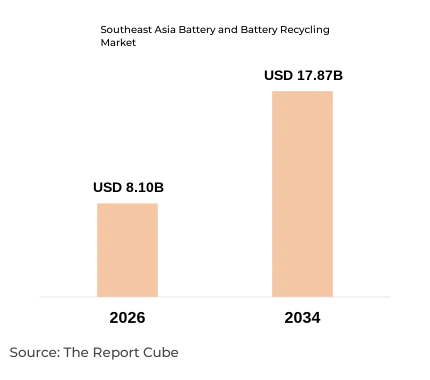
The Southeast Asia Battery and Battery Recycling Market is anticipated to register a CAGR of around 10.4% during the forecast period 2026-2034. The market size is valued at USD 8.1 billion in 2026 and is projected to reach USD 17.87 billion by 2034. Rapid electrification across Southeast Asia, combined with increasing renewable energy deployment, is shaping strong demand for battery storage systems and recycling infrastructure. Countries such as Indonesia, Vietnam, and Thailand are witnessing rising investments in electric vehicle ecosystems and grid-scale storage, which directly drives battery demand and end-of-life recycling needs.
Government-backed industrial strategies and private sector investments are strengthening the region’s position as a global battery supply chain hub. Indonesia’s nickel reserves, accounting for nearly 22% of global supply, are encouraging downstream battery manufacturing and recycling facilities. Companies are investing heavily in hydrometallurgical recycling processes to recover lithium, cobalt, and nickel efficiently. At the same time, regulatory frameworks promoting circular economy models are pushing manufacturers toward sustainable material recovery. This combination of resource availability, policy support, and industrial expansion is accelerating Southeast Asia battery market growth while improving recycling efficiency.
Southeast Asia Battery and Battery Recycling Market Dynamics
Key Driver: Rising Electric Vehicle Adoption and Energy Storage Expansion
The growing adoption of electric vehicles across Southeast Asia is a major factor driving the Southeast Asia battery market size. Countries like Thailand and Indonesia have introduced incentives such as tax exemptions and subsidies, leading to a steady increase in EV registrations, which grew by over 35% in 2025 compared to the previous year. This surge directly increases demand for lithium-ion batteries and future recycling requirements.
Parallel to EV growth, energy storage systems are gaining traction as renewable energy penetration increases. Solar and wind installations require efficient storage solutions to maintain grid stability. This dual demand from mobility and power sectors is expanding battery consumption while creating a parallel surge in battery recycling demand, ensuring long-term market sustainability.
Book your FREE 30-minute expert consultation today
Contact UsIndustry Trends: Shift Toward Advanced Recycling Technologies
A key trend shaping Southeast Asia battery recycling market growth is the transition from traditional pyrometallurgical methods to advanced hydrometallurgical and hybrid recycling processes. These newer technologies can recover up to 90–95% of valuable metals, significantly improving efficiency and reducing environmental impact compared to older methods.
Companies are also focusing on closed-loop recycling systems, where recovered materials are reintegrated into battery production. This approach reduces dependency on raw material imports and stabilizes supply chains. Additionally, digital tracking of battery lifecycle using QR-based systems is emerging, helping companies manage recycling logistics and compliance more effectively across Southeast Asia.
Major Challenge: Lack of Standardized Recycling Infrastructure
One of the primary challenges in the Southeast Asia battery recycling market is the uneven development of recycling infrastructure across countries. While Singapore and Malaysia have relatively advanced systems, nations like Cambodia and the Philippines are still developing formal collection and processing networks. This disparity limits efficient material recovery.
In addition, inconsistent regulatory frameworks across the region create compliance challenges for multinational companies. Informal recycling practices also persist, leading to environmental risks and loss of valuable materials. Addressing these structural gaps is essential for improving recycling rates and ensuring sustainable market growth.
Opportunity: Growth of Circular Economy and Local Material Recovery
The increasing focus on circular economy practices presents strong growth opportunities for the Southeast Asia battery market. Governments and private players are investing in local recycling facilities to recover critical minerals such as lithium, cobalt, and nickel, reducing reliance on imports and stabilizing supply chains.
Furthermore, rising demand for second-life batteries in energy storage applications is opening new revenue streams. Retired EV batteries are being repurposed for grid storage and backup systems, extending their lifecycle. This trend not only enhances resource efficiency but also supports cost-effective energy solutions across developing Southeast Asian economies.
Southeast Asia Battery and Battery Recycling Market Segment-wise Analysis
By Battery Type:
- Lead-acid Batteries
- Lithium-ion Batteries
- Nickel-metal Hydride Batteries
- Nickel-cadmium Batteries
- Others
Lithium-ion batteries dominate the Southeast Asia battery market share, accounting for approximately 42.6% in 2026, driven by their widespread use in electric vehicles and consumer electronics. Their high energy density, longer lifecycle, and declining cost per kWh have made them the preferred choice for modern applications. The segment is expected to witness strong growth as EV adoption accelerates across Indonesia, Thailand, and Vietnam. Additionally, advancements in battery chemistry, such as lithium iron phosphate (LFP), are improving safety and affordability, further strengthening this segment’s position in the regional market.
By Application:
- Automotive Batteries
- Industrial Batteries
- Consumer Electronics Batteries
- Energy Storage Batteries
- Others
The automotive batteries segment leads with around 38.9% revenue share, fueled by increasing EV production and government incentives. The segment has grown significantly as regional automotive manufacturers transition toward electrification.
In 2025, EV production capacity in Southeast Asia increased by nearly 28%, boosting battery demand. Additionally, ride-hailing fleets and commercial vehicle electrification are contributing to sustained growth. The integration of battery management systems is also enhancing performance and safety, further driving adoption across the automotive sector.
Regional Projection of Southeast Asia Battery and Battery Recycling Industry
- Malaysia
- Indonesia
- Singapore
- Cambodia
- Vietnam
- Thailand
- Philippines
- Other Southeast Asia
Indonesia holds the leading position in the Southeast Asia battery market with approximately 34.2% share, supported by its vast nickel reserves and strong government push toward downstream processing industries. The country has become a focal point for battery manufacturing and recycling investments, attracting global players seeking access to raw materials.
In 2025, Indonesia accounted for over 40% of regional battery material processing capacity. Strategic partnerships between local and international companies are further strengthening the ecosystem. With continued infrastructure development and policy support, Indonesia is expected to maintain its dominance in both battery production and recycling activities.
Need insights for a specific region within this market?
Request Regional DataGovernment Initiatives & Policies
- Indonesia EV Battery Ecosystem Program: Indonesia’s Ministry of Industry launched initiatives in 2025 to accelerate EV battery production and recycling, focusing on nickel downstreaming and sustainable processing.
- Malaysia National Energy Transition Roadmap (NETR): Introduced in 2025, NETR promotes energy storage systems and battery recycling infrastructure to support renewable energy expansion.
Southeast Asia Battery and Battery Recycling Industry Recent Developments
- 2025: Sembcorp Industries launched the Nusantara Sembcorp Solar Energi project in Indonesia, integrating 50 MW solar capacity with a 14.2 MWh battery storage system, strengthening renewable-linked battery demand and grid stability across the region.
- 2025: GEM Co., Ltd (SEA Hub) announced an $8 billion investment plan for a battery recycling industrial park in Indonesia, focusing on nickel refining and critical material recovery to boost regional supply chains.
- 2025: EcoNiLi Battery Group expanded EV battery recycling capabilities in Malaysia, gaining recognition for ESG initiatives and supporting the country’s growing end-of-life battery management ecosystem.
Why Choose This Report?
- Provides a comprehensive overview of the overall market analysis, encompassing key trends, consumer behavior analysis, and risk assessment to support strategic decision-making.
- Provides accurate, up-to-date insights into market size, segmentation, and emerging opportunities, helping to minimize risk & capitalizing on growth.
- Gives deep understanding of target audience preferences, investment habits, and communication channels for enhanced product development & marketing effectiveness.
- Delivers competitive analysis & benchmarking, uncovering the strengths & weaknesses of market competitors to guide strategies.
- Consolidate comprehensive market intelligence, reducing reasoning & streamlining research efforts.
- Facilitates customized market segmentation & risk mitigation strategies, fine-tuned to the business objectives.
- Aids in identifying both market challenges & untapped opportunities within the industry to drive long-term business growth.
- Provides valuable information based on actual customer data & search trends.
Table of Contents
- Introduction
- Objective of the Study
- Product and Category Definition
- Market Segmentation
- Study Variables
- Research Methodology
- Secondary Data Points
- Breakdown of Secondary Sources
- Primary Data Points
- Breakdown of Primary Interviews
- Secondary Data Points
- Executive Summary
- Market Dynamics
- Drivers
- Challenges
- Opportunity Assessment
- Recent Trends and Developments
- Regulatory and Policy Landscape
- Southeast Asia Battery and Battery Recycling Market Overview (2021-2034)
- Market Size, By Value, By Growth Rate (CAGR/USD Billion)
- Market Share, By Battery Type
- Lead-acid Batteries
- Lithium-ion Batteries
- Nickel-metal Hydride Batteries
- Nickel-cadmium Batteries
- Others
- Market Share, By Application
- Automotive Batteries
- Industrial Batteries
- Consumer Electronics Batteries
- Energy Storage Batteries
- Others
- Market Share, By Recycling Source
- Automotive Battery Waste
- Industrial Battery Waste
- Consumer Electronics Battery Waste
- Energy Storage Battery Waste
- Others
- Market Share, By Recycling Chemistry
- Lead-acid Battery Recycling
- Lithium-ion Battery Recycling
- Nickel-based Battery Recycling
- Others
- Market Share, By Recycling Process
- Pyrometallurgical Recycling
- Hydrometallurgical Recycling
- Mechanical Recycling
- Combined Recycling Processes
- Market Share, By Component
- Cathode Materials
- Anode Materials
- Electrolytes
- Separators
- Casing Materials
- Market Share, By End-use Sector
- Automotive Sector
- Industrial Sector
- Consumer Electronics Sector
- Energy and Utilities Sector
- Others
- Market Share, By Country
- Malaysia
- Indonesia
- Singapore
- Cambodia
- Vietnam
- Thailand
- Philippines
- Other Southeast Asia
- Market Share, By Company
- Revenue Shares and Analysis
- Competitive Landscape
- Malaysia Battery and Battery Recycling Market
- Market Size, By Value, By Growth Rate (CAGR/USD Billion/Million)
- Market Share, By Battery Type
- Market Share, By Application
- Market Share, By Recycling Source
- Market Share, By Recycling Chemistry
- Market Share, By Recycling Process
- Market Share, By End-use Sector
- Indonesia Battery and Battery Recycling Market
- Market Size, By Value, By Growth Rate (CAGR/USD Billion/Million)
- Market Share, By Battery Type
- Market Share, By Application
- Market Share, By Recycling Source
- Market Share, By Recycling Chemistry
- Market Share, By Recycling Process
- Market Share, By End-use Sector
- Singapore Battery and Battery Recycling Market
- Market Size, By Value, By Growth Rate (CAGR/USD Billion/Million)
- Market Share, By Battery Type
- Market Share, By Application
- Market Share, By Recycling Source
- Market Share, By Recycling Chemistry
- Market Share, By Recycling Process
- Market Share, By End-use Sector
- Cambodia Battery and Battery Recycling Market
- Market Size, By Value, By Growth Rate (CAGR/USD Billion/Million)
- Market Share, By Battery Type
- Market Share, By Application
- Market Share, By Recycling Source
- Market Share, By Recycling Chemistry
- Market Share, By Recycling Process
- Market Share, By End-use Sector
- Vietnam Battery and Battery Recycling Market
- Market Size, By Value, By Growth Rate (CAGR/USD Billion/Million)
- Market Share, By Battery Type
- Market Share, By Application
- Market Share, By Recycling Source
- Market Share, By Recycling Chemistry
- Market Share, By Recycling Process
- Market Share, By End-use Sector
- Thailand Battery and Battery Recycling Market
- Market Size, By Value, By Growth Rate (CAGR/USD Billion/Million)
- Market Share, By Battery Type
- Market Share, By Application
- Market Share, By Recycling Source
- Market Share, By Recycling Chemistry
- Market Share, By Recycling Process
- Market Share, By End-use Sector
- Philippines Battery and Battery Recycling Market
- Market Size, By Value, By Growth Rate (CAGR/USD Billion/Million)
- Market Share, By Battery Type
- Market Share, By Application
- Market Share, By Recycling Source
- Market Share, By Recycling Chemistry
- Market Share, By Recycling Process
- Market Share, By End-use Sector
- Competitive Outlook and Company Profiles
- EcoNiLi Battery Group
- Company Overview
- Product Portfolio
- Strategic Alliances/Partnerships
- Recent Developments
- Virogreen (S)
- Company Overview
- Product Portfolio
- Strategic Alliances/Partnerships
- Recent Developments
- Umicore (SEA HQ)
- Company Overview
- Product Portfolio
- Strategic Alliances/Partnerships
- Recent Developments
- Meriahtek (M) Sdn Bhd
- Company Overview
- Product Portfolio
- Strategic Alliances/Partnerships
- Recent Developments
- Sembcorp Industries
- Company Overview
- Product Portfolio
- Strategic Alliances/Partnerships
- Recent Developments
- Volt Recycle
- Company Overview
- Product Portfolio
- Strategic Alliances/Partnerships
- Recent Developments
- SK tes (TES-AMM)
- Company Overview
- Product Portfolio
- Strategic Alliances/Partnerships
- Recent Developments
- MEP Enviro Tech
- Company Overview
- Product Portfolio
- Strategic Alliances/Partnerships
- Recent Developments
- Dowa Eco-System
- Company Overview
- Product Portfolio
- Strategic Alliances/Partnerships
- Recent Developments
- Enviro-Hub Holdings
- Company Overview
- Product Portfolio
- Strategic Alliances/Partnerships
- Recent Developments
- GenPlus (SK tes)
- Company Overview
- Product Portfolio
- Strategic Alliances/Partnerships
- Recent Developments
- ACE Green Recycling
- Company Overview
- Product Portfolio
- Strategic Alliances/Partnerships
- Recent Developments
- Eco Beringin
- Company Overview
- Product Portfolio
- Strategic Alliances/Partnerships
- Recent Developments
- GEM Co., Ltd (SEA Hub)
- Company Overview
- Product Portfolio
- Strategic Alliances/Partnerships
- Recent Developments
- Others
- EcoNiLi Battery Group
- Contact Us and Disclaimer
Top Key Players & Market Share Outlook
- EcoNiLi Battery Group
- Virogreen (S)
- Umicore (SEA HQ)
- Meriahtek (M) Sdn Bhd
- Sembcorp Industries
- Volt Recycle
- SK tes (TES-AMM)
- MEP Enviro Tech
- Dowa Eco-System
- Enviro-Hub Holdings
- GenPlus (SK tes)
- ACE Green Recycling
- Eco Beringin
- GEM Co., Ltd (SEA Hub)
- Others
Frequently Asked Questions






