



Build Your Custom Market Intelligence Report
Customize Your ReportGlobal Battery Components Market Key Highlights
By Component Type:
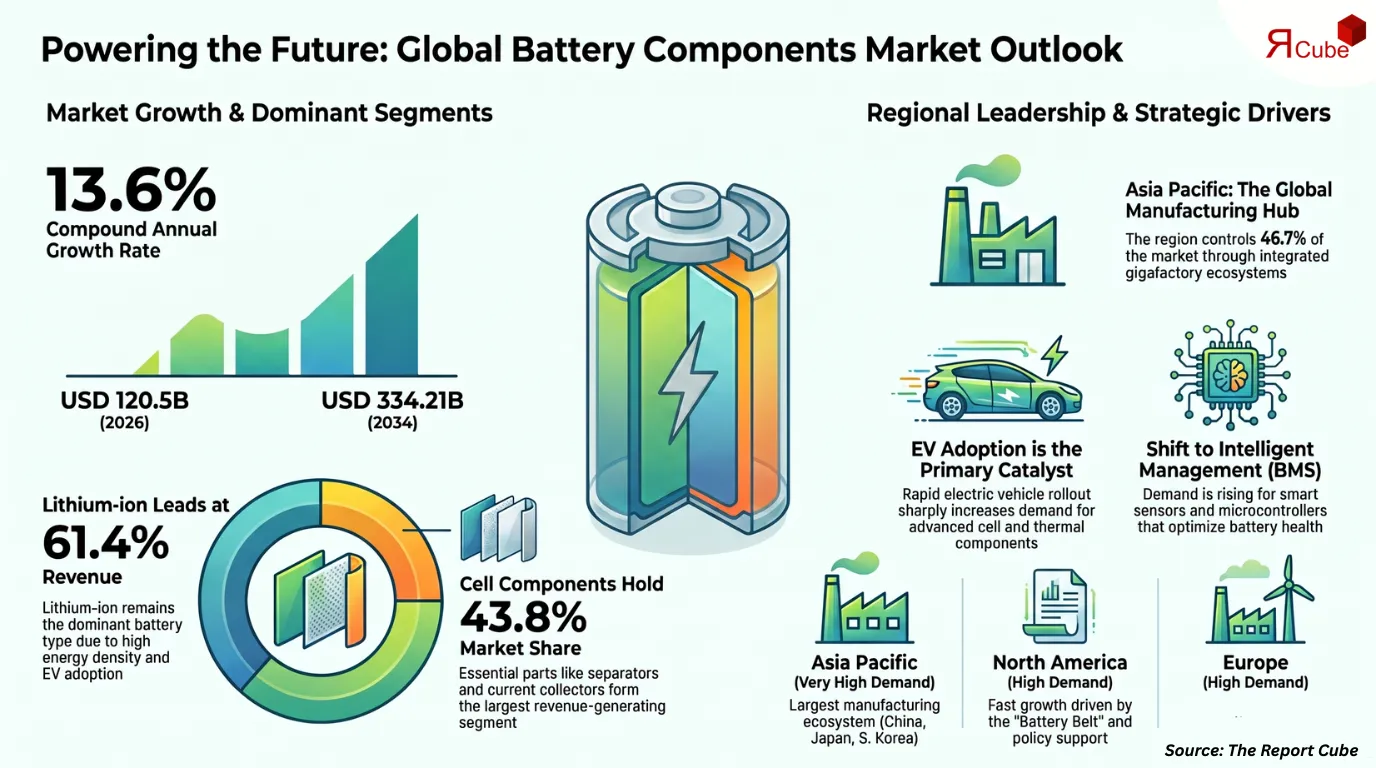
Cell Components segment leads the market with approximately 43.8% share.
By Battery Type:
Lithium-ion Battery segment dominates the market with nearly 61.4% of total revenue.
Regional Outlook:
Asia Pacific dominates the Global Battery Components Market with around 46.7% market share.
Global Battery Components Market Insights & Analysis
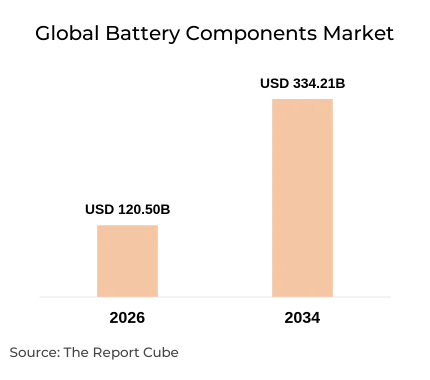
The Global Battery Components Market is anticipated to register a CAGR of around 13.6% during the forecast period of 2026-2034. The market size is valued at USD 120.5 billion in 2026 and is projected to reach USD 334.21 billion by 2034. Growth is being driven by sustained investments in electric mobility, renewable energy storage, and localized battery manufacturing. Battery components including separators, current collectors, battery management systems (BMS), cooling plates, sensors, connectors, and battery enclosures have become increasingly important as manufacturers pursue higher energy density, improved safety, and longer battery life. Major automotive OEMs and battery producers are expanding gigafactory capacity across Asia Pacific, Europe, and North America to secure regional supply chains and meet accelerating battery demand. This manufacturing expansion is creating consistent opportunities for component suppliers that provide advanced thermal management, electronic control, and structural battery solutions.
Technological innovation continues to reshape the Battery Components Global Market as manufacturers introduce next-generation materials and intelligent battery architectures. Growing commercialization of solid-state batteries, sodium-ion batteries, and high-performance lithium-ion chemistries has increased demand for specialized components capable of supporting improved thermal stability and operational efficiency. At the same time, governments are strengthening domestic battery ecosystems through incentive programs, critical mineral strategies, and investments in battery recycling infrastructure to reduce supply chain dependence. Industry participants are responding with strategic collaborations, capacity expansion projects, and long-term material supply agreements that improve production resilience. These developments are enabling component manufacturers to deliver higher-performance products while supporting global electrification targets and the transition toward cleaner energy systems.
Global Battery Components Market Impact Analysis
| Factor | Type | Specific Impact on Market | Magnitude | Business Implication |
|---|---|---|---|---|
| Acceleration of Electric Vehicle Adoption | Market | Rapid EV rollout sharply increases demand for cell components | High | Supports long term volume growth for cathodes, anodes, separators |
| Expansion of Grid Scale Energy Storage | Market | Utility projects need durable components for large battery arrays | High | Drives uptake of robust cells and control parts in storage systems |
| Asia Pacific Manufacturing Dominance | Competitive | Regional clusters scale integrated production of key components | High | Creates cost leadership pressure and supply reliance on Asia hubs |
| Shift to Advanced Battery Architectures | Technological | CTP and structural packs reduce use of legacy module hardware | Medium | Requires redesign of housings while boosting integrated materials demand |
| Integration of Smart Battery Management Systems | Technological | More sensing and control electronics embedded within packs | High | Raises demand for monitoring, semiconductors and safety modules |
| Raw Material and Electronics Price Volatility | Environmental | Cost swings disrupt stable sourcing of chemicals and components | Medium | Necessitates hedging, long term contracts and diversified suppliers |
| Sustainability and Lifecycle Impact Scrutiny | Regulatory | Policies push for lower emissions and more circular material flows | Medium | Encourages investment in recyclable designs and cleaner inputs |
Global Battery Components Market Dynamics
Key Driver: Accelerating Electric Vehicle Manufacturing Supporting Long-Term Component Demand
Rising electric vehicle production continues to create substantial growth opportunities for the Global Battery Components Market. Modern battery packs require highly engineered components such as battery management systems, busbars, separators, thermal management systems, voltage sensors, current sensors, battery enclosures, and power distribution units to achieve high safety standards and reliable performance. As global automakers expand their electric vehicle portfolios, demand for these critical components continues to increase across passenger vehicles, commercial vehicles, and electric buses. Battery manufacturers are also investing in larger production facilities to support growing vehicle demand while improving manufacturing efficiency through automation and digital quality control systems.
Government incentives promoting clean transportation and stricter vehicle emission regulations are encouraging battery manufacturers to establish regional production facilities closer to automotive assembly plants. This shift is strengthening domestic supply chains while reducing logistics costs and procurement risks. Growing adoption of high-capacity battery packs capable of supporting fast charging and extended driving range is also increasing the value of advanced battery components. These market conditions continue to reinforce investment across the Battery Components Global Market as suppliers focus on developing durable, lightweight, and high-efficiency technologies that enhance battery reliability and operational performance.
Industry Trends: Intelligent Battery Management and Advanced Thermal Technologies Enhancing Battery Performance
Product innovation remains a defining characteristic of the Global Battery Components Market as battery manufacturers prioritize performance, safety, and operational efficiency. Intelligent battery management systems equipped with precision sensing, real-time diagnostics, and predictive monitoring capabilities are becoming standard across electric vehicles and stationary energy storage applications. Advanced communication modules, microcontrollers, voltage sensors, and current monitoring devices enable continuous battery health assessment, allowing operators to optimize charging cycles and extend battery service life. Semiconductor manufacturers are introducing integrated solutions that simplify battery architecture while improving measurement accuracy and reducing energy losses.
Thermal management technologies are advancing alongside increasing battery energy density. Manufacturers are introducing liquid cooling plates, lightweight battery enclosures, advanced insulation materials, and high-performance thermal interface solutions that effectively control operating temperatures under demanding conditions. Component suppliers are also developing compact and modular designs that simplify battery assembly while supporting next-generation vehicle platforms. Continuous investment in digital battery monitoring, predictive maintenance software, and intelligent power distribution technologies is expected to strengthen product differentiation and support long-term expansion of the Battery Components Global Market.
Book your FREE 30-minute expert consultation today
Contact UsMajor Challenge: Raw Material Price Volatility and Supply Chain Complexity Affecting Production Stability
The Global Battery Components Market continues to experience pricing pressure resulting from fluctuations in the cost of aluminum, copper, specialty polymers, engineering plastics, semiconductors, and advanced electronic materials used in battery manufacturing. Volatile commodity prices directly influence production costs for separators, current collectors, battery casings, sensors, connectors, and thermal management components. At the same time, geopolitical uncertainties, changing trade policies, and transportation disruptions continue to create procurement challenges for manufacturers operating across international supply chains. Maintaining stable inventories while controlling production costs has become a key priority throughout the industry.
Manufacturers are also adapting to increasingly stringent regulatory requirements related to battery safety, environmental compliance, responsible sourcing, and recycling obligations. Meeting these evolving standards often requires additional investment in product testing, quality assurance, and manufacturing upgrades. Smaller suppliers may encounter financial constraints when adopting advanced automation technologies or expanding production capacity, creating competitive challenges within the industry. Even with these obstacles, ongoing investment in localized manufacturing and diversified sourcing strategies is gradually improving supply chain resilience across the Battery Components Global Market.
Opportunity: Renewable Energy Storage and Emerging Battery Technologies Expanding Future Revenue Potential
Growing deployment of renewable energy generation is creating attractive opportunities for the Global Battery Components Market. Utility-scale energy storage projects require advanced battery enclosures, battery management systems, thermal management technologies, sensors, wiring harnesses, and protective devices capable of supporting reliable long-duration operation. Rising investments in grid modernization and energy storage infrastructure across developed and emerging economies are increasing demand for high-performance battery components designed for large-scale applications. The rapid expansion of commercial and residential energy storage systems is expected to further strengthen long-term market growth.
Emerging battery chemistries are opening new avenues for component innovation throughout the Battery Components Global Market. Commercial development of solid-state batteries, sodium-ion batteries, and next-generation lithium-based technologies is driving demand for redesigned separators, advanced insulation materials, precision monitoring systems, and lightweight structural components optimized for improved efficiency and safety. Manufacturers are simultaneously investing in battery recycling technologies and second-life battery applications that support circular economy objectives while creating additional demand for specialized battery components. These developments position the industry for sustained growth throughout the forecast period as electrification expands across transportation, industrial, and energy sectors.
Global Battery Components Market Segment-wise Analysis
By Component Type:
- Monitoring & Control Components
- Temperature Sensors
- Communication Modules
- Power Distribution Units (PDU)
- Current Sensors
- Control Units
- Voltage Sensors
- Others
- Cell Components
- Current Collector
- Cell Housing/Casing
- Separator
- Venting Components
- Gaskets & Seals
- Tabs & Terminals
- Insulation Components
- Others
- Module & Pack Components
- Battery Enclosure
- Cooling Plates
- Thermal Management System
- Busbars
- Battery Management System (BMS)
- Connectors
- Wiring Harness
- Fuses & Protection Devices
- Others
The Cell Components segment accounted for the largest share of the Global Battery Components Market, representing approximately 43.8% of total revenue in 2026. This segment forms the foundation of every rechargeable battery by incorporating essential components such as separators, current collectors, cell housings, venting components, insulation materials, tabs, terminals, and sealing solutions. Rising production of lithium-ion batteries for electric vehicles, energy storage systems, and consumer electronics continues to increase the consumption of these critical components. Battery manufacturers are prioritizing advanced separator technologies, lightweight casings, and high-conductivity current collectors to improve battery safety, increase energy density, and extend operational life. Continuous investment in battery gigafactories across China, the United States, Europe, South Korea, and India is further strengthening demand for high-quality cell components.
Material innovation remains a key growth factor for the Cell Components segment as battery manufacturers pursue higher-performance battery chemistries and safer cell designs. Development of ceramic-coated separators, advanced insulation materials, corrosion-resistant current collectors, and lightweight aluminum casings is improving battery reliability under demanding operating conditions. The commercialization of solid-state and sodium-ion batteries is also creating opportunities for next-generation cell component suppliers capable of meeting new design specifications. As battery production scales to support electric mobility and renewable energy storage, manufacturers continue to expand investments in automated production technologies that enhance product consistency while reducing manufacturing costs, reinforcing the segment's leadership in the Battery Components Global Market.
By Battery Type:
- Solid-state Battery
- Nickel-based Battery
- Sodium-ion Battery
- Lead-acid Battery
- Flow Battery
- Lithium-ion Battery
- Others
The Lithium-ion Battery segment dominated the Battery Components Global Market with nearly 61.4% of total revenue in 2026. Its leadership is supported by widespread adoption across electric vehicles, portable electronics, industrial equipment, grid-scale energy storage, and telecommunications infrastructure. Lithium-ion batteries offer high energy density, longer cycle life, faster charging capability, and lower maintenance requirements compared to conventional battery technologies. These advantages continue to drive demand for sophisticated battery management systems, thermal management components, sensors, connectors, and protective enclosures specifically designed for lithium-ion battery packs. Expanding electric vehicle production and large-scale renewable energy storage projects remain the primary contributors to segment growth.
Continuous advancements in lithium-ion battery chemistry are further increasing component requirements across the value chain. Battery manufacturers are investing in lithium iron phosphate (LFP), nickel manganese cobalt (NMC), and high-nickel cathode technologies to improve battery performance, safety, and charging efficiency. These innovations require precision-engineered cooling systems, intelligent monitoring devices, advanced separators, and improved electrical connection technologies capable of supporting higher operating voltages and greater energy density. Increasing localization of battery manufacturing, combined with strategic investments in recycling infrastructure and battery material processing, is expected to sustain the strong growth trajectory of the lithium-ion battery segment throughout the forecast period.
Regional Projection of Global Battery Components Market
- North America
- Europe
- Asia Pacific
- Middle East and Africa
- South America
Asia Pacific held the largest share of the Global Battery Components Market, accounting for approximately 46.7% in 2026. The region benefits from a highly integrated battery manufacturing ecosystem supported by leading battery cell producers, automotive manufacturers, electronics companies, and component suppliers. China continues to dominate global battery production capacity, while Japan and South Korea maintain leadership in advanced battery materials, electronic components, and battery management technologies. Meanwhile, India is rapidly strengthening its domestic battery manufacturing capabilities through policy support and investments in electric vehicle production. This strong industrial base continues to generate substantial demand for battery enclosures, separators, sensors, thermal management systems, connectors, and battery management systems.
Growing investments in renewable energy infrastructure and electric mobility continue to reinforce Asia Pacific's dominant position in the Battery Components Global Market. Governments across the region are encouraging localized battery production through manufacturing incentives, strategic mineral development programs, and support for battery recycling facilities. Automotive manufacturers are expanding regional gigafactory capacity to secure stable supply chains and meet rising battery demand from both domestic and export markets. Continuous research into next-generation battery technologies, combined with the presence of established raw material processing and component manufacturing networks, is expected to help Asia Pacific maintain its market leadership throughout the 2026-2034 forecast period.
Need insights for a specific region within this market?
Request Regional DataRegional Analysis of Global Battery Components Market
The global battery components market shows varied growth across regions, driven by EV adoption, energy storage, and local supply chain policies.
| Region | Demand Level | Key Areas | Component Dominance | Core Demand Logic | Growth Nature |
|---|---|---|---|---|---|
| North America | High | US battery belt, Ontario | Cathodes & pack assemblies | EV plants & grid storage buildout | Fastest-growing on policy support |
| Europe | High | Germany, Nordics, France | Anodes, cathodes, cell modules | Gigafactories under EU Green Deal | Steady growth via localization |
| Asia Pacific | Very High | China, South Korea, Japan | Full-chain cells & raw materials | Dominant manufacturing ecosystems | Largest & most mature region |
| Middle East & Africa | Medium | Lithium triangle Africa, GCC | Raw materials & precursor inputs | Resource-led supply for global OEMs | Emerging upstream growth |
| South America | Medium | Chile, Argentina, Brazil | Lithium, nickel, basic processing | Mineral exports to Asia & US | Resource-driven expansion |
Government Initiatives & Policies
- United States Battery Materials Processing and Manufacturing Grant Program (2025): The U.S. Department of Energy continued funding advanced battery manufacturing and domestic battery component production to strengthen resilient supply chains, accelerate clean energy adoption, and reduce dependence on imported battery materials.
- European Union Net-Zero Industry Act Implementation (2025): The European Union accelerated incentives supporting battery manufacturing, strategic raw material processing, and clean technology investments to strengthen regional battery component production and achieve long-term energy transition objectives.
Global Battery Components Industry Recent Developments
- 2025: NXP Semiconductors introduced an advanced battery health monitoring Electrochemical Impedance Spectroscopy (EIS) chipset designed to improve real-time battery diagnostics and state-of-health estimation for electric vehicles and energy storage systems. The solution enables higher measurement accuracy, predictive maintenance, and longer battery lifecycle performance.
- 2025: Infineon Technologies launched the PSoC™ 4 HVPA-SPM 1.0 microcontroller for next-generation automotive battery management systems. The device integrates edge intelligence, precision analog sensing, and enhanced processing capabilities to support zonal vehicle architectures while reducing central ECU workload and improving battery safety.
- 2025: BASF signed a global cathode active materials framework agreement with CATL to support the company's expanding international battery manufacturing footprint. The agreement strengthens BASF's position in the battery materials value chain by supplying high-performance cathode materials through its global production network.
Why Choose This Report?
- Provides a comprehensive overview of the overall market analysis, encompassing key trends, consumer behavior analysis, and risk assessment to support strategic decision-making.
- Provides accurate, up-to-date insights into market size, segmentation, and emerging opportunities, helping organizations minimize risk while capitalizing on future growth opportunities.
- Gives deep understanding of target audience preferences, investment patterns, technological developments, and communication channels for enhanced product development and marketing effectiveness.
- Delivers competitive analysis and benchmarking, uncovering the strengths, strategic initiatives, and market positioning of leading industry participants.
- Consolidates comprehensive market intelligence, reducing research efforts while supporting informed business planning and investment decisions.
- Facilitates customized market segmentation and risk mitigation strategies that align with evolving business objectives and regional market conditions.
- Helps identify market restraints, growth opportunities, emerging technologies, and investment hotspots to support long-term business expansion.
- Provides valuable information derived from industry trends, customer demand patterns, regulatory developments, and extensive market research.
Table of Contents
- Introduction
- Objective of the Study
- Product and Category Definition
- Market Segmentation
- Study Variables
- Research Methodology
- Secondary Data Points
- Breakdown of Secondary Sources
- Primary Data Points
- Breakdown of Primary Interviews
- Secondary Data Points
- Executive Summary
- Market Dynamics
- Emerging Opportunities
- Adoption Trends
- Demand Drivers
- Disruption Analysis (Challenges)
- Industry Analysis & Strategic Insights
- Supply/Value Chain Analysis
- Pricing Analysis
- Go-To-Market (GTM) Strategy
- BCG Matrix
- Recent Trends and Developments
- Import and Export Analysis
- Regulatory and Policy Landscape
- Region-wise Policies
- Government Initiatives
- Global Battery Components Market Overview and Forecast Analysis (2021-2034)
- Market Size, By Value, By Growth Rate (CAGR/USD Billion)
- Market Share, By Component Type
- Monitoring & Control Components
- Temperature Sensors
- Communication Modules
- Power Distribution Units (PDU)
- Current Sensors
- Control Units
- Voltage Sensors
- Others
- Cell Components
- Current Collector
- Cell Housing/Casing
- Separator
- Venting Components
- Gaskets & Seals
- Tabs & Terminals
- Insulation Components
- Others
- Module & Pack Components
- Battery Enclosure
- Cooling Plates
- Thermal Management System
- Busbars
- Battery Management System (BMS)
- Connectors
- Wiring Harness
- Fuses & Protection Devices
- Others
- Monitoring & Control Components
- Market Share, By Battery Type
- Solid-state Battery
- Nickel-based Battery
- Sodium-ion Battery
- Lead-acid Battery
- Flow Battery
- Lithium-ion Battery
- Others
- Market Share, By Cell Format
- Pouch
- Prismatic
- Coin Cell
- Cylindrical
- Others
- Market Share, By Application
- Energy Storage Systems (ESS)
- Consumer Electronics
- Industrial Equipment
- Medical Devices
- Aerospace & Defense
- Telecommunications
- Marine
- Automotive
- Others
- Market Share, By Region
- North America
- Europe
- Asia Pacific
- Middle East and Africa
- South America
- Market Share, By Company
- Revenue Shares & Analysis
- Competitive Landscape
- North America Battery Components Market Overview and Forecast Analysis (2021-2034)
- Market Size, By Value, By Growth Rate (CAGR/USD Billion/Million)
- Market Share, By Component Type
- Market Share, By Battery Type
- Market Share, By Cell Format
- Market Share, By Application
- Market Share, By Country
- United States
- Canada
- Mexico
- Rest of North America
- Europe Battery Components Market Overview and Forecast Analysis (2021-2034)
- Market Size, By Value, By Growth Rate (CAGR/USD Billion/Million)
- Market Share, By Component Type
- Market Share, By Battery Type
- Market Share, By Cell Format
- Market Share, By Application
- Market Share, By Country
- Germany
- United Kingdom
- France
- Italy
- Spain
- Netherlands
- Russia
- Poland
- Belgium
- Sweden
- Rest of Europe
- Asia Pacific Battery Components Market Overview and Forecast Analysis (2021-2034)
- Market Size, By Value, By Growth Rate (CAGR/USD Billion/Million)
- Market Share, By Component Type
- Market Share, By Battery Type
- Market Share, By Cell Format
- Market Share, By Application
- Market Share, By Country
- China
- India
- Japan
- South Korea
- Australia
- Indonesia
- Thailand
- Malaysia
- Vietnam
- Philippines
- Singapore
- New Zealand
- Rest of Asia-Pacific
- Middle East and Africa Battery Components Market Overview and Forecast Analysis (2021-2034)
- Market Size, By Value, By Growth Rate (CAGR/USD Billion/Million)
- Market Share, By Component Type
- Market Share, By Battery Type
- Market Share, By Cell Format
- Market Share, By Application
- Market Share, By Country
- Saudi Arabia
- United Arab Emirates
- South Africa
- Egypt
- Nigeria
- Morocco
- Turkey
- Rest of Middle East & Africa
- South America Battery Components Market Overview and Forecast Analysis (2021-2034)
- Market Size, By Value, By Growth Rate (CAGR/USD Billion/Million)
- Market Share, By Component Type
- Market Share, By Battery Type
- Market Share, By Cell Format
- Market Share, By Application
- Market Share, By Country
- Brazil
- Argentina
- Chile
- Colombia
- Peru
- Rest of South America
- Competitive Analysis, 2026
- Market Share of Key Players
- Competitive Mapping for Each Segment and Companies Operating Regionally
- North America Battery Components Companies Share & Competitive Analysis, 2026
- Europe Battery Components Companies Share & Competitive Analysis, 2026
- Asia Pacific Battery Components Companies Share & Competitive Analysis, 2026
- Middle East and Africa Battery Components Companies Share & Competitive Analysis, 2026
- South America Battery Components Companies Share & Competitive Analysis, 2026
- Company Profile (Partial List)
- Sensata Technologies
- Company Overview
- Product Portfolio
- Strategic Alliances/Partnerships
- Recent Developments
- Bosch
- Company Overview
- Product Portfolio
- Strategic Alliances/Partnerships
- Recent Developments
- Dana Incorporated
- Company Overview
- Product Portfolio
- Strategic Alliances/Partnerships
- Recent Developments
- Infineon Technologies
- Company Overview
- Product Portfolio
- Strategic Alliances/Partnerships
- Recent Developments
- TE Connectivity
- Company Overview
- Product Portfolio
- Strategic Alliances/Partnerships
- Recent Developments
- MAHLE
- Company Overview
- Product Portfolio
- Strategic Alliances/Partnerships
- Recent Developments
- Asahi Kasei
- Company Overview
- Product Portfolio
- Strategic Alliances/Partnerships
- Recent Developments
- Analog Devices
- Company Overview
- Product Portfolio
- Strategic Alliances/Partnerships
- Recent Developments
- Celgard
- Company Overview
- Product Portfolio
- Strategic Alliances/Partnerships
- Recent Developments
- Toray Industries
- Company Overview
- Product Portfolio
- Strategic Alliances/Partnerships
- Recent Developments
- Hanon Systems
- Company Overview
- Product Portfolio
- Strategic Alliances/Partnerships
- Recent Developments
- Eberspächer
- Company Overview
- Product Portfolio
- Strategic Alliances/Partnerships
- Recent Developments
- Valeo
- Company Overview
- Product Portfolio
- Strategic Alliances/Partnerships
- Recent Developments
- Continental AG
- Company Overview
- Product Portfolio
- Strategic Alliances/Partnerships
- Recent Developments
- UBE Corporation
- Company Overview
- Product Portfolio
- Strategic Alliances/Partnerships
- Recent Developments
- Others (Partial List)
- Sensata Technologies
- Contact Us and Disclaimer
Top Key Players & Market Share Outlook
- Sensata Technologies
- Bosch
- Dana Incorporated
- Infineon Technologies
- TE Connectivity
- MAHLE
- Asahi Kasei
- Analog Devices
- Celgard
- Toray Industries
- Hanon Systems
- Eberspächer
- Valeo
- Continental AG
- UBE Corporation
Frequently Asked Questions






