



Build Your Custom Market Intelligence Report
Customize Your ReportGlobal EV Battery Chemicals Market Insights & Analysis
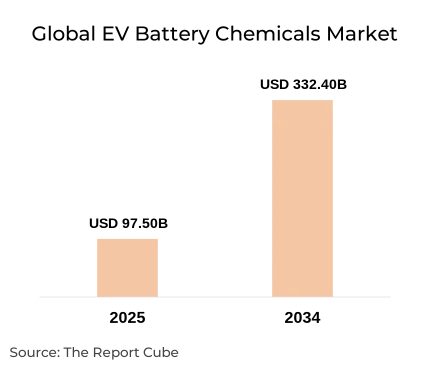
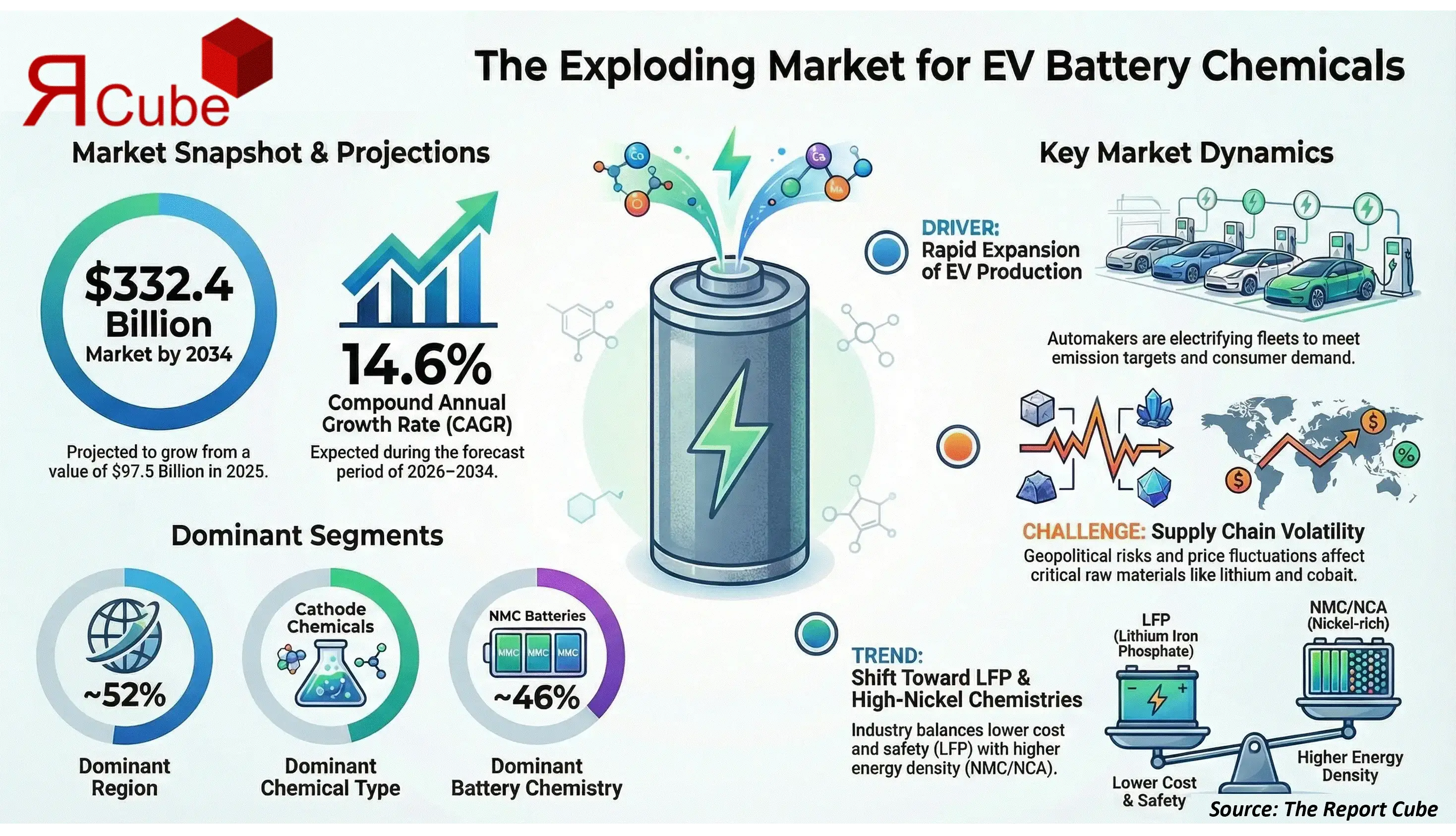
The Global EV Battery Chemicals Market is anticipated to register a CAGR of 14.6% during the forecast period 2026-2034. The market size was valued at USD 97.5 Billion in 2025 and is projected to reach USD 332.40 Billion by 2034. This robust growth reflects the accelerating global transition toward electric mobility, supported by stringent emission regulations, government incentives, and sustained investments across the EV battery value chain. Battery chemicals form the foundation of EV performance, safety, cost, and energy density, making them a strategic priority for automakers, battery manufacturers, and governments worldwide.
The EV battery chemicals market sits at the intersection of energy transition, advanced materials, and industrial policy. As electric vehicle adoption scales rapidly across passenger cars, commercial vehicles, and two- and three-wheelers, demand for high-purity cathode, anode, electrolyte, and separator materials continues to rise. Battery manufacturers are under constant pressure to improve energy density, reduce costs, extend lifecycle performance, and ensure supply chain security. This has led to intensified R&D, long-term sourcing agreements, and vertical integration strategies across lithium, nickel, cobalt, graphite, and next-generation battery materials, reinforcing the long-term expansion of the market.
Global EV Battery Chemicals Market Recent Developments
- 2025: Umicore expanded cathode materials production capacity to support growing EV battery manufacturing in Europe.
- 2025: Albemarle increased lithium refining investments to strengthen supply security for EV battery manufacturers.
Government Initiatives & Policies
- U.S. Inflation Reduction Act (IRA): Supports domestic EV battery material sourcing and processing.
- EU Battery Regulation: Mandates sustainability, traceability, and recycling of battery materials.
Global EV Battery Chemicals Market Dynamics
Key Driver: Rapid Expansion of Electric Vehicle Production
The primary driver of the global EV battery chemicals market is the rapid expansion of electric vehicle production worldwide. Global EV sales continue to grow at double-digit rates as automakers electrify vehicle portfolios to meet emission targets and shifting consumer preferences. Each EV battery pack requires substantial volumes of high-performance chemicals, particularly for cathode and anode materials that determine energy density and cost. As battery capacities increase and vehicle electrification expands into commercial fleets and public transportation, demand for battery chemicals rises proportionally, creating a strong and sustained growth trajectory for the market.
Major Challenge: Supply Chain Volatility and Raw Material Constraints
A major challenge facing the EV battery chemicals market is supply chain volatility and dependence on critical raw materials. Lithium, nickel, cobalt, and graphite supplies are geographically concentrated, exposing manufacturers to geopolitical risks, price volatility, and regulatory constraints. Fluctuations in commodity prices can significantly impact battery costs and profitability. Additionally, environmental and social concerns related to mining practices add complexity to sourcing strategies. Battery chemical suppliers are responding by diversifying sourcing, investing in recycling, and developing alternative chemistries to mitigate long-term supply risks.
Industry Trends: Shift Toward LFP and High-Nickel Chemistries
An important trend shaping the market is the shift toward lithium iron phosphate and high-nickel cathode chemistries. LFP batteries are gaining popularity due to lower cost, improved safety, and reduced reliance on cobalt and nickel, particularly in mass-market EVs and commercial vehicles. At the same time, high-nickel NMC and NCA chemistries remain critical for premium and long-range EVs due to superior energy density. This dual-track chemistry evolution is driving diversified demand across multiple battery chemical categories rather than a single dominant solution.
Opportunity Ahead: Recycling, Localization, and Next-generation Materials
Significant growth opportunities exist in battery material recycling, localized chemical production, and next-generation battery technologies. Recycling of lithium, nickel, cobalt, and graphite is becoming increasingly important as EV volumes grow and sustainability regulations tighten. Governments are also encouraging domestic processing and refining of battery chemicals to reduce import dependence. Additionally, solid-state batteries and silicon-based anodes offer long-term potential to reshape material demand. Companies investing early in recycling infrastructure and advanced materials are well positioned for future growth.
Global EV Battery Chemicals Market Segment-wise Analysis
By Chemical Type:
- Cathode Chemicals
- Nickel
- Cobalt
- Manganese
- Aluminum
- Iron Phosphate
- Other
- Anode Chemicals
- Lithium
- Natural Graphite
- Artificial Graphite
- Silicon
- Silicon Oxide
- Others
- Electrolyte Chemicals
- Lithium Salts
- Solvents
- Additives
- Solid Electrolytes
- Gel Electrolytes
- Separator Chemicals
- Binder Chemicals
- Others
Cathode chemicals represent the largest segment, accounting for approximately 46% of total market revenue in 2025. Cathode materials largely determine battery cost and energy density, making them the most value-intensive component. Anode chemicals follow, driven by rising use of high-purity graphite and silicon-enhanced materials. Electrolyte chemicals are gaining importance as battery designs evolve toward higher voltage and solid-state architectures, while separator and binder chemicals remain essential for safety and durability.
By Battery Chemistry:
- Lithium Iron Phosphate (LFP)
- Lithium Nickel Manganese Cobalt Oxide (NMC)
- Lithium Nickel Cobalt Aluminum Oxide (NCA)
- Lithium Manganese Oxide (LMO)
- Lithium Titanate (LTO)
- Solid State and Next Generation Chemistries
NMC batteries dominate the market, contributing nearly 38% of total chemical demand in 2025 due to their balanced energy density and cost. LFP chemistry is the fastest-growing segment, driven by adoption in entry-level EVs, buses, and commercial vehicles. NCA chemistry remains important in high-performance EVs, while solid-state and next-generation chemistries represent a smaller but rapidly emerging segment with strong long-term potential.
Regional Projection of Global EV Battery Chemicals Industry
- North America
- Europe
- Asia Pacific
- Middle East and Africa
- South America
Asia Pacific leads the global EV battery chemicals market, accounting for approximately 52% of total revenue in 2025. The region benefits from large-scale battery manufacturing capacity, strong EV adoption, and vertically integrated supply chains in China, South Korea, and Japan. Europe follows, supported by aggressive EV targets, battery gigafactory investments, and regulatory emphasis on sustainability. North America is experiencing rapid growth driven by policy incentives and localization efforts. The Middle East and Africa and South America present emerging opportunities linked to raw material availability and refining investments.
Why Choose This Report?
- Provides a comprehensive overview of the EV battery chemicals market and supply chain dynamics.
- Delivers accurate, up-to-date insights into market size, segmentation, and growth opportunities.
- Offers deep understanding of battery chemistries and material innovation trends.
- Presents competitive analysis & benchmarking of leading global suppliers.
- Consolidates market intelligence to support strategic sourcing and investment decisions.
- Supports customized segmentation and regional market assessments.
- Identifies challenges and untapped opportunities in the EV materials ecosystem.
- Grounded in real-world EV production, policy, and technology trends.
Table of Contents
- Introduction
- Objective of the Study
- Product and Category Definition
- Market Segmentation
- Study Variables
- Research Methodology
- Secondary Data Points
- Breakdown of Secondary Sources
- Primary Data Points
- Breakdown of Primary Interviews
- Secondary Data Points
- Executive Summary
- Market Dynamics
- Drivers
- Challenges
- Opportunity Assessment
- Recent Trends and Developments
- Regulatory and Policy Landscape
- Global EV Battery Chemicals Market Overview (2020-2034)
- Market Size, By Value (USD Billion)
- Market Share, By Chemical Type
- Cathode Chemicals
- Nickel
- Cobalt
- Manganese
- Aluminum
- Iron Phosphate and Other Cathode Materials
- Anode Chemicals
- Lithium
- Natural Graphite
- Artificial Graphite
- Silicon and Silicon Oxide
- Other Anode Materials
- Electrolyte Chemicals
- Lithium Salts
- Solvents and Additives
- Solid and Gel Electrolytes
- Separator and Binder Chemicals
- Other Battery Chemicals and Additives
- Cathode Chemicals
- Market Share, By Battery Chemistry
- Lithium Iron Phosphate LFP
- Lithium Nickel Manganese Cobalt Oxide NMC
- Lithium Nickel Cobalt Aluminum Oxide NCA
- Lithium Manganese Oxide LMO
- Lithium Titanate LTO
- Solid State and Next Generation Chemistries
- Market Share, By Battery Component
- Cathode
- Anode
- Electrolyte
- Separator
- Current Collectors and Other Components
- Market Share, By Source Material
- Primary Mined Materials
- Secondary Recycled Materials
- Market Share, By Vehicle Type
- Passenger Electric Vehicles
- Light Commercial Electric Vehicles
- Heavy Commercial Electric Vehicles and Buses
- Two and Three Wheeler Electric Vehicles
- Off Highway and Specialty Electric Vehicles
- Market Share, By End Use Application
- Electric Vehicle Traction Batteries
- Plug In Hybrid and Hybrid Vehicle Batteries
- Battery Second Life and Stationary Storage
- Market Share, By Region
- North America
- Europe
- Asia Pacific
- Middle East and Africa
- South America
- Market Share, By Company
- Revenue Shares
- Competitive Landscape
- North America EV Battery Chemicals Market
- Market Size, By Value (USD Billion)
- Market Share, By Chemical Type
- Market Share, By Battery Chemistry
- Market Share, By Battery Component
- Market Share, By Source Material
- Market Share, By Vehicle Type
- Market Share, By End Use Application
- Market Share, By Country
- United States
- Canada
- Mexico
- Europe EV Battery Chemicals Market
- Market Size, By Value (USD Billion)
- Market Share, By Chemical Type
- Market Share, By Battery Chemistry
- Market Share, By Battery Component
- Market Share, By Source Material
- Market Share, By Vehicle Type
- Market Share, By End Use Application
- Market Share, By Country
- Germany
- United Kingdom
- France
- Italy
- Spain
- Northern and Nordic Countries
- Rest of Europe
- Asia Pacific EV Battery Chemicals Market
- Market Size, By Value (USD Billion)
- Market Share, By Chemical Type
- Market Share, By Battery Chemistry
- Market Share, By Battery Component
- Market Share, By Source Material
- Market Share, By Vehicle Type
- Market Share, By End Use Application
- Market Share, By Country
- China
- Japan
- South Korea
- India
- Indonesia
- Rest of Asia Pacific
- Middle East and Africa EV Battery Chemicals Market
- Market Size, By Value (USD Billion)
- Market Share, By Chemical Type
- Market Share, By Battery Chemistry
- Market Share, By Battery Component
- Market Share, By Source Material
- Market Share, By Vehicle Type
- Market Share, By End Use Application
- Market Share, By Country
- Saudi Arabia
- United Arab Emirates
- South Africa
- Rest of Middle East and Africa
- South America EV Battery Chemicals Market
- Market Size, By Value (USD Billion)
- Market Share, By Chemical Type
- Market Share, By Battery Chemistry
- Market Share, By Battery Component
- Market Share, By Source Material
- Market Share, By Vehicle Type
- Market Share, By End Use Application
- Market Share, By Country
- Brazil
- Argentina
- Chile
- Rest of South America
- Competitive Outlook and Company Profiles
- Umicore
- Company Overview
- EV Battery Chemicals Product Portfolio
- Strategic Alliances and Partnerships
- Recent Developments
- BASF
- Company Overview
- EV Battery Chemicals Product Portfolio
- Strategic Alliances and Partnerships
- Recent Developments
- LG Chem
- Company Overview
- Battery Materials Product Portfolio
- Strategic Alliances and Partnerships
- Recent Developments
- Contemporary Amperex Technology
- Company Overview
- Battery Materials and Cathode Portfolio
- Strategic Alliances and Partnerships
- Recent Developments
- Albemarle
- Company Overview
- Lithium and Battery Chemical Portfolio
- Strategic Alliances and Partnerships
- Recent Developments
- Sumitomo Metal Mining
- Company Overview
- Cathode and Battery Materials Portfolio
- Strategic Alliances and Partnerships
- Recent Developments
- Johnson Matthey
- Company Overview
- Battery Materials and Catalysts Portfolio
- Strategic Alliances and Partnerships
- Recent Developments
- Ganfeng Lithium Group
- Company Overview
- Lithium and Battery Chemical Portfolio
- Strategic Alliances and Partnerships
- Recent Developments
- Livent
- Company Overview
- Lithium and Battery Chemical Portfolio
- Strategic Alliances and Partnerships
- Recent Developments
- Samsung SDI
- Company Overview
- Battery and Materials Portfolio
- Strategic Alliances and Partnerships
- Recent Developments
- Others
- Umicore
- Contact Us and Disclaimer
Top Key Players & Market Share Outlook
- Umicore
- BASF
- LG Chem
- Contemporary Amperex Technology
- Albemarle
- Sumitomo Metal Mining
- Johnson Matthey
- Ganfeng Lithium Group
- Livent
- Samsung SDI
- Others
Frequently Asked Questions






