


Build Your Custom Market Intelligence Report
Customize Your ReportKey Highlights
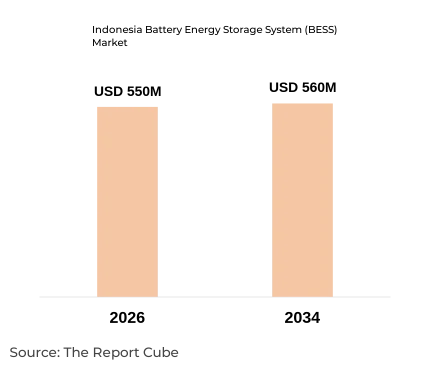
- The Indonesia Battery Energy Storage System (BESS) Market is projected to reach USD 550 million in 2026, supported by increasing investments in renewable energy integration, grid modernisation and electricity storage infrastructure.
- The market is expected to reach USD 560 million by 2034, registering a CAGR of 0.23% during 2026–2034, based on the provided investment forecast.
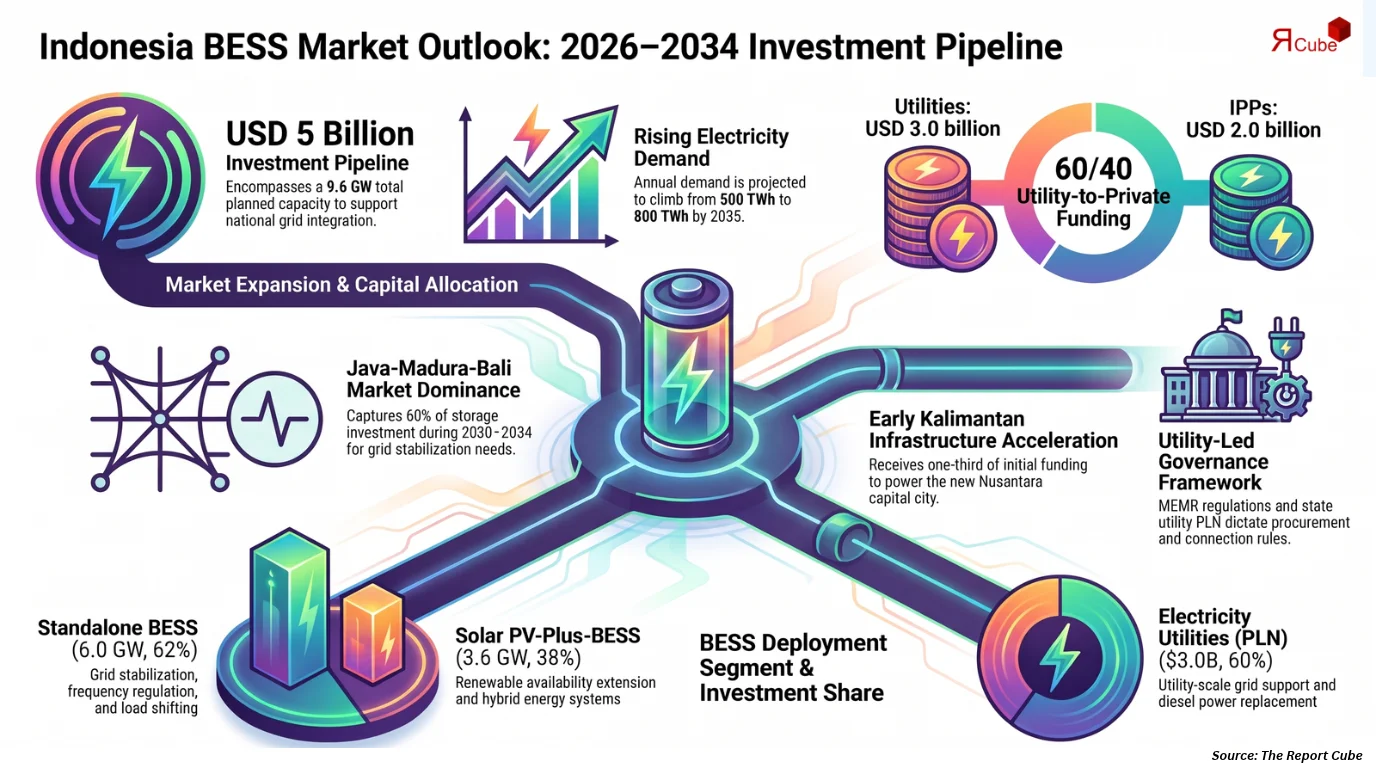
- Indonesia’s RUPTL 2025–2034 identifies a 9.6 GW BESS deployment pipeline, comprising 6 GW of standalone storage and 3.6 GW of solar PV-plus-battery capacity.
- Java, Madura and Bali account for about 60% of investment during 2030–2034, making them the leading investment region in the second half of the period.
- Renewable energy integration and rising electricity demand are the principal growth drivers; demand is projected to rise from nearly 500 TWh in 2025 to about 800 TWh by 2035.
- Key participants include PLN, Sembcorp Industries, CATL, BYD, Sungrow, Huawei Digital Power, REPT Battero and Indonesia Battery Corporation.
Market Outlook
The Indonesia Battery Energy Storage System Market covers battery-based technologies that store electricity and release it when needed. These systems support grid stability, renewable energy integration, peak demand management, backup power and electricity access across Indonesia’s geographically dispersed islands, where supply reliability remains a policy priority.
Market activity is shaped by PLN’s Electricity Supply Business Plan (RUPTL) 2025-2034, which sets out a structured storage pipeline. Applications include utility-scale grid support, solar-plus-storage projects, remote-island microgrids, industrial backup and diesel replacement. Solar and wind additions increase the need for flexible capacity wherever generation does not match consumption.
The Indonesia Battery Energy Storage System (BESS) Market is projected to reach USD 550 million in 2026 and USD 560 million by 2034, registering a CAGR of 0.23% during 2026-2034. Growth is supported by investments in renewable energy integration, grid modernisation, electricity storage infrastructure, and the country's evolving energy transition priorities.
Government Regulations
Indonesia’s BESS framework is led by the Ministry of Energy and Mineral Resources (MEMR) and implemented by state utility PLN. Presidential Regulation No. 112/2022 sets the renewable electricity procurement framework. MEMR Regulations No. 5/2025 and No. 19/2025 govern renewable power project structures and electricity supply arrangements. The RUPTL 2025–2034 establishes the planned storage pipeline, covering 6 GW of standalone BESS and 3.6 GW of solar PV-plus-BESS. The Indonesia Battery Integration Project supports domestic battery industry development. Developers must meet grid connection, permitting, safety and power purchase requirements set by PLN and MEMR. The IEA notes that remuneration for standalone BESS remains an area requiring greater clarity, which affects project bankability and investor confidence. Companies with established utility relationships, financing capacity and compliant technical designs are best placed to participate as procurement advances.
Indonesia Battery Energy Storage System Market Dynamics
Market dynamics are shaped by renewable energy deployment, electricity demand growth, grid reliability needs and the pace of regulatory development. Commercial progress also depends on financing costs, battery procurement prices and the availability of bankable revenue models for standalone projects.
|
Factor |
Type |
Specific Impact on Market |
Magnitude |
|---|---|---|---|
|
Renewable energy expansion |
Driver |
Raises need for balancing and storage capacity |
High |
|
Electricity demand growth |
Driver |
Increases grid flexibility and peak management needs |
Medium–High |
|
Standalone BESS remuneration uncertainty |
Challenge |
Limits revenue visibility and investor confidence |
High |
|
Financing costs (WACC of 9–11%) |
Challenge |
Raises project capital costs |
Medium–High |
|
Solar-plus-storage adoption |
Trend |
Expands hybrid project development |
Medium–High |
|
Remote island and industrial microgrids |
Opportunity |
Supports diesel replacement and local supply reliability |
Medium |
Growth Drivers: Expansion of Renewable Energy Generation
The RUPTL 2025–2034 includes substantial solar and wind additions, which increase demand for grid flexibility and electricity balancing. BESS installations store surplus renewable electricity and release it during periods of lower generation or higher consumption. This makes battery storage a supporting technology for renewable integration and grid reliability, and it underpins the planned 9.6 GW pipeline across standalone and hybrid projects.
Market Opportunities: Utility-Scale Battery Storage Deployment
The planned 6 GW of standalone BESS and 3.6 GW of solar-plus-storage capacity create openings for battery manufacturers, developers, engineering contractors and system integrators. Companies offering complete solutions, including battery management systems, power conversion equipment, energy management software and long-term maintenance, may benefit from future utility-scale procurement as PLN advances its storage programme.
Industry Challenges: Regulatory Uncertainty and Project Bankability
Standalone BESS projects face uncertainty over remuneration and long-term revenue visibility. Presidential Regulation 112/2022 and MEMR Regulations 5/2025 and 19/2025 provide foundations for renewable and hybrid projects, but further clarity on standalone storage is important. The IEA identifies weighted average costs of capital of 9–11%, so financing costs, currency exposure and implementation risk can materially affect project economics and investment decisions.
Need Specific Data, Let’s Customize the Report for You
Request CustomizationMarket Trends: Increasing Adoption of Solar-Plus-Storage Systems
Solar PV-plus-BESS projects are emerging as a significant development pathway because pairing generation with storage extends the availability of renewable electricity. The Nusantara Sembcorp Solar Energi project, launched in January 2025, combines a 50 MW solar farm with a 14.2 MWh battery storage system, showing the integrated model that the RUPTL hybrid capacity targets are intended to scale.
Indonesia Battery Energy Storage System Market Segment Analysis
The Indonesia Battery Energy Storage System Market is segmented by battery type, system type, application, end user and capacity. All supplied segments are listed below. Detailed analysis covers the two leading segments in each category, and only one share is displayed per category where supported.
By System Type
- Standalone Battery Energy Storage Systems
- Solar PV-plus-BESS Systems
- Wind-plus-BESS Systems
- Microgrid Battery Storage Systems
- Behind-the-Meter Battery Storage Systems
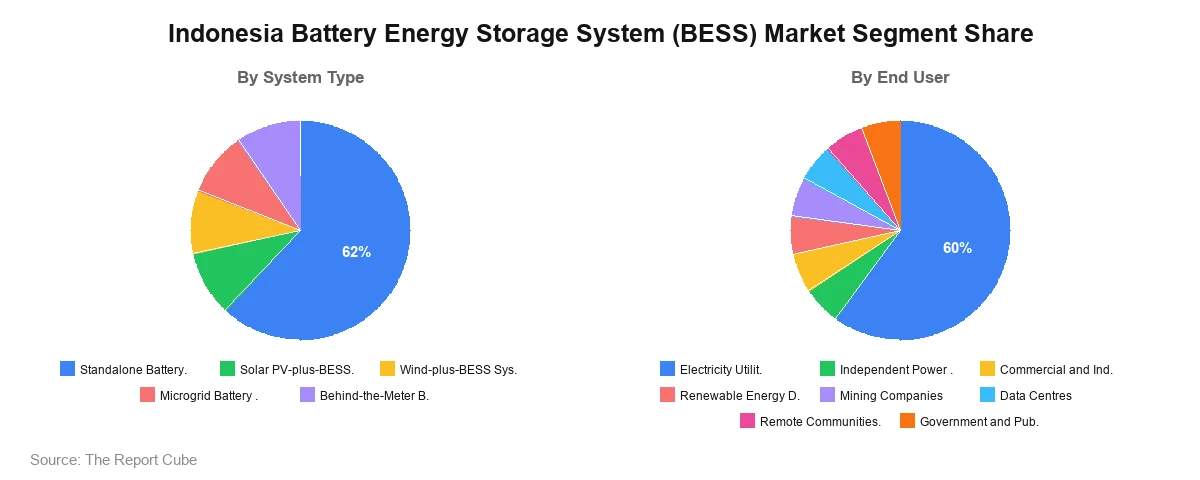
Standalone BESS leads with a 62% share of the 9.6 GW planned pipeline for 2026–2034, reflecting PLN’s emphasis on grid-scale storage for stabilisation, frequency support and renewable integration. Solar PV-plus-BESS follows as the second-largest segment, valued for improving renewable availability and supporting hybrid projects such as the Nusantara development. Wind-plus-BESS, microgrid and behind-the-meter systems serve more specialised needs, including remote islands and industrial users. This share reflects planned capacity, not market revenue.
By End User
- Electricity Utilities
- Independent Power Producers
- Commercial and Industrial Facilities
- Renewable Energy Developers
- Mining Companies
- Data Centres
- Remote Communities
- Government and Public Infrastructure
Based on project ownership and investment allocation, the Indonesia Battery Energy Storage System (BESS) market is primarily driven by electricity utilities, which account for approximately 60% of the planned BESS investment, equivalent to USD 3.0 billion during 2026–2034. PLN-led projects represent the largest demand category, supported by grid stabilisation, frequency regulation, load management and renewable energy integration requirements. Independent Power Producers (IPPs) and other private-sector participants account for the remaining 40% of planned investment, valued at approximately USD 2.0 billion, driven by solar-plus-storage projects, renewable energy development and hybrid power generation.
Indonesia Battery Energy Storage System Market Regional Analysis
Regional deployment reflects differences in electricity demand, renewable potential, grid infrastructure and accessibility. Java, Madura and Bali lead investment priorities as the most populous demand centre, Kalimantan is influenced by the development of Nusantara, and eastern islands depend on isolated-grid storage solutions.
|
Region |
Key Growth Factors |
Industry Trends |
|---|---|---|
|
Java, Madura and Bali |
Largest electricity demand, grid stabilisation needs |
Renewable integration and grid-scale storage |
|
Kalimantan |
Nusantara capital development |
Storage infrastructure for new urban demand |
|
Sumatra |
Utility-scale grid requirements |
Major planned deployment region |
|
Sulawesi |
Renewable and industrial storage needs |
Developing |
|
Maluku and Papua |
Remote-grid supply, diesel replacement |
Developing |
|
Nusa Tenggara |
Solar-plus-storage, isolated microgrids |
Developing |
Java, Madura and Bali account for about 60% of investment during 2030–2034, as electricity demand rises in Indonesia’s most populous region and grid stabilisation and renewable integration needs increase. Kalimantan accounts for about one-third of investment during the first half of the RUPTL period, partly reflecting storage requirements for Nusantara.
Competitive Landscape
The Indonesia Battery Energy Storage System Market includes international battery manufacturers, domestic industry participants, renewable developers, technology providers and the state utility. Competition is expected to evolve as PLN advances storage procurement and international suppliers expand their participation in Indonesia’s battery ecosystem.
|
Company |
Competitive Strength |
Primary Segment Served |
|---|---|---|
|
CATL |
Battery cells and energy storage solutions |
Utility-scale, battery supply chain |
|
BYD |
Integrated battery manufacturing and BESS |
Standalone and hybrid systems |
|
Sungrow |
Storage and power conversion systems |
Utility-scale, solar-plus-storage |
|
Huawei Digital Power |
Energy storage and energy management |
Utility and commercial systems |
|
REPT Battero |
Battery cells and storage solutions |
Battery manufacturing |
|
Indonesia Battery Corporation |
Domestic battery industry development |
National battery ecosystem |
|
Sembcorp Industries |
Renewable and storage project development |
Solar-plus-storage projects |
|
PLN |
Utility infrastructure and procurement |
Standalone and hybrid BESS |
Sembcorp Industries: Sembcorp is a Singapore-headquartered energy and infrastructure group. In January 2025 it launched, with PLN, the Nusantara Sembcorp Solar Energi project, which pairs a 50 MW solar farm with a 14.2 MWh battery storage system. Its competitive strength lies in developing integrated solar-plus-storage projects and its established partnership with PLN.
PLN: PLN is Indonesia’s state-owned electricity utility and the developer of the RUPTL 2025–2034, which includes 6 GW of standalone BESS and 3.6 GW of solar PV-plus-BESS. It is the principal stakeholder in electricity infrastructure planning and procurement, giving it a central position in the pace and structure of storage deployment. No verified company-level market share ranking is available.
Recent Developments and Updates
- September 2026: The International Energy Agency published Financing Battery Energy Storage Systems in Indonesia, estimating USD 5 billion in BESS investment needs for 2026–2034 under the RUPTL-aligned scenario and giving financing cost benchmarks relevant to developers and lenders.
- 2025: PLN introduced the RUPTL 2025–2034, identifying 6 GW of standalone BESS and 3.6 GW of solar PV-plus-BESS, which establishes the main deployment pathway for the forecast period.
- January 2025: Sembcorp and PLN launched the Nusantara solar-plus-storage project, combining a 50 MW solar farm with a 14.2 MWh battery system, demonstrating integrated renewable and storage infrastructure in Indonesia.
Indonesia Battery Energy Storage System Market Future Outlook
The Indonesia Battery Energy Storage System Market is expected to see substantial infrastructure development, with USD 5 billion of investment across 2026–2034 and a 9.6 GW pipeline of standalone and hybrid projects. Early years depend on procurement, financing and initial utility-scale projects, while later years benefit from rising electricity demand, renewable integration and the growth of Nusantara and industrial infrastructure.
Competition is likely to centre on integrated solutions, financing structures and domestic battery supply chain participation. Long-term expansion depends on bankable standalone business models, lower battery and installation costs, private investor participation and clearer remuneration rules. Actual annual project spending may differ from the planned profile, and a revenue-based CAGR cannot yet be established from official sources.
Indonesia Battery Energy Storage System Market Report Coverage
This report covers the Indonesia Battery Energy Storage System Market by battery type, system type, application, end user, capacity and region, using government and international organisation sources.
|
Parameter |
Details |
|---|---|
|
Market Name |
Indonesia Battery Energy Storage System Market |
|
Market Size (Base Year) |
USD 550 million (2026) |
|
Market Size (Forecast Year) |
USD 560 Million (2034) |
|
CAGR |
0.23% |
|
Base Year |
2026 |
|
Historical Period |
2021–2025 |
|
Forecast Period |
2026–2034 |
|
Geographic Scope |
Indonesia |
|
Segmentation |
By Battery Type; By System Type; By Application; By End User; By Capacity |
|
Regions Covered |
Java, Madura and Bali; Kalimantan; Sumatra; Sulawesi; Maluku and Papua; Nusa Tenggara |
|
Key Companies |
CATL; BYD; Sungrow; Huawei Digital Power; REPT Battero; Indonesia Battery Corporation; Sembcorp Industries; PLN |
|
Customization |
Available as per requirement |
Why Choose This Indonesia Battery Energy Storage System Market Report?
- Presents the USD 5 billion investment requirement and annual benchmarks for 2026-2034.
- Segments the market by battery type, system type, application, end user and capacity.
- Reviews drivers, opportunities, challenges and trends with regulatory and financing context.
- Provides regional context across Java, Kalimantan, Sumatra, Sulawesi, eastern islands and Nusa Tenggara.
- Profiles eight participants, including PLN, Sembcorp, CATL and BYD.
- Highlights solar-plus-storage, domestic battery manufacturing and remote microgrid opportunities.
- Supports investment, procurement and market-entry decisions with clear data limitations.
Table of Contents
- Introduction
- Objective of the Study
- Product Definition
- Market Segmentation
- Study Variables
- Research Methodology
- Secondary Data Points
- Companies Interviewed
- Primary Data Points
- Breakdown of Primary Interviews
- Secondary Data Points
- Executive Summary
- Market Dynamics
- Drivers
- Challenges
- Opportunity Assessment
- Recent Trends and Developments
- Policy and Regulatory Landscape
- Indonesia Battery Energy Storage System Market Overview and Forecast Analysis (2021-2034)
- Market Size, By Value, By Growth Rate (CAGR/USD Millions)
- Demand – Supply Trends
- Market Share, By Battery Type
- Lithium-ion Batteries
- Lead-acid Batteries
- Sodium-ion Batteries
- Flow Batteries
- Other Battery Technologies
- Market Share, By System Type
- Standalone Battery Energy Storage Systems
- Solar PV-plus-BESS Systems
- Wind-plus-BESS Systems
- Hybrid Renewable Energy Storage Systems
- Microgrid Battery Storage Systems
- Behind-the-Meter Battery Storage Systems
- Market Share, By Component
- Battery Cells
- Battery Modules and Packs
- Battery Management Systems (BMS)
- Power Conversion Systems (PCS)
- Energy Management Systems (EMS)
- Thermal Management and Cooling Systems
- Fire Protection and Safety Systems
- Balance of Plant (BoP)
- Installation, Integration and Commissioning Services
- Market Share, By Application
- Renewable Energy Integration
- Grid Stabilisation
- Frequency Regulation
- Peak Shaving
- Load Shifting
- Energy Arbitrage
- Backup Power
- Diesel Replacement
- Transmission and Distribution Support
- Off-grid Electricity Supply
- Market Share, By End User
- Electricity Utilities
- Independent Power Producers (IPPs)
- Commercial and Industrial Facilities
- Renewable Energy Developers
- Mining Companies
- Data Centres
- Government and Public Infrastructure
- Remote Communities and Microgrid Operators
- Market Share, By Capacity
- Below 1 MW
- 1–10 MW
- 10–50 MW
- 50–100 MW
- Above 100 MW
- Market Share, By Duration
- Below 2 Hours
- 2–4 Hours
- 4–8 Hours
- Above 8 Hours
- Market Share, By Region
- Java Madura and Bali
- Sumatra
- Kalimantan
- Sulawesi
- Maluku
- Papua
- Nusa Tenggara
- Market Share, By Competitors
- Competition Characteristics
- Revenue Shares
- Lithium-ion Batteries Indonesia Battery Energy Storage System Market Overview, 2021-2034F
- By Value (USD Million)
- By System Type – Market Size & Forecast 2021-2034, USD Million
- Standalone Battery Energy Storage Systems
- Solar PV-plus-BESS Systems
- Wind-plus-BESS Systems
- Hybrid Renewable Energy Storage Systems
- Microgrid Battery Storage Systems
- Behind-the-Meter Battery Storage Systems
- Lead-acid Batteries Indonesia Battery Energy Storage System Market Overview, 2021-2034F
- By Value (USD Million)
- By System Type – Market Size & Forecast 2021-2034, USD Million
- Standalone Battery Energy Storage Systems
- Solar PV-plus-BESS Systems
- Wind-plus-BESS Systems
- Hybrid Renewable Energy Storage Systems
- Microgrid Battery Storage Systems
- Behind-the-Meter Battery Storage Systems
- Sodium-ion Batteries Indonesia Battery Energy Storage System Market Overview, 2021-2034F
- By Value (USD Million)
- By System Type – Market Size & Forecast 2021-2034, USD Million
- Standalone Battery Energy Storage Systems
- Solar PV-plus-BESS Systems
- Wind-plus-BESS Systems
- Hybrid Renewable Energy Storage Systems
- Microgrid Battery Storage Systems
- Behind-the-Meter Battery Storage Systems
- Flow Batteries Indonesia Battery Energy Storage System Market Overview, 2021-2034F
- By Value (USD Million)
- By System Type – Market Size & Forecast 2021-2034, USD Million
- Standalone Battery Energy Storage Systems
- Solar PV-plus-BESS Systems
- Wind-plus-BESS Systems
- Hybrid Renewable Energy Storage Systems
- Microgrid Battery Storage Systems
- Behind-the-Meter Battery Storage Systems
- Other Battery Technologies Indonesia Battery Energy Storage System Market Overview, 2021-2034F
- By Value (USD Million)
- By System Type – Market Size & Forecast 2021-2034, USD Million
- Standalone Battery Energy Storage Systems
- Solar PV-plus-BESS Systems
- Wind-plus-BESS Systems
- Hybrid Renewable Energy Storage Systems
- Microgrid Battery Storage Systems
- Behind-the-Meter Battery Storage Systems
- Competitive Outlook (Company Profile – Partial List)
- CATL
- Company Overview
- Business Segments
- Strategic Alliances/Partnerships
- Recent Developments
- BYD
- Company Overview
- Business Segments
- Strategic Alliances/Partnerships
- Recent Developments
- Sungrow
- Company Overview
- Business Segments
- Strategic Alliances/Partnerships
- Recent Developments
- Huawei Digital Power
- Company Overview
- Business Segments
- Strategic Alliances/Partnerships
- Recent Developments
- REPT Battero
- Company Overview
- Business Segments
- Strategic Alliances/Partnerships
- Recent Developments
- Indonesia Battery Corporation
- Company Overview
- Business Segments
- Strategic Alliances/Partnerships
- Recent Developments
- Sembcorp Industries
- Company Overview
- Business Segments
- Strategic Alliances/Partnerships
- Recent Developments
- PLN
- Company Overview
- Business Segments
- Strategic Alliances/Partnerships
- Recent Developments
- Others
- CATL
- Contact Us & Disclaimer
Top Key Players & Market Share Outlook
- CATL
- BYD
- Sungrow
- Huawei Digital Power
- REPT Battero
- Indonesia Battery Corporation
- Sembcorp Industries
- PLN
- Others
Frequently Asked Questions